Georgia Bathroom Products Market Summary
The georgia bathroom products market was estimated at USD 274 Million in 2025 and is projected to reach USD 380 Million by 2032, growing at a CAGR of 5.8% from 2026 to 2032.
Georgia Bathroom Products Market Year-wise Growth Rate and Key Drivers
This graph highlights how the Georgia Bathroom Products Market has steadily grown over the past five years, supported by major growth factors.
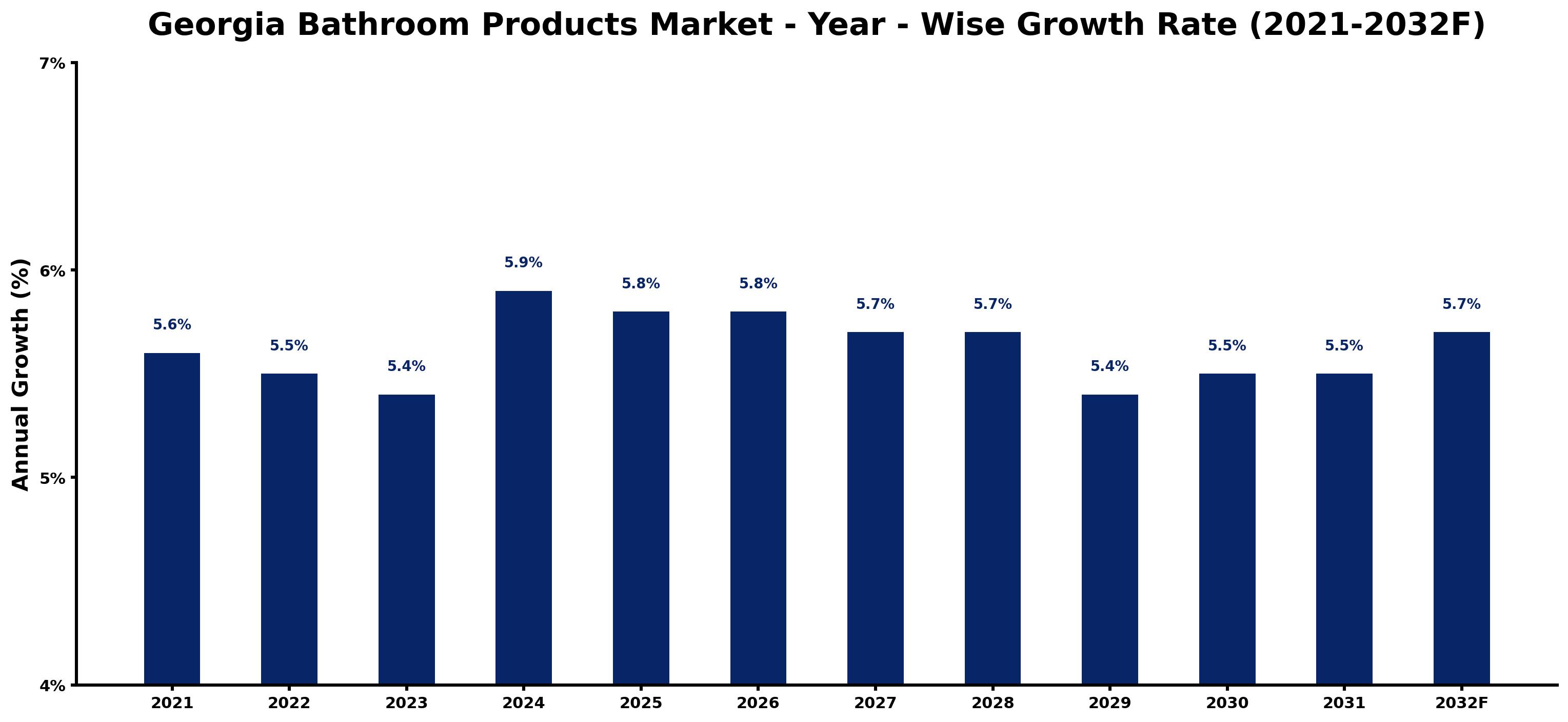
The table below presents the year wise growth rates along with the key drivers influencing the market
| Year | Growth Rate | Major Drivers |
| 2021 | 5.6% | Consumer interest in eco-friendly bathroom products began shaping market preferences significantly. |
| 2022 | 5.5% | Local manufacturers invested heavily in innovative design and sustainable materials to attract buyers. |
| 2023 | 5.4% | Shifts toward home improvement projects reflected a strong recovery post-pandemic, boosting sales. |
| 2024 | 5.9% | Brand collaborations with interior designers expanded visibility for premium bathroom product lines. |
| 2025 | 5.8% | Smart bathroom technologies gained traction, appealing to tech-savvy, younger demographics increasingly. |
| 2026 | 5.8% | Increased focus on wellness within home spaces prompted demand for luxury bathroom fixtures. |
| 2027 | 5.7% | Urbanization trends led to higher construction rates, fueling market expansion in metropolitan areas. |
| 2028 | 5.7% | Economic growth spurred higher disposable incomes, encouraging luxury purchases in bathroom products. |
| 2029 | 5.4% | Sustainability certifications became a competitive advantage for brands in environmentally conscious markets. |
| 2030 | 5.5% | E-commerce platforms streamlined purchasing processes, expanding consumer access to diverse product ranges. |
| 2031 | 5.5% | Innovative marketing strategies focused on lifestyle branding attracted a wider customer base online. |
| 2032 | 5.7% | Global supply chain improvements significantly reduced costs, enhancing profitability for local manufacturers. |
Note - Market size estimations and growth projections presented in this report are based on 6Wresearch's advanced forecasting approach, validated with industry datasets as of June 2026.
Georgia Bathroom Products Market Synopsis
The Georgia Bathroom Products Market is projected to reach 5.8% and witness significant growth during the forecast period (2026-2032). This dynamic market is characterized by a diverse array of products, including bathroom fixtures, fittings, accessories, and decor, driven by a growing population and an increasing focus on home renovation activities. Consumers in Georgia are increasingly seeking high-quality and innovative bathroom products that align with emerging market trends.
Georgia Bathroom Products Market Growth Drivers
Several key factors are propelling the growth of the Georgia Bathroom Products Market. Firstly, the state's expanding population contributes to heightened demand for residential and commercial bathroom renovations. As new housing developments arise, the requirement for modern bathroom fixtures becomes essential. Secondly, consumers are exhibiting a robust interest in eco-friendly products, including water-saving fixtures and energy-efficient lighting solutions, which cater to their growing environmental awareness. Thirdly, the integration of smart technologies into bathroom products fosters convenience and efficiency, further enhancing their appeal. Additionally, the trend towards customizable product design enables consumers to personalize their spaces according to individual preferences, driving sales in the market. Lastly, the rise in disposable income among Georgia's population allows consumers to invest in luxury bathroom products, thereby stimulating overall market growth.
Georgia Bathroom Products Market Trends and Opportunities
The Georgia Bathroom Products Market is experiencing notable trends that signify shifting consumer preferences. A significant trend is the movement towards sustainable and environmentally friendly products. Consumers increasingly seek out items such as low-flow faucets and energy-efficient showerheads that minimize environmental impact. Furthermore, the popularity of smart bathroom technologies, including touchless faucets and smart mirrors, presents significant opportunities for market expansion as the population embraces the smart home trend. Luxury bathroom products are also gaining traction, with high-end fixtures and spa-like amenities being sought after by homeowners looking to create relaxing and stylish spaces. The increasing integration of technology with bathroom aesthetics offers a fertile ground for innovation, providing opportunities for growth and differentiation in a competitive marketplace. Overall, the combination of sustainability, technology, and luxury characterizes the evolving landscape of the Georgia Bathroom Products Market.
Georgia Bathroom Products Market Challenges and Restraints
While the Georgia Bathroom Products Market holds substantial growth potential, it also faces several challenges. One of the primary challenges is the intense competition among established brands and new entrants vying for a share of the market. This competition necessitates continuous innovation and adaptation to rapidly changing consumer preferences. Additionally, fluctuating raw material costs can impact pricing strategies and profit margins for manufacturers. Economic uncertainties may further complicate market dynamics, particularly for new players trying to enter a saturated market. Moreover, adherence to regulatory standards and building codes is crucial for maintaining product safety and quality, which can present additional challenges for companies operating in the sector. To navigate these issues successfully, businesses must remain customer-centric and agile in their operations, adapting to market demands while ensuring product excellence.
Georgia Bathroom Products Market Investment Opportunities
The Georgia Bathroom Products Market presents numerous investment opportunities for stakeholders looking to capitalize on growth trends. With a burgeoning population and an increase in disposable income, there is a rising demand for high-quality bathroom essentials. Investing in eco-friendly products, such as water-saving faucets and organic bath products, can effectively attract environmentally conscious buyers. Furthermore, the increasing prevalence of smart technologies in the home provides a distinct opportunity for stakeholders to tap into a lucrative market by offering innovative bathroom solutions that enhance convenience and efficiency. Collaborating with local manufacturers to design customized products tailored to the unique preferences of Georgia consumers can also present strategic investment approaches. As the demand for modern bathroom upgrades continues to rise, investors can find substantial growth potential within this thriving market.
Georgia Bathroom Products Market Government Investment and Initiatives
The Georgia Bathroom Products Market is influenced by various government initiatives and policies aimed at promoting sustainable practices and ensuring product safety. Government regulations on building codes necessitate adherence to specific standards for plumbing fixtures, ensuring safety and compliance across construction projects. Additionally, water efficiency standards encourage the use of eco-friendly products that minimize excessive water consumption, contributing to environmental sustainability. Local governments may also implement public funding initiatives designed to enhance infrastructure and support housing developments, indirectly influencing demand for bathroom products. These policies play a significant role in shaping market dynamics, driving manufacturers and retailers to align their products with regulatory requirements while creating a safer and more efficient market for consumers.
Georgia Bathroom Products Market Latest Developments (May 2025 - June 2026)
Recent developments in the Georgia Bathroom Products Market from May 2025 to June 2026 indicate a strong focus on innovation and sustainability. Companies are increasingly introducing technologically advanced bathroom products designed to improve energy efficiency and user experience. The integration of smart home technologies continues to expand, with several product launches highlighting enhanced functionalities that attract modern consumers. Moreover, a noticeable rise in partnerships between manufacturers and eco-friendly suppliers showcases the industry's commitment to sustainable practices. These trends reflect a reaction to consumer demands for both luxury and environmentally responsible options, indicating a sector that is rapidly adapting to evolving market conditions.
Georgia Bathroom Products Market - Key Attractiveness of the Report
- 10 Years of Market Numbers
- Historical Data Starting from 2022 to 2025
- Base Year: 2025
- Forecast Data until 2032
- Key Performance Indicators Impacting the Market
- Major Upcoming Developments and Projects
Key Highlights of the Report:
- Georgia Bathroom Products Market Outlook
- Market Size of Georgia Bathroom Products Market, 2025
- Forecast of Georgia Bathroom Products Market, 2032F
- Historical Data and Forecast of Georgia Bathroom Products Revenues & Volume for the Period 2022-2032F
- Georgia Bathroom Products Market Trend Evolution
- Georgia Bathroom Products Market Drivers and Challenges
- Georgia Bathroom Products Price Trends
- Georgia Bathroom Products Porter's Five Forces
- Georgia Bathroom Products Industry Life Cycle
- Historical Data and Forecast of Georgia Bathroom Products Market Revenues & Volume By Product Type for the Period 2022-2032F
- Historical Data and Forecast of Georgia Bathroom Products Market Revenues & Volume By Towel Rack for the Period 2022-2032F
- Historical Data and Forecast of Georgia Bathroom Products Market Revenues & Volume By Shower for the Period 2022-2032F
- Historical Data and Forecast of Georgia Bathroom Products Market Revenues & Volume By Soap Holder for the Period 2022-2032F
- Historical Data and Forecast of Georgia Bathroom Products Market Revenues & Volume By Toilet Brushes and Holder for the Period 2022-2032F
- Historical Data and Forecast of Georgia Bathroom Products Market Revenues & Volume By Others for the Period 2022-2032F
- Historical Data and Forecast of Georgia Bathroom Products Market Revenues & Volume By Applications for the Period 2022-2032F
- Historical Data and Forecast of Georgia Bathroom Products Market Revenues & Volume By Residential for the Period 2022-2032F
- Historical Data and Forecast of Georgia Bathroom Products Market Revenues & Volume By Hotels for the Period 2022-2032F
- Historical Data and Forecast of Georgia Bathroom Products Market Revenues & Volume By Others for the Period 2022-2032F
- Historical Data and Forecast of Georgia Bathroom Products Market Revenues & Volume By Distribution Channel for the Period 2022-2032F
- Historical Data and Forecast of Georgia Bathroom Products Market Revenues & Volume By Online for the Period 2022-2032F
- Historical Data and Forecast of Georgia Bathroom Products Market Revenues & Volume By Offline for the Period 2022-2032F
- Georgia Bathroom Products Import Export Trade Statistics
- Market Opportunity Assessment By Product Type
- Market Opportunity Assessment By Applications
- Market Opportunity Assessment By Distribution Channel
- Georgia Bathroom Products Top Companies Market Share
- Georgia Bathroom Products Competitive Benchmarking By Technical and Operational Parameters
- Georgia Bathroom Products Company Profiles
- Georgia Bathroom Products Key Strategic Recommendations






































