Georgia Canned Fruits Market Summary
The georgia canned fruits market was estimated at USD 453 Million in 2025 and is projected to reach USD 619 Million by 2032, growing at a CAGR of 5.5% from 2026 to 2032.
Georgia Canned Fruits Market Year-wise Growth Rate and Key Drivers
This graph highlights how the Georgia Canned Fruits Market has steadily grown over the past five years, supported by major growth factors.
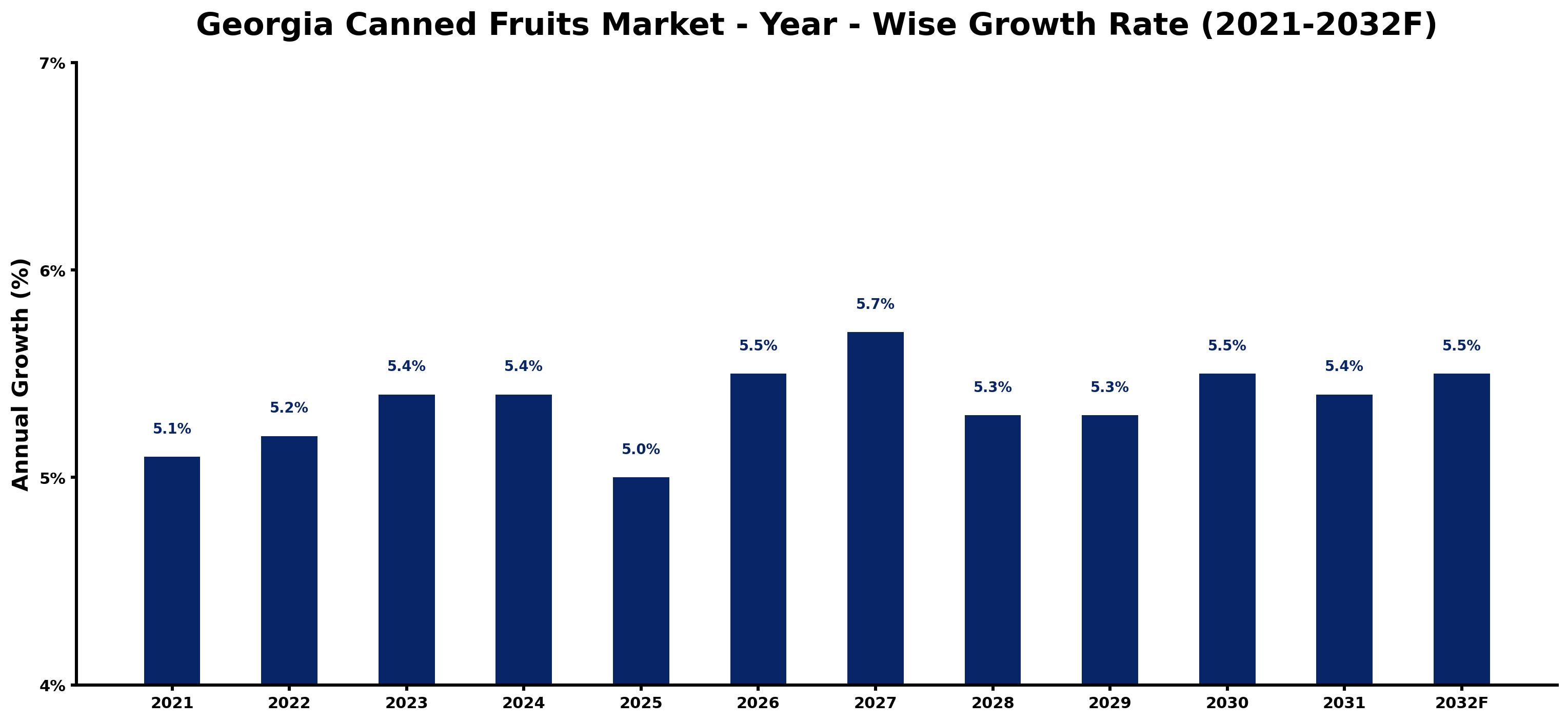
The table below presents the year wise growth rates along with the key drivers influencing the market
| Year | Growth Rate | Major Drivers |
| 2021 | 5.1% | Consumer preferences shift towards convenient and ready-to-eat food options rapidly. |
| 2022 | 5.2% | Local producers innovate with organic offerings, appealing to health-conscious buyers significantly. |
| 2023 | 5.4% | E-commerce platforms expand, enhancing accessibility for canned fruit products across Georgia. |
| 2024 | 5.4% | Packaging improvements focus on sustainability, capturing environmentally aware consumers' attention. |
| 2025 | 5.0% | New flavor profiles emerge, attracting adventurous eaters seeking unique culinary experiences. |
| 2026 | 5.5% | Collaborations between chefs and brands boost the gourmet canned fruit segment dramatically. |
| 2027 | 5.7% | Increased awareness of nutritional benefits elevates canned fruits in diet trends noticeably. |
| 2028 | 5.3% | Economic conditions stabilize, leading to higher disposable income for consumer spending growth. |
| 2029 | 5.3% | Regional agricultural advancements ensure consistent supply of quality fruits throughout seasons. |
| 2030 | 5.5% | Urbanization trends result in more households seeking convenient, shelf-stable food solutions. |
| 2031 | 5.4% | Health and wellness campaigns drive interest in preserved fruits as nutritious snacks. |
| 2032 | 5.5% | Innovation in preservation techniques enhances product quality, expanding market share significantly. |
Note - Market size estimations and growth projections presented in this report are based on 6Wresearch's advanced forecasting approach, validated with industry datasets as of June 2026.
Georgia Canned Fruits Market Synopsis
The Georgia Canned Fruits Market is projected to reach 5.5% and witness significant growth during the forecast period (2026-2032). This market is characterized by a robust assortment of products that include peaches, pears, and various fruit cocktail mixes, all of which reflect Georgia's status as a leading producer of high-quality fruits. The state's distinctive climate and fertile agricultural landscape play a crucial role in ensuring abundant harvests, which are processed and canned for both domestic and international distribution. Canned fruits have become increasingly popular among consumers, who value the convenience and year-round availability of these products, making them a staple in households, restaurants, and food manufacturers alike.
Georgia Canned Fruits Market Trends and Opportunities
The Georgia Canned Fruits Market is experiencing transformative trends that are reshaping the industry's landscape. One significant trend is the rising consumer demand for organic and natural canned fruits, a reflection of an increasing preference for healthier and environmentally friendly food options. This shift is encouraging producers to diversify their product lines to include organic selections.
- Innovative packaging solutions are being adopted, including resealable and portion-controlled containers, which cater to the convenience of consumers seeking easy-to-use products.
- There is a notable emphasis on sustainability practices, with companies exploring eco-friendly packaging materials and sustainable sourcing methods for fruits.
- The introduction of exotic and unique fruit varieties beyond traditional offerings is becoming more common, providing consumers with diverse and exciting choices.
- Consumer education about the nutritional benefits of canned fruits is increasing, promoting their use as healthy snacks and ingredients in various culinary applications.
- The focus on enhancing product quality through improved canning and preservation techniques is helping to maintain the appeal of canned fruits among health-conscious consumers.
Georgia Canned Fruits Market Challenges and Restraints
Despite its promising growth, the Georgia Canned Fruits Market faces several challenges. Intense competition from imported canned fruits poses a significant threat to local producers, as these products typically benefit from lower production costs that can result in cheaper retail prices.
- Fluctuations in raw material prices, particularly for fruits and packaging components, can adversely affect profit margins and pricing strategies for manufacturers.
- The growing consumer shift towards fresh produce, spurred by rising health consciousness, has led to declining demand for canned options.
- Maintaining quality control amid increasing production demands is critical for producers seeking to uphold their reputations and secure market share.
- Innovation is essential; companies must continuously develop new flavors and products to remain relevant in a competitive landscape.
- Adapting marketing strategies in response to changing consumer preferences is imperative for survival in this dynamic market.
Georgia Canned Fruits Market Investment Opportunities
For investors, the Georgia Canned Fruits Market presents numerous opportunities for strategic growth. The increasing demand for healthy and convenient food alternatives is encouraging investment in product innovations that improve convenience and nutrition.
- Investing in advanced packaging technologies that enhance the shelf life and quality of canned fruits can yield substantial returns as consumer preferences shift toward premium products.
- With the rise of organic produce, there exists a lucrative opportunity to develop and market organically sourced canned fruits targeting health-conscious consumers.
- Establishing partnerships with local farmers to ensure a steady supply of high-quality fruits can improve product offerings and strengthen market positioning.
- Investing in marketing campaigns that emphasize the nutritional benefits and sustainability of canned fruits can effectively attract a broader consumer base.
- Exploring avenues for international distribution can open new markets and expand the consumer reach for Georgia's canned fruit products.
Georgia Canned Fruits Market Government Investment and Initiatives
The government of Georgia has implemented several supportive policies aimed at bolstering the canned fruits market. These initiatives focus on enhancing local agriculture, ensuring food safety, and fostering the growth of small and medium enterprises in the sector.
- Subsidies and grants are provided to farmers and food processors to stimulate production and encourage innovation across the canned fruits industry.
- Regulatory frameworks are established to maintain quality control and uphold standards that protect consumers.
- Support programs are designed to enhance the competitiveness of local producers against imported products.
- Efforts are made to promote sustainable farming practices, creating an incentive for environmentally responsible production methods.
- Investment in infrastructure development, such as transportation and storage facilities, is prioritized to facilitate the efficient distribution of canned fruit products.
Georgia Canned Fruits Market Latest Developments (May 2025 - June 2026)
In the period between May 2025 and June 2026, the Georgia Canned Fruits Market has seen several noteworthy developments. Industry players are increasingly adopting sustainability initiatives, focusing on environmentally friendly packaging solutions that reduce waste.
- New partnerships have formed between local producers and organic farms to ensure a consistent supply of high-quality raw materials.
- Innovations in canning technology have improved product shelf life and retained the nutritional value of fruits, catering to health-focused consumers.
- Marketing campaigns emphasizing the convenience and health benefits of canned fruits have gained traction, aiming to boost consumer interest.
- Industry stakeholders have been investing in research and development to explore exotic fruit varieties for canning, diversifying product offerings.
- Regulatory updates have reinforced food safety standards, ensuring that canned fruit products meet consumer expectations for quality and safety.
Georgia Canned Fruits Market - Key Attractiveness of the Report
- 10 Years of Market Numbers
- Historical Data Starting from 2022 to 2025
- Base Year: 2025
- Forecast Data until 2032
- Key Performance Indicators Impacting the Market
- Major Upcoming Developments and Projects
Key Highlights of the Report:
- Georgia Canned Fruits Market Outlook
- Market Size of Georgia Canned Fruits Market, 2025
- Forecast of Georgia Canned Fruits Market, 2032F
- Historical Data and Forecast of Georgia Canned Fruits Revenues & Volume for the Period 2022-2032F
- Georgia Canned Fruits Market Trend Evolution
- Georgia Canned Fruits Market Drivers and Challenges
- Georgia Canned Fruits Price Trends
- Georgia Canned Fruits Porter's Five Forces
- Georgia Canned Fruits Industry Life Cycle
- Historical Data and Forecast of Georgia Canned Fruits Market Revenues & Volume By Fruit Type for the Period 2022-2032F
- Historical Data and Forecast of Georgia Canned Fruits Market Revenues & Volume By Peaches for the Period 2022-2032F
- Historical Data and Forecast of Georgia Canned Fruits Market Revenues & Volume By Pineapple for the Period 2022-2032F
- Historical Data and Forecast of Georgia Canned Fruits Market Revenues & Volume By Mandarin oranges for the Period 2022-2032F
- Historical Data and Forecast of Georgia Canned Fruits Market Revenues & Volume By Pears for the Period 2022-2032F
- Historical Data and Forecast of Georgia Canned Fruits Market Revenues & Volume By Others for the Period 2022-2032F
- Historical Data and Forecast of Georgia Canned Fruits Market Revenues & Volume By Form for the Period 2022-2032F
- Historical Data and Forecast of Georgia Canned Fruits Market Revenues & Volume By Whole fruits for the Period 2022-2032F
- Historical Data and Forecast of Georgia Canned Fruits Market Revenues & Volume By Cut fruits for the Period 2022-2032F
- Historical Data and Forecast of Georgia Canned Fruits Market Revenues & Volume By Distribution Channel for the Period 2022-2032F
- Historical Data and Forecast of Georgia Canned Fruits Market Revenues & Volume By Supermarkets/Hypermarkets for the Period 2022-2032F
- Historical Data and Forecast of Georgia Canned Fruits Market Revenues & Volume By Convenience Stores for the Period 2022-2032F
- Historical Data and Forecast of Georgia Canned Fruits Market Revenues & Volume By Online Retail for the Period 2022-2032F
- Historical Data and Forecast of Georgia Canned Fruits Market Revenues & Volume By Other for the Period 2022-2032F
- Georgia Canned Fruits Import Export Trade Statistics
- Market Opportunity Assessment By Fruit Type
- Market Opportunity Assessment By Form
- Market Opportunity Assessment By Distribution Channel
- Georgia Canned Fruits Top Companies Market Share
- Georgia Canned Fruits Competitive Benchmarking By Technical and Operational Parameters
- Georgia Canned Fruits Company Profiles
- Georgia Canned Fruits Key Strategic Recommendations






































