Georgia Cultured Meat Market Size, Share & Growth Rate
The Georgia Cultured Meat Market was estimated at USD 368 Million in 2025 and is projected to reach USD 503 Million by 2032, growing at a CAGR of 4.6% from 2026 to 2032. This growth trajectory is fueled by increasing consumer awareness of sustainability and ethical food production, as well as the state's established biotechnology sector that is well-equipped to innovate in this area. Moreover, collaborative efforts between academia and industry are accelerating research and development, propelling the market forward in both capacity and consumer acceptance.
Georgia Cultured Meat Market Year-wise Growth Rate and Key Drivers
This graph highlights how the Georgia Cultured Meat Market has steadily grown over the years, supported by major growth factors.
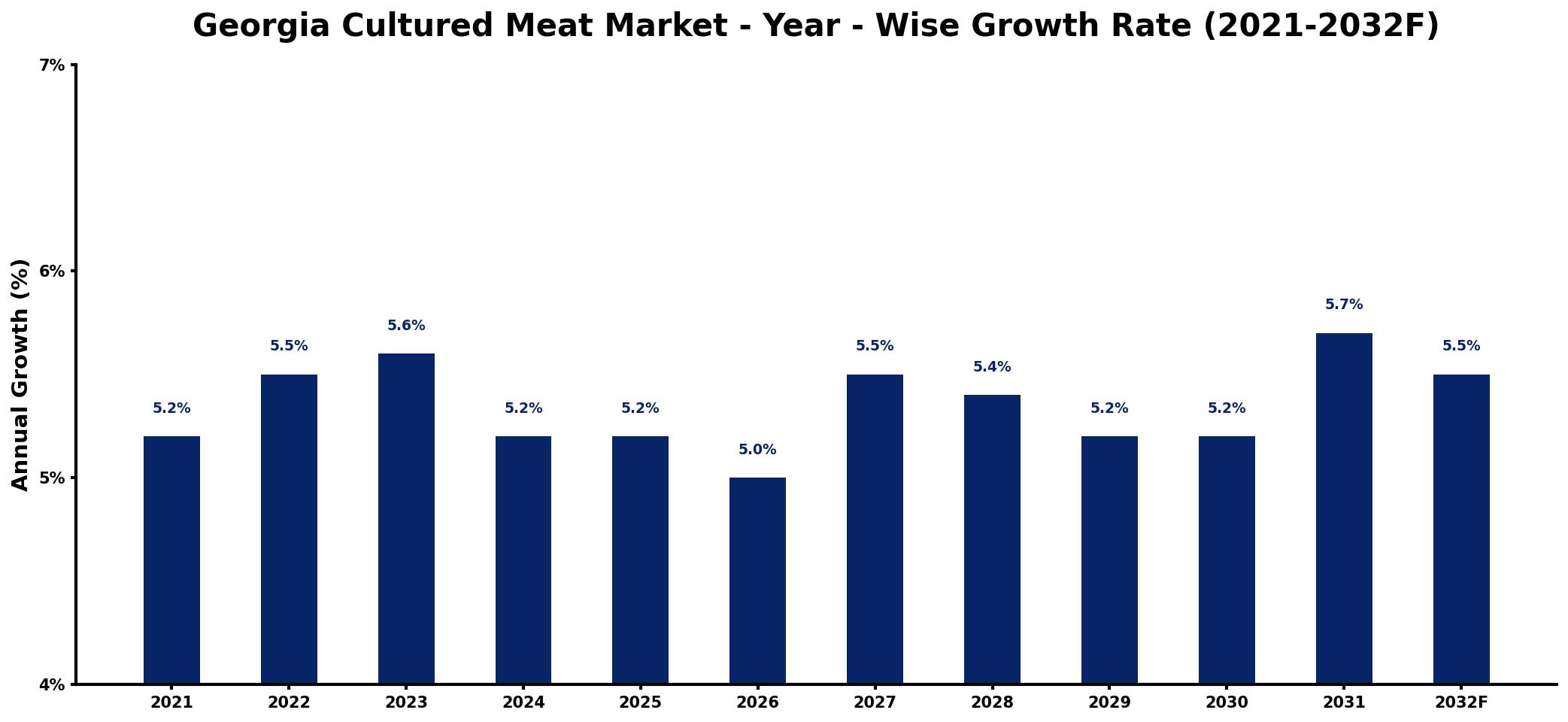
The table below presents the year‑wise growth rates along with the key drivers influencing the market
| Year | Growth Rate | Major Drivers |
| 2021 | 5.2% | Increased consumer health awareness |
| 2022 | 5.5% | Rise in sustainable food investments |
| 2023 | 5.6% | Growing plant-based food trends |
| 2024 | 5.2% | Expansion of alternative protein markets |
| 2025 | 5.2% | Increased regulatory support initiatives |
| 2026 | 5.0% | Technological advancements in production |
| 2027 | 5.5% | Surge in urban population demand |
| 2028 | 5.4% | Enhanced distribution network capabilities |
| 2029 | 5.2% | Growing focus on food security |
| 2030 | 5.2% | Increased global environmental concerns |
| 2031 | 5.7% | growing commercial sector adoption |
| 2032 | 5.5% | Growing consumer ethical considerations |
Note: Market size estimations and growth projections presented in this report are based on 6Wresearch's proprietary forecasting methodology, utilizing the latest available industry data, government publications, and primary research inputs.
Georgia Cultured Meat Market Synopsis
In recent years, the Georgia cultured meat market has gained significant momentum, reflecting both consumer demand for sustainable food options and technological advancements in cellular agriculture. Looking ahead, the market is poised to evolve further as regulatory frameworks become more defined and production scalability improves, positioning Georgia as a leader in this transformative food sector.
As the market matures, stakeholders are navigating both opportunities and challenges related to consumer acceptance and cost competitiveness. With a growing population seeking alternatives to traditional meat, the potential for cultured meat to meet these evolving needs is vast, offering a path toward sustainable food systems in Georgia.
Georgia Cultured Meat Market Key Takeaways
- The market is driven by heightened consumer awareness of sustainability and animal welfare.
- Technological advancements are essential for improving production efficiency and product quality.
- Regulatory support is creating an enabling environment for innovation and commercialization.
- Collaboration among universities, government, and private sector is accelerating development efforts.
- Market growth is expected to meet increasing demand for ethical food products.
Evaluation of Restraints in Georgia Cultured Meat Market
Despite its promising outlook, the Georgia cultured meat market faces several restraints that could temper its growth. The path to regulatory approval for new products is often lengthy and complex, which may delay market entry for innovative offerings. Additionally, while consumer awareness is rising, widespread acceptance remains a hurdle, with many still hesitant to embrace lab-grown meat. Furthermore, the scalability of production processes is a pivotal concern, as achieving cost parity with traditional meat remains a formidable challenge for producers.
Georgia Cultured Meat Market Trends
Key trends shaping the Georgia cultured meat market include a robust emphasis on sustainability and health, with consumers actively seeking alternatives to conventional meat due to environmental concerns. Technological innovations in cellular agriculture are enabling enhanced production techniques, which are critical for meeting consumer expectations regarding taste and texture. Additionally, the trend towards personalized nutrition is influencing product development, prompting companies to focus on specific dietary needs and preferences.
Georgia Cultured Meat Market Opportunities
Investment opportunities in the Georgia cultured meat market are plentiful, particularly in the areas of R&D for more efficient production methods and consumer education initiatives. As the state continues to support biotechnology innovation, there are avenues for collaboration among startups, research institutions, and established food companies. Additionally, the potential for export markets presents a unique opportunity for growth, particularly as cultured meat gains acceptance on a global scale.
Government Initiatives in the Georgia Cultured Meat Market
The Georgia government has recognized the importance of the cultured meat sector, implementing policies that foster research and development within cellular agriculture. Public funding programs are aimed at supporting innovative startups and collaborations between industry and academia. Regulatory frameworks are being established to guide the safe commercialization of cultured meat products, ensuring that Georgia remains competitive in the rapidly evolving global food landscape.
Future Insights of the Georgia Cultured Meat Market
Looking towards the future, the Georgia cultured meat market is set to grow dynamically through 2032. As consumer preferences shift toward more ethical and sustainable food options, the demand for cultured meat will likely surge. Continuous advancements in technology will aid producers in overcoming current production limitations, while increasing regulatory clarity will enhance market stability. Georgia's unique blend of agricultural tradition and biotech innovation places it in an ideal position to lead the charge in this next phase of food production.
Georgia Cultured Meat Market Latest Developments (2025 - 2026)
In the last year, the Georgia cultured meat market has seen exciting developments with several new partnerships forming between academic institutions and industry players aimed at advancing R&D in cellular agriculture. Events and forums dedicated to showcasing innovations in the field have drawn significant interest from investors, signaling growing confidence in the market's potential. Additionally, public discussions surrounding regulatory frameworks have started to gain traction, indicating a move towards more defined guidelines that could expedite the commercialization process for cultured meat products.
Georgia Cultured Meat Market - Key Attractiveness of the Report
- 10 Years of Market Numbers
- Historical Data Starting from 2022 to 2025
- Base Year: 2025
- Forecast Data until 2032
- Key Performance Indicators Impacting the Market
- Major Upcoming Developments and Projects
Key Highlights of the Report:
- Georgia Cultured Meat Market Outlook
- Market Size of Georgia Cultured Meat Market, 2025
- Forecast of Georgia Cultured Meat Market, 2032
- Historical Data and Forecast of Georgia Cultured Meat Revenues & Volume for the Period 2022-2032F
- Georgia Cultured Meat Market Trend Evolution
- Georgia Cultured Meat Market Drivers and Challenges
- Georgia Cultured Meat Price Trends
- Georgia Cultured Meat Porter's Five Forces
- Georgia Cultured Meat Industry Life Cycle
- Historical Data and Forecast of Georgia Cultured Meat Market Revenues & Volume By Product Type for the Period 2022-2032F
- Historical Data and Forecast of Georgia Cultured Meat Market Revenues & Volume By Poultry for the Period 2022-2032F
- Historical Data and Forecast of Georgia Cultured Meat Market Revenues & Volume By Beef for the Period 2022-2032F
- Historical Data and Forecast of Georgia Cultured Meat Market Revenues & Volume By Seafood for the Period 2022-2032F
- Historical Data and Forecast of Georgia Cultured Meat Market Revenues & Volume By Pork for the Period 2022-2032F
- Historical Data and Forecast of Georgia Cultured Meat Market Revenues & Volume By Duck for the Period 2022-2032F
- Historical Data and Forecast of Georgia Cultured Meat Market Revenues & Volume By End-Use for the Period 2022-2032F
- Historical Data and Forecast of Georgia Cultured Meat Market Revenues & Volume By Nuggets for the Period 2022-2032F
- Historical Data and Forecast of Georgia Cultured Meat Market Revenues & Volume By Burgers for the Period 2022-2032F
- Historical Data and Forecast of Georgia Cultured Meat Market Revenues & Volume By Meatballs for the Period 2022-2032F
- Historical Data and Forecast of Georgia Cultured Meat Market Revenues & Volume By Sausage for the Period 2022-2032F
- Historical Data and Forecast of Georgia Cultured Meat Market Revenues & Volume By Hot dogs for the Period 2022-2032F
- Historical Data and Forecast of Georgia Cultured Meat Market Revenues & Volume By Others for the Period 2022-2032F
- Georgia Cultured Meat Import Export Trade Statistics
- Market Opportunity Assessment By Product Type
- Market Opportunity Assessment By End-Use
- Georgia Cultured Meat Top Companies Market Share
- Georgia Cultured Meat Competitive Benchmarking By Technical and Operational Parameters
- Georgia Cultured Meat Company Profiles
- Georgia Cultured Meat Key Strategic Recommendations






































