Georgia Decorative tile Market Summary
The georgia decorative tile market was estimated at USD 707 Million in 2025 and is projected to reach USD 1009 Million by 2032, growing at a CAGR of 6.3% from 2026 to 2032.
Georgia Decorative tile Market Year-wise Growth Rate and Key Drivers
This graph highlights how the Georgia Decorative tile Market has steadily grown over the past five years, supported by major growth factors.
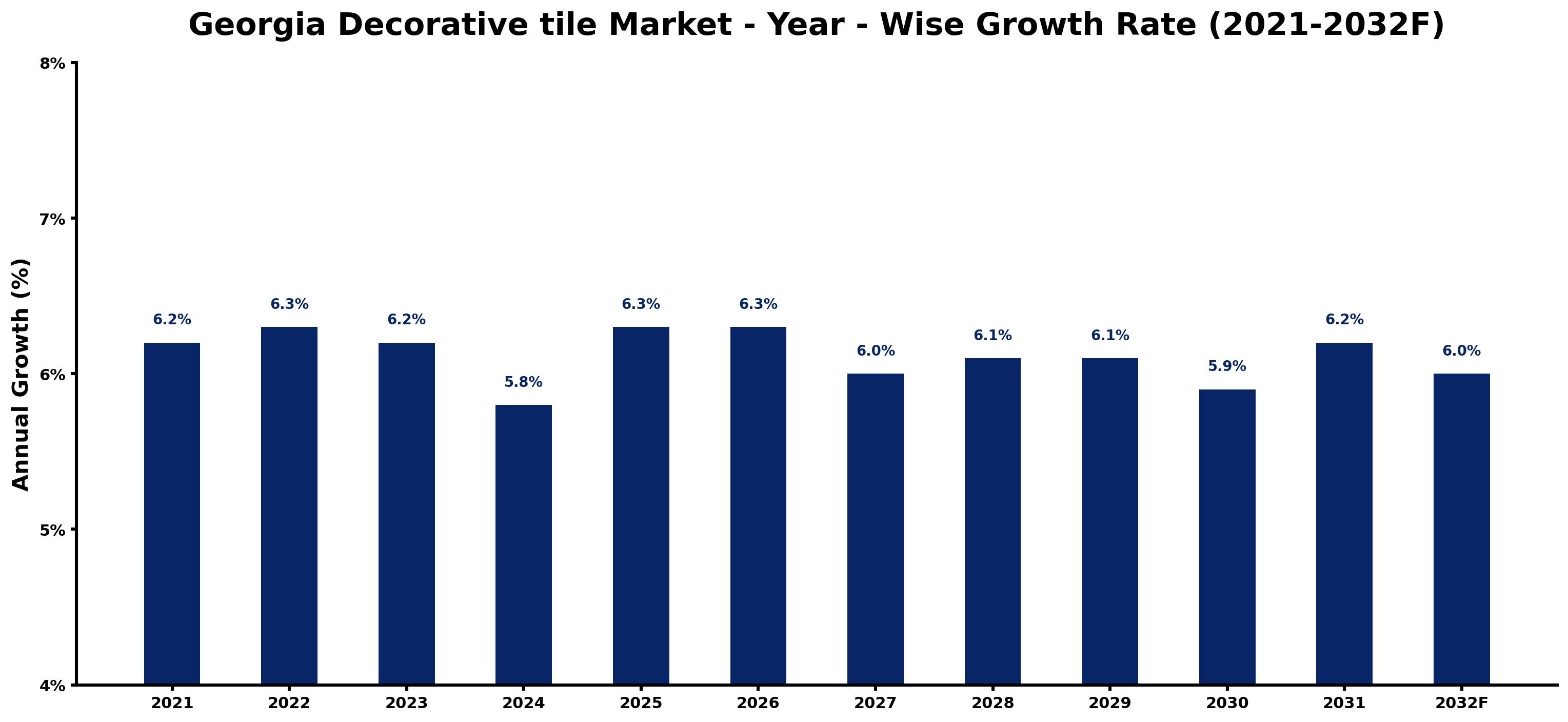
The table below presents the year wise growth rates along with the key drivers influencing the market
| Year | Growth Rate | Major Drivers |
| 2021 | 6.2% | Post-lockdown retail projects began revitalizing demand for stylish decorative tiles. |
| 2022 | 6.3% | Increased home renovations reflected evolving consumer aesthetics and personal style choices. |
| 2023 | 6.2% | Sustainable materials gained traction as consumers prioritized eco-friendly tile options. |
| 2024 | 5.8% | Architectural trends focused on indoor-outdoor spaces, boosting demand for versatile tiles. |
| 2025 | 6.3% | Technological integration in manufacturing improved tile design capabilities and customization options. |
| 2026 | 6.3% | Commercial construction projects surged, particularly in retail and hospitality sectors across Georgia. |
| 2027 | 6.0% | Home builders embraced decorative tiles to enhance property value and appeal. |
| 2028 | 6.1% | Local craftsmanship and artistry became a focal point of design, fostering regional pride. |
| 2029 | 6.1% | Virtual reality tools empowered homeowners to visualize tile options in their spaces. |
| 2030 | 5.9% | Urbanization trends led to smaller living spaces, increasing demand for space-efficient tile designs. |
| 2031 | 6.2% | Emerging lifestyle trends showcased tiles as central to personalized interior environments. |
| 2032 | 6.0% | Collaborations between designers and manufacturers created innovative tile collections reflecting local culture. |
Note - Market size estimations and growth projections presented in this report are based on 6Wresearch's advanced forecasting approach, validated with industry datasets as of June 2026.
Georgia Decorative tile Market Synopsis
The Georgia Decorative tile Market is projected to reach 6.3% and witness significant growth during the forecast period (2026-2032). This dynamic sector is intrinsically tied to the broader construction and interior design landscape within the state. An expanding economy, coupled with a booming real estate market, indicates a consistent rise in demand for decorative tiles in residential and commercial properties. Consumers are increasingly inclined towards unique and aesthetically appealing tile options, aiming to elevate the visual charm of their living and working spaces. Key trends spotlighting this market include a preference for bold patterns, textured finishes, and sustainable materials, reflecting a shift in consumer preferences towards personalization and style.
Georgia Decorative tile Market Trends
In recent years, the Georgia Decorative tile Market has witnessed a surge in the popularity of distinctive designs. Contemporary consumers, particularly millennials, are favoring artisanal and handcrafted tiles, which contrast significantly with traditional mass-produced alternatives. This trend is amplified by an increasing interest in sustainability; eco-friendly materials and tiles made from recycled or natural resources are gaining traction among environmentally-conscious buyers. Furthermore, advancements in digital printing technology are facilitating intricate designs and highly customizable tile options. As a result, the market is evolving to offer a more diverse spectrum of styles and materials that cater to the aesthetic demands of homeowners and designers in Georgia.
Georgia Decorative tile Market Challenges and Restraints
Despite its robust growth, the Georgia Decorative tile Market faces several challenges that could hinder momentum. Intense competition from both domestic and international manufacturers has created a saturated market environment. Additionally, price volatility in raw materials, particularly ceramics and glass, poses a risk to profitability. Shifting consumer preferences towards contemporary and sustainable designs further complicate the landscape, requiring manufacturers to adapt continually. Economic uncertainties, often leading to fluctuations in construction activities, can directly impact demand for decorative tiles. Finally, companies must navigate stringent quality standards and maintain timely delivery, while also investing in technological advancements such as eco-friendly production processes and digital printing capabilities to stay competitive.
Georgia Decorative tile Market Investment Opportunities
The Georgia Decorative tile Market presents an array of investment opportunities for stakeholders, both local and international. With the construction sector poised for steady growth, there is a rising appetite for high-quality decorative tiles in both residential and commercial projects. Investing in the manufacturing and distribution of innovative, sustainable tiles could yield significant returns. Moreover, retail outlets and showrooms that showcase a diverse selection of decorative tiles can attract a broad customer base, catering to varied consumer tastes. Embracing the burgeoning trend of eco-friendly tiles also presents a compelling avenue for differentiation and competitive advantage within the market. Overall, the Georgia Decorative tile Market promises a vibrant landscape for investors eager to capitalize on increasing demand for stylish and functional tiling solutions.
Georgia Decorative tile Market Government Investment and Initiatives
Government policies play a pivotal role in shaping the Georgia Decorative tile Market. Regulations established by the Georgia State Construction Industry Licensing Board focus on ensuring that contractors and builders adhere to stringent licensing and certification requirements, particularly for tile installation. These regulations aim to enhance craftsmanship quality and consumer safety within the decorative tile sector. Additionally, initiatives from the Georgia Environmental Protection Division emphasize responsible practices in construction waste management, mandating proper disposal techniques for tile debris. Such policies serve to bolster industry confidence while promoting sustainable practices and environmental protection, in line with the growing consumer shift towards eco-friendly products.
Georgia Decorative tile Market Latest Developments (May 2025 - June 2026)
From May 2025 to June 2026, the Georgia Decorative tile Market has experienced notable developments reflecting the industry's adaptive strategies in response to changing consumer preferences. As interest in sustainable solutions escalates, manufacturers are increasingly prioritizing eco-friendly materials in their product lines. The introduction of innovative manufacturing processes, including advancements in digital printing technologies, has enabled businesses to offer more customizable options that resonate well with modern consumers. Furthermore, strategic partnerships aimed at enhancing distribution channels are fostering greater market accessibility for consumers seeking premium decorative tiles. Overall, these developments signify a market keen on addressing evolving demands while maintaining growth momentum.
Georgia Decorative tile Market Future Outlook
The future outlook for the Georgia Decorative Tile Market is optimistic, with steady growth anticipated over the coming years. Various factors contribute to this positive trajectory, including a significant uptick in construction activities across both residential and commercial sectors, as well as the rising trend of remodeling and renovation projects. Consumers are increasingly turning to decorative tiles to enhance their spaces' aesthetic appeal, leading to heightened demand for diverse designs, colors, and textures. Additionally, the continuous evolution in manufacturing technologies is likely to yield innovative products that align with shifting consumer preferences. A growing emphasis on sustainability underscores a transition towards the utilization of recycled and environmentally friendly materials, further enhancing the market's expansion prospects. Overall, the Georgia Decorative Tile Market stands poised for sustained growth, adapting to technological advancements and consumer trends.
Georgia Decorative tile Market - Key Attractiveness of the Report
- 10 Years of Market Numbers
- Historical Data Starting from 2022 to 2025
- Base Year: 2025
- Forecast Data until 2032
- Key Performance Indicators Impacting the Market
- Major Upcoming Developments and Projects
Key Highlights of the Report:
- Georgia Decorative tile Market Outlook
- Market Size of Georgia Decorative tile Market, 2025
- Forecast of Georgia Decorative tile Market, 2032F
- Historical Data and Forecast of Georgia Decorative tile Revenues & Volume for the Period 2022-2032F
- Georgia Decorative tile Market Trend Evolution
- Georgia Decorative tile Market Drivers and Challenges
- Georgia Decorative tile Price Trends
- Georgia Decorative tile Porter's Five Forces
- Georgia Decorative tile Industry Life Cycle
- Historical Data and Forecast of Georgia Decorative tile Market Revenues & Volume By Type for the Period 2022-2032F
- Historical Data and Forecast of Georgia Decorative tile Market Revenues & Volume By Ceramic Wall Tiles for the Period 2022-2032F
- Historical Data and Forecast of Georgia Decorative tile Market Revenues & Volume By Vinyl Wall Tiles for the Period 2022-2032F
- Historical Data and Forecast of Georgia Decorative tile Market Revenues & Volume By Stone Wall Tiles for the Period 2022-2032F
- Historical Data and Forecast of Georgia Decorative tile Market Revenues & Volume By Other Types for the Period 2022-2032F
- Historical Data and Forecast of Georgia Decorative tile Market Revenues & Volume By End-users for the Period 2022-2032F
- Historical Data and Forecast of Georgia Decorative tile Market Revenues & Volume By Residential for the Period 2022-2032F
- Historical Data and Forecast of Georgia Decorative tile Market Revenues & Volume By Commercial for the Period 2022-2032F
- Historical Data and Forecast of Georgia Decorative tile Market Revenues & Volume By Application for the Period 2022-2032F
- Historical Data and Forecast of Georgia Decorative tile Market Revenues & Volume By Flooring for the Period 2022-2032F
- Historical Data and Forecast of Georgia Decorative tile Market Revenues & Volume By Wall Coverings for the Period 2022-2032F
- Historical Data and Forecast of Georgia Decorative tile Market Revenues & Volume By Other Applications for the Period 2022-2032F
- Georgia Decorative tile Import Export Trade Statistics
- Market Opportunity Assessment By Type
- Market Opportunity Assessment By End-users
- Market Opportunity Assessment By Application
- Georgia Decorative tile Top Companies Market Share
- Georgia Decorative tile Competitive Benchmarking By Technical and Operational Parameters
- Georgia Decorative tile Company Profiles
- Georgia Decorative tile Key Strategic Recommendations






































