Georgia Fluorochemicals Market Size Growth Rate
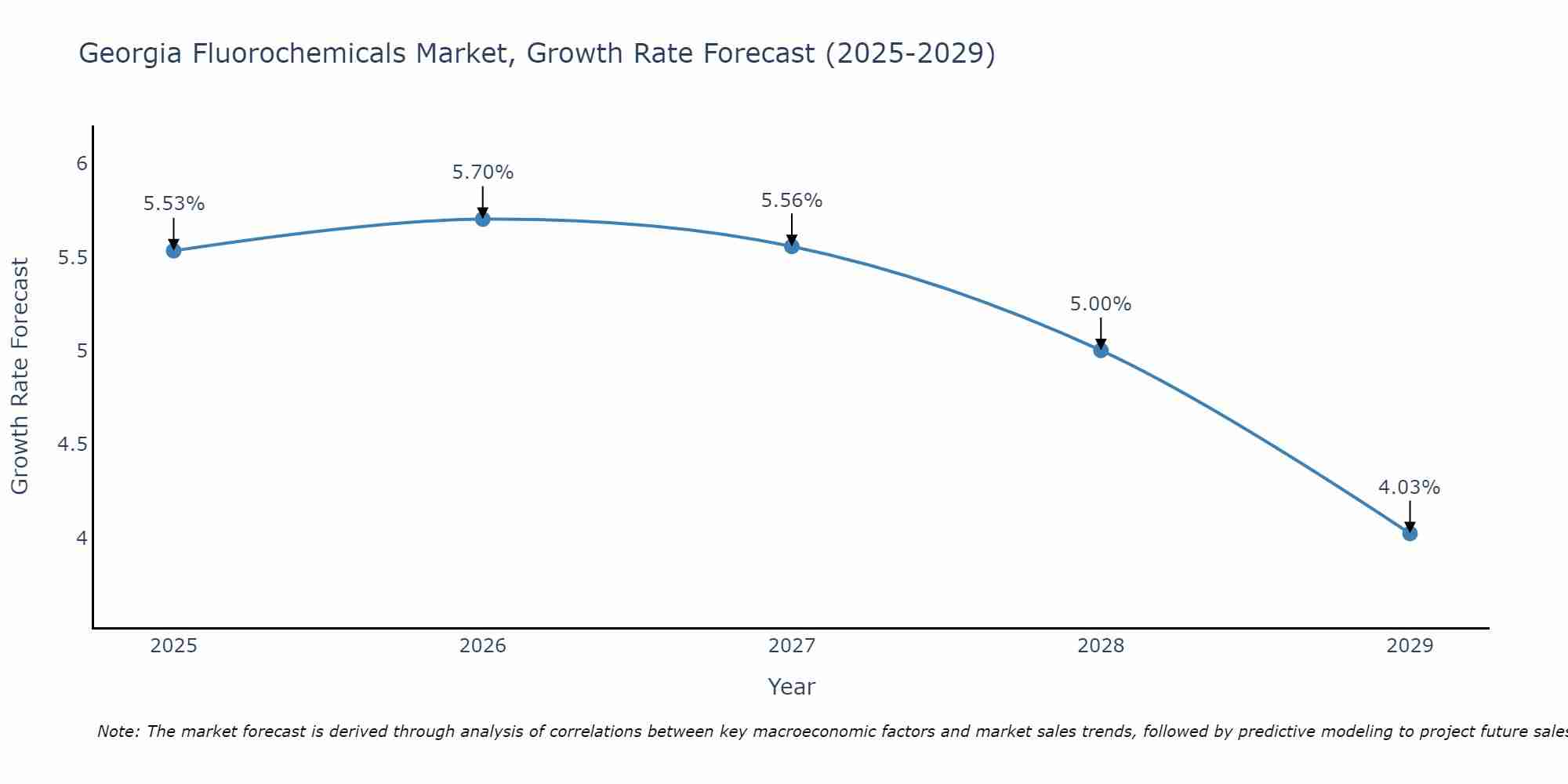
The Georgia Fluorochemicals Market is projected to witness mixed growth rate patterns during 2025 to 2029. Starting at 5.53% in 2025, the market peaks at 5.70% in 2026, and settles at 4.03% by 2029.
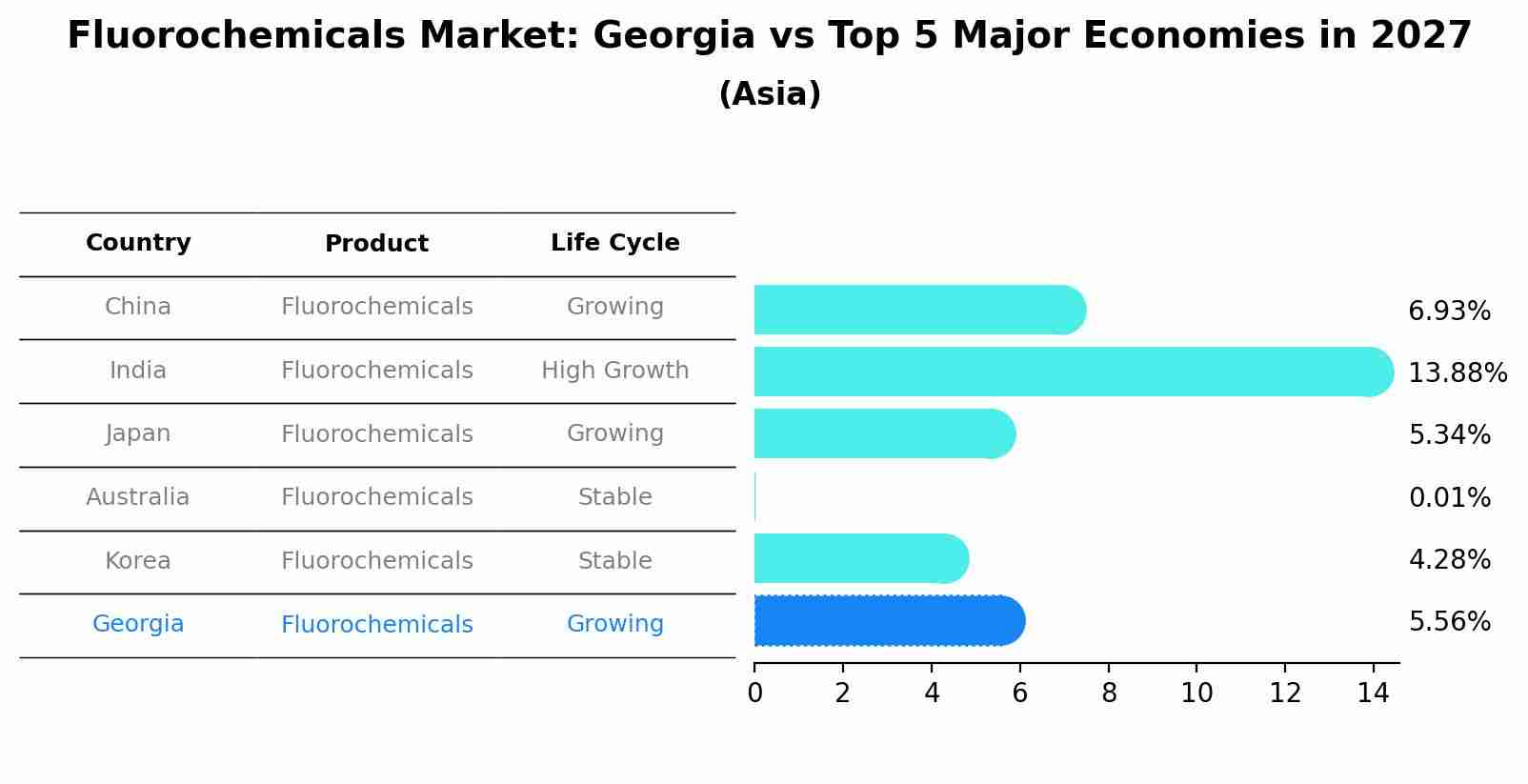
Fluorochemicals Market: Georgia vs Top 5 Major Economies in 2027 (Asia)
Georgia's Fluorochemicals market is anticipated to experience a growing growth rate of 5.56% by 2027, reflecting trends observed in the largest economy China, followed by India, Japan, Australia and South Korea.
Georgia Fluorochemicals Market Overview
In Georgia, the fluorochemicals market is witnessing significant growth driven by the increasing demand from the refrigeration, air conditioning, and automotive industries. Fluorochemicals such as fluorocarbons and fluoropolymers are widely used as refrigerants, solvents, and lubricants in various industrial processes and applications. With Georgia strong presence in the chemical manufacturing sector and the growing emphasis on energy efficiency and environmental sustainability, the demand for fluorochemicals is expected to continue rising in the state, supporting further expansion of the market.
Drivers of the market
The Georgia fluorochemicals market is driven by the growing demand from the refrigeration, air conditioning, and semiconductor industries. Fluorochemicals, including refrigerants, solvents, and polymers, offer properties such as high stability, thermal resistance, and chemical inertness, making them essential for numerous industrial applications. Technological advancements and environmental regulations influence market dynamics in Georgia.
Challenges of the market
In the Georgia Fluorochemicals market, challenges arise from environmental regulations, technological advancements, and shifting consumer preferences. With increasing scrutiny on the environmental impact of fluorinated compounds, manufacturers need to develop sustainable alternatives with lower global warming potential (GWP) and ozone depletion potential (ODP). Moreover, competition from substitute materials and the need for continuous innovation to improve performance characteristics pose challenges for market players. Additionally, navigating regulatory compliance and addressing safety concerns associated with handling and disposal of fluorochemicals add complexity to market dynamics. Furthermore, global supply chain disruptions and raw material shortages can impact production schedules and logistics, affecting market competitiveness.
Government Policy of the market
Georgias government supports the fluorochemicals market through policies aimed at promoting environmental regulations, product safety standards, and market competitiveness. This includes incentives for manufacturers to adopt environmentally friendly production processes, support for research on alternative chemicals, and collaboration with industry stakeholders.
Key Highlights of the Report:
- Georgia Fluorochemicals Market Outlook
- Market Size of Georgia Fluorochemicals Market, 2024
- Forecast of Georgia Fluorochemicals Market, 2031
- Historical Data and Forecast of Georgia Fluorochemicals Revenues & Volume for the Period 2021-2031
- Georgia Fluorochemicals Market Trend Evolution
- Georgia Fluorochemicals Market Drivers and Challenges
- Georgia Fluorochemicals Price Trends
- Georgia Fluorochemicals Porter's Five Forces
- Georgia Fluorochemicals Industry Life Cycle
- Historical Data and Forecast of Georgia Fluorochemicals Market Revenues & Volume By Product for the Period 2021-2031
- Historical Data and Forecast of Georgia Fluorochemicals Market Revenues & Volume By Fuorocarbon for the Period 2021-2031
- Historical Data and Forecast of Georgia Fluorochemicals Market Revenues & Volume By Inorganic &Specialities for the Period 2021-2031
- Historical Data and Forecast of Georgia Fluorochemicals Market Revenues & Volume By Fluoropolymer for the Period 2021-2031
- Historical Data and Forecast of Georgia Fluorochemicals Market Revenues & Volume By Application for the Period 2021-2031
- Historical Data and Forecast of Georgia Fluorochemicals Market Revenues & Volume By Refrigerant for the Period 2021-2031
- Historical Data and Forecast of Georgia Fluorochemicals Market Revenues & Volume By Aluminium Production for the Period 2021-2031
- Historical Data and Forecast of Georgia Fluorochemicals Market Revenues & Volume By Blowing Agent for the Period 2021-2031
- Historical Data and Forecast of Georgia Fluorochemicals Market Revenues & Volume By Components & Others for the Period 2021-2031
- Georgia Fluorochemicals Import Export Trade Statistics
- Market Opportunity Assessment By Product
- Market Opportunity Assessment By Application
- Georgia Fluorochemicals Top Companies Market Share
- Georgia Fluorochemicals Competitive Benchmarking By Technical and Operational Parameters
- Georgia Fluorochemicals Company Profiles
- Georgia Fluorochemicals Key Strategic Recommendations






































