Georgia Food Products Machinery Market Growth Rate Analysis (2025 - 2031)
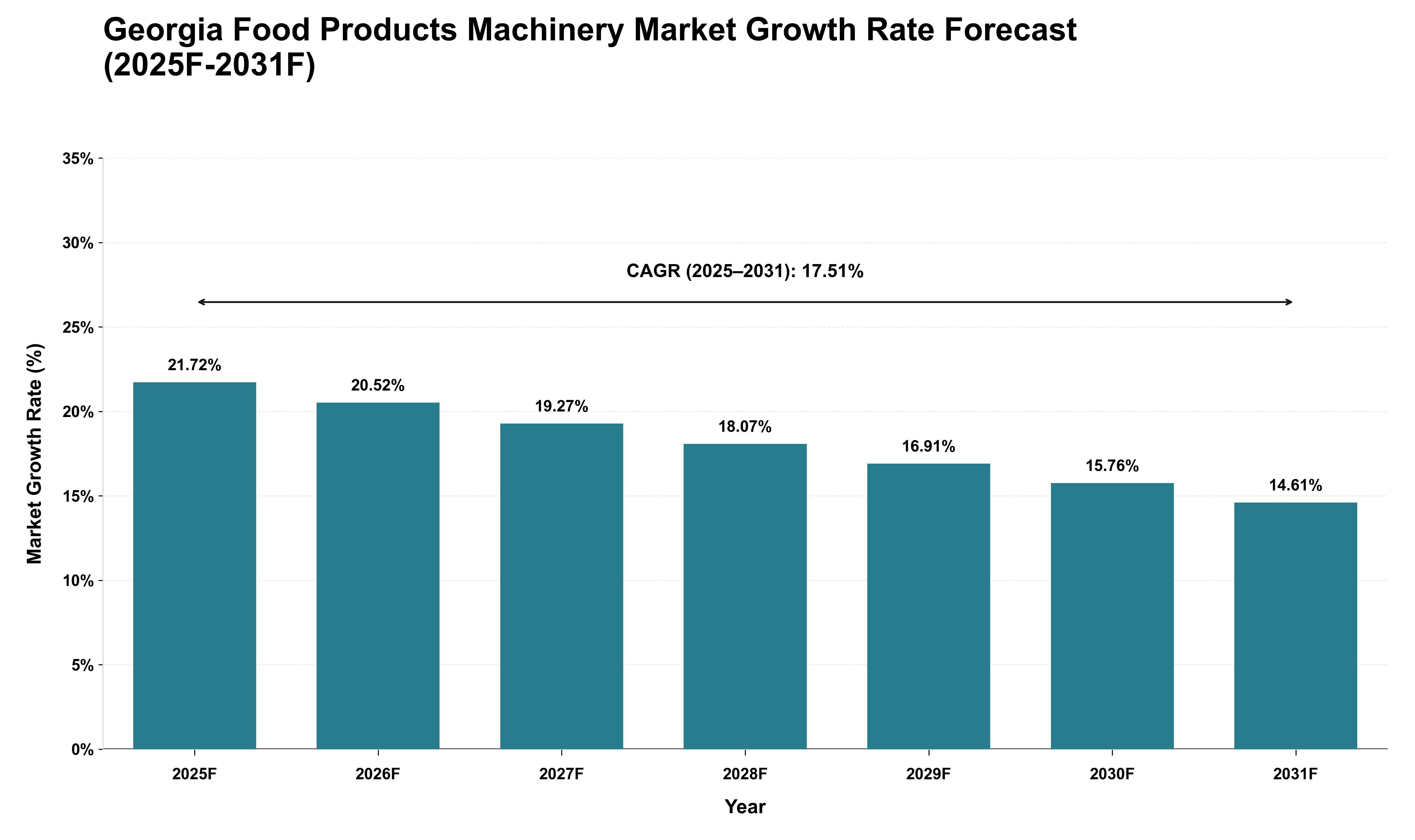
The Georgia food products machinery market will experience robust growth driven by increasing domestic demand for processed food and the expansion of export opportunities in regional markets. With a projected CAGR of 17.51% from 2025 to 2031, the annual growth rates will reflect a strong upward trajectory, peaking at 21.72% in 2025 before gradually tapering to 14.61% by 2031. This trend will be underpinned by heightened import dependencies on advanced machinery technologies, as local manufacturers seek to enhance production efficiency and meet evolving consumer preferences. Additionally, cyclical trends in global agricultural output and food consumption patterns will further stimulate trade flows, positioning Georgia as a competitive player in the international market for food processing equipment. As such, the interplay between domestic innovation and international trade dynamics will significantly shape the sector's performance during this forecast period.
Key Highlights of the Report:
- Georgia Food products machinery Market Outlook
- Market Size of Georgia Food products machinery Market, 2024
- Forecast of Georgia Food products machinery Market, 2026
- Historical Data and Forecast of Georgia Food products machinery Revenues & Volume for the Period 2021 - 2031
- Georgia Food products machinery Market Trend Evolution
- Georgia Food products machinery Market Drivers and Challenges
- Georgia Food products machinery Price Trends
- Georgia Food products machinery Porter's Five Forces
- Georgia Food products machinery Industry Life Cycle
- Historical Data and Forecast of Georgia Food products machinery Market Revenues & Volume By Type for the Period 2021 - 2031
- Historical Data and Forecast of Georgia Food products machinery Market Revenues & Volume By Dairy Product Plant Machinery and Equipment for the Period 2021 - 2031
- Historical Data and Forecast of Georgia Food products machinery Market Revenues & Volume By Bakery Machinery and Equipment for the Period 2021 - 2031
- Historical Data and Forecast of Georgia Food products machinery Market Revenues & Volume By Meat and Poultry Processing And Preparation Machinery for the Period 2021 - 2031
- Historical Data and Forecast of Georgia Food products machinery Market Revenues & Volume By Other Commercial Food Products Machinery for the Period 2021 - 2031
- Historical Data and Forecast of Georgia Food products machinery Market Revenues & Volume By Applications for the Period 2021 - 2031
- Historical Data and Forecast of Georgia Food products machinery Market Revenues & Volume By Bakery & Confectionery for the Period 2021 - 2031
- Historical Data and Forecast of Georgia Food products machinery Market Revenues & Volume By Meat, Poultry, and Seafood for the Period 2021 - 2031
- Historical Data and Forecast of Georgia Food products machinery Market Revenues & Volume By Dairy for the Period 2021 - 2031
- Historical Data and Forecast of Georgia Food products machinery Market Revenues & Volume By Beverages for the Period 2021 - 2031
- Historical Data and Forecast of Georgia Food products machinery Market Revenues & Volume By Others for the Period 2021 - 2031
- Georgia Food products machinery Import Export Trade Statistics
- Market Opportunity Assessment By Type
- Market Opportunity Assessment By Applications
- Georgia Food products machinery Top Companies Market Share
- Georgia Food products machinery Competitive Benchmarking By Technical and Operational Parameters
- Georgia Food products machinery Company Profiles
- Georgia Food products machinery Key Strategic Recommendations






































