Georgia Identity and Access Management Market Size & Growth Rate (2026-2032)
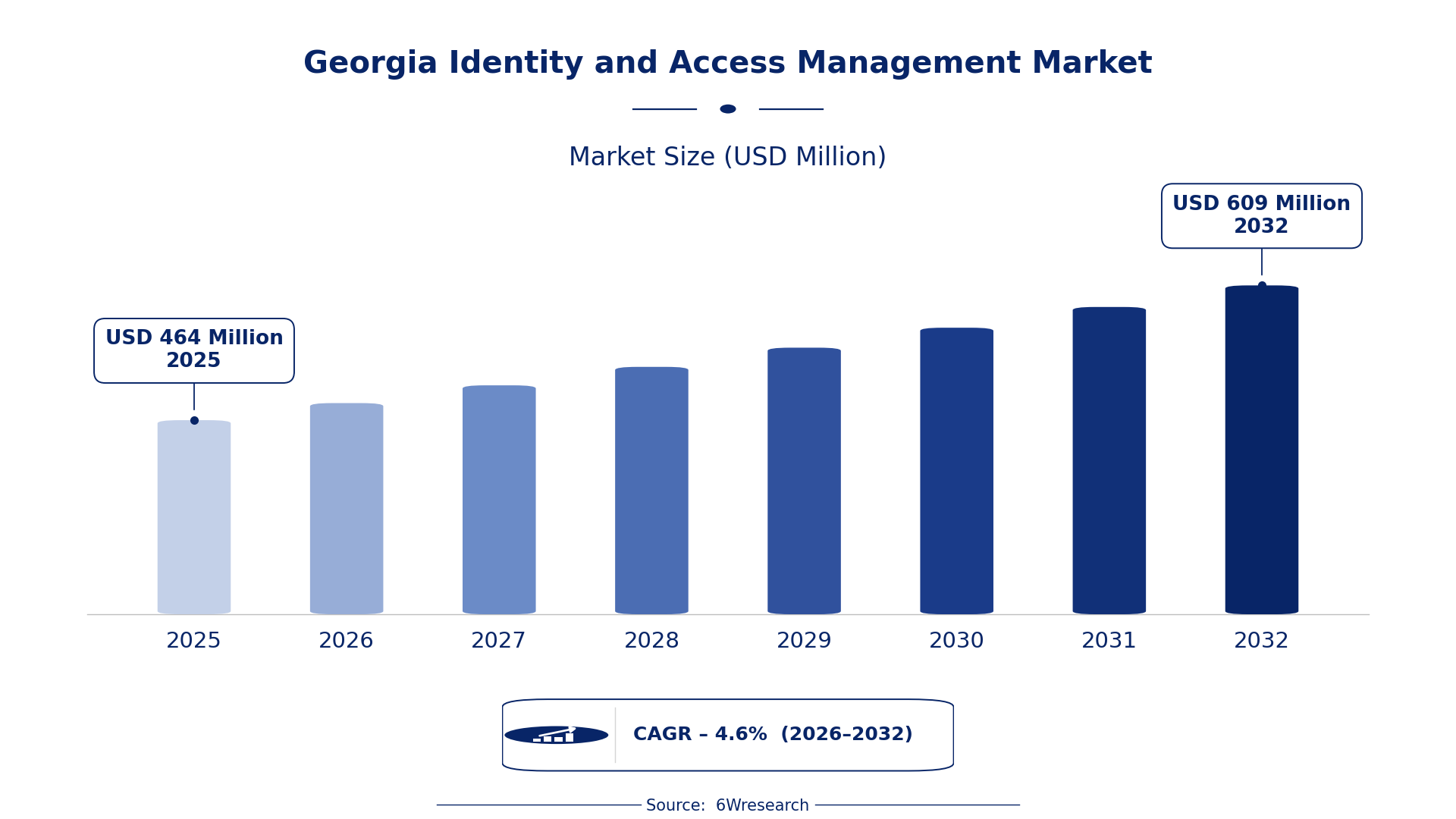
The Georgia Identity and Access Management Market was estimated at USD 464 Million in 2025 and is projected to reach USD 609 Million by 2032, growing at a CAGR of 4.6% from 2026 to 2032.
Georgia Identity and Access Management Market Synopsis
The demand for identity and access management (IAM) solutions in Georgia is surging, primarily fueled by a rapid shift towards cloud services and remote work practices. Organizations recognize that effective IAM is vital for protecting sensitive data and ensuring compliance with regulatory requirements.
Businesses across sectors are investing in IAM technologies like multi-factor authentication and identity governance. The focus on mobile-centric solutions is rising, reflecting the growing trend of supporting a distributed workforce, and highlighting the urgency for strong security measures.
Georgia Identity and Access Management Market Year-wise Growth Rate and Key Drivers
This graph illustrates the annual growth rates of the Georgia Identity and Access Management Market from 2021 to 2032, highlighting a steady upward trajectory and projected expansion over the forecast period.
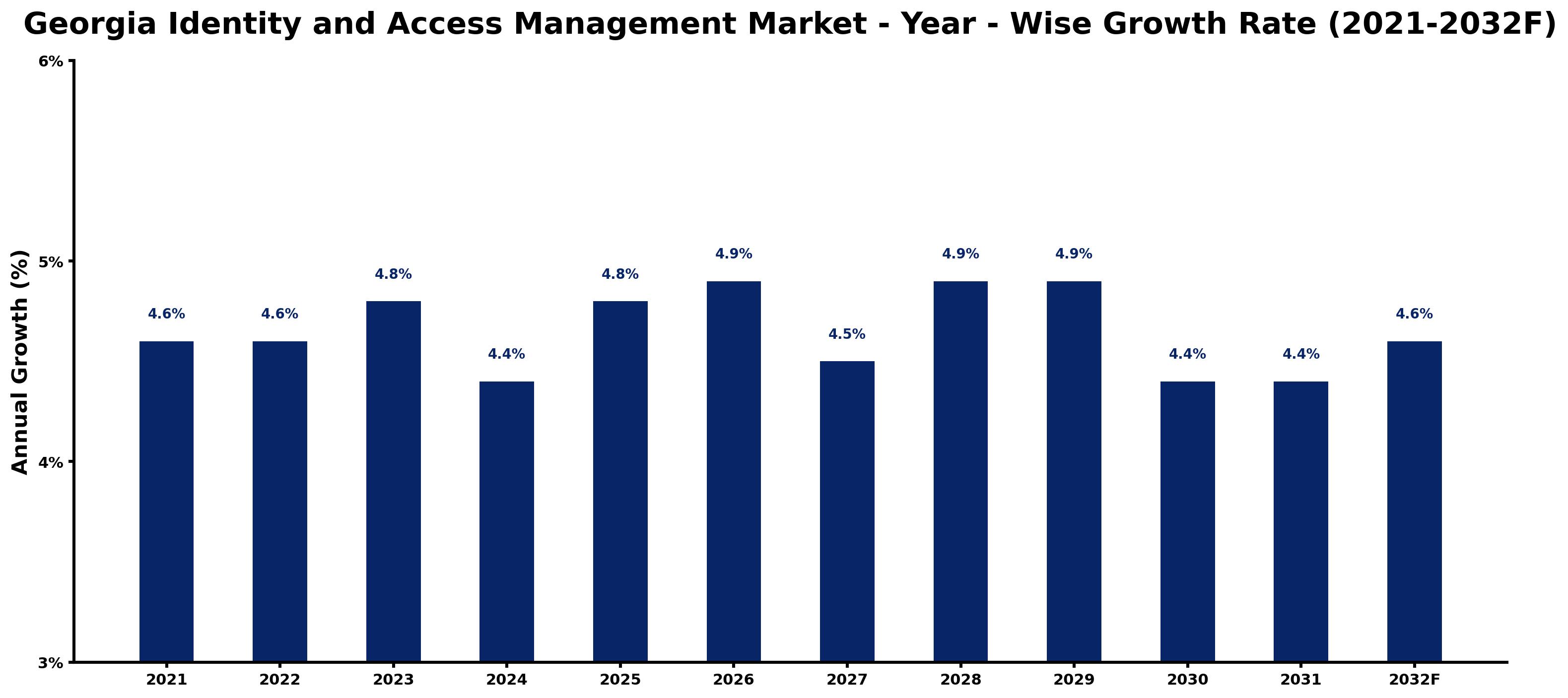
The table below presents the year‑wise growth rates along with the key drivers influencing the market
| Year | Growth Rate | Major Drivers |
| 2021 | 4.6% | Growing adoption of e-Government services by citizens |
| 2022 | 4.6% | Increased cybersecurity regulations from National Cyber Security Center |
| 2023 | 4.8% | Rise in digital banking services and KYC requirements |
| 2024 | 4.4% | Promotion of smart city initiatives by government policies |
| 2025 | 4.8% | Demand for biometric solutions in public sector projects |
| 2026 | 4.9% | Implementation of data protection laws enhancing ID verification |
| 2027 | 4.5% | Surge in online fraud cases prompting security upgrades |
| 2028 | 4.9% | Growing awareness of data privacy among consumers |
| 2029 | 4.9% | Support for digital identity frameworks from international organizations |
| 2030 | 4.4% | Partnerships with tech companies for innovative ID solutions |
| 2031 | 4.4% | Increased remote work driving need for identity management |
| 2032 | 4.6% | Focus on seamless customer experiences in digital transactions |
Note: Market size estimations and growth projections presented in this report are based on 6Wresearch's proprietary forecasting methodology, utilizing the latest available industry data, government publications, and primary research inputs.
Georgia Identity and Access Management Market Key Takeaways
Below are some of the specific key takeaways from the market, including:
- The market is increasingly driven by the need for advanced security measures against rising cyber threats.
- Organizations are prioritizing cloud-based IAM solutions to accommodate remote work and compliance demands.
- Multi-factor and biometric authentication are becoming standard as businesses enhance their IAM strategies.
- Regulatory pressures are prompting a proactive approach to data protection and identity management.
- Investment opportunities are emerging for IAM vendors offering innovative, scalable solutions tailored to specific business needs.
Evaluation of Restraints in Georgia Identity and Access Management Market
Despite its growth, the Georgia IAM market grapples with multiple constraints. A notable challenge is the escalating cybersecurity threats that leave organizations vulnerable to breaches. Many businesses struggle to strike a balance between stringent security protocols and user convenience, which can result in oversights.
Compounding this issue is the rapid pace of technology advancements, necessitating continuous investment in IAM systems. Additionally, interoperability issues among various IAM solutions can hinder integration, while many small to medium-sized enterprises remain unaware of the critical importance of robust IAM systems.
Georgia Identity and Access Management Market Trends
A clear trend within the Georgia IAM market is the move towards cloud-based solutions. As organizations increasingly rely on cloud environments, IAM solutions must evolve accordingly. The ongoing push for Zero Trust security models is indicative of a shift in how companies view access management, demanding more granular controls.
User experience has also gained prominence, with businesses seeking IAM solutions that simplify access management processes while maintaining security standards. The integration of emerging technologies such as AI and machine learning further enhances the ability to adapt to new threats and streamline IAM functionalities.
Georgia Identity and Access Management Market Opportunities
The evolving landscape presents a wealth of investment opportunities for stakeholders within Georgia's IAM market. The heightened adoption of cloud computing and a growing reliance on digital infrastructures mean businesses are actively seeking comprehensive IAM solutions.
Investors are well-positioned to capitalize on this demand by focusing on firms that provide innovative offerings, particularly in biometric and multi-factor authentication technologies. The remote work model is here to stay, further solidifying the need for accessible and secure IAM solutions tailored to various organizational requirements.
Government Initiatives in the Georgia Identity and Access Management Market
Government policies in Georgia are increasingly shaping the IAM market, focusing on bolstering cybersecurity and protecting sensitive data. The regulatory environment is evolving to demand compliance, prompting organizations to adopt comprehensive IAM solutions to align with these standards.
- A recently completed initiative includes the Georgia Data Protection Act, which sets forth regulations for safeguarding personal information.
- Currently underway is the expansion of IAM solutions across public sector agencies to meet compliance and security needs.
- Planned initiatives for the upcoming year include a framework aimed at enhancing public-private partnerships in cybersecurity, promoting better IAM practices across industries.
- State-sponsored workshops are being organized to increase awareness about IAM importance among small and medium enterprises, currently in progress throughout Georgia.
Future Insights of the Georgia Identity and Access Management Market
Looking ahead, the Georgia IAM market is anticipated to grow steadily through 2026-2032. As digital transformation efforts continue, organizations will increasingly prioritize robust identity and access management to protect their digital assets and adhere to stringent regulatory frameworks.
The emphasis on advanced authentication methods will become more pronounced, as enterprises strive to enhance their cybersecurity posture. An ongoing evolution in user experience will also drive the development of IAM solutions, ensuring that organizations can efficiently manage access while mitigating risks.
Georgia Identity and Access Management Market Latest Developments
In the last year, significant activity has emerged within the Georgia IAM market, reflecting a commitment to addressing cybersecurity needs. Organizations are increasingly recognizing the importance of adopting IAM solutions to safeguard against evolving threats.
- A major technology vendor launched a comprehensive IAM solution tailored for the healthcare sector in early 2025, focusing on compliance and data protection.
- Currently ongoing is a partnership between local government agencies and cybersecurity firms to enhance IAM capabilities across public services, initiated in mid-2025.
- A rollout of a new IAM platform designed for educational institutions is planned to begin in Q3 2025, aiming to streamline user access management.
- By late 2025, a regional operator expects to complete a project to integrate advanced biometric authentication into their existing IAM systems.
Georgia Identity and Access Management Market - Key Attractiveness of the Report
- 10 Years of Market Numbers
- Historical Data Starting from 2022 to 2025
- Base Year: 2025
- Forecast Data until 2032
- Key Performance Indicators Impacting the Market
- Major Upcoming Developments and Projects
Key Highlights of the Report:
- Georgia Identity and Access Management Market Outlook
- Market Size of Georgia Identity and Access Management Market, 2025
- Forecast of Georgia Identity and Access Management Market, 2032
- Historical Data and Forecast of Georgia Identity and Access Management Revenues & Volume for the Period 2022-2032F
- Georgia Identity and Access Management Market Trend Evolution
- Georgia Identity and Access Management Market Drivers and Challenges
- Georgia Identity and Access Management Price Trends
- Georgia Identity and Access Management Porter's Five Forces
- Georgia Identity and Access Management Industry Life Cycle
- Historical Data and Forecast of Georgia Identity and Access Management Market Revenues & Volume By Component for the Period 2022-2032F
- Historical Data and Forecast of Georgia Identity and Access Management Market Revenues & Volume By Solutions for the Period 2022-2032F
- Historical Data and Forecast of Georgia Identity and Access Management Market Revenues & Volume By Services for the Period 2022-2032F
- Historical Data and Forecast of Georgia Identity and Access Management Market Revenues & Volume By Solution for the Period 2022-2032F
- Historical Data and Forecast of Georgia Identity and Access Management Market Revenues & Volume By Data Directory for the Period 2022-2032F
- Historical Data and Forecast of Georgia Identity and Access Management Market Revenues & Volume By Identity Lifecycle Management for the Period 2022-2032F
- Historical Data and Forecast of Georgia Identity and Access Management Market Revenues & Volume By Deployment Mode for the Period 2022-2032F
- Historical Data and Forecast of Georgia Identity and Access Management Market Revenues & Volume By Cloud for the Period 2022-2032F
- Historical Data and Forecast of Georgia Identity and Access Management Market Revenues & Volume By On-premises for the Period 2022-2032F
- Historical Data and Forecast of Georgia Identity and Access Management Market Revenues & Volume By Organization Size for the Period 2022-2032F
- Historical Data and Forecast of Georgia Identity and Access Management Market Revenues & Volume By SMEs for the Period 2022-2032F
- Historical Data and Forecast of Georgia Identity and Access Management Market Revenues & Volume By Large Enterprises for the Period 2022-2032F
- Historical Data and Forecast of Georgia Identity and Access Management Market Revenues & Volume By Vertical for the Period 2022-2032F
- Historical Data and Forecast of Georgia Identity and Access Management Market Revenues & Volume By BFSI for the Period 2022-2032F
- Historical Data and Forecast of Georgia Identity and Access Management Market Revenues & Volume By Travel and Hospitality for the Period 2022-2032F
- Historical Data and Forecast of Georgia Identity and Access Management Market Revenues & Volume By Healthcare for the Period 2022-2032F
- Historical Data and Forecast of Georgia Identity and Access Management Market Revenues & Volume By Retail and eCommerce for the Period 2022-2032F
- Historical Data and Forecast of Georgia Identity and Access Management Market Revenues & Volume By IT and ITeS for the Period 2022-2032F
- Historical Data and Forecast of Georgia Identity and Access Management Market Revenues & Volume By Education for the Period 2022-2032F
- Historical Data and Forecast of Georgia Identity and Access Management Market Revenues & Volume By Others (Energy and Utilities, Telecommunication, Other Citizen Services) for the Period 2022-2032F
- Georgia Identity and Access Management Import Export Trade Statistics
- Market Opportunity Assessment By Component
- Market Opportunity Assessment By Solution
- Market Opportunity Assessment By Deployment Mode
- Market Opportunity Assessment By Organization Size
- Market Opportunity Assessment By Vertical
- Georgia Identity and Access Management Top Companies Market Share
- Georgia Identity and Access Management Competitive Benchmarking By Technical and Operational Parameters
- Georgia Identity and Access Management Company Profiles
- Georgia Identity and Access Management Key Strategic Recommendations






































