Georgia Natural Fragrance Market Size, Share & Growth Rate
The Georgia Natural Fragrance Market was estimated at USD 868 Million in 2025 and is projected to reach USD 1248 Million by 2032, growing at a CAGR of 5.3% from 2026 to 2032. This impressive growth trajectory is primarily fueled by a shift in consumer preferences towards eco-friendly products, alongside a growing awareness of the health benefits associated with natural ingredients. As consumers increasingly demand transparency and sustainability, manufacturers are innovating their offerings to meet these evolving expectations.
Georgia Natural Fragrance Market Year-wise Growth Rate and Key Drivers
This graph highlights how the Georgia Natural Fragrance Market has steadily grown over the years, supported by major growth factors.
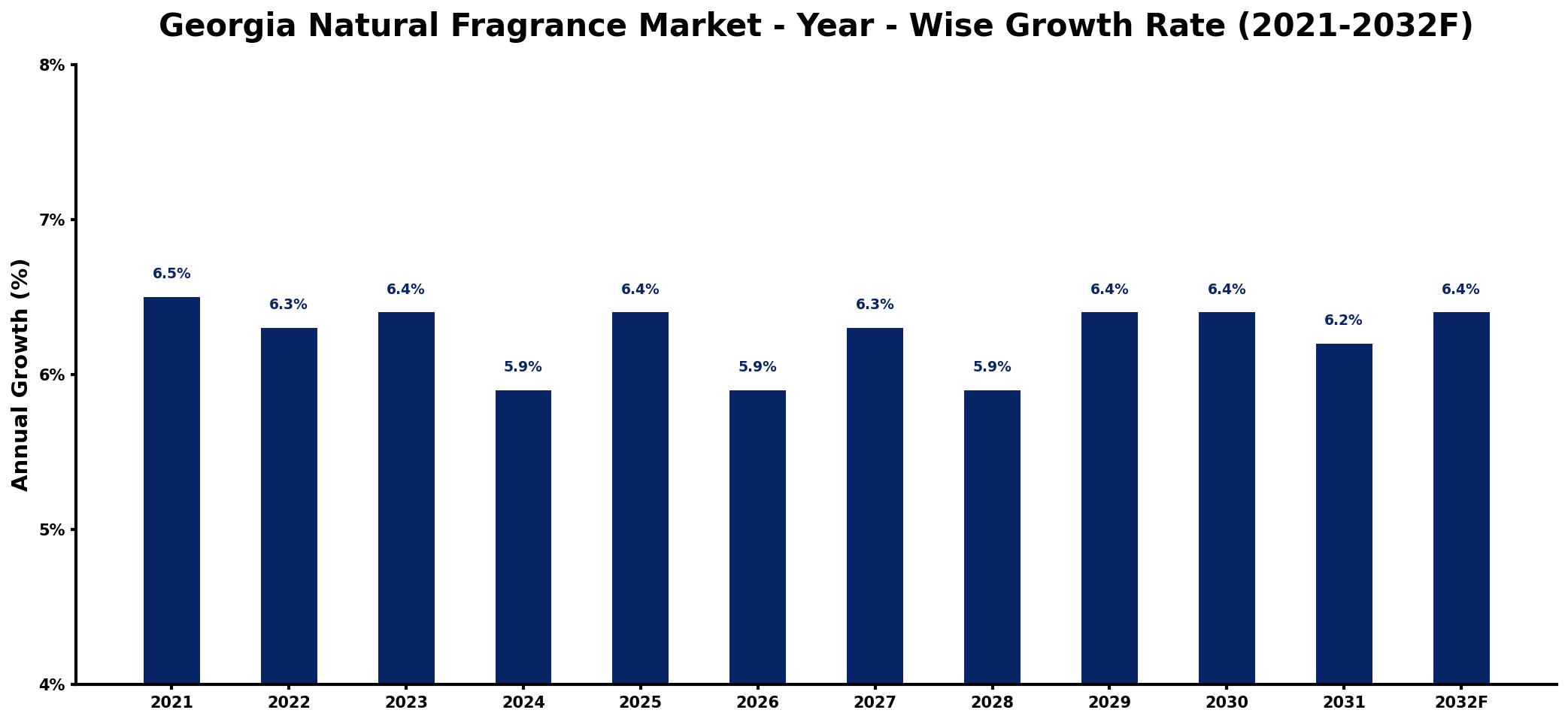
The table below presents the year‑wise growth rates along with the key drivers influencing the market
| Year | Growth Rate | Major Drivers |
| 2021 | 6.5% | Rising consumer health consciousness |
| 2022 | 6.3% | Innovative sustainable sourcing practices |
| 2023 | 6.4% | Increased eco-friendly product offerings |
| 2024 | 5.9% | Growing demand for organic ingredients |
| 2025 | 6.4% | Expansion of retail distribution channels |
| 2026 | 5.9% | Strengthened online shopping platforms |
| 2027 | 6.3% | Increased interest in artisanal products |
| 2028 | 5.9% | Emergence of new market players |
| 2029 | 6.4% | Enhanced consumer education initiatives |
| 2030 | 6.4% | Growth in wellness lifestyle trends |
| 2031 | 6.2% | Broader acceptance of ethical brands |
| 2032 | 6.4% | Investment in clean label products |
Note: Market size estimations and growth projections presented in this report are based on 6Wresearch's proprietary forecasting methodology, utilizing the latest available industry data, government publications, and primary research inputs.
Georgia Natural Fragrance Market Synopsis
The Georgia natural fragrance market is witnessing a notable increase in demand for products that emphasize clean, sustainable ingredients. Consumers are gravitating towards fragrances crafted from essential oils and plant extracts, which not only provide delightful scents but also align with their values surrounding health and environmental stewardship.
Additionally, the market is buoyed by a growing number of local brands embracing ethical sourcing practices and emphasizing clean label initiatives. This shift towards authenticity and quality in fragrance formulation is reshaping how consumers view personal care and cosmetics, thereby enhancing market potential.
Georgia Natural Fragrance Market Key Takeaways
- The market is responding dynamically to consumer demands for natural, chemical-free fragrance options.
- Innovations in product formulations are crucial for sustaining market growth and consumer trust.
- Competitive pressures from synthetic fragrances challenge market players to maintain transparency and authenticity.
- Government policies are increasingly supportive of sustainable practices in the fragrance sector.
- Educational initiatives are raising consumer awareness regarding natural fragrance benefits.
Evaluation of Restraints in Georgia Natural Fragrance Market
Despite its growth potential, the Georgia Natural Fragrance Market faces notable restraints primarily rooted in ingredient sourcing and formulation complexities. Manufacturers must carefully navigate the balance between sourcing sustainable and ethically derived materials and ensuring that their products meet rigorous performance standards. Furthermore, consumer concerns surrounding fragrance allergies and environmental impact necessitate ongoing adaptation in product development. These factors, coupled with the intense competition from synthetic alternatives and the demand for clear and authentic labeling, create a challenging landscape for market participants.
Georgia Natural Fragrance Market Trends
Current trends highlight a significant shift towards multi-functional products within the natural fragrance sector, where consumers seek fragrances that not only smell good but also offer additional wellness benefits. Furthermore, there is an increasing reliance on technological advancements in formulation techniques that enhance product stability while ensuring natural authenticity. The rise of e-commerce platforms for fragrance sales is also reshaping how consumers discover and purchase natural fragrances, further fueling market demand.
Georgia Natural Fragrance Market Opportunities
The Georgia Natural Fragrance Market presents genuine opportunities for growth, particularly in the areas of personal care and household products. As consumer interest in bespoke and niche fragrances rises, brands can capitalize on this trend by offering personalized options that reflect individual preferences. Additionally, there is a significant potential for product development aimed at specific consumer segments, such as vegan or cruelty-free options, which align with a broader trend towards ethical consumption.
Government Initiatives in the Georgia Natural Fragrance Market
In response to the burgeoning demand for natural and sustainable products, the Georgia government has implemented supportive policies designed to bolster the natural fragrance market. This includes regulatory frameworks that establish certification standards for natural fragrances, alongside incentives to encourage sustainable sourcing practices among manufacturers. Furthermore, public education initiatives aim to increase consumer awareness about the benefits and options available within the natural fragrance sector.
Future Insights of the Georgia Natural Fragrance Market
Looking ahead to 2026-2032, the Georgia Natural Fragrance Market is poised for robust growth driven by an expanding consumer base that prioritizes health, wellness, and sustainability. As innovation in fragrance formulation continues to evolve, brands that embrace transparency and ethical sourcing will likely emerge as leaders. Additionally, as consumers become more educated about the environmental impact of their purchasing choices, the demand for genuinely natural and sustainably produced fragrances will remain strong.
Georgia Natural Fragrance Market Latest Developments (2025 - 2026)
Recent developments in the Georgia natural fragrance sector indicate an increased focus on sustainability and innovation. Many manufacturers are prioritizing new methods of sourcing ingredients, emphasizing traceability and ethical practices. Additionally, collaborations between brands and local farmers for ingredient cultivation have gained traction, reinforcing the commitment to local economies while enhancing product authenticity. Educational programs aimed at both retailers and consumers are increasingly shaping buying decisions, promoting natural options over synthetic alternatives.
Georgia Natural Fragrance Market - Key Attractiveness of the Report
- 10 Years of Market Numbers
- Historical Data Starting from 2022 to 2025
- Base Year: 2025
- Forecast Data until 2032
- Key Performance Indicators Impacting the Market
- Major Upcoming Developments and Projects
Key Highlights of the Report:
- Georgia Natural Fragrance Market Outlook
- Market Size of Georgia Natural Fragrance Market, 2025
- Forecast of Georgia Natural Fragrance Market, 2032
- Historical Data and Forecast of Georgia Natural Fragrance Revenues & Volume for the Period 2022-2032F
- Georgia Natural Fragrance Market Trend Evolution
- Georgia Natural Fragrance Market Drivers and Challenges
- Georgia Natural Fragrance Price Trends
- Georgia Natural Fragrance Porter's Five Forces
- Georgia Natural Fragrance Industry Life Cycle
- Historical Data and Forecast of Georgia Natural Fragrance Market Revenues & Volume By Ingredient for the Period 2022-2032F
- Historical Data and Forecast of Georgia Natural Fragrance Market Revenues & Volume By Essential Oils for the Period 2022-2032F
- Historical Data and Forecast of Georgia Natural Fragrance Market Revenues & Volume By Natural Extracts for the Period 2022-2032F
- Historical Data and Forecast of Georgia Natural Fragrance Market Revenues & Volume By Type for the Period 2022-2032F
- Historical Data and Forecast of Georgia Natural Fragrance Market Revenues & Volume By Top note for the Period 2022-2032F
- Historical Data and Forecast of Georgia Natural Fragrance Market Revenues & Volume By Middle Note for the Period 2022-2032F
- Historical Data and Forecast of Georgia Natural Fragrance Market Revenues & Volume By Base Note for the Period 2022-2032F
- Historical Data and Forecast of Georgia Natural Fragrance Market Revenues & Volume By Application for the Period 2022-2032F
- Historical Data and Forecast of Georgia Natural Fragrance Market Revenues & Volume By Fine Fragrances for the Period 2022-2032F
- Historical Data and Forecast of Georgia Natural Fragrance Market Revenues & Volume By Personal Care & Cosmetics for the Period 2022-2032F
- Historical Data and Forecast of Georgia Natural Fragrance Market Revenues & Volume By Household Care for the Period 2022-2032F
- Georgia Natural Fragrance Import Export Trade Statistics
- Market Opportunity Assessment By Ingredient
- Market Opportunity Assessment By Type
- Market Opportunity Assessment By Application
- Georgia Natural Fragrance Top Companies Market Share
- Georgia Natural Fragrance Competitive Benchmarking By Technical and Operational Parameters
- Georgia Natural Fragrance Company Profiles
- Georgia Natural Fragrance Key Strategic Recommendations






































