Georgia Ploughing and Cultivating Machinery Market Size, Share & Growth Rate
The Georgia Ploughing and Cultivating Machinery Market was estimated at USD 279 Million in 2025 and is projected to reach USD 369 Million by 2032, growing at a CAGR of 4.1% from 2026 to 2032. This upward trajectory is primarily fueled by the increasing mechanization of agriculture in Georgia, alongside the adoption of precision farming techniques. Farmers are striving to improve productivity and efficiency, making sophisticated machinery not just an option, but a necessity in their operations.
Georgia Ploughing and Cultivating Machinery Market Year-wise Growth Rate and Key Drivers
This graph highlights how the Georgia Ploughing and Cultivating Machinery Market has steadily grown over the years, supported by major growth factors.
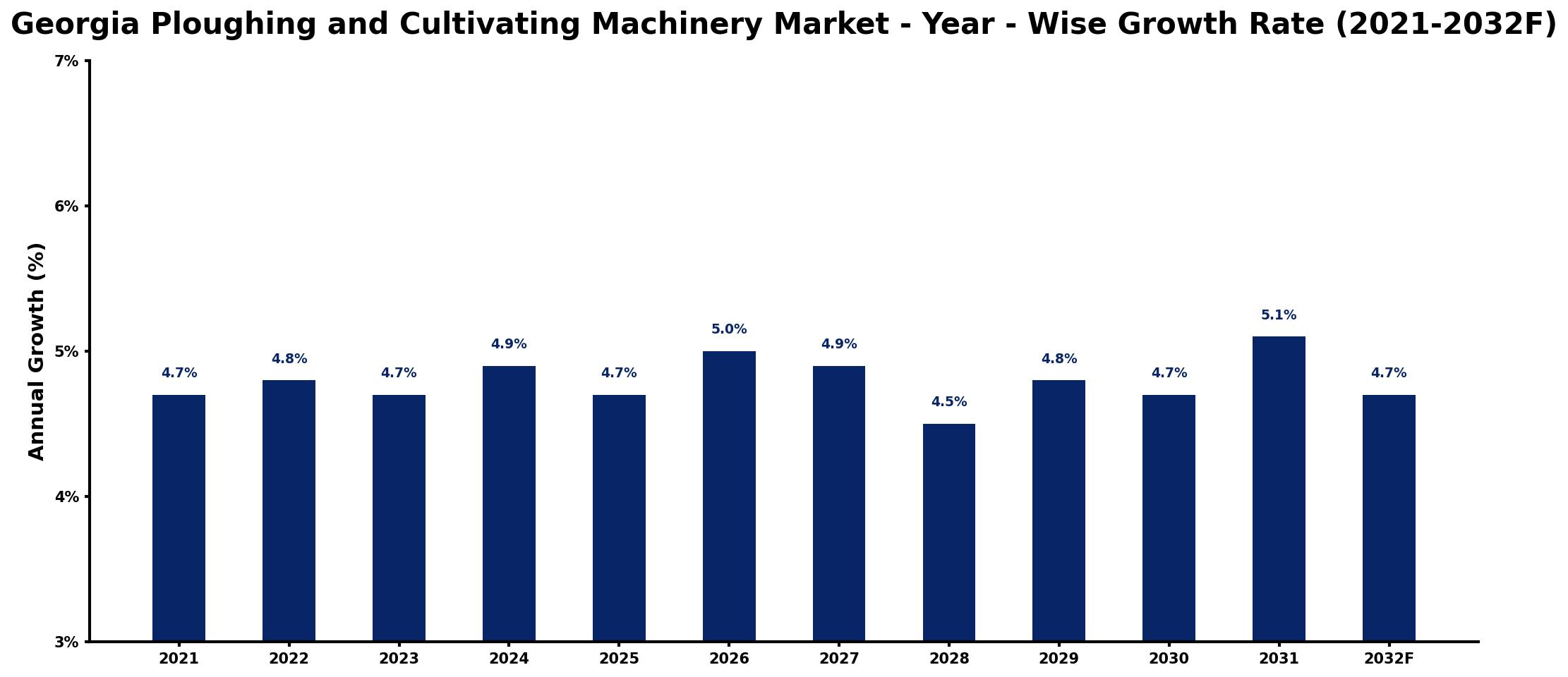
The table below presents the year‑wise growth rates along with the key drivers influencing the market
| Year | Growth Rate | Major Drivers |
| 2021 | 4.7% | Increased agricultural technology adoption |
| 2022 | 4.8% | Rising demand for sustainable practices |
| 2023 | 4.7% | Expansion of precision farming techniques |
| 2024 | 4.9% | Growing interest in automation solutions |
| 2025 | 4.7% | Investment in rural infrastructure projects |
| 2026 | 5.0% | Surge in eco-friendly farming initiatives |
| 2027 | 4.9% | Higher crop yield expectations emerging |
| 2028 | 4.5% | Diversification of agricultural investments |
| 2029 | 4.8% | Increased urban agriculture opportunities |
| 2030 | 4.7% | Strengthening of supply chain networks |
| 2031 | 5.1% | Enhanced government agricultural incentives |
| 2032 | 4.7% | Growing consumer health consciousness |
Note: Market size estimations and growth projections presented in this report are based on 6Wresearch's proprietary forecasting methodology, utilizing the latest available industry data, government publications, and primary research inputs.
Georgia Ploughing and Cultivating Machinery Market Synopsis
The Georgia Ploughing and Cultivating Machinery Market has witnessed significant momentum recently, marked by a growing emphasis on technological innovation and efficiency. However, the future of this market is poised for even greater transformation, driven by advancements in precision agriculture and government initiatives supporting modernization.
As the agricultural sector in Georgia adapts to contemporary challenges, there is a notable shift towards eco-friendly practices and machinery that support sustainable farming. This evolving landscape is pushing manufacturers to introduce equipment that minimizes soil disturbance, thereby meeting the dual demands of productivity and environmental stewardship.
Georgia Ploughing and Cultivating Machinery Market Key Takeaways
- The market is projected to grow from USD 279 Million in 2025 to USD 369 Million by 2032.
- Innovation and technology integration are crucial in driving market expansion and efficiency.
- Sustainability is becoming a key focus, shaping product development and consumer preferences.
- Government policies are increasingly supporting the adoption of advanced agricultural technologies.
- Precision agriculture tools are on the rise, significantly impacting operational effectiveness.
Evaluation of Restraints in Georgia Ploughing and Cultivating Machinery Market
Despite promising growth prospects, the Georgia Ploughing and Cultivating Machinery Market faces several real constraints. Intense competition among manufacturers, coupled with rapid technological advancements, necessitates continuous innovation to keep up with market demands. Furthermore, fluctuating raw material prices can affect production costs and lead to market volatility. The availability of skilled labor for operating modern machinery poses another challenge, with many farmers needing ongoing training to effectively utilize advanced equipment. These factors create a complex environment that manufacturers and stakeholders must navigate carefully.
Georgia Ploughing and Cultivating Machinery Market Trends
Current trends within the Georgia Ploughing and Cultivating Machinery Market indicate a strong shift towards automation and digitization. Farmers are increasingly adopting GPS-guided tractors and automated systems designed for ploughing and cultivation, allowing for enhanced precision and reduced labor costs. Additionally, the focus on conservation tillage practices reflects a growing awareness of environmental impact, prompting manufacturers to design equipment that minimizes soil disturbance while maintaining productivity. The incorporation of data analytics and IoT technology is further revolutionizing farming by providing real-time insights that facilitate informed decision-making.
Georgia Ploughing and Cultivating Machinery Market Opportunities
The Georgia Ploughing and Cultivating Machinery Market is ripe with investment opportunities, largely due to the region's strong agricultural foundation and ongoing mechanization trends. Investors can explore avenues in manufacturing advanced machinery tailored to meet the diverse needs of local crop cultivation. There is also significant potential in technology-driven solutions, particularly in precision agriculture tools that enhance efficiency. Collaborating with local agricultural organizations and engaging in government initiatives aimed at modernizing farming practices can further position investors to capitalize on this growing market demand.
Government Initiatives in the Georgia Ploughing and Cultivating Machinery Market
Government initiatives play a crucial role in shaping the Georgia Ploughing and Cultivating Machinery Market. Policies are focused on promoting agricultural modernization, which includes financial incentives for farmers to adopt advanced machinery. Training programs designed to enhance the skill sets of agricultural workers ensure that they can effectively operate and maintain modern equipment. Moreover, regulatory frameworks are in place to uphold safety and quality standards, fostering a competitive and sustainable agricultural sector.
Future Insights of the Georgia Ploughing and Cultivating Machinery Market
Looking ahead to the period from 2026 to 2032, the Georgia Ploughing and Cultivating Machinery Market is expected to thrive. Factors such as escalating mechanization, heightened efficiency demands, and progressive government policies will drive this growth. The integration of smart technologies, including AI and IoT in agricultural machinery, will further enhance operational productivity. As the market embraces these advancements, an increased focus on sustainable farming practices will likely influence product development, steering the sector towards a more eco-friendly future.
Georgia Ploughing and Cultivating Machinery Market Latest Developments (2025 - 2026)
Recently, the industry has been witnessing substantial shifts towards automation and smart technologies in ploughing and cultivating machinery. Developments have included the introduction of sophisticated farming equipment incorporating data analytics for real-time operational insights. Additionally, partnerships between agricultural organizations and machinery manufacturers have emerged, aiming to enhance training programs for farmers. These initiatives are helping to bridge the gap between technology and practical farming needs, making advanced machinery more accessible and user-friendly.
Georgia Ploughing and Cultivating Machinery Market - Key Attractiveness of the Report
- 10 Years of Market Numbers
- Historical Data Starting from 2022 to 2025
- Base Year: 2025
- Forecast Data until 2032
- Key Performance Indicators Impacting the Market
- Major Upcoming Developments and Projects
Key Highlights of the Report:
- Georgia Ploughing and Cultivating Machinery Market Outlook
- Market Size of Georgia Ploughing and Cultivating Machinery Market, 2025
- Forecast of Georgia Ploughing and Cultivating Machinery Market, 2032
- Historical Data and Forecast of Georgia Ploughing and Cultivating Machinery Revenues & Volume for the Period 2022-2032F
- Georgia Ploughing and Cultivating Machinery Market Trend Evolution
- Georgia Ploughing and Cultivating Machinery Market Drivers and Challenges
- Georgia Ploughing and Cultivating Machinery Price Trends
- Georgia Ploughing and Cultivating Machinery Porter's Five Forces
- Georgia Ploughing and Cultivating Machinery Industry Life Cycle
- Historical Data and Forecast of Georgia Ploughing and Cultivating Machinery Market Revenues & Volume By Type for the Period 2022-2032F
- Historical Data and Forecast of Georgia Ploughing and Cultivating Machinery Market Revenues & Volume By Ploughs for the Period 2022-2032F
- Historical Data and Forecast of Georgia Ploughing and Cultivating Machinery Market Revenues & Volume By Harrows for the Period 2022-2032F
- Historical Data and Forecast of Georgia Ploughing and Cultivating Machinery Market Revenues & Volume By Others for the Period 2022-2032F
- Historical Data and Forecast of Georgia Ploughing and Cultivating Machinery Market Revenues & Volume By Application for the Period 2022-2032F
- Historical Data and Forecast of Georgia Ploughing and Cultivating Machinery Market Revenues & Volume By Soil Loosening for the Period 2022-2032F
- Historical Data and Forecast of Georgia Ploughing and Cultivating Machinery Market Revenues & Volume By Clod Size Reduction for the Period 2022-2032F
- Historical Data and Forecast of Georgia Ploughing and Cultivating Machinery Market Revenues & Volume By Clod Sorting for the Period 2022-2032F
- Historical Data and Forecast of Georgia Ploughing and Cultivating Machinery Market Revenues & Volume By Others for the Period 2022-2032F
- Georgia Ploughing and Cultivating Machinery Import Export Trade Statistics
- Market Opportunity Assessment By Type
- Market Opportunity Assessment By Application
- Georgia Ploughing and Cultivating Machinery Top Companies Market Share
- Georgia Ploughing and Cultivating Machinery Competitive Benchmarking By Technical and Operational Parameters
- Georgia Ploughing and Cultivating Machinery Company Profiles
- Georgia Ploughing and Cultivating Machinery Key Strategic Recommendations






































