Georgia Polio Vaccine Market Size, Share & Growth Rate
The Georgia Polio Vaccine Market was estimated at USD 182 Million in 2025 and is projected to reach USD 240 Million by 2032, growing at a CAGR of 4.0% from 2026 to 2032. This growth trajectory is underscored by the government's robust commitment to vaccination initiatives and heightened awareness surrounding polio prevention. Ongoing efforts to enhance immunization accessibility, particularly in underserved areas, coupled with public health campaigns emphasizing the importance of vaccination, are vital drivers propelling this market forward.
Georgia Polio Vaccine Market Year-wise Growth Rate and Key Drivers
This graph highlights how the Georgia Polio Vaccine Market has steadily grown over the years, supported by major growth factors.
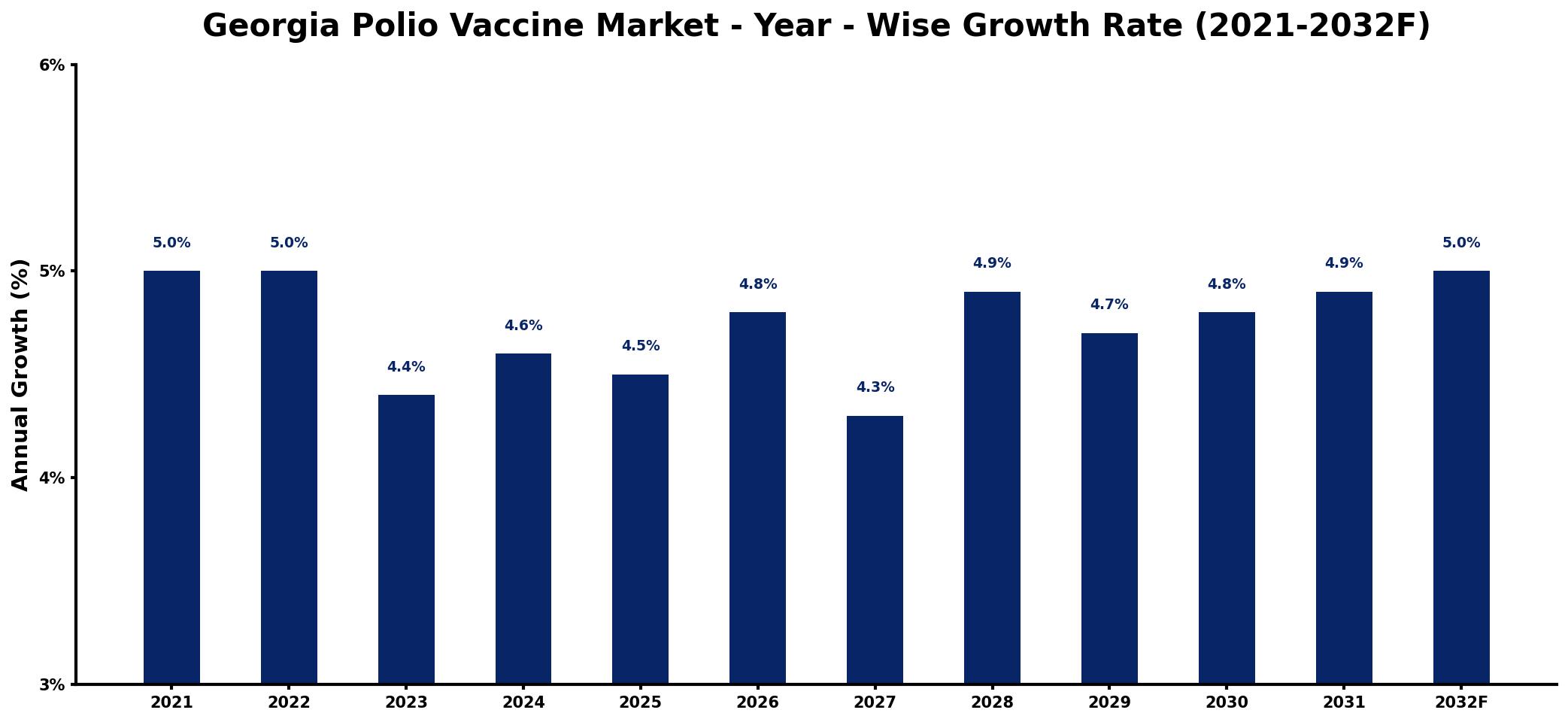
The table below presents the year‑wise growth rates along with the key drivers influencing the market
| Year | Growth Rate | Major Drivers |
| 2021 | 5.0% | Increased public health awareness campaigns |
| 2022 | 5.0% | Rising government healthcare investments |
| 2023 | 4.4% | Growing demand for preventive healthcare |
| 2024 | 4.6% | Expansion of healthcare infrastructure projects |
| 2025 | 4.5% | Surge in international health collaborations |
| 2026 | 4.8% | Enhanced distribution network efficiencies |
| 2027 | 4.3% | Boost in community health initiatives |
| 2028 | 4.9% | Greater access to healthcare services |
| 2029 | 4.7% | Increased funding for research initiatives |
| 2030 | 4.8% | rising demand from electronics |
| 2031 | 4.9% | Strengthened partnerships with NGOs |
| 2032 | 5.0% | Rising global health security concerns |
Note: Market size estimations and growth projections presented in this report are based on 6Wresearch's proprietary forecasting methodology, utilizing the latest available industry data, government publications, and primary research inputs.
Georgia Polio Vaccine Market Synopsis
The recent momentum in the Georgia polio vaccine market reflects a concentrated push towards achieving full immunization coverage. However, the landscape is rapidly evolving, as the demand for vaccines remains underpinned by global eradication initiatives and local public health strategies. Looking ahead, the market is poised to expand, driven by continuous advocacy for vaccination and the maintenance of high vaccination rates.
Despite recent successes in vaccination rates, Georgia faces challenges related to access and vaccine hesitancy that could temper future growth. Nevertheless, the strong governmental policies and community engagement programs are strategically aligned to overcome these hurdles, thereby solidifying a more resilient market moving forward.
Georgia Polio Vaccine Market Key Takeaways
- The Georgia polio vaccine market is projected to reach USD 240 Million by 2032, indicating strong growth opportunities.
- Government-led initiatives play a pivotal role in driving vaccination rates and combating misinformation.
- Community engagement and awareness campaigns are essential in addressing vaccine hesitancy.
- Logistical challenges and healthcare infrastructure disparities are key factors influencing market dynamics.
- International collaborations enhance the sustainability and supply chain of vaccines in the region.
Evaluation of Restraints in Georgia Polio Vaccine Market
The Georgia polio vaccine market grapples with significant restraints that can impede growth. One primary concern is the immunization coverage in remote and underserved regions, where logistical barriers prevent consistent access to vaccines. This disparity is compounded by existing gaps in healthcare infrastructure, which can lead to uneven distribution and delays in vaccination programs. Moreover, vaccine hesitancy fueled by misinformation poses a critical challenge, necessitating effective public outreach efforts and targeted educational campaigns to build trust within communities.
Georgia Polio Vaccine Market Trends
Current trends in the Georgia polio vaccine market indicate a growing reliance on technology to enhance vaccine distribution and tracking. Digital platforms are increasingly employed to monitor immunization rates and manage supply chains, allowing for better resource allocation. Additionally, an uptick in public awareness campaigns reflects a strategic shift towards educating the population about the importance of vaccination, thus combating misinformation and encouraging higher participation in vaccination programs.
Georgia Polio Vaccine Market Opportunities
There are significant opportunities for growth and investment within the Georgia polio vaccine market. Enhancing partnerships with international organizations can bolster vaccine supply chains and ensure timely access to immunizations across diverse populations. Furthermore, engaging local communities through outreach programs can strengthen public trust and increase participation rates. Investing in innovative distribution methods and educational campaigns could address logistical challenges while fostering a culture of vaccination that empowers community health.
Government Initiatives in the Georgia Polio Vaccine Market
The government of Georgia prioritizes public health through various initiatives aimed at eradicating polio. Policies focus on implementing routine immunization programs, conducting widespread vaccination campaigns, and engaging in public awareness efforts to promote vaccine uptake. Collaborations with international organizations and local healthcare providers further reinforce these strategies, ensuring a sustainable supply of polio vaccines and addressing barriers to access across different demographics. Comprehensive governmental support is essential to eliminate the risk of poliovirus transmission within Georgia.
Future Insights of the Georgia Polio Vaccine Market
As the Georgia polio vaccine market progresses toward 2032, the emphasis will likely shift towards optimizing vaccination strategies and improving infrastructure. Enhanced surveillance and monitoring systems will be critical for identifying gaps in coverage and ensuring timely intervention. Additionally, the potential for innovative vaccine technologies may further elevate immunization efforts, making them more effective and accessible. The commitment to education and community engagement will remain fundamental in maintaining high vaccination rates and moving closer to eradication goals.
Georgia Polio Vaccine Market Latest Developments (2025 - 2026)
Recent developments in the Georgia polio vaccine market highlight the proactive measures taken to bolster vaccination efforts. Increased funding for public health campaigns has been observed, focusing on outreach in remote communities. Additionally, partnerships between the government and international health organizations are becoming more pronounced, aimed at addressing supply chain challenges and improving vaccine distribution networks. Efforts to educate the public about vaccine safety and efficacy are also being prioritized to combat hesitancy and misinformation.
Georgia Polio Vaccine Market - Key Attractiveness of the Report
- 10 Years of Market Numbers
- Historical Data Starting from 2022 to 2025
- Base Year: 2025
- Forecast Data until 2032
- Key Performance Indicators Impacting the Market
- Major Upcoming Developments and Projects
Key Highlights of the Report:
- Georgia Polio Vaccine Market Outlook
- Market Size of Georgia Polio Vaccine Market, 2025
- Forecast of Georgia Polio Vaccine Market, 2032
- Historical Data and Forecast of Georgia Polio Vaccine Revenues & Volume for the Period 2022-2032F
- Georgia Polio Vaccine Market Trend Evolution
- Georgia Polio Vaccine Market Drivers and Challenges
- Georgia Polio Vaccine Price Trends
- Georgia Polio Vaccine Porter's Five Forces
- Georgia Polio Vaccine Industry Life Cycle
- Historical Data and Forecast of Georgia Polio Vaccine Market Revenues & Volume By Type for the Period 2022-2032F
- Historical Data and Forecast of Georgia Polio Vaccine Market Revenues & Volume By Oral Polio Vaccine (OPV) for the Period 2022-2032F
- Historical Data and Forecast of Georgia Polio Vaccine Market Revenues & Volume By Inactivated Poliomyelitis Vaccine (IPV) for the Period 2022-2032F
- Historical Data and Forecast of Georgia Polio Vaccine Market Revenues & Volume By Application for the Period 2022-2032F
- Historical Data and Forecast of Georgia Polio Vaccine Market Revenues & Volume By Public for the Period 2022-2032F
- Historical Data and Forecast of Georgia Polio Vaccine Market Revenues & Volume By Private for the Period 2022-2032F
- Georgia Polio Vaccine Import Export Trade Statistics
- Market Opportunity Assessment By Type
- Market Opportunity Assessment By Application
- Georgia Polio Vaccine Top Companies Market Share
- Georgia Polio Vaccine Competitive Benchmarking By Technical and Operational Parameters
- Georgia Polio Vaccine Company Profiles
- Georgia Polio Vaccine Key Strategic Recommendations






































