Georgia Radioactive Waste Management Market Size, Share & Growth Rate
The Georgia Radioactive Waste Management Market was estimated at USD 270 Million in 2025 and is projected to reach USD 368 Million by 2032, growing at a CAGR of 4.5% from 2026 to 2032. This growth is primarily driven by the increasing regulatory pressure on medical, industrial, and research facilities to ensure safe handling and disposal of radioactive waste. The operation of nuclear facilities within the state necessitates advanced waste management strategies, further propelling investment in innovative disposal technologies and processes.
Georgia Radioactive Waste Management Market Year-wise Growth Rate and Key Drivers
This graph highlights how the Georgia Radioactive Waste Management Market has steadily grown over the years, supported by major growth factors.
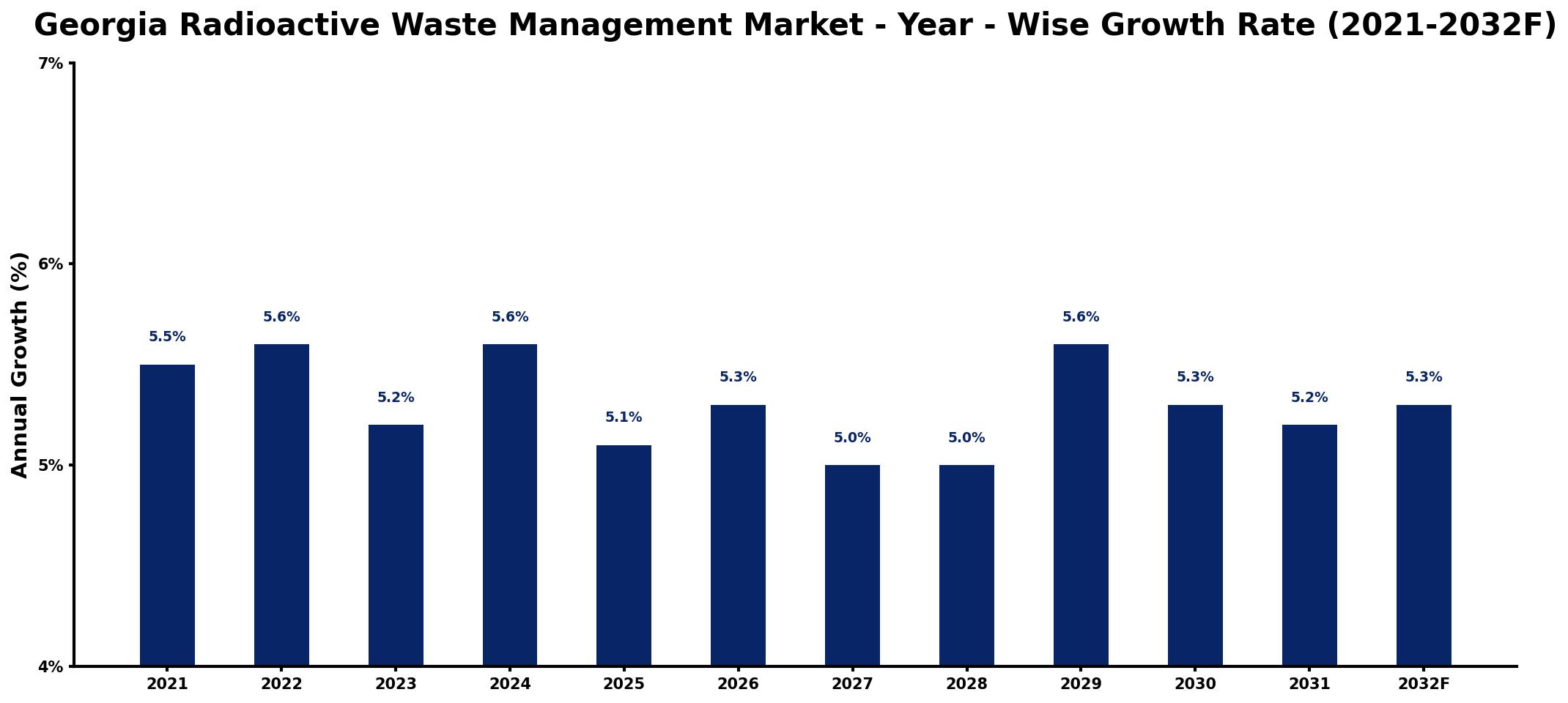
The table below presents the year‑wise growth rates along with the key drivers influencing the market
| Year | Growth Rate | Major Drivers |
| 2021 | 5.5% | Increased regulatory compliance requirements |
| 2022 | 5.6% | Expansion of renewable energy initiatives |
| 2023 | 5.2% | Growth in environmental sustainability focus |
| 2024 | 5.6% | Rising investments in infrastructure development |
| 2025 | 5.1% | Increased public awareness campaigns |
| 2026 | 5.3% | Technological advancements in recycling |
| 2027 | 5.0% | Emerging markets for disposal solutions |
| 2028 | 5.0% | Strengthening partnerships with stakeholders |
| 2029 | 5.6% | Enhanced safety protocols implementation |
| 2030 | 5.3% | Growing demand for innovative solutions |
| 2031 | 5.2% | Strengthened community engagement initiatives |
| 2032 | 5.3% | increased production capacity utilization |
Note: Market size estimations and growth projections presented in this report are based on 6Wresearch's proprietary forecasting methodology, utilizing the latest available industry data, government publications, and primary research inputs.
Georgia Radioactive Waste Management Market Synopsis
The need for effective radioactive waste management in Georgia is underscored by the active nuclear power plants and various research institutions in the region. These facilities generate significant amounts of radioactive waste, which must be managed in compliance with stringent regulations.
Moreover, public awareness and concern regarding environmental protection continue to shape the landscape of waste management. As such, service providers are increasingly prioritizing transparency and sustainability in their operations to enhance community trust and acceptance.
Georgia Radioactive Waste Management Market Key Takeaways
- The market is primarily driven by regulatory compliance and safety standards established for radioactive waste management.
- Advanced waste treatment technologies are gaining traction as organizations seek innovative solutions.
- Public perception significantly influences the establishment and operation of radioactive waste management facilities.
- Government policies aimed at environmental protection are shaping market dynamics and opportunities.
- Investment in nuclear energy remains a key driver for the demand for effective waste management solutions.
Evaluation of Restraints in Georgia Radioactive Waste Management Market
Despite the positive growth trajectory, several restraints hinder the Georgia Radioactive Waste Management Market. One of the primary limitations is the challenge of securing public acceptance for new waste management facilities. The stigma associated with radioactive materials can complicate siting and permitting processes. Furthermore, compliance with stringent regulatory requirements demands a significant financial commitment from companies, which may limit investments in new technologies and services. The complexity of logistics involved in waste transportation and disposal adds another layer of operational challenge that market participants must navigate.
Georgia Radioactive Waste Management Market Trends
One of the prevailing trends in the Georgia Radioactive Waste Management Market is the increasing adoption of advanced technologies for waste processing and treatment. Innovations such as robotic handling systems and AI-powered monitoring tools are being integrated to enhance operational efficiency and safety. Additionally, there is a growing emphasis on sustainability practices, prompting companies to explore green alternatives in waste treatment methodologies. The push towards greater transparency and community engagement also reflects a trend towards more socially responsible waste management practices.
Georgia Radioactive Waste Management Market Opportunities
Investment opportunities within the Georgia Radioactive Waste Management Market are abundant, particularly in the realm of technological advancements. Companies focused on developing efficient and eco-friendly waste treatment methods stand to benefit as regulatory frameworks evolve. Furthermore, the expansion of nuclear energy initiatives in Georgia presents a ripe opportunity for service providers specializing in waste management to collaborate with energy producers. As the demand for decommissioning and remediation services increases, businesses can capitalize on these needs through targeted offerings.
Government Initiatives in the Georgia Radioactive Waste Management Market
Government policies play a critical role in shaping the Georgia Radioactive Waste Management Market. Regulatory agencies are actively establishing licensing requirements that govern the handling, storage, and disposal of radioactive waste. Initiatives aimed at environmental protection and waste remediation are driving demand for advanced waste management solutions. Public spending on infrastructure improvements in waste management facilities is also gaining traction, reflecting a commitment to enhancing safety and compliance within the industry.
Future Insights of the Georgia Radioactive Waste Management Market
Looking ahead to the years 2026-2032, the Georgia Radioactive Waste Management Market is poised for steady growth. The continued expansion of nuclear power facilities, alongside increasing regulatory scrutiny, will require robust waste management solutions. Companies that can successfully integrate cutting-edge technologies with transparent and responsible practices are likely to gain a competitive edge. Additionally, as public concerns over environmental safety evolve, the market will need to adapt to these shifts to maintain stakeholder trust and operational viability.
Georgia Radioactive Waste Management Market Latest Developments (2025 - 2026)
In recent months, there has been a notable push towards enhancing waste treatment processes in Georgia. Advances in technology are being leveraged to improve efficiency in the disposal and decommissioning of radioactive materials. Regulatory bodies are also tightening guidelines, prompting industry players to adapt their practices. Furthermore, community outreach initiatives are being implemented to foster public trust and educate citizens about safety measures concerning radioactive waste management.
Georgia Radioactive Waste Management Market - Key Attractiveness of the Report
- 10 Years of Market Numbers
- Historical Data Starting from 2022 to 2025
- Base Year: 2025
- Forecast Data until 2032
- Key Performance Indicators Impacting the Market
- Major Upcoming Developments and Projects
Key Highlights of the Report:
- Georgia Radioactive Waste Management Market Outlook
- Market Size of Georgia Radioactive Waste Management Market, 2025
- Forecast of Georgia Radioactive Waste Management Market, 2032F
- Historical Data and Forecast of Georgia Radioactive Waste Management Revenues & Volume for the Period 2022-2032F
- Georgia Radioactive Waste Management Market Trend Evolution
- Georgia Radioactive Waste Management Market Drivers and Challenges
- Georgia Radioactive Waste Management Price Trends
- Georgia Radioactive Waste Management Porter's Five Forces
- Georgia Radioactive Waste Management Industry Life Cycle
- Historical Data and Forecast of Georgia Radioactive Waste Management Market Revenues & Volume By Type for the Period 2022-2032F
- Historical Data and Forecast of Georgia Radioactive Waste Management Market Revenues & Volume By Exempt Waste and Very Low-Level Waste(VLLW) for the Period 2022-2032F
- Historical Data and Forecast of Georgia Radioactive Waste Management Market Revenues & Volume By Low-Level Waste(LLW) for the Period 2022-2032F
- Historical Data and Forecast of Georgia Radioactive Waste Management Market Revenues & Volume By Intermediate-Level Waste(ILW) for the Period 2022-2032F
- Historical Data and Forecast of Georgia Radioactive Waste Management Market Revenues & Volume By High-Level Waste(HLW) for the Period 2022-2032F
- Historical Data and Forecast of Georgia Radioactive Waste Management Market Revenues & Volume By Application for the Period 2022-2032F
- Historical Data and Forecast of Georgia Radioactive Waste Management Market Revenues & Volume By Industrial for the Period 2022-2032F
- Historical Data and Forecast of Georgia Radioactive Waste Management Market Revenues & Volume By Utility for the Period 2022-2032F
- Georgia Radioactive Waste Management Import Export Trade Statistics
- Market Opportunity Assessment By Type
- Market Opportunity Assessment By Application
- Georgia Radioactive Waste Management Top Companies Market Share
- Georgia Radioactive Waste Management Competitive Benchmarking By Technical and Operational Parameters
- Georgia Radioactive Waste Management Company Profiles
- Georgia Radioactive Waste Management Key Strategic Recommendations






































