Georgia Three Wheeler Market Size, Share & Growth Rate
The Georgia Three Wheeler Market was estimated at USD 191 Million in 2025 and is projected to reach USD 257 Million by 2032, growing at a CAGR of 4.3% from 2026 to 2032. This growth trajectory is fueled by a confluence of factors, including increasing urbanization, rising fuel prices, and an enhanced emphasis on environmentally friendly transportation solutions. Additionally, government incentives for electric vehicles are likely to bolster consumer interest and adoption rates, making three-wheelers an appealing choice for Georgia residents.
Georgia Three Wheeler Market Year-wise Growth Rate and Key Drivers
This graph highlights how the Georgia Three Wheeler Market has steadily grown over the years, supported by major growth factors.
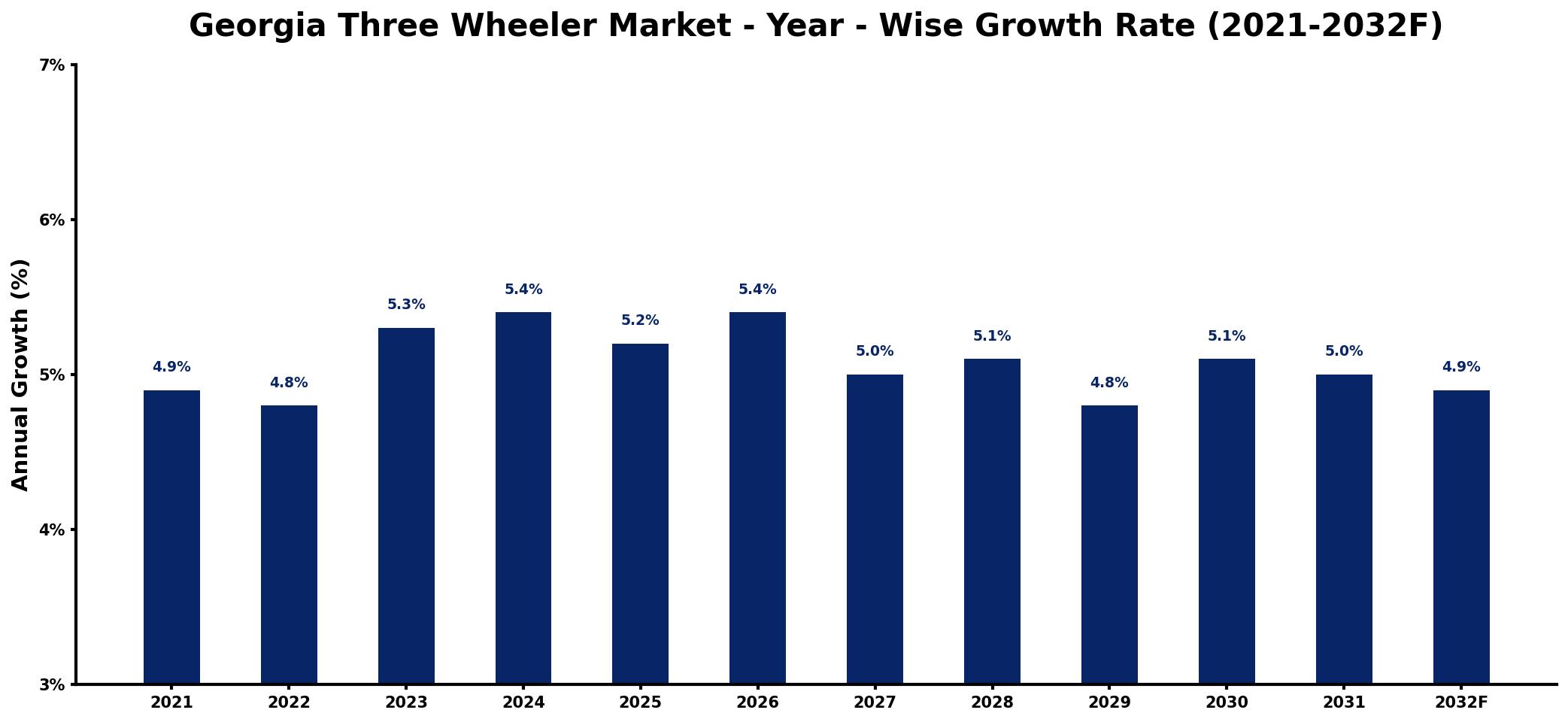
The table below presents the year‑wise growth rates along with the key drivers influencing the market
| Year | Growth Rate | Major Drivers |
| 2021 | 4.9% | Rising consumer preference for mobility |
| 2022 | 4.8% | Increased urbanization and congestion |
| 2023 | 5.3% | Growing demand for eco-friendly transport |
| 2024 | 5.4% | Expansion of ride-sharing services |
| 2025 | 5.2% | Investment in infrastructure improvements |
| 2026 | 5.4% | Technological advancements in design |
| 2027 | 5.0% | Surge in recreational vehicle popularity |
| 2028 | 5.1% | Enhanced fuel efficiency standards |
| 2029 | 4.8% | Growth in tourism and travel |
| 2030 | 5.1% | Increased focus on last-mile solutions |
| 2031 | 5.0% | Rising demand for compact vehicles |
| 2032 | 4.9% | enhanced product quality standards |
Note: Market size estimations and growth projections presented in this report are based on 6Wresearch's proprietary forecasting methodology, utilizing the latest available industry data, government publications, and primary research inputs.
Georgia Three Wheeler Market Synopsis
The strongest force shaping the Georgia Three Wheeler Market right now is the increasing demand for electric three-wheelers. With consumers becoming more environmentally conscious, these vehicles represent a sustainable alternative to traditional modes of transport. This shift is not just about eco-friendliness; it's also about practicality in densely populated urban environments where maneuverability and cost-effectiveness are highly valued.
Moreover, the market is evolving with advancements in technology and customization options. Manufacturers are responding to consumer preferences by offering enhanced features and personalized designs, catering to a growing demographic looking for both style and efficiency. The availability of online platforms for sales is further streamlining the purchasing process, making three-wheelers more accessible to a wider audience.
Georgia Three Wheeler Market Key Takeaways
- The market is expected to see robust growth driven by urbanization and rising fuel costs.
- Electric three-wheelers are gaining traction due to government incentives and environmental awareness.
- Customization and technology advancements are becoming key selling points for manufacturers.
- Infrastructure development, including charging stations, is crucial for future market expansion.
- Online sales platforms are changing the way consumers engage with and purchase three-wheelers.
Evaluation of Restraints in Georgia Three Wheeler Market
Despite its positive growth trajectory, the Georgia Three Wheeler Market faces several constraints. Limited consumer awareness remains a significant barrier, as many potential buyers still view traditional cars as the primary mode of transport. Regulatory hurdles, particularly regarding the classification and licensing of three-wheelers, create additional challenges that can deter manufacturers and consumers alike. Additionally, competition from alternative transportation options, such as electric scooters and bicycles, complicates the market landscape, making it essential for industry stakeholders to navigate these challenges effectively.
Georgia Three Wheeler Market Trends
Current trends in the Georgia Three Wheeler Market indicate a pronounced shift towards electric models, aligning with broader societal goals of sustainability and reduced emissions. Consumers are increasingly prioritizing eco-friendly options, leading manufacturers to enhance their electric offerings with improved battery life and performance. Furthermore, there's a noticeable demand for personalized vehicles, with customization options becoming a key focus in product development. The rise of e-commerce is also making three-wheelers more accessible, allowing customers to easily compare options and make informed purchasing decisions.
Georgia Three Wheeler Market Opportunities
Investment opportunities within the Georgia Three Wheeler Market are abundant. The growing appetite for electric three-wheelers creates a compelling case for manufacturers to expand their offerings. Additionally, there is significant potential in developing infrastructure, such as charging stations, which is essential for supporting the electric vehicle segment. Innovative financing solutions tailored specifically for three-wheelers could also help enhance consumer adoption rates, presenting another avenue for investment and growth within this burgeoning market.
Government Initiatives in the Georgia Three Wheeler Market
Government policies in Georgia are increasingly focused on promoting sustainable transportation solutions, particularly through incentives for electric vehicle purchases. Subsidies and tax breaks for consumers opting for electric three-wheelers are designed to encourage broader adoption. Moreover, regulations ensuring safety and quality standards for these vehicles play a critical role in shaping the market. The state also supports initiatives aimed at enhancing the efficiency and performance of three-wheelers through research and development funding, fostering a conducive environment for market growth.
Future Insights of the Georgia Three Wheeler Market
Looking ahead, the Georgia Three Wheeler Market is poised for substantial growth from 2026 to 2032, driven by an ongoing demand for affordable and eco-friendly transportation solutions. The trend towards electric vehicles is expected to accelerate, propelled by technological advancements in battery efficiency and charging infrastructure. Furthermore, as urban areas continue to expand, three-wheelers are likely to play an increasingly vital role in last-mile delivery and urban mobility, positioning them as a key component of future transportation strategies in Georgia.
Georgia Three Wheeler Market Latest Developments (2025 - 2026)
Recent developments in the Georgia Three Wheeler Market have showcased a growing commitment to innovation and sustainability. Manufacturers are unveiling new models that emphasize electric technology and consumer-driven features. Meanwhile, local governments are expanding infrastructure projects to improve charging accessibility, further promoting the adoption of electric three-wheelers. The trend of e-commerce platforms gaining traction is also influencing how vehicles are marketed and sold, reflecting a shift towards a more digital approach in the industry.
Georgia Three Wheeler Market - Key Attractiveness of the Report
- 10 Years of Market Numbers
- Historical Data Starting from 2022 to 2025
- Base Year: 2025
- Forecast Data until 2032
- Key Performance Indicators Impacting the Market
- Major Upcoming Developments and Projects
Key Highlights of the Report:
- Georgia Three Wheeler Market Outlook
- Market Size of Georgia Three Wheeler Market, 2025
- Forecast of Georgia Three Wheeler Market, 2032
- Historical Data and Forecast of Georgia Three Wheeler Revenues & Volume for the Period 2022-2032F
- Georgia Three Wheeler Market Trend Evolution
- Georgia Three Wheeler Market Drivers and Challenges
- Georgia Three Wheeler Price Trends
- Georgia Three Wheeler Porter's Five Forces
- Georgia Three Wheeler Industry Life Cycle
- Historical Data and Forecast of Georgia Three Wheeler Market Revenues & Volume By Fuel Type for the Period 2022-2032F
- Historical Data and Forecast of Georgia Three Wheeler Market Revenues & Volume By Petrol/CNG for the Period 2022-2032F
- Historical Data and Forecast of Georgia Three Wheeler Market Revenues & Volume By Diesel for the Period 2022-2032F
- Historical Data and Forecast of Georgia Three Wheeler Market Revenues & Volume By Electric for the Period 2022-2032F
- Historical Data and Forecast of Georgia Three Wheeler Market Revenues & Volume By Vehicle Type for the Period 2022-2032F
- Historical Data and Forecast of Georgia Three Wheeler Market Revenues & Volume By Passenger Carrier for the Period 2022-2032F
- Historical Data and Forecast of Georgia Three Wheeler Market Revenues & Volume By Load Carrier for the Period 2022-2032F
- Georgia Three Wheeler Import Export Trade Statistics
- Market Opportunity Assessment By Fuel Type
- Market Opportunity Assessment By Vehicle Type
- Georgia Three Wheeler Top Companies Market Share
- Georgia Three Wheeler Competitive Benchmarking By Technical and Operational Parameters
- Georgia Three Wheeler Company Profiles
- Georgia Three Wheeler Key Strategic Recommendations






































