Georgia Ultrasonic Cleaning Equipment Market Size, Share & Growth Rate
The Georgia Ultrasonic Cleaning Equipment Market was estimated at USD 284 Million in 2025 and is projected to reach USD 385 Million by 2032, growing at a CAGR of 4.4% from 2026 to 2032. This growth trajectory is fueled by increasing demand across various industries such as automotive, electronics, and healthcare, where precision cleaning is vital. Furthermore, the ongoing shift towards sustainable manufacturing practices has also intensified the focus on eco-friendly cleaning solutions, underscoring the market's positive outlook.
Georgia Ultrasonic Cleaning Equipment Market Year-wise Growth Rate and Key Drivers
This graph highlights how the Georgia Ultrasonic Cleaning Equipment Market has steadily grown over the years, supported by major growth factors.
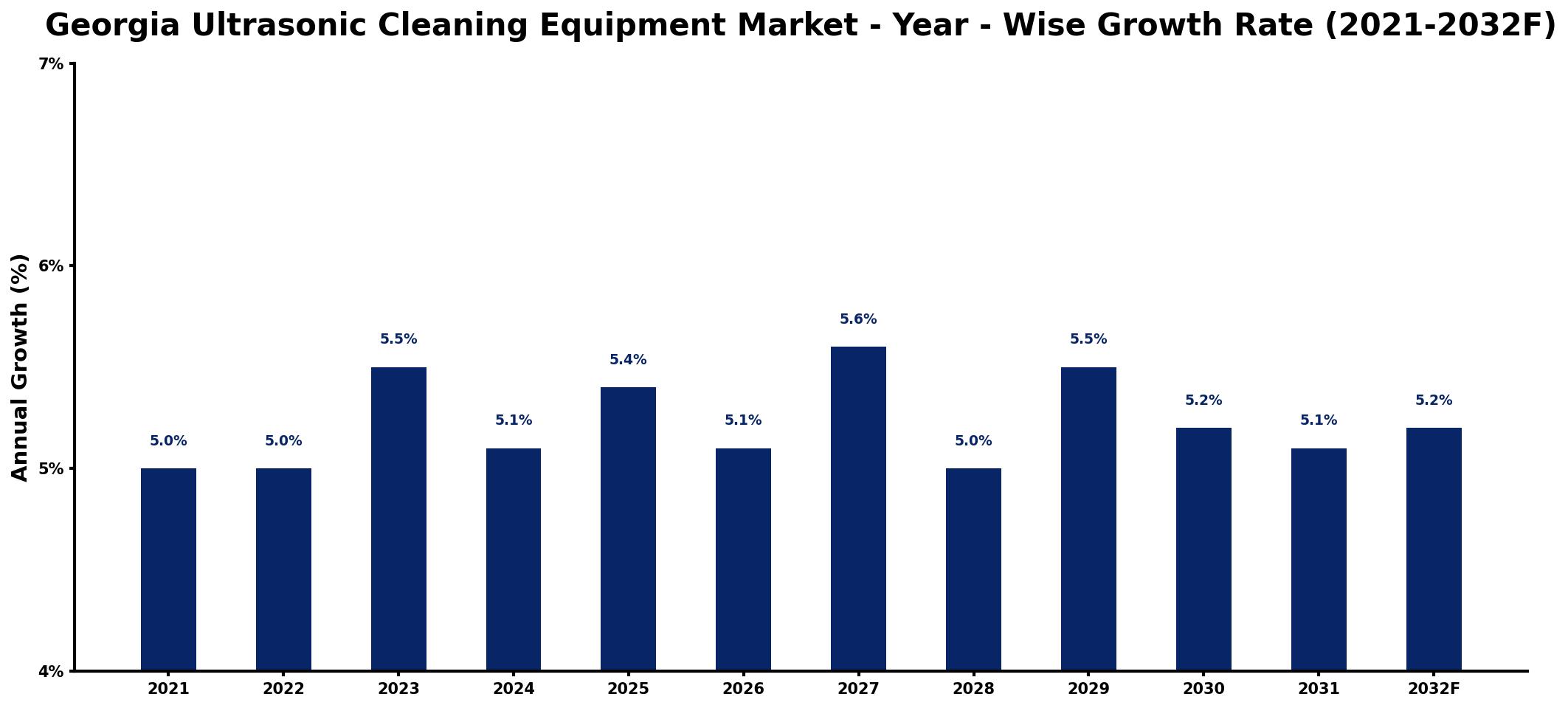
The table below presents the year‑wise growth rates along with the key drivers influencing the market
| Year | Growth Rate | Major Drivers |
| 2021 | 5.0% | Rising demand in automotive sector |
| 2022 | 5.0% | Increased investment in healthcare facilities |
| 2023 | 5.5% | Growth in industrial manufacturing applications |
| 2024 | 5.1% | Expansion of electronics recycling initiatives |
| 2025 | 5.4% | Surge in precision engineering requirements |
| 2026 | 5.1% | Boost in laboratory research funding |
| 2027 | 5.6% | Heightened focus on sustainability practices |
| 2028 | 5.0% | Growing popularity in jewelry sector |
| 2029 | 5.5% | Increase in dental hygiene standards |
| 2030 | 5.2% | Advancements in scientific research techniques |
| 2031 | 5.1% | Escalating demand for aerospace components |
| 2032 | 5.2% | Strengthened regulations on contamination control |
Note: Market size estimations and growth projections presented in this report are based on 6Wresearch's proprietary forecasting methodology, utilizing the latest available industry data, government publications, and primary research inputs.
Georgia Ultrasonic Cleaning Equipment Market Synopsis
The demand for ultrasonic cleaning systems in Georgia is increasingly driven by the automotive sector, where the need for meticulous component cleaning is critical to maintaining operational efficiency and product quality. Additionally, the healthcare industry is witnessing heightened adoption of ultrasonic cleaning equipment to ensure stringent sterilization processes, especially in surgical and diagnostic applications.
Supply chains have adapted to integrate advanced ultrasonic cleaning solutions, presenting opportunities for equipment manufacturers to innovate and expand their offerings. Customization options for different industrial applications are becoming a vital differentiator for businesses looking to meet specific client needs in cleaning efficiency and compatibility.
Georgia Ultrasonic Cleaning Equipment Market Key Takeaways
- The market is driven by growing demand for eco-friendly cleaning solutions across diverse sectors.
- Technological advancements in ultrasonic transducer technology enhance cleaning efficiency and customization.
- Government incentives support the adoption of sustainable cleaning technologies.
- Challenges related to equipment reliability and user training remain key considerations for market players.
- Precision cleaning remains a cornerstone of market expansion, particularly within automotive and healthcare applications.
Evaluation of Restraints in Georgia Ultrasonic Cleaning Equipment Market
Despite its promising growth, the Georgia Ultrasonic Cleaning Equipment Market faces several restraints. One major issue is ensuring material compatibility across various applications, which can complicate cleaning processes. Furthermore, concerns regarding cleaning validation and regulatory compliance create hurdles for businesses looking to adopt these technologies. The reliability of equipment, ongoing maintenance costs, and necessary user training add layers of complexity that can deter potential investors and users alike, affecting overall market uptake.
Georgia Ultrasonic Cleaning Equipment Market Trends
Emerging trends in the Georgia Ultrasonic Cleaning Equipment Market indicate a significant shift towards automation in cleaning processes. As industries embrace Industry 4.0, integrating ultrasonic cleaning systems with IoT capabilities allows for real-time monitoring and enhanced operational efficiency. Additionally, the focus on sustainability is leading to increased research on biodegradable cleaning solutions that can be utilized in conjunction with ultrasonic technology, aligning with global environmental standards.
Georgia Ultrasonic Cleaning Equipment Market Opportunities
The market offers genuine growth opportunities, particularly for companies that can leverage advancements in technology to provide innovative cleaning solutions. The healthcare sector, which demands high standards of cleanliness and sterilization, presents a lucrative avenue for tailored ultrasonic cleaning systems. Moreover, as businesses seek to comply with stringent environmental regulations, there is substantial potential for retrofitting existing facilities with modern ultrasonic cleaning equipment that meets eco-friendly standards.
Government Initiatives in the Georgia Ultrasonic Cleaning Equipment Market
The Georgian government is actively promoting the adoption of ultrasonic cleaning technologies through various incentives. These include tax credits for businesses investing in environmentally friendly solutions and subsidies aimed at retrofitting older industrial equipment with advanced ultrasonic systems. Furthermore, regulatory frameworks are being established to ensure compliance with environmental and occupational health standards, fostering a conducive environment for market growth.
Future Insights of the Georgia Ultrasonic Cleaning Equipment Market
Looking ahead to 2026-2032, the Georgia Ultrasonic Cleaning Equipment Market is poised for significant developments. The continuous evolution of cleaning technologies and heightened emphasis on sustainable practices are expected to drive the market forward. As industries increasingly recognize the benefits of ultrasonic cleaning, the integration of smart technologies and innovative applications will likely shape the future landscape, making it essential for stakeholders to adapt and invest in cutting-edge solutions.
Georgia Ultrasonic Cleaning Equipment Market Latest Developments (2025 - 2026)
Recent industry developments indicate a focused push towards enhancing the efficiency of ultrasonic cleaning systems. Companies are increasingly investing in R&D to improve transducer technology, aiming for better cleaning outcomes with lower energy consumption. Additionally, there is a notable trend in collaborative partnerships aimed at addressing unique industry needs, thereby fostering innovation within the ultrasonic cleaning equipment landscape.
Georgia Ultrasonic Cleaning Equipment Market - Key Attractiveness of the Report
- 10 Years of Market Numbers
- Historical Data Starting from 2022 to 2025
- Base Year: 2025
- Forecast Data until 2032
- Key Performance Indicators Impacting the Market
- Major Upcoming Developments and Projects
Key Highlights of the Report:
- Georgia Ultrasonic Cleaning Equipment Market Outlook
- Market Size of Georgia Ultrasonic Cleaning Equipment Market, 2025
- Forecast of Georgia Ultrasonic Cleaning Equipment Market, 2032F
- Historical Data and Forecast of Georgia Ultrasonic Cleaning Equipment Revenues & Volume for the Period 2022-2032F
- Georgia Ultrasonic Cleaning Equipment Market Trend Evolution
- Georgia Ultrasonic Cleaning Equipment Market Drivers and Challenges
- Georgia Ultrasonic Cleaning Equipment Price Trends
- Georgia Ultrasonic Cleaning Equipment Porter's Five Forces
- Georgia Ultrasonic Cleaning Equipment Industry Life Cycle
- Historical Data and Forecast of Georgia Ultrasonic Cleaning Equipment Market Revenues & Volume By Type for the Period 2022-2032F
- Historical Data and Forecast of Georgia Ultrasonic Cleaning Equipment Market Revenues & Volume By Standalone for the Period 2022-2032F
- Historical Data and Forecast of Georgia Ultrasonic Cleaning Equipment Market Revenues & Volume By Benchtop for the Period 2022-2032F
- Historical Data and Forecast of Georgia Ultrasonic Cleaning Equipment Market Revenues & Volume By Multistage for the Period 2022-2032F
- Historical Data and Forecast of Georgia Ultrasonic Cleaning Equipment Market Revenues & Volume By Application for the Period 2022-2032F
- Historical Data and Forecast of Georgia Ultrasonic Cleaning Equipment Market Revenues & Volume By Automotive for the Period 2022-2032F
- Historical Data and Forecast of Georgia Ultrasonic Cleaning Equipment Market Revenues & Volume By Healthcare for the Period 2022-2032F
- Historical Data and Forecast of Georgia Ultrasonic Cleaning Equipment Market Revenues & Volume By Electrical & Electronics for the Period 2022-2032F
- Historical Data and Forecast of Georgia Ultrasonic Cleaning Equipment Market Revenues & Volume By Aerospace & Defense for the Period 2022-2032F
- Historical Data and Forecast of Georgia Ultrasonic Cleaning Equipment Market Revenues & Volume By Others for the Period 2022-2032F
- Georgia Ultrasonic Cleaning Equipment Import Export Trade Statistics
- Market Opportunity Assessment By Type
- Market Opportunity Assessment By Application
- Georgia Ultrasonic Cleaning Equipment Top Companies Market Share
- Georgia Ultrasonic Cleaning Equipment Competitive Benchmarking By Technical and Operational Parameters
- Georgia Ultrasonic Cleaning Equipment Company Profiles
- Georgia Ultrasonic Cleaning Equipment Key Strategic Recommendations






































