Georgia Vetiver Oil Market Size, Share & Growth Rate
The Georgia Vetiver Oil Market was estimated at USD 1060 Million in 2025 and is projected to reach USD 1513 Million by 2032, growing at a CAGR of 5.2% from 2026 to 2032. This upward trajectory is fueled by the increasing consumer preference for natural and sustainable ingredients in the fragrance and cosmetics sectors. Moreover, the rising awareness of vetiver oil's therapeutic benefits and its diverse applications in aromatherapy and personal care are significant factors propelling market growth in Georgia.
Georgia Vetiver Oil Market Year-wise Growth Rate and Key Drivers
This graph highlights how the Georgia Vetiver Oil Market has steadily grown over the years, supported by major growth factors.
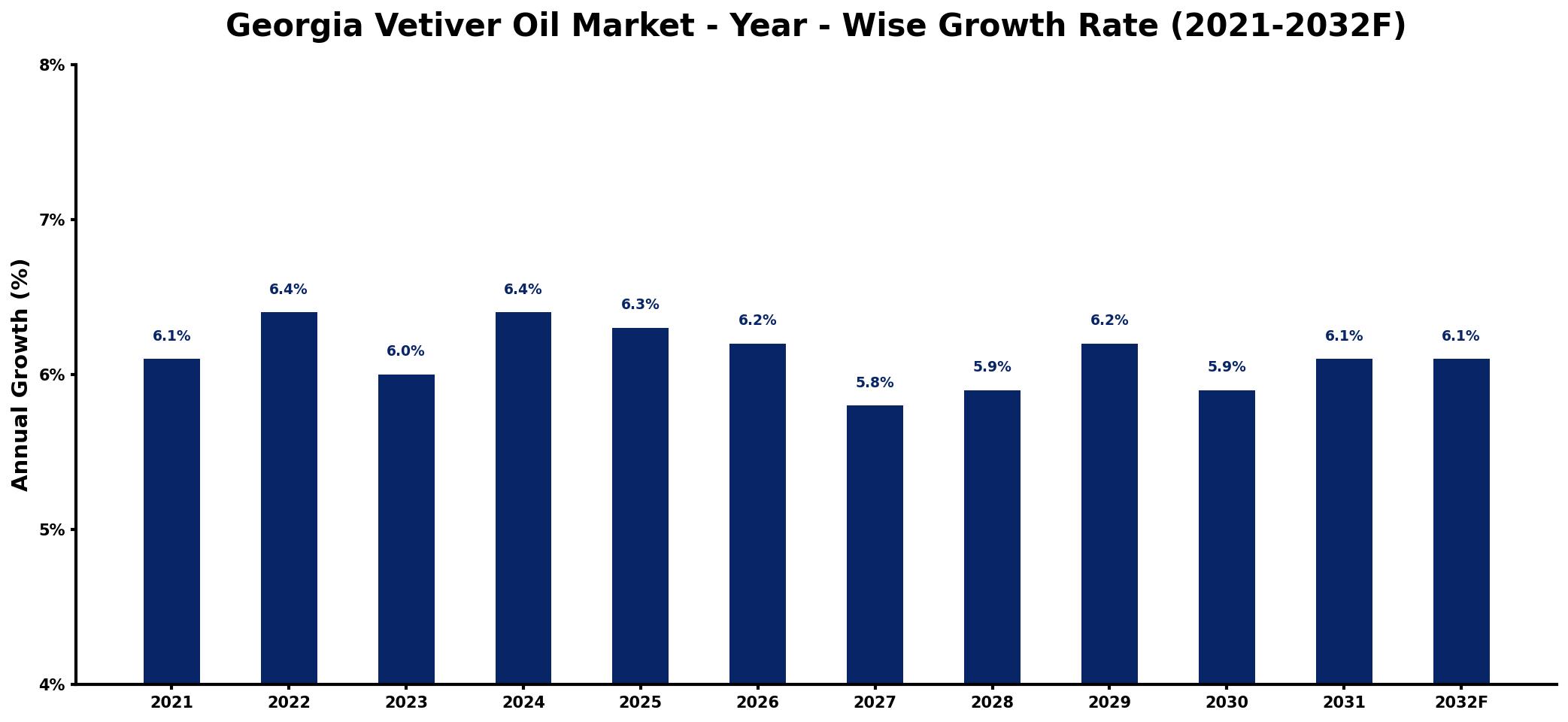
The table below presents the year‑wise growth rates along with the key drivers influencing the market
| Year | Growth Rate | Major Drivers |
| 2021 | 6.1% | Rising demand for natural fragrances |
| 2022 | 6.4% | Increased interest in aromatherapy practices |
| 2023 | 6.0% | Growth in wellness product sector |
| 2024 | 6.4% | Expansion of cosmetic industry usage |
| 2025 | 6.3% | Investments in sustainable agriculture practices |
| 2026 | 6.2% | Emerging markets adopting natural products |
| 2027 | 5.8% | Popularity of organic personal care |
| 2028 | 5.9% | rising export shipment volumes |
| 2029 | 6.2% | Surge in herbal product formulations |
| 2030 | 5.9% | Increasing consumer awareness of sustainability |
| 2031 | 6.1% | Development of innovative extraction techniques |
| 2032 | 6.1% | increased overall sector activity |
Note: Market size estimations and growth projections presented in this report are based on 6Wresearch's proprietary forecasting methodology, utilizing the latest available industry data, government publications, and primary research inputs.
Georgia Vetiver Oil Market Synopsis
Recent momentum in the Georgia vetiver oil market indicates a burgeoning interest in natural fragrances, aligning with global trends towards sustainability. However, as the market evolves, it faces competition from synthetic alternatives that could impact traditional sourcing practices.
Looking ahead, the Georgia vetiver oil market is poised for robust growth driven by innovative extraction methods and growing applications across various industries. These factors are expected to solidify Georgias position as a key player in the vetiver oil segment.
Georgia Vetiver Oil Market Key Takeaways
- The market is witnessing strong growth due to the shift towards natural and eco-friendly products.
- Consumer awareness of the therapeutic properties of vetiver oil is significantly influencing demand.
- Advancements in extraction and formulation technologies are enhancing product offerings.
- Government initiatives are supporting sustainable cultivation and quality assurance.
- Vetiver oil's versatility in applications continues to broaden its market appeal.
Evaluation of Restraints in Georgia Vetiver Oil Market
Despite the promising growth trajectory, the Georgia vetiver oil market faces certain restraints. One primary challenge is the dependence on climatic conditions for the cultivation of vetiver grass, which can lead to supply inconsistencies. Additionally, rising competition from synthetic fragrances may deter some consumers, particularly in price-sensitive segments. Concerns regarding sustainability practices and sourcing transparency further complicate market dynamics, requiring stakeholders to adapt to evolving consumer expectations.
Georgia Vetiver Oil Market Trends
Current trends in the Georgia vetiver oil market highlight a growing inclination towards aromatherapy and wellness products. Consumers are increasingly seeking holistic experiences, amplifying the demand for vetiver oil in therapeutic applications. Moreover, there is a marked trend towards eco-conscious consumerism, which is driving brands to emphasize natural sourcing and sustainable production practices. Technological advancements in extraction methods are also enhancing the purity and quality of vetiver oil, further boosting its appeal.
Georgia Vetiver Oil Market Opportunities
The market presents substantial opportunities for growth and investment, particularly in innovative product development. Brands that can leverage the unique properties of vetiver oil in new formulations are likely to thrive. Additionally, expanding into emerging markets and forging partnerships with eco-friendly brands could unlock new distribution channels. Increased research into the health benefits of vetiver oil may also lead to novel applications in wellness and personal care products.
Government Initiatives in the Georgia Vetiver Oil Market
The Georgia government is actively promoting sustainable cultivation practices in the vetiver oil sector. Initiatives include financial support for local farmers adopting eco-friendly methods and programs that encourage quality assurance standards. Furthermore, public spending on research and development is aimed at enhancing vetiver oil production efficiency and promoting the state's vetiver products on international platforms. These measures aim to bolster local economies and foster environmental conservation.
Future Insights of the Georgia Vetiver Oil Market
As we look towards 2026-2032, the Georgia vetiver oil market is expected to experience dynamic growth, supported by increased consumer awareness and demand for natural ingredients. With ongoing advancements in extraction technologies and formulation processes, product differentiation will likely enhance market competitiveness. Additionally, the focus on sustainable practices and local sourcing will continue to resonate with environmentally conscious consumers, creating a favorable landscape for further expansion.
Georgia Vetiver Oil Market Latest Developments (2025 - 2026)
In recent months, the Georgia vetiver oil market has witnessed significant industry movements. Stakeholders are increasingly collaborating to innovate extraction technologies that improve yield and quality. Moreover, there has been a notable uptick in consumer education campaigns aimed at highlighting the benefits of vetiver oil, particularly in aromatherapy and personal care. These efforts are enhancing the overall market visibility and driving demand across diverse consumer segments.
Georgia Vetiver Oil Market - Key Attractiveness of the Report
- 10 Years of Market Numbers
- Historical Data Starting from 2022 to 2025
- Base Year: 2025
- Forecast Data until 2032
- Key Performance Indicators Impacting the Market
- Major Upcoming Developments and Projects
Key Highlights of the Report:
- Georgia Vetiver Oil Market Outlook
- Market Size of Georgia Vetiver Oil Market, 2025
- Forecast of Georgia Vetiver Oil Market, 2032F
- Historical Data and Forecast of Georgia Vetiver Oil Revenues & Volume for the Period 2022-2032F
- Georgia Vetiver Oil Market Trend Evolution
- Georgia Vetiver Oil Market Drivers and Challenges
- Georgia Vetiver Oil Price Trends
- Georgia Vetiver Oil Porter's Five Forces
- Georgia Vetiver Oil Industry Life Cycle
- Historical Data and Forecast of Georgia Vetiver Oil Market Revenues & Volume By Application for the Period 2022-2032F
- Historical Data and Forecast of Georgia Vetiver Oil Market Revenues & Volume By Medical for the Period 2022-2032F
- Historical Data and Forecast of Georgia Vetiver Oil Market Revenues & Volume By Food & Beverage for the Period 2022-2032F
- Historical Data and Forecast of Georgia Vetiver Oil Market Revenues & Volume By Spa & Relaxation for the Period 2022-2032F
- Georgia Vetiver Oil Import Export Trade Statistics
- Market Opportunity Assessment By Application
- Georgia Vetiver Oil Top Companies Market Share
- Georgia Vetiver Oil Competitive Benchmarking By Technical and Operational Parameters
- Georgia Vetiver Oil Company Profiles
- Georgia Vetiver Oil Key Strategic Recommendations






































