Georgia Windows Market Summary
The georgia windows market was estimated at USD 174 Million in 2025 and is projected to reach USD 241 Million by 2032, growing at a CAGR of 5.4% from 2026 to 2032.
Georgia Windows Market Year-wise Growth Rate and Key Drivers
This graph highlights how the Georgia Windows Market has steadily grown over the past five years, supported by major growth factors.
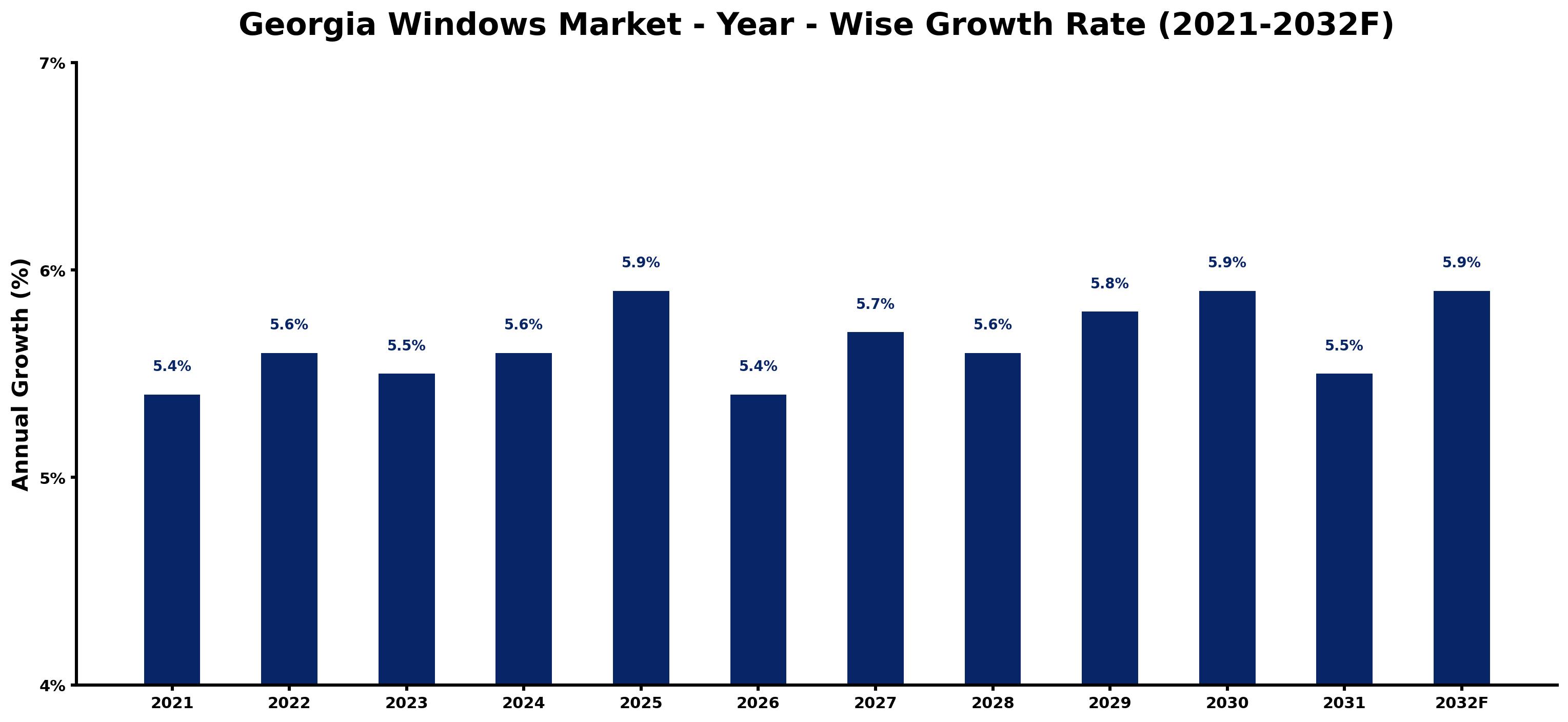
The table below presents the year wise growth rates along with the key drivers influencing the market
| Year | Growth Rate | Major Drivers |
| 2021 | 5.4% | Post-lockdown renovations prompted homeowners to invest in energy-efficient window solutions. |
| 2022 | 5.6% | Local construction booms led to significant demand for durable window installations statewide. |
| 2023 | 5.5% | Competitive pricing from manufacturers attracted more builders to upgrade window offerings. |
| 2024 | 5.6% | Emerging trends in smart home technology encouraged innovative window features and designs. |
| 2025 | 5.9% | Sustainability initiatives from corporations shifted focus toward eco-friendly window materials. |
| 2026 | 5.4% | Rising home value enhancements prompted homeowners to prioritize window upgrades for aesthetics. |
| 2027 | 5.7% | Urban development projects showcased new architectural designs, increasing window customization needs. |
| 2028 | 5.6% | Consumer awareness about energy savings fueled interest in high-performance window options. |
| 2029 | 5.8% | Technological collaborations among manufacturers led to groundbreaking window insulation technologies. |
| 2030 | 5.9% | Market consolidation among window suppliers resulted in improved product availability and variety. |
| 2031 | 5.5% | Shifts in consumer preferences favored large, panoramic windows to maximize natural light. |
| 2032 | 5.9% | A surge in residential smart home installations created a niche for integrated window systems. |
Note - Market size estimations and growth projections presented in this report are based on 6Wresearch's advanced forecasting approach, validated with industry datasets as of June 2026.
Georgia Windows Market Synopsis
The Georgia Windows Market is projected to reach 5.4% and witness significant growth during the forecast period (2026-2032). This dynamic market encompasses the sales and installation of windows tailored for residential, commercial, and institutional buildings, emphasizing energy efficiency, durability, and aesthetic appeal.
Georgia Windows Market Growth Drivers
Several factors are driving the expansion of the Georgia Windows Market. First and foremost, the surge in new construction projects is a significant contributor, as both residential and commercial developments require innovative window solutions to meet modern aesthetic and performance standards. The ongoing renovation activities further bolster market demand, as homeowners and businesses alike seek to upgrade their existing windows for improved energy efficiency.
- The increase in housing construction reflects a robust real estate market, which necessitates the installation of energy-efficient windows that comply with contemporary building regulations.
- Renovation trends are shifting towards energy-saving solutions as consumers aim to reduce their utility bills, spurring demand for high-performance window options.
- Technological advancements in window manufacturing and glazing have made it possible to offer products that not only enhance thermal insulation but also incorporate modern aesthetic elements.
- The rising consumer awareness regarding sustainability is influencing purchasing decisions, as individuals actively seek eco-friendly window solutions that contribute to lower carbon footprints.
- Architectural designs increasingly favor large windows for natural light and ventilation, thus driving the need for sophisticated window systems that can fulfill these demands.
Georgia Windows Market Trends and Opportunities
The Georgia Windows Market is entering a transformative phase with noteworthy trends emerging in product offerings and consumer preferences. A significant trend is the increasing focus on energy efficiency, prompting manufacturers to innovate with advanced materials and technologies that enhance thermal performance.
- The integration of smart technologies in window systems is becoming more prevalent, allowing for automated operations that optimize energy use and comfort within buildings.
- Customization is a growing demand, with consumers looking for windows that fit specific architectural styles and personal preferences, leading to more tailored manufacturing processes.
- There is a noticeable shift towards environmental certifications, with more products being designed to comply with LEED and ENERGY STAR standards, appealing to environmentally conscious buyers.
- Expansion in the use of alternative materials, such as fiberglass and composite frames, showcases innovation aimed at improving performance while reducing maintenance needs.
- Rural and suburban areas in Georgia are seeing a rise in window replacement initiatives, driven by increased disposable incomes and the trend of homeowners enhancing property value through upgrades.
Georgia Windows Market Challenges and Restraints
Despite the growth potential, the Georgia Windows Market faces certain challenges and constraints. Chief among these are the fluctuations in raw material costs, which can significantly impact pricing strategies and profit margins for manufacturers.
- Supply chain disruptions can lead to delays in product availability, affecting the timely completion of construction projects that rely on window installations.
- Regulatory compliance can be a significant hurdle, as manufacturers must continually adapt to evolving building codes that dictate energy performance requirements.
- Competition from alternative building solutions, such as wall panels that provide superior insulation, may divert interest from traditional window products.
- The market is also challenged by a shortage of skilled labor for installation, which can impede market growth and customer satisfaction due to improper installations.
- Consumer perception of window products may be limited by a lack of awareness regarding the benefits of energy-efficient windows, necessitating increased marketing and educational efforts.
Georgia Windows Market Government Investment and Initiatives
The government of Georgia has implemented several policies and initiatives aimed at fostering the growth of the windows market. These initiatives focus on enhancing energy efficiency and supporting manufacturers through incentives and support programs.
- Incentives for manufacturers to invest in product innovation and energy efficiency improvements are central to government strategy, encouraging advancements in window technologies.
- Regulations have been established to set performance and durability standards, ensuring that windows installed in residential and commercial buildings meet high-quality benchmarks.
- Awareness campaigns are launched to educate consumers on the long-term benefits of investing in energy-efficient windows, aiming to boost market demand.
- Partnerships among window manufacturers, building designers, and energy efficiency advocates are encouraged to promote collaborative projects that enhance market competitiveness.
- Public funding for sustainable construction projects often includes provisions for upgrading fenestration products, allowing the windows market to thrive in conjunction with broader green building initiatives.
Georgia Windows Market Latest Developments (May 2025 - June 2026)
In the period from May 2025 to June 2026, the Georgia Windows Market has witnessed a series of developments reflecting industry trends and consumer demands. Manufacturers have increasingly focused on the integration of smart glass technology, enhancing window capabilities by allowing users to regulate light and heat levels automatically.
- Energy-efficient window replacements have gained traction as consumers recognize the importance of sustainability in home improvement projects, particularly amid rising energy costs.
- Industry collaborations have emerged, aimed at developing new glazing technologies that significantly enhance the thermal performance of windows.
- Trade shows and exhibitions have highlighted the latest innovations in window design, showcasing products that align with contemporary architectural trends and energy standards.
- In response to the labor shortage, many manufacturers have initiated training programs designed to enhance the skill sets of installers and improve overall service quality.
- Public discussions regarding building codes have intensified, prompting calls for stricter energy conservation measures that will likely influence future market dynamics.
Georgia Windows Market - Key Attractiveness of the Report
- 10 Years of Market Numbers
- Historical Data Starting from 2022 to 2025
- Base Year: 2025
- Forecast Data until 2032
- Key Performance Indicators Impacting the Market
- Major Upcoming Developments and Projects
Key Highlights of the Report:
- Georgia Windows Market Outlook
- Market Size of Georgia Windows Market, 2025
- Forecast of Georgia Windows Market, 2032F
- Historical Data and Forecast of Georgia Windows Revenues & Volume for the Period 2022-2032F
- Georgia Windows Market Trend Evolution
- Georgia Windows Market Drivers and Challenges
- Georgia Windows Price Trends
- Georgia Windows Porter's Five Forces
- Georgia Windows Industry Life Cycle
- Historical Data and Forecast of Georgia Windows Market Revenues & Volume By Material for the Period 2022-2032F
- Historical Data and Forecast of Georgia Windows Market Revenues & Volume By uPVC for the Period 2022-2032F
- Historical Data and Forecast of Georgia Windows Market Revenues & Volume By Wood for the Period 2022-2032F
- Historical Data and Forecast of Georgia Windows Market Revenues & Volume By Metal for the Period 2022-2032F
- Historical Data and Forecast of Georgia Windows Market Revenues & Volume By Others for the Period 2022-2032F
- Historical Data and Forecast of Georgia Windows Market Revenues & Volume By Application for the Period 2022-2032F
- Historical Data and Forecast of Georgia Windows Market Revenues & Volume By Residential for the Period 2022-2032F
- Historical Data and Forecast of Georgia Windows Market Revenues & Volume By Commercial for the Period 2022-2032F
- Georgia Windows Import Export Trade Statistics
- Market Opportunity Assessment By Material
- Market Opportunity Assessment By Application
- Georgia Windows Top Companies Market Share
- Georgia Windows Competitive Benchmarking By Technical and Operational Parameters
- Georgia Windows Company Profiles
- Georgia Windows Key Strategic Recommendations






































