Germany Bcg Vaccine Market Size, Share & Growth Rate
The Germany Bcg Vaccine Market was estimated at USD 157 Million in 2025 and is projected to reach USD 169 Million by 2032, growing at a CAGR of 1.1% from 2026 to 2032. This growth is propelled by ongoing government vaccination initiatives aimed at combating tuberculosis, alongside a sustained increase in public awareness surrounding the critical need for immunization. Additionally, the high incidence of TB cases within Germany continues to reinforce the necessity for accessible BCG vaccinations.
Germany Bcg Vaccine Market Year-wise Growth Rate and Key Drivers
This graph highlights how the Germany Bcg Vaccine Market has steadily grown over the years, supported by major growth factors.
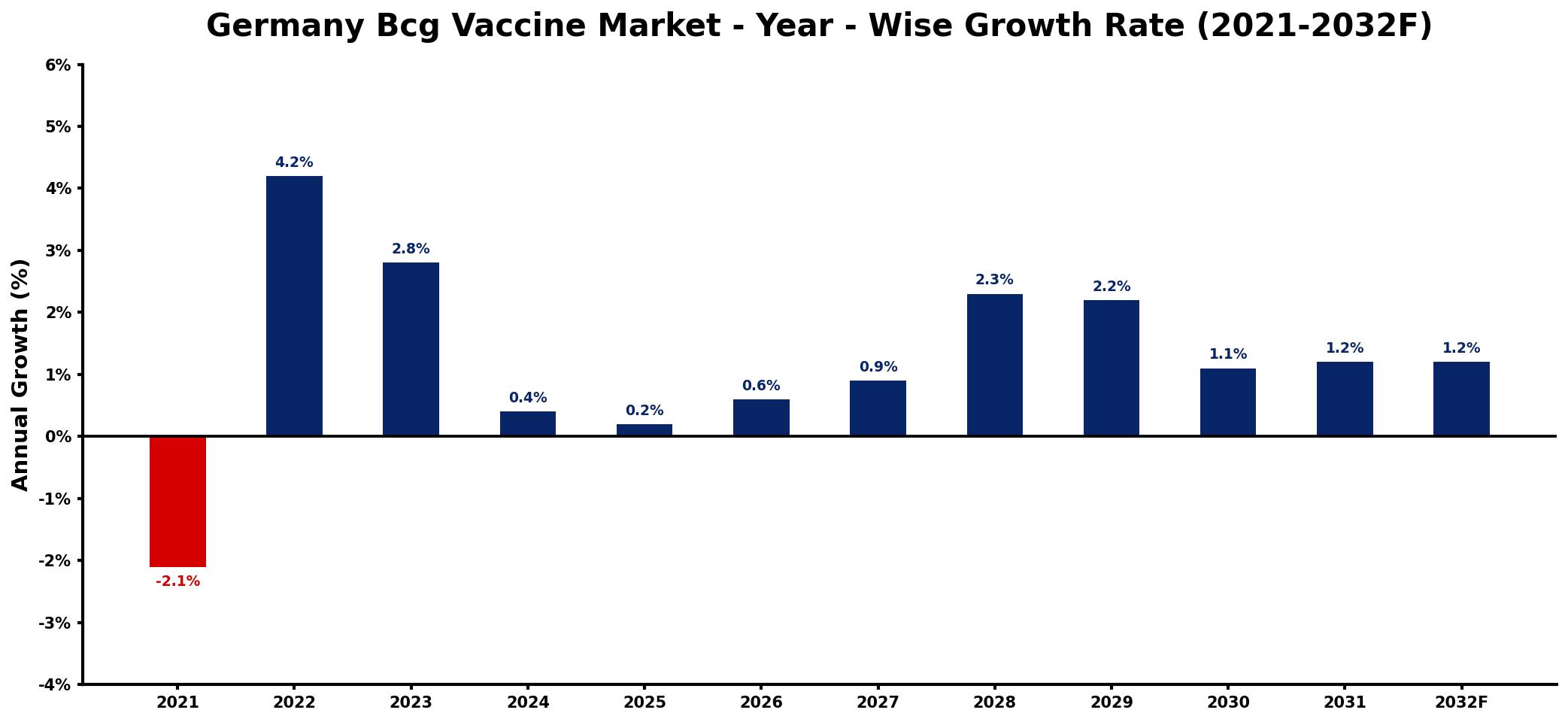
The table below presents the year‑wise growth rates along with the key drivers influencing the market
| Year | Growth Rate | Major Drivers |
| 2021 | -2.1% | decrease in healthcare investments |
| 2022 | 4.2% | surge in public health initiatives |
| 2023 | 2.8% | increase in disease awareness campaigns |
| 2024 | 0.4% | growth in immunization programs |
| 2025 | 0.2% | expansion of healthcare infrastructure |
| 2026 | 0.6% | rise in global health collaboration |
| 2027 | 0.9% | enhanced funding for research |
| 2028 | 2.3% | increased demand for preventive measures |
| 2029 | 2.2% | increased production capacity utilization |
| 2030 | 1.1% | advancements in healthcare technology |
| 2031 | 1.2% | broadening access to healthcare services |
| 2032 | 1.2% | strengthening of regulatory frameworks |
Note: Market size estimations and growth projections presented in this report are based on 6Wresearch's proprietary forecasting methodology, utilizing the latest available industry data, government publications, and primary research inputs.
Germany Bcg Vaccine Market Synopsis
The strongest force shaping the Germany BCG vaccine market currently is the robust government commitment to enhancing immunization programs aimed at tuberculosis prevention. This proactive approach ensures widespread accessibility and adherence to vaccination schedules, particularly among vulnerable populations.
Moreover, the German healthcare system's strong infrastructure facilitates the efficient distribution and administration of BCG vaccines. As TB cases remain a public health concern, the focus on maintaining high-quality standards and regulatory compliance further drives the market's dynamics.
Germany Bcg Vaccine Market Key Takeaways
- The market is significantly influenced by government vaccination programs and TB prevention strategies.
- There is a growing focus on product innovation and quality assurance among suppliers in the market.
- Strategic partnerships and collaborations are essential for market players to enhance distribution networks.
- Public awareness campaigns have been pivotal in driving demand for BCG vaccination.
- Ongoing advancements in vaccine technology are anticipated to propel market growth further.
Evaluation of Restraints in Germany Bcg Vaccine Market
Despite its growth trajectory, the Germany BCG vaccine market faces several restraints. Increasing competition from alternative TB vaccines poses a challenge, as do the stringent regulatory requirements that often slow the approval process for new vaccines. Additionally, public funding limitations for TB prevention initiatives can hinder the accessibility of vaccinations. Issues concerning the availability of high-quality BCG vaccines and the fragmentation among suppliers also contribute to market inefficiencies that could impact overall performance.
Germany Bcg Vaccine Market Trends
Current trends in the Germany BCG vaccine market indicate a growing demand for vaccinations among both children and adults, driven by increased public awareness of tuberculosis and its prevention. Innovative vaccine delivery methods are emerging, enhancing the overall efficiency of vaccination campaigns. Furthermore, collaborations among healthcare providers, educational institutions, and non-governmental organizations are becoming common, aiming to increase community engagement and improve immunization rates across various demographics.
Germany Bcg Vaccine Market Opportunities
Investment opportunities within the Germany BCG vaccine market appear promising, particularly in companies focused on research and development for enhanced vaccine formulations. As awareness of tuberculosis prevention continues to rise, there is potential for growth in companies that facilitate access to BCG vaccines, especially in underserved areas. Additionally, emerging technologies and novel delivery systems present avenues for innovation, promising substantial returns on investment for those looking to enter the market.
Government Initiatives in the Germany Bcg Vaccine Market
The German government has enacted various initiatives to ensure the affordability and availability of the BCG vaccine. Included in the national vaccination schedule, the vaccine is readily accessible to all citizens, particularly infants and high-risk groups. The government also provides subsidies and incentives to manufacturers to enhance production capabilities. Quality control measures are firmly in place, with collaborations between government entities and healthcare providers to bolster public awareness about the critical role of BCG vaccination in tuberculosis prevention.
Future Insights of the Germany Bcg Vaccine Market
Looking ahead to 2026-2032, the Germany BCG vaccine market is poised for steady growth, largely fueled by an increasing emphasis on preventive healthcare measures. Continued government support for vaccination initiatives will be crucial, alongside rising healthcare expenditures that reflect a commitment to tackling public health challenges. Although regulatory hurdles and alternative treatment options may pose obstacles, ongoing advancements in vaccine technology and R&D efforts are expected to sustain a positive market outlook.
Germany Bcg Vaccine Market Latest Developments (2025 - 2026)
In recent months, the Germany BCG vaccine market has observed advancements in vaccine delivery systems aimed at improving accessibility. Industry stakeholders are engaging in partnerships to address distribution inefficiencies, thereby enhancing availability. Efforts to increase public health funding for tuberculosis prevention programs are also being discussed, emphasizing the importance of BCG vaccination. Furthermore, research initiatives focused on vaccine efficacy improvements are expected to gain momentum in light of the persistent TB threat.
Germany Bcg Vaccine Market - Key Attractiveness of the Report
- 10 Years of Market Numbers
- Historical Data Starting from 2022 to 2025
- Base Year: 2025
- Forecast Data until 2032
- Key Performance Indicators Impacting the Market
- Major Upcoming Developments and Projects
Key Highlights of the Report:
- Germany Bcg Vaccine Market Outlook
- Market Size of Germany Bcg Vaccine Market, 2025
- Forecast of Germany Bcg Vaccine Market, 2032
- Historical Data and Forecast of Germany Bcg Vaccine Revenues & Volume for the Period 2022-2032F
- Germany Bcg Vaccine Market Trend Evolution
- Germany Bcg Vaccine Market Drivers and Challenges
- Germany Bcg Vaccine Price Trends
- Germany Bcg Vaccine Porter's Five Forces
- Germany Bcg Vaccine Industry Life Cycle
- Historical Data and Forecast of Germany Bcg Vaccine Market Revenues & Volume By Demographics for the Period 2022-2032F
- Historical Data and Forecast of Germany Bcg Vaccine Market Revenues & Volume By Pediatrics (0-18 Years) for the Period 2022-2032F
- Historical Data and Forecast of Germany Bcg Vaccine Market Revenues & Volume By Adults (19-35 years) for the Period 2022-2032F
- Germany Bcg Vaccine Import Export Trade Statistics
- Market Opportunity Assessment By Demographics
- Germany Bcg Vaccine Top Companies Market Share
- Germany Bcg Vaccine Competitive Benchmarking By Technical and Operational Parameters
- Germany Bcg Vaccine Company Profiles
- Germany Bcg Vaccine Key Strategic Recommendations






































