Germany Botanical Supplements Market: Import Trend Analysis
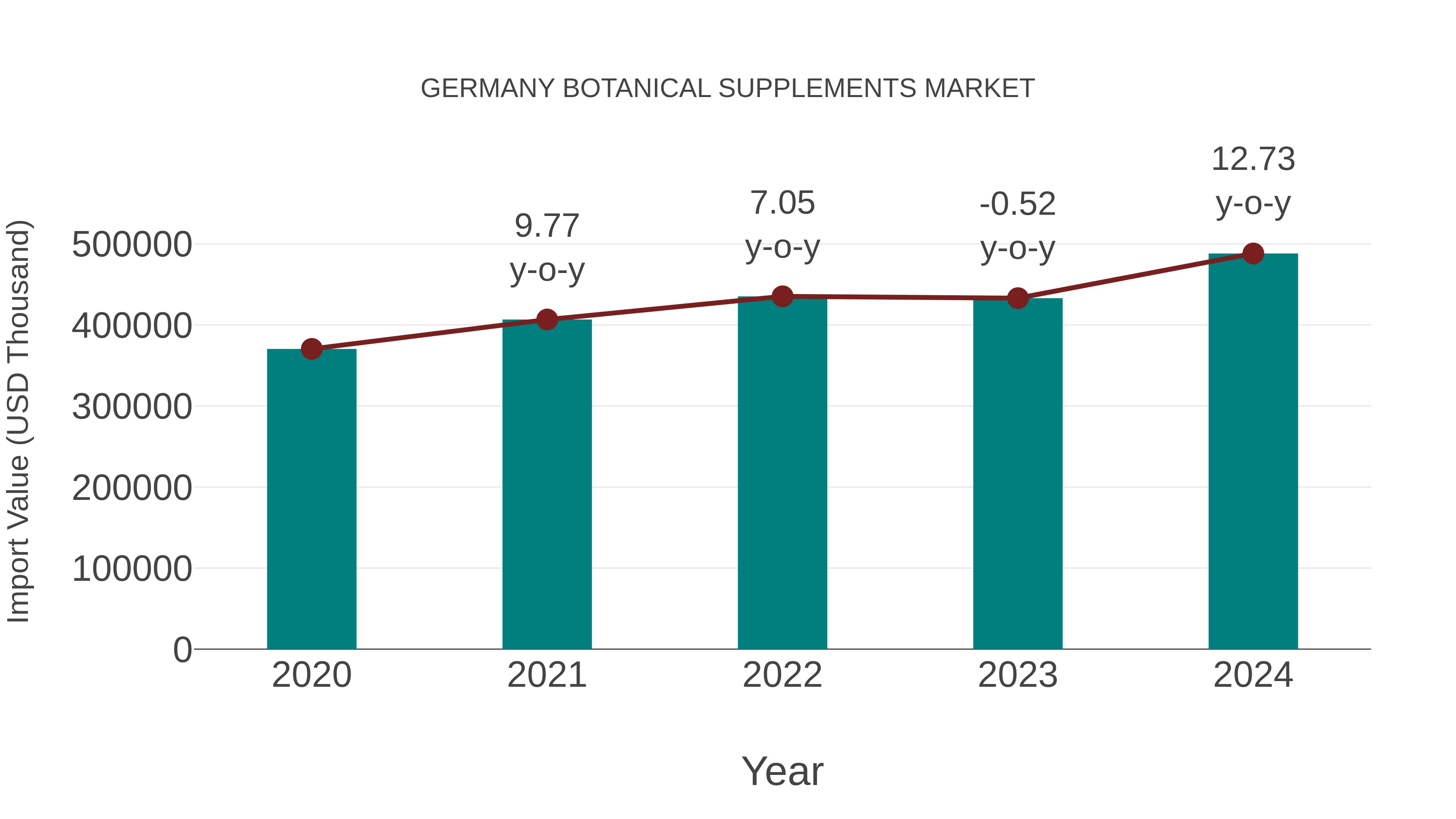
In the Germany botanical supplements market, the import trend from 2023 to 2024 exhibited a growth rate of 12.73%, with a compound annual growth rate (CAGR) of 7.14% from 2020 to 2024. This notable increase in imports can be attributed to a surge in consumer demand for natural health products and a shift towards wellness-oriented lifestyles.
Germany Botanical Supplements Market Synopsis
The Germany botanical supplements market is experiencing steady growth driven by increasing consumer awareness about the health benefits of natural supplements. Consumers in Germany are showing a preference for botanical supplements due to their perceived safety and efficacy compared to synthetic alternatives. The market offers a wide range of products derived from plants and herbs, including popular options such as ginseng, turmeric, and echinacea. Key trends in the market include the rising demand for organic and sustainably sourced botanical supplements, as well as innovative product formulations that cater to specific health needs. With a growing focus on preventive healthcare and holistic wellness practices, the Germany botanical supplements market is expected to continue expanding, offering opportunities for both domestic and international manufacturers to meet the evolving needs of health-conscious consumers.
Germany Botanical Supplements Market Trends
In Germany, the botanical supplements market is experiencing a growing trend towards natural and organic products as consumers are increasingly seeking holistic approaches to health and wellness. There is a rising awareness of the benefits of botanical supplements in supporting various health needs, such as immunity, digestion, and stress management. Consumers are also showing a preference for transparency and sustainability in product sourcing and manufacturing processes, leading to an increased demand for ethically sourced and environmentally friendly botanical supplements. Additionally, personalized nutrition and the use of traditional herbal remedies are gaining popularity in the market. With a focus on quality, efficacy, and safety, the Germany botanical supplements market is evolving to meet the changing preferences and demands of health-conscious consumers.
Germany Botanical Supplements Market Challenges
In the Germany Botanical Supplements Market, challenges include increasing regulatory scrutiny and compliance requirements, particularly concerning health claims and product safety standards. The market is also highly competitive, with a wide range of products available to consumers, making it essential for companies to differentiate themselves and establish brand trust. Consumer awareness and education about the benefits and efficacy of botanical supplements are also important challenges, as some may still be skeptical about their effectiveness or may not be well-informed about the various options available. Additionally, sustainability and sourcing issues can arise, as consumers are increasingly concerned about the environmental impact of botanical supplement production and the ethical sourcing of ingredients. Overall, navigating these challenges requires companies to stay informed, innovate, and adapt to changing market dynamics effectively.
Germany Botanical Supplements Market Investment Opportunities
The Germany Botanical Supplements Market presents promising investment opportunities due to the increasing consumer preference for natural and organic products, coupled with a growing awareness of health and wellness. With a strong culture of sustainability and environmental consciousness, German consumers are seeking botanical supplements for various health benefits such as immune support, stress relief, and overall well-being. Investors can capitalize on this trend by identifying niche botanical ingredients with proven efficacy and partnering with reputable manufacturers to develop high-quality supplements that meet the stringent regulatory standards in Germany. Additionally, leveraging digital marketing strategies to reach a wider audience and establishing partnerships with retailers and e-commerce platforms can further drive growth and profitability in the booming botanical supplements market in Germany.
Jordan Agar Market Government Policies
In Germany, botanical supplements are regulated under the food and health supplement category by the Federal Ministry of Food and Agriculture (BMEL). The European Food Safety Authority (EFSA) provides scientific guidance on the safety and efficacy of botanical ingredients, which are further enforced by the Federal Office of Consumer Protection and Food Safety (BVL). The German Medicines Agency (BfArM) oversees the registration and marketing authorization of botanical supplements with medicinal claims. Additionally, the German Commission E Monographs provide guidelines on the therapeutic uses and safety of herbal remedies. The regulations aim to ensure the quality, safety, and efficacy of botanical supplements in the German market, safeguarding consumer health and promoting transparency in product labeling and marketing practices.
Germany Botanical Supplements Market Future Outlook
The Germany Botanical Supplements Market is expected to witness steady growth in the coming years, driven by increasing consumer awareness about the health benefits of botanical supplements, rising demand for natural and organic products, and a growing focus on preventive healthcare. The market is likely to be propelled by factors such as the trend towards clean label products, the popularity of herbal remedies in traditional medicine, and the growing aging population seeking alternative health solutions. Key players are likely to invest in research and development to introduce innovative botanical supplements targeting specific health concerns, while e-commerce platforms are anticipated to play a significant role in expanding the market reach. Overall, the Germany Botanical Supplements Market is poised for expansion and is expected to offer lucrative opportunities for market players in the foreseeable future.
Key Highlights of the Report:
- Germany Botanical Supplements Market Outlook
- Market Size of Germany Botanical Supplements Market, 2021
- Forecast of Germany Botanical Supplements Market, 2031
- Historical Data and Forecast of Germany Botanical Supplements Revenues & Volume for the Period 2018 - 2031
- Germany Botanical Supplements Market Trend Evolution
- Germany Botanical Supplements Market Drivers and Challenges
- Germany Botanical Supplements Price Trends
- Germany Botanical Supplements Porter's Five Forces
- Germany Botanical Supplements Industry Life Cycle
- Historical Data and Forecast of Germany Botanical Supplements Market Revenues & Volume By Source for the Period 2018 - 2031
- Historical Data and Forecast of Germany Botanical Supplements Market Revenues & Volume By Herbs for the Period 2018 - 2031
- Historical Data and Forecast of Germany Botanical Supplements Market Revenues & Volume By Leaves for the Period 2018 - 2031
- Historical Data and Forecast of Germany Botanical Supplements Market Revenues & Volume By Spices for the Period 2018 - 2031
- Historical Data and Forecast of Germany Botanical Supplements Market Revenues & Volume By Flowers for the Period 2018 - 2031
- Historical Data and Forecast of Germany Botanical Supplements Market Revenues & Volume By Others for the Period 2018 - 2031
- Historical Data and Forecast of Germany Botanical Supplements Market Revenues & Volume By Form for the Period 2018 - 2031
- Historical Data and Forecast of Germany Botanical Supplements Market Revenues & Volume By Powder for the Period 2018 - 2031
- Historical Data and Forecast of Germany Botanical Supplements Market Revenues & Volume By Liquid for the Period 2018 - 2031
- Historical Data and Forecast of Germany Botanical Supplements Market Revenues & Volume By Tablets for the Period 2018 - 2031
- Historical Data and Forecast of Germany Botanical Supplements Market Revenues & Volume By Capsules for the Period 2018 - 2031
- Historical Data and Forecast of Germany Botanical Supplements Market Revenues & Volume By Gummies for the Period 2018 - 2031
- Historical Data and Forecast of Germany Botanical Supplements Market Revenues & Volume By Others for the Period 2018 - 2031
- Historical Data and Forecast of Germany Botanical Supplements Market Revenues & Volume By Application for the Period 2018 - 2031
- Historical Data and Forecast of Germany Botanical Supplements Market Revenues & Volume By Energy & Weight Management for the Period 2018 - 2031
- Historical Data and Forecast of Germany Botanical Supplements Market Revenues & Volume By General Health for the Period 2018 - 2031
- Historical Data and Forecast of Germany Botanical Supplements Market Revenues & Volume By Bone & Joint Health for the Period 2018 - 2031
- Historical Data and Forecast of Germany Botanical Supplements Market Revenues & Volume By Gastrointestinal Health for the Period 2018 - 2031
- Historical Data and Forecast of Germany Botanical Supplements Market Revenues & Volume By Immunity for the Period 2018 - 2031
- Historical Data and Forecast of Germany Botanical Supplements Market Revenues & Volume By Cardiac Health for the Period 2018 - 2031
- Historical Data and Forecast of Germany Botanical Supplements Market Revenues & Volume By Diabetes for the Period 2018 - 2031
- Historical Data and Forecast of Germany Botanical Supplements Market Revenues & Volume By Anti-cancer for the Period 2018 - 2031
- Historical Data and Forecast of Germany Botanical Supplements Market Revenues & Volume By Distribution Channel for the Period 2018 - 2031
- Historical Data and Forecast of Germany Botanical Supplements Market Revenues & Volume By Offline for the Period 2018 - 2031
- Historical Data and Forecast of Germany Botanical Supplements Market Revenues & Volume By Online for the Period 2018 - 2031
- Germany Botanical Supplements Import Export Trade Statistics
- Market Opportunity Assessment By Source
- Market Opportunity Assessment By Form
- Market Opportunity Assessment By Application
- Market Opportunity Assessment By Distribution Channel
- Germany Botanical Supplements Top Companies Market Share
- Germany Botanical Supplements Competitive Benchmarking By Technical and Operational Parameters
- Germany Botanical Supplements Company Profiles
- Germany Botanical Supplements Key Strategic Recommendations






































