Germany Chlorine Market: Import Trend Analysis
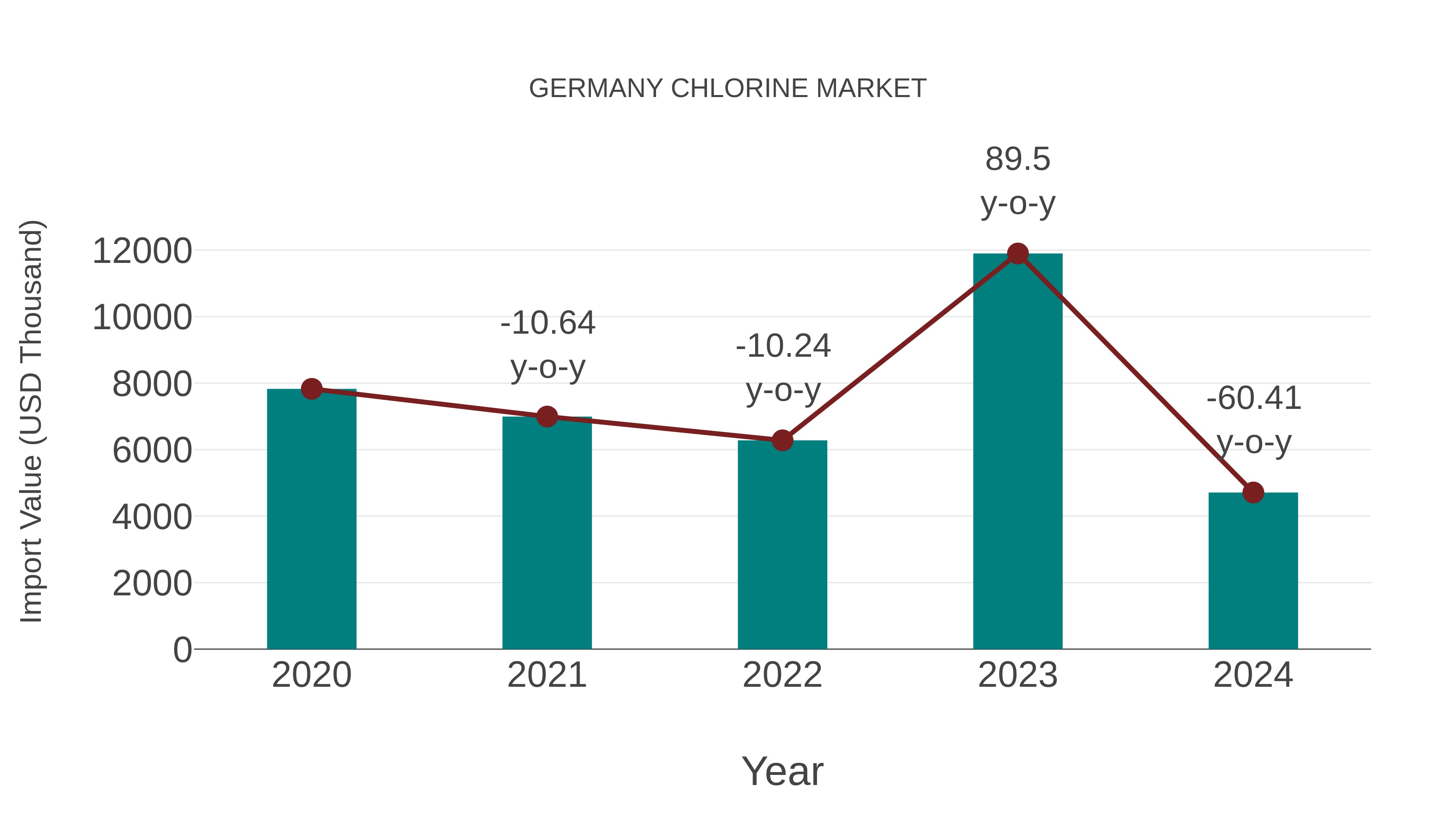
Germany`s import trend for the chlorine market saw a significant decline from 2023 to 2024, with a growth rate of -60.41%. The compound annual growth rate (CAGR) for the period of 2020-2024 stood at -11.92%. This sharp decrease in imports could be attributed to shifting demand dynamics or changes in trade policies affecting market stability.
Germany Chlorine Market Overview
The chlorine market in Germany is integral to the chemical industry, serving as a fundamental building block for a wide range of products. Chlorine is a versatile chemical with applications in the production of PVC, solvents, agrochemicals, and pharmaceuticals, among others. Germany strong manufacturing base and emphasis on innovation drive the demand for chlorine in the country. However, regulatory pressures regarding environmental concerns and safety measures pose challenges to the market. Nevertheless, ongoing research and development efforts aimed at sustainable production methods are likely to sustain market growth.
Drivers of the market
Chlorine is a fundamental chemical used in the production of various products such as PVC, solvents, and pesticides. In Germany, the chlorine market is driven by factors such as the growth of the chemical industry, increasing demand for PVC, and advancements in chlorine production technologies.
Challenges of the market
The Germany Chlorine market confronts challenges stemming from environmental concerns and regulatory frameworks aimed at reducing emissions and enhancing safety standards. As chlorine production is energy-intensive and involves hazardous chemicals, manufacturers must invest in sustainable practices and adhere to strict compliance measures. Moreover, market players face volatility in feedstock prices, which impacts production costs and profitability. Diversification into downstream products or exploring new applications for chlorine derivatives can mitigate these challenges and foster growth opportunities in industries such as water treatment, pharmaceuticals, and agriculture.
Government Policy of the market
The Germany chlorine market operates within a framework of strict regulatory oversight to ensure public safety and environmental protection. Government policies governing the chlorine industry encompass various aspects, including production, transportation, storage, and usage of chlorine gas and its derivatives. Regulatory agencies enforce standards for chlorine manufacturing facilities to minimize emissions of hazardous by-products and ensure compliance with health and safety protocols. Additionally, there may be regulations promoting the adoption of chlorine-free technologies or the use of chlorine substitutes in certain applications to mitigate environmental risks associated with chlorine usage.
Key Highlights of the Report:
- Germany Chlorine Market Outlook
- Market Size of Germany Chlorine Market, 2024
- Forecast of Germany Chlorine Market, 2031
- Historical Data and Forecast of Germany Chlorine Revenues & Volume for the Period 2018 - 2031
- Germany Chlorine Market Trend Evolution
- Germany Chlorine Market Drivers and Challenges
- Germany Chlorine Price Trends
- Germany Chlorine Porter's Five Forces
- Germany Chlorine Industry Life Cycle
- Historical Data and Forecast of Germany Chlorine Market Revenues & Volume By Application for the Period 2018 - 2031
- Historical Data and Forecast of Germany Chlorine Market Revenues & Volume By EDC/PVC for the Period 2018 - 2031
- Historical Data and Forecast of Germany Chlorine Market Revenues & Volume By Isocyanates and Oxygenates for the Period 2018 - 2031
- Historical Data and Forecast of Germany Chlorine Market Revenues & Volume By Chloromethanes for the Period 2018 - 2031
- Historical Data and Forecast of Germany Chlorine Market Revenues & Volume By Solvents and Epichlorohydrin for the Period 2018 - 2031
- Historical Data and Forecast of Germany Chlorine Market Revenues & Volume By Inorganic Chemicals for the Period 2018 - 2031
- Historical Data and Forecast of Germany Chlorine Market Revenues & Volume By Other Applications for the Period 2018 - 2031
- Historical Data and Forecast of Germany Chlorine Market Revenues & Volume By End-user Industry for the Period 2018 - 2031
- Historical Data and Forecast of Germany Chlorine Market Revenues & Volume By Water Treatment for the Period 2018 - 2031
- Historical Data and Forecast of Germany Chlorine Market Revenues & Volume By Pharmaceutical for the Period 2018 - 2031
- Historical Data and Forecast of Germany Chlorine Market Revenues & Volume By Chemicals for the Period 2018 - 2031
- Historical Data and Forecast of Germany Chlorine Market Revenues & Volume By Paper and Pulp for the Period 2018 - 2031
- Historical Data and Forecast of Germany Chlorine Market Revenues & Volume By Plastic for the Period 2018 - 2031
- Historical Data and Forecast of Germany Chlorine Market Revenues & Volume By Pesticides for the Period 2018 - 2031
- Historical Data and Forecast of Germany Chlorine Market Revenues & Volume By Other End-user Industries for the Period 2018 - 2031
- Germany Chlorine Import Export Trade Statistics
- Market Opportunity Assessment By Application
- Market Opportunity Assessment By End-user Industry
- Germany Chlorine Top Companies Market Share
- Germany Chlorine Competitive Benchmarking By Technical and Operational Parameters
- Germany Chlorine Company Profiles
- Germany Chlorine Key Strategic Recommendations






































