Germany Community Cloud Market Size & Growth Rate (2026-2032)
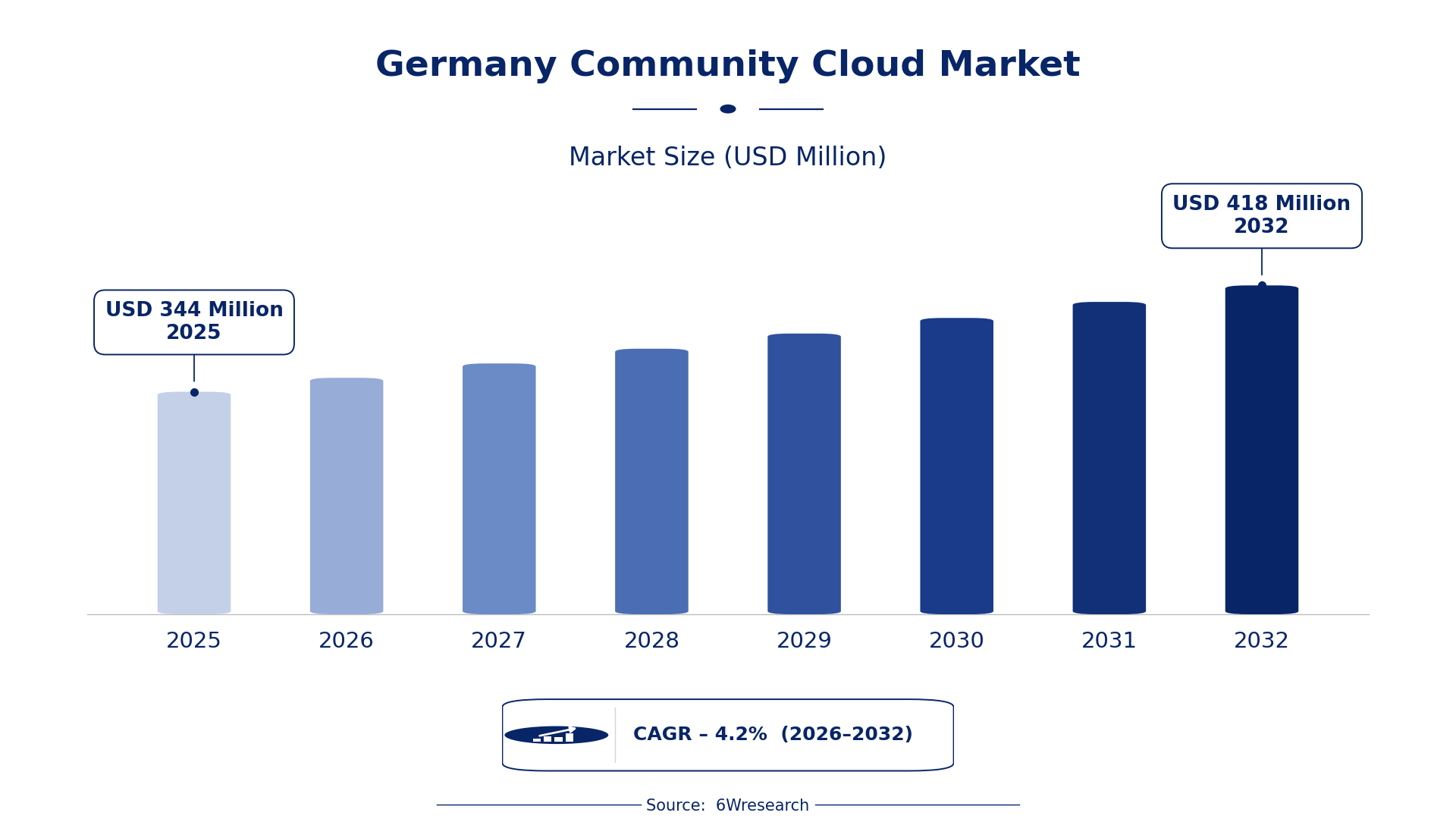
The Germany Community Cloud Market was estimated at USD 344 Million in 2025 and is projected to reach USD 418 Million by 2032, growing at a CAGR of 4.2% from 2026 to 2032.
Germany Community Cloud Market Synopsis
The Germany Community Cloud Market is on a steady upward trajectory, driven by the increasing emphasis on data privacy and compliance among various sectors, including healthcare, finance, and government. Organizations are turning to community cloud solutions that provide shared infrastructure tailored to meet their unique regulatory needs while ensuring data security.
As German businesses grapple with stringent data protection regulations, particularly GDPR, community cloud services are gaining traction. These services not only facilitate compliance but also foster collaboration among organizations within the same sector. The market's growth reflects a broader trend toward secure, industry-specific cloud solutions that prioritize data sovereignty.
Germany Community Cloud Market Year-wise Growth Rate and Key Drivers
This graph illustrates the annual growth rates of the Germany Community Cloud Market from 2021 to 2032, highlighting a steady upward trajectory and projected expansion over the forecast period.
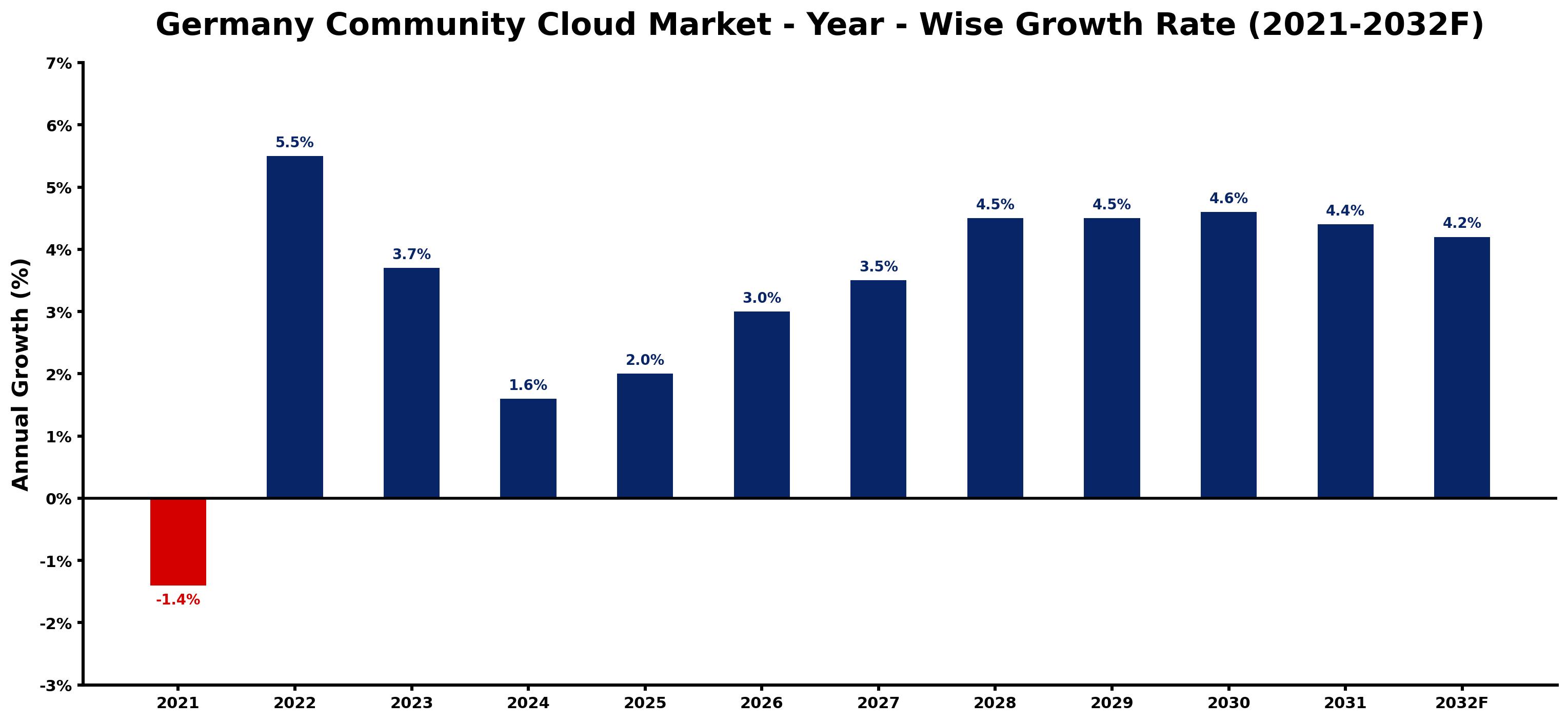
The table below presents the year‑wise growth rates along with the key drivers influencing the market
| Year | Growth Rate | Major Drivers |
| 2021 | -1.4% | Cloud Act compliance issues hindering adoption in Germany. |
| 2022 | 5.5% | EU Data Act enhancing data sharing in clouds |
| 2023 | 3.7% | Germany's Digital Strategy 2025 boosting cloud adoption |
| 2024 | 1.6% | Increased demand for secure, localized data storage solutions |
| 2025 | 2.0% | Growing emphasis on data sovereignty among German businesses |
| 2026 | 3.0% | Investment in cybersecurity measures for cloud environments |
| 2027 | 3.5% | Surge in remote work increasing community cloud utilization |
| 2028 | 4.5% | Rising popularity of open-source cloud technologies in Germany |
| 2029 | 4.5% | Collaboration among SMEs for cost-effective cloud services |
| 2030 | 4.6% | Government incentives for green data center initiatives |
| 2031 | 4.4% | Emergence of cloud-native applications driving market growth |
| 2032 | 4.2% | Increased regulatory compliance demand for community cloud solutions |
Note: Market size estimations and growth projections presented in this report are based on 6Wresearch's proprietary forecasting methodology, utilizing the latest available industry data, government publications, and primary research inputs.
Germany Community Cloud Market Key Takeaways
Below are some of the specific key takeaways from the market, including:
- Growing demand for community cloud solutions across healthcare, finance, and government sectors.
- Heightened focus on compliance with GDPR and local data protection regulations.
- Increasing interest in hybrid cloud models that support collaboration and data sharing.
- Opportunities for tailored cloud services that address industry-specific needs.
- Expansion of localized data centers to enhance data residency and security.
Evaluation of Restraints in Germany Community Cloud Market
Despite the positive growth trajectory, several constraints hinder the Germany Community Cloud Market. Chief among these is the challenge of adhering to the strict compliance requirements set forth by GDPR and other local regulations. Organizations must navigate a complex legal environment to ensure data protection and sovereignty, which can be daunting and resource-intensive.
on top of that, there exists a gap in awareness regarding the benefits of community cloud services among potential users. Concerns about data breaches and security threats further complicate the decision-making process for businesses considering these solutions. Building trust through transparent communication and robust security measures will be essential for overcoming these hurdles.
Germany Community Cloud Market Trends
Several trends are shaping the Germany Community Cloud Market. First, the demand for secure and compliant cloud services continues to rise, particularly in industries that handle sensitive data. The adoption of hybrid cloud models is also on the rise, as organizations seek to balance the benefits of public and private cloud infrastructures.
Another trend is the increasing focus on collaboration among organizations within specific sectors, driving the need for community cloud platforms that facilitate shared data access while maintaining compliance. These trends are indicative of a market that is maturing, with providers increasingly tailoring solutions to meet the complex needs of various industries.
Germany Community Cloud Market Opportunities
The Germany Community Cloud Market is ripe with opportunities for growth and investment. As organizations continue to seek secure and compliant cloud solutions, service providers that can offer tailored services will be well-positioned to capture market share. The increasing digital transformation initiatives across sectors create a demand for innovative community cloud solutions that enhance data control and compliance.
on top of that, the push for localized cloud infrastructures aligns with the growing focus on data sovereignty, providing further avenues for investment. Companies that can effectively communicate the advantages of community cloud services and address specific industry challenges will find themselves at an advantage in this evolving market.
Government Initiatives in the Germany Community Cloud Market
Government policies play a crucial role in shaping the Germany Community Cloud Market. The German government has established a regulatory framework focused on data protection and security, particularly under GDPR guidelines. Public-sector initiatives encourage the adoption of cloud services, emphasizing the importance of compliance and data sovereignty.
- A national digital infrastructure upgrade programme launched in early 2025, aimed at enhancing data security for public sector organizations.
- Current initiatives promoting the use of localized cloud solutions among governmental agencies to meet compliance requirements.
- Ongoing discussions about regulatory frameworks to support transparency in cloud service billing practices.
- A planned public-private initiative expected to improve cloud infrastructure access for small and medium enterprises by 2028.
- Recent efforts to establish industry-specific compliance certifications for cloud providers to enhance trust and security.
Future Insights of the Germany Community Cloud Market
Looking ahead to 2026-2032, the Germany Community Cloud Market is set to experience sustained growth driven by increasing awareness of data security and compliance among businesses. As organizations prioritize tailored cloud solutions that meet industry-specific regulatory standards, the demand for community cloud services will likely continue to rise.
The ongoing digital transformation initiatives across various sectors will further fuel this demand, providing opportunities for service providers to innovate and adapt to the changing landscape. With a focus on data control and compliance, the market is positioned for steady expansion.
Germany Community Cloud Market Latest Developments
Recent developments in the Germany Community Cloud Market reflect a dynamic environment with a focus on compliance, security, and collaboration. Over the last 12-14 months, there has been a noticeable shift towards more tailored cloud solutions that address specific industry needs.
- A major technology vendor launched an enhanced community cloud service in Q3 2025, focusing on healthcare compliance features.
- An initiative that began in early 2025 and remains underway aims to establish regional data centers to support localized cloud services.
- By mid-2026, a new partnership is expected to be announced between cloud service providers to enhance data sharing capabilities within specific sectors.
- A recently completed project aimed at upgrading existing cloud infrastructures to improve security protocols was finalized in late 2025.
- Upcoming initiatives in 2026 will focus on expanding community cloud offerings tailored to the financial services sector.
Germany Community Cloud Market - Key Attractiveness of the Report
- 10 Years of Market Numbers
- Historical Data Starting from 2022 to 2025
- Base Year: 2025
- Forecast Data until 2032
- Key Performance Indicators Impacting the Market
- Major Upcoming Developments and Projects
Key Highlights of the Report:
- Germany Community Cloud Market Outlook
- Market Size of Germany Community Cloud Market, 2025
- Forecast of Germany Community Cloud Market, 2032
- Historical Data and Forecast of Germany Community Cloud Revenues & Volume for the Period 2022-2032F
- Germany Community Cloud Market Trend Evolution
- Germany Community Cloud Market Drivers and Challenges
- Germany Community Cloud Price Trends
- Germany Community Cloud Porter's Five Forces
- Germany Community Cloud Industry Life Cycle
- Historical Data and Forecast of Germany Community Cloud Market Revenues & Volume By Components for the Period 2022-2032F
- Historical Data and Forecast of Germany Community Cloud Market Revenues & Volume By Server for the Period 2022-2032F
- Historical Data and Forecast of Germany Community Cloud Market Revenues & Volume By Storage Devices for the Period 2022-2032F
- Historical Data and Forecast of Germany Community Cloud Market Revenues & Volume By Network Equipments for the Period 2022-2032F
- Historical Data and Forecast of Germany Community Cloud Market Revenues & Volume By Verticals for the Period 2022-2032F
- Historical Data and Forecast of Germany Community Cloud Market Revenues & Volume By Healthcare for the Period 2022-2032F
- Historical Data and Forecast of Germany Community Cloud Market Revenues & Volume By Finance for the Period 2022-2032F
- Historical Data and Forecast of Germany Community Cloud Market Revenues & Volume By Government for the Period 2022-2032F
- Historical Data and Forecast of Germany Community Cloud Market Revenues & Volume By Transport and Logistics for the Period 2022-2032F
- Historical Data and Forecast of Germany Community Cloud Market Revenues & Volume By Gaming for the Period 2022-2032F
- Historical Data and Forecast of Germany Community Cloud Market Revenues & Volume By Education for the Period 2022-2032F
- Germany Community Cloud Import Export Trade Statistics
- Market Opportunity Assessment By Components
- Market Opportunity Assessment By Verticals
- Germany Community Cloud Top Companies Market Share
- Germany Community Cloud Competitive Benchmarking By Technical and Operational Parameters
- Germany Community Cloud Company Profiles
- Germany Community Cloud Key Strategic Recommendations






































