Germany Complex Fertilizers Market: Import Trend Analysis
In the Germany complex fertilizers market, the import trend showed a growth rate of 10.12% from 2023 to 2024, with a compound annual growth rate (CAGR) of 0.74% from 2020 to 2024. This uptick in imports can be attributed to increased demand for specialized fertilizers due to evolving agricultural practices and a push for sustainable farming methods.
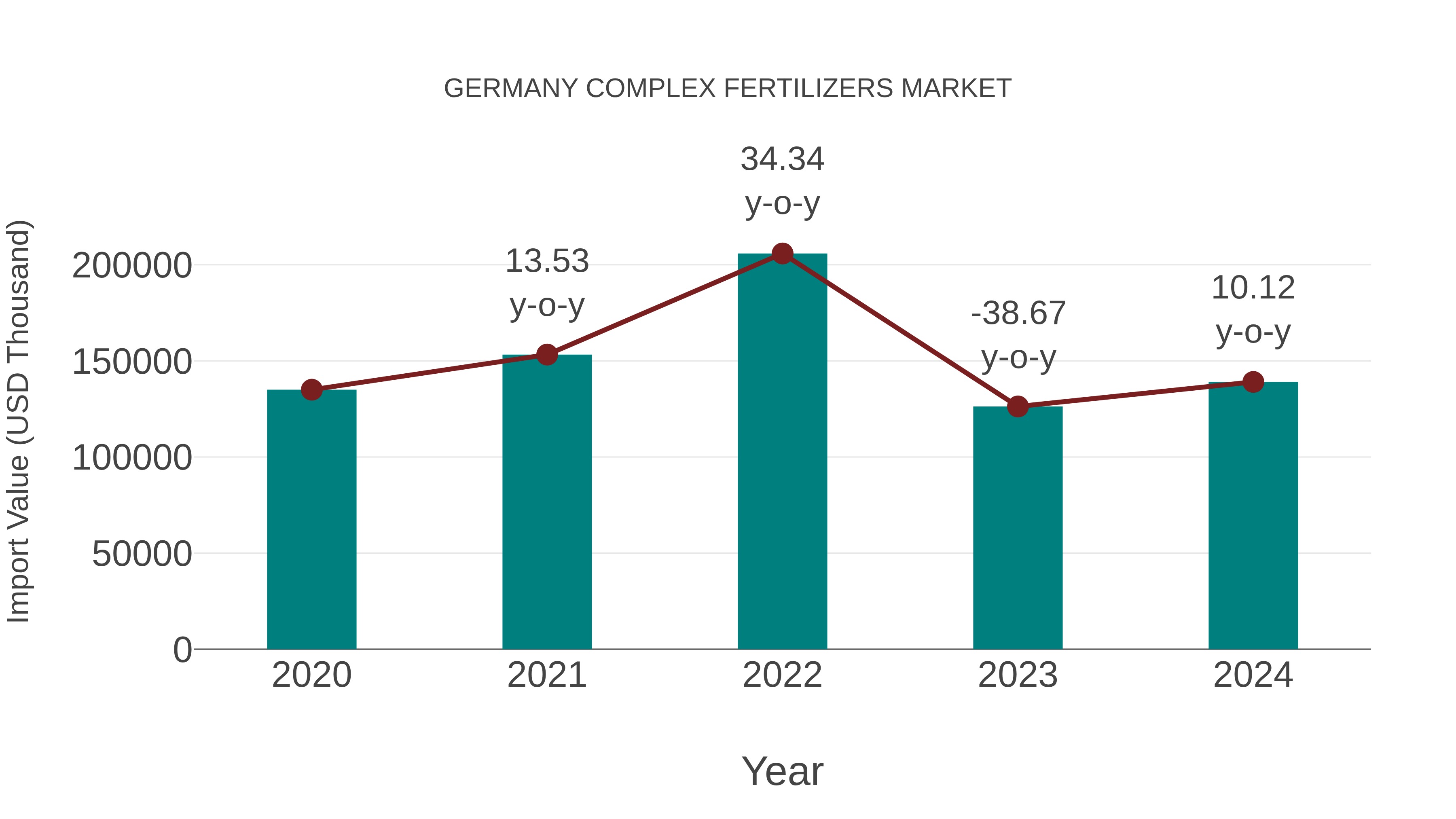
Germany Complex Fertilizers Market Synopsis
The Germany complex fertilizers market is experiencing steady growth driven by the increasing demand for high-quality agricultural products. The market is characterized by a shift towards sustainable agriculture practices, leading to the rising adoption of complex fertilizers that provide balanced nutrition to crops. Key players in the market are focusing on product innovation and development to cater to the evolving needs of farmers. The use of advanced technologies in fertilizer production and application is also contributing to market growth. Additionally, government initiatives promoting organic farming and environmental sustainability are influencing market trends. Overall, the Germany complex fertilizers market is expected to continue its growth trajectory, supported by the increasing awareness about the benefits of using balanced fertilizers for improved crop yield and quality.
Germany Complex Fertilizers Market Trends
The Germany complex fertilizers market is experiencing a shift towards sustainable and environmentally friendly products, driven by increasing awareness about the impact of conventional fertilizers on soil health. There is a growing demand for slow-release fertilizers, micronutrient-enriched products, and organic blends. The emphasis on precision agriculture and digital farming practices is also creating opportunities for customized complex fertilizers tailored to specific crop needs. With the government`s focus on promoting sustainable agriculture, there is a potential for research and development in innovative fertilizer formulations. Additionally, partnerships between fertilizer companies and technology providers to develop smart fertilizers and nutrient management solutions are likely to shape the future of the complex fertilizers market in Germany.
Germany Complex Fertilizers Market Challenges
In the Germany Complex Fertilizers Market, some key challenges include stringent regulations on fertilizer composition and application, which can limit innovation and product development. Additionally, increasing environmental concerns are driving demand for sustainable and organic fertilizers, posing a challenge for traditional complex fertilizer producers. Fluctuating raw material prices and currency exchange rates also impact the market, affecting production costs and profitability. Competition from alternative nutrient sources such as biofertilizers and slow-release fertilizers further intensifies the market landscape. Moreover, the need for efficient distribution channels and tailored marketing strategies to reach diverse agricultural regions in Germany adds complexity to market penetration efforts for complex fertilizer manufacturers.
Germany Complex Fertilizers Market Investment Opportunities
The Germany Complex Fertilizers Market is primarily driven by factors such as the increasing demand for higher agricultural productivity and efficiency, the growing awareness among farmers about the benefits of using complex fertilizers, and the emphasis on sustainable agricultural practices. Additionally, the government initiatives to promote balanced nutrient application and reduce environmental impact are fueling the market growth. The shift towards precision farming techniques and the rising trend of integrated nutrient management are also contributing to the demand for complex fertilizers in Germany. Furthermore, the focus on improving soil health and crop yield while minimizing nutrient wastage is driving the adoption of complex fertilizers among farmers in the region.
Germany Complex Fertilizers Market Government Polices
In Germany, the Complex Fertilizers Market is influenced by several key government policies aimed at promoting sustainable agriculture practices and reducing environmental impact. The government has implemented regulations to limit the use of certain chemicals in fertilizers, encourage the use of organic and bio-based fertilizers, and promote the efficient use of nutrients in agricultural production. Additionally, there are subsidies and incentives available to farmers who adopt environmentally friendly fertilization practices, such as precision agriculture techniques. The government also supports research and development initiatives to improve the effectiveness and sustainability of complex fertilizers. Overall, these policies play a crucial role in shaping the complex fertilizers market in Germany towards more environmentally friendly and sustainable practices.
Germany Complex Fertilizers Market Future Outlook
The future outlook for the Germany Complex Fertilizers Market appears promising due to several factors. These include a growing focus on sustainable agricultural practices, increasing demand for high-efficiency fertilizers to improve crop yield and quality, and government initiatives promoting the use of advanced fertilizers. Technological advancements in the production of complex fertilizers are also expected to drive market growth, catering to the evolving needs of German farmers for customized nutrient solutions. Additionally, the rising awareness about the importance of soil health and the environmental benefits of using complex fertilizers are likely to further boost market demand. Overall, the Germany Complex Fertilizers Market is anticipated to witness steady growth in the coming years as the agricultural sector continues to prioritize productivity and sustainability.
Key Highlights of the Report:
- Germany Complex Fertilizers Market Outlook
- Market Size of Germany Complex Fertilizers Market, 2025
- Forecast of Germany Complex Fertilizers Market, 2032
- Historical Data and Forecast of Germany Complex Fertilizers Revenues & Volume for the Period 2022 - 2032F
- Germany Complex Fertilizers Market Trend Evolution
- Germany Complex Fertilizers Market Drivers and Challenges
- Germany Complex Fertilizers Price Trends
- Germany Complex Fertilizers Porter's Five Forces
- Germany Complex Fertilizers Industry Life Cycle
- Historical Data and Forecast of Germany Complex Fertilizers Market Revenues & Volume By Type for the Period 2022 - 2032F
- Historical Data and Forecast of Germany Complex Fertilizers Market Revenues & Volume By Incomplete for the Period 2022 - 2032F
- Historical Data and Forecast of Germany Complex Fertilizers Market Revenues & Volume By Complete for the Period 2022 - 2032F
- Historical Data and Forecast of Germany Complex Fertilizers Market Revenues & Volume By Crop Type for the Period 2022 - 2032F
- Historical Data and Forecast of Germany Complex Fertilizers Market Revenues & Volume By Cereals for the Period 2022 - 2032F
- Historical Data and Forecast of Germany Complex Fertilizers Market Revenues & Volume By Oilseeds for the Period 2022 - 2032F
- Historical Data and Forecast of Germany Complex Fertilizers Market Revenues & Volume By Fruits & Vegetables for the Period 2022 - 2032F
- Historical Data and Forecast of Germany Complex Fertilizers Market Revenues & Volume By Form for the Period 2022 - 2032F
- Historical Data and Forecast of Germany Complex Fertilizers Market Revenues & Volume By Solid for the Period 2022 - 2032F
- Historical Data and Forecast of Germany Complex Fertilizers Market Revenues & Volume By Liquid for the Period 2022 - 2032F
- Germany Complex Fertilizers Import Export Trade Statistics
- Market Opportunity Assessment By Type
- Market Opportunity Assessment By Crop Type
- Market Opportunity Assessment By Form
- Germany Complex Fertilizers Top Companies Market Share
- Germany Complex Fertilizers Competitive Benchmarking By Technical and Operational Parameters
- Germany Complex Fertilizers Company Profiles
- Germany Complex Fertilizers Key Strategic Recommendations






































