Germany Construction Market: Import Trend Analysis
Germany`s construction market experienced a notable decline in import momentum from 2023 to 2024, with a growth rate of -34.17%. The compound annual growth rate (CAGR) for imports from 2020 to 2024 stood at -2.04%. This substantial decrease could be attributed to shifts in demand dynamics or alterations in trade policies impacting market stability.
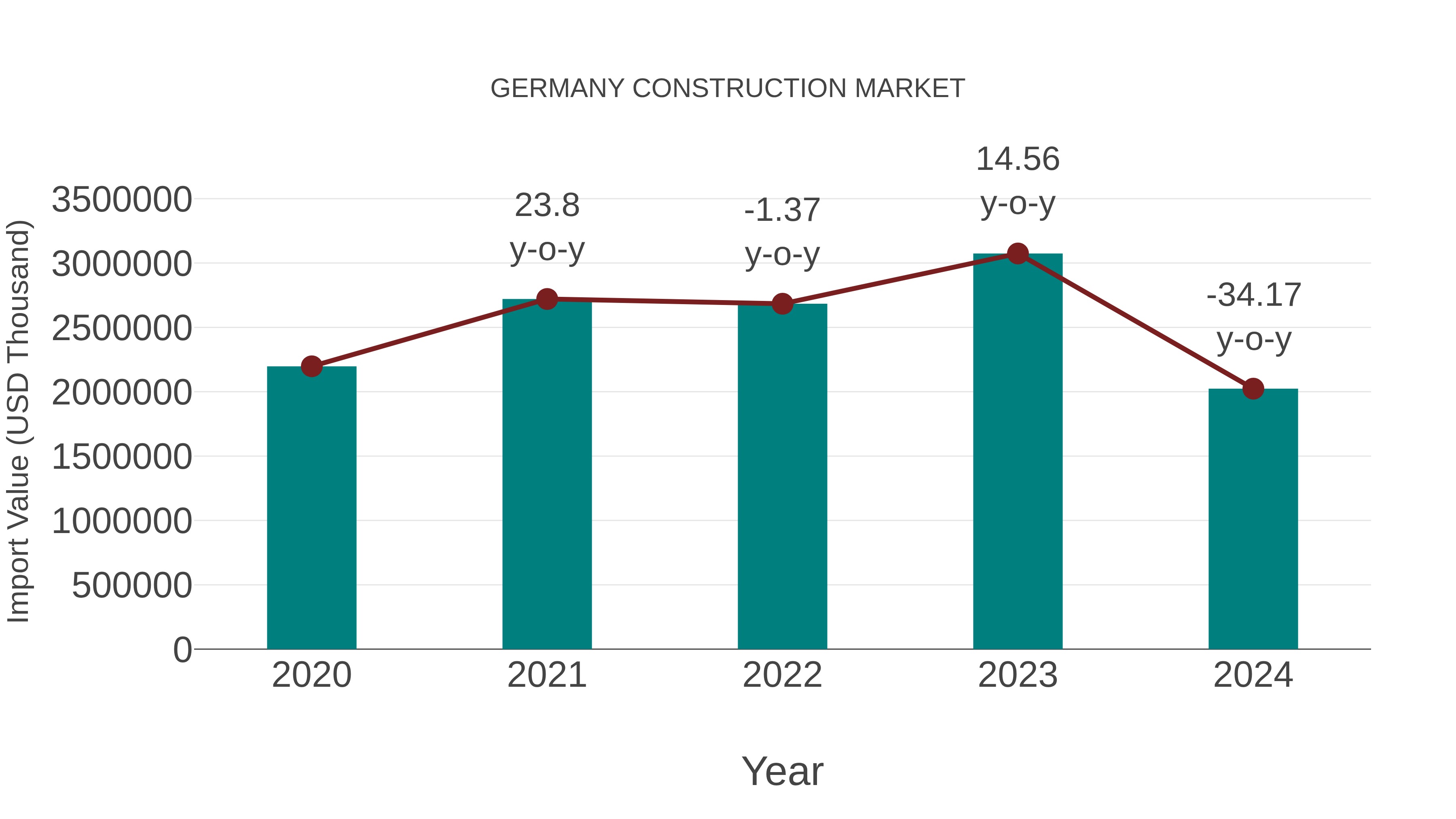
Germany Construction Market Growth Rate
According to 6Wresearch internal database and industry insights, the Germany Construction Market is projected to grow at a compound annual growth rate (CAGR) of 4% during the forecast period (2026–2032).
Five-Years Growth Trajectory of the Germany Construction Market with Core Drivers
Below is the evaluation of the year-wise growth rate along with key drivers:
| Years | Estimated Annual Growth (%) | Growth Drivers |
| 2021 | 3.2 | Government focus on infrastructure upgrades and housing demand |
| 2022 | 3.4 | Urbanization and population growth driving residential construction |
| 2023 | 3.6 | Expansion in public infrastructure and commercial construction |
| 2024 | 3.7 | Rising demand for sustainable construction and eco-friendly buildings |
| 2025 | 3.9 | Government initiatives supporting energy-efficient construction practices and smart cities |
Topics Covered in the Germany Construction Market Report
The Germany Construction Market report thoroughly covers the market by Product Types, Sectors, and Categories. The report provides a detailed analysis of ongoing market trends, opportunities/high-growth areas, and market drivers that will help stakeholders devise and align strategies according to current and future market dynamics.
Germany Construction Market Highlights
| Report Name | Germany Construction Market |
| Forecast period | 2026-2032 |
| CAGR | 4% |
| Growing Sector | Residential, Commercial, Infrastructure |
Germany Construction Market Synopsis
Through government infrastructure funding, increasing population due to urbanization, and the increased demographic pressures on housing supply, there has been a consistent growth trend in the Germany Construction Market. There has also been a growth in commercial real estate and public infrastructure. The demand for residential property is increasing, and this is a significant factor contributing to the growth of the market. The initiative by government agencies to provide incentives for sustainable construction and the increase in interest toward eco-efficient housing is pushing market expansion.
Evaluation of Growth Drivers in the Germany Construction Market
Below are some prominent drivers and their influence on the Germany Construction Market dynamics:
| Drivers | Primary Segments Affected | Why it Matters |
| Growing Residential Demand | By Categories (Residential) | Urban expansion, rising population, and government emphasis on affordable housing are boosting residential construction demand in cities. |
| Expansion in Commercial and Infrastructure Sectors | By Categories (Commercial, Infrastructure) | Increased government support is accelerating demand for commercial and infrastructure construction, including offices and retail properties. |
| Government Support for Sustainable Building Practices | By Product Types (General Construction) | Eco- Friendly policies in Germany are promoting energy-efficient buildings and sustainable infrastructure. |
| Technological Advancements in Construction | By Sectors (Urban, Rural) | The use of technologies such as BIM and automation are transforming residential and commercial construction, especially in urban areas. |
The Germany Construction Market Size is projected to grow at a CAGR of 4% during the forecast period (2026–2032). The Germany Construction Market is supported by growing housing demand, robust government backing for infrastructure projects, and increasing emphasis on sustainable and energy-efficient construction practices. Residential and commercial sectors are likely to remain important, underpinned by urban growth and increasing population. Continuous funding for green construction technologies and sustainability initiatives is expected to drive long-term market development. Smart city initiatives and digital construction methods will boost efficiency and innovation, supporting market growth.
Evaluation of Restraints in the Germany Construction Market
Below are some prominent restraints and their influence on the Germany Construction Market dynamics:
| Restraints | Primary Segments Affected | What this Means |
| High Raw Material Costs | By Product Types (Materials) | Fluctuating prices of materials like steel, cement, and timber can raise construction costs and cause budget overruns. |
| Environmental Regulations and Compliance | By Product Types (General Construction) | Stringent regulations on emissions, waste manangement, and energy efficiency raise the complexity and cost of construction projects. |
| Labor Shortages | By Sectors (Residential, Commercial, Infrastructure) | Skilled labor shortages and high demand make it challenging to meet deadlines and budgets, especially in urban areas. |
| Logistics and Distribution Challenges | By Sectors (Urban, Rural) | Logistics challenges in rural areas can delay project schedules and limit material transportation. |
Germany Construction Market Challenges
Several challenges affect the Germany Construction Industry, such as fluctuating raw material prices, a lack of skilled workforce, and tighter sustainability regulations. Lack of urban land has resulted in increased land prices, restricting opportunities for new developments. Besides, the adoption of green building methods entails high costs, which can affect the financial viability of some projects. Environmental regulations impose burden on the developers, thus, requiring developers to manage costs while adhering to regulations to stay competitive over time.
Germany Construction Market Trends
Several major factors are shaping the Germany Construction Market Growth:
- Sustainable Construction: Interest in environmentally efficient buildings and sustainable infrastructure is increasing.
- Smart Cities and Technological Integration: The drive for smart cities is modernizing construction practices with technology adoption.
- Modular Construction: There is a rising trend towards modular and prefabricated buildings.
- Urbanization and Infrastructure Expansion: The growing demand for the newer forms of urban area forces the construction of better infrastructure for the city.
Investment Opportunities in the Germany Construction Market
Some notable investment opportunities include:
- Public Infrastructure Development: Government funding for the expansion of highways, railroads, and publicly funded facilities represents a growing market for construction companies.
- Modular and Prefabricated Construction: The growing demand for modular buildings presents opportunities in the prefabricated construction sector, especially for residential housing and commercial spaces.
- Smart City Infrastructure: Germany's support for smart city development includes establishing of technology-based urban infrastructure, with significant investments in areas such as automated transport and intelligent buildings.
- Sustainable Construction Projects: Investments in sustainable buildings, energy-efficient construction, and green infrastructure are on the rise.
Top 5 Leading Players in the Germany Construction Market
Some leading players operating in the Germany Construction Market Share include:
1. Hochtief AG
| Company Name | Hochtief AG |
|---|---|
| Established Year | 1873 |
| Headquarters | Essen, Germany |
| Website | Click Here |
A leading German construction company, Hochtief specializes in large-scale infrastructure and commercial construction projects, with a strong focus on sustainable building practices and innovative solutions.
2. Strabag SE
| Company Name | Strabag SE |
|---|---|
| Established Year | 1835 |
| Headquarters | Cologne, Germany |
| Website | Click Here |
Strabag is a major construction and civil engineering company in Germany, known for its work in the infrastructure, residential, and commercial sectors, with an emphasis on energy-efficient buildings.
3. Bilfinger SE
| Company Name | Bilfinger SE |
|---|---|
| Established Year | 1880 |
| Headquarters | Mannheim, Germany |
| Website | Click Here |
Bilfinger is a global construction and engineering company, providing services in infrastructure, industrial plants, and buildings, with a focus on sustainable solutions and innovation.
4. Züblin
| Company Name | Züblin |
|---|---|
| Established Year | 1874 |
| Headquarters | Stuttgart, Germany |
| Website | Click Here |
Züblin is one of Germany’s leading construction companies, specializing in civil engineering, residential, and commercial construction, with a strong focus on green building solutions.
5. Kling Consult GmbH
| Company Name | Kling Consult GmbH |
|---|---|
| Established Year | 1983 |
| Headquarters | Düsseldorf, Germany |
| Website | Click Here |
Kling Consult is a renowned engineering and construction consultancy providing services in residential, commercial, and infrastructure projects, with an emphasis on sustainable construction practices.
Government Regulations Introduced in the Germany Construction Market
According to German Government data, The Federal Republic of Germany has put forth several legislative measures to promote sustainable building initiatives. For instance, such programs are the Energy Efficiency Program and the KfW Funding Program, these programs promote the creation of energy-efficient structures and encourage environmentally sustainable methods of construction. The Economic Support Programs available to builders via these government-supported funding sources offer financial support to enable builders to build homes that utilize less energy, provide tax credits for utilizing renewable/sustainable materials, and establish standards to reduce the pollutants generated from the building industry.
Future Insights of the Germany Construction Market
Germany Construction Industry is set for consistent growth, supported by government sustainability programs and increasing demand for residential, commercial, and infrastructure projects. The expansion of the market is supported by urban development and smart city initiatives. The widespread adoption of digital construction technologies and smart building solutions is boosting operational efficiency and fostering sustainable practices. Consequently, along with rising investments in green infrastructure, these factors are expected to ensure long-term expansion while fostering environmentally responsible construction practices.
Market Segmentation Analysis
The report offers a comprehensive study of the following market segments and their leading categories:
By Product – General Construction to Lead the Market
According to Ritika Kalra, Senior Research Analyst at 6Wresearch, General construction is expected to dominate the market as residential and commercial construction projects continue to grow in both urban and rural areas. Demand for residential, office, and commercial properties is rising rapidly throughout Germany cities.
By Sector – Urban to Lead the Market
Rising urbanization in major German cities is boosting demand for modern residential, office, and commercial buildings. This shift is also pushing the construction sector toward energy-efficient and sustainable practices in line with environmental standards.
By Category – New to Lead the Market
Rising demand for new homes, offices, and retail spaces will make residential and commercial projects the key drivers of the market.
Key Attractiveness of the Report
- 10 Years of Market Numbers
- Historical Data Starting from 2022 to 2025
- Base Year: 2025
- Forecast Data until 2032
- Key Performance Indicators Impacting the Market
- Major Upcoming Developments and Projects
Key Highlights of the Report:
- Germany Construction Market Outlook
- Market Size of Germany Construction Market, 2025
- Forecast of Germany Construction Market, 2032
- Historical Data and Forecast of Germany Construction Revenues & Volume for the Period 2022- 2032
- Germany Construction Market Trend Evolution
- Germany Construction Market Drivers and Challenges
- Germany Construction Price Trends
- Germany Construction Porter's Five Forces
- Germany Construction Industry Life Cycle
- Historical Data and Forecast of Germany Construction Market Revenues & Volume By Product for the Period 2022- 2032
- Historical Data and Forecast of Germany Construction Market Revenues & Volume By Heavy and Civil Engineering for the Period 2022- 2032
- Historical Data and Forecast of Germany Construction Market Revenues & Volume By General Construction for the Period 2022- 2032
- Historical Data and Forecast of Germany Construction Market Revenues & Volume By Sector for the Period 2022- 2032
- Historical Data and Forecast of Germany Construction Market Revenues & Volume By Urban for the Period 2022- 2032
- Historical Data and Forecast of Germany Construction Market Revenues & Volume By Rural for the Period 2022- 2032
- Historical Data and Forecast of Germany Construction Market Revenues & Volume By Category for the Period 2022- 2032
- Historical Data and Forecast of Germany Construction Market Revenues & Volume By New for the Period 2022- 2032
- Historical Data and Forecast of Germany Construction Market Revenues & Volume By Renovation for the Period 2022- 2032
- Germany Construction Import Export Trade Statistics
- Market Opportunity Assessment By Product
- Market Opportunity Assessment By Sector
- Market Opportunity Assessment By Category
- Germany Construction Top Companies Market Share
- Germany Construction Competitive Benchmarking By Technical and Operational Parameters
- Germany Construction Company Profiles
- Germany Construction Key Strategic Recommendations
Markets Covered
The report offers a comprehensive study of the following market segments:
By Product Type
- Heavy and Civil Engineering
- General Construction
By Sector
- Urban
- Rural
By Category
- New
- Renovation






































