Germany Content Analytics Market Size & Growth Rate (2026-2032)
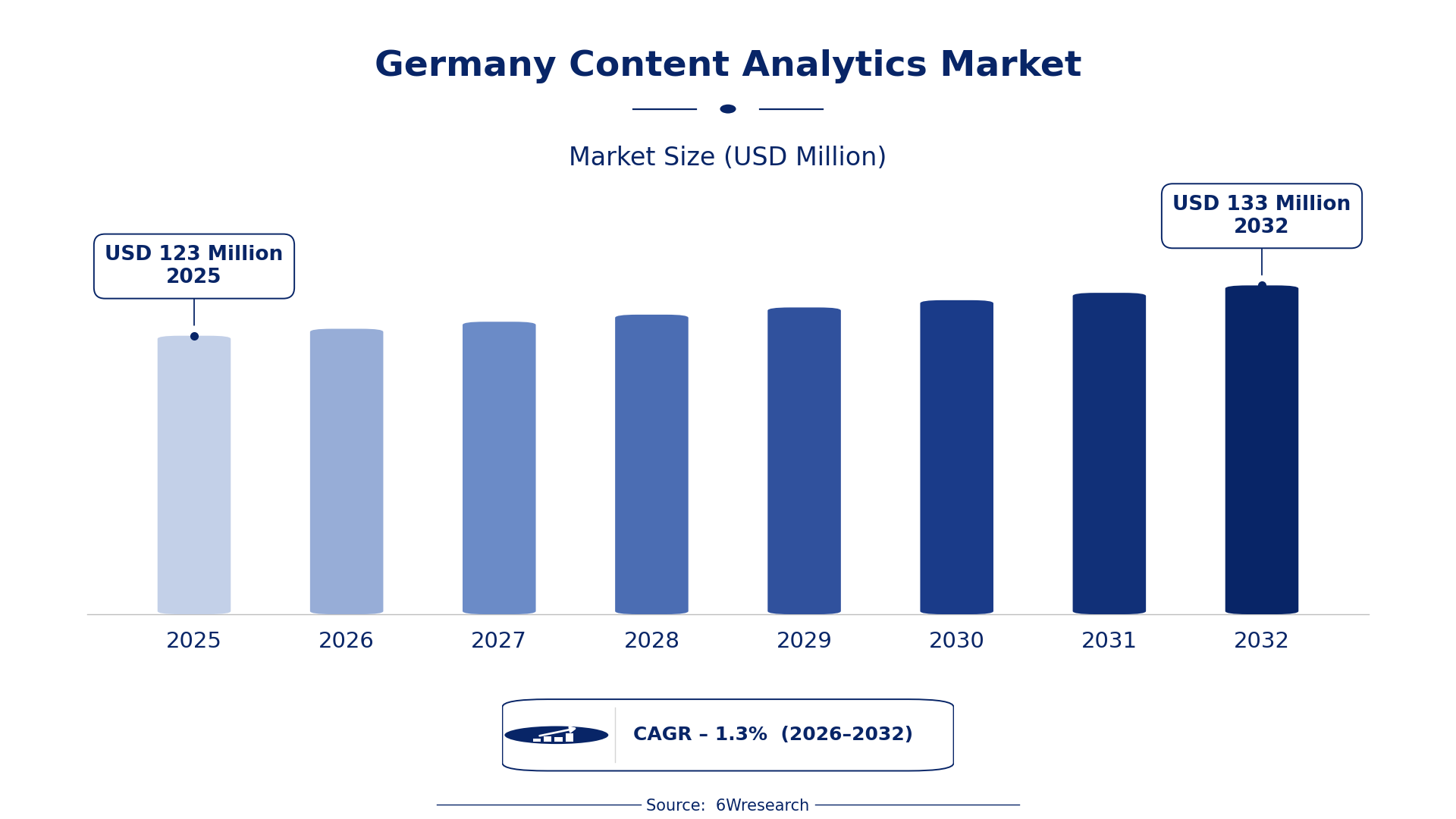
The Germany Content Analytics Market was estimated at USD 123 Million in 2025 and is projected to reach USD 133 Million by 2032, growing at a CAGR of 1.3% from 2026 to 2032.
Germany Content Analytics Market Synopsis
The content analytics market in Germany is experiencing a notable surge as organizations increasingly recognize the value of unstructured data. This trend is fueled by a growing digital landscape that demands sophisticated analytical capabilities to convert vast amounts of text, images, and video into actionable insights.
Businesses across various sectors are adopting content analytics solutions not just for operational efficiency, but also to enhance customer engagement. With leading companies investing in advanced technologies, the market is set to evolve, pushing the boundaries of how data can inform strategic decisions.
Germany Content Analytics Market Year-wise Growth Rate and Key Drivers
This graph illustrates the annual growth rates of the Germany Content Analytics Market from 2021 to 2032, highlighting a steady upward trajectory and projected expansion over the forecast period.
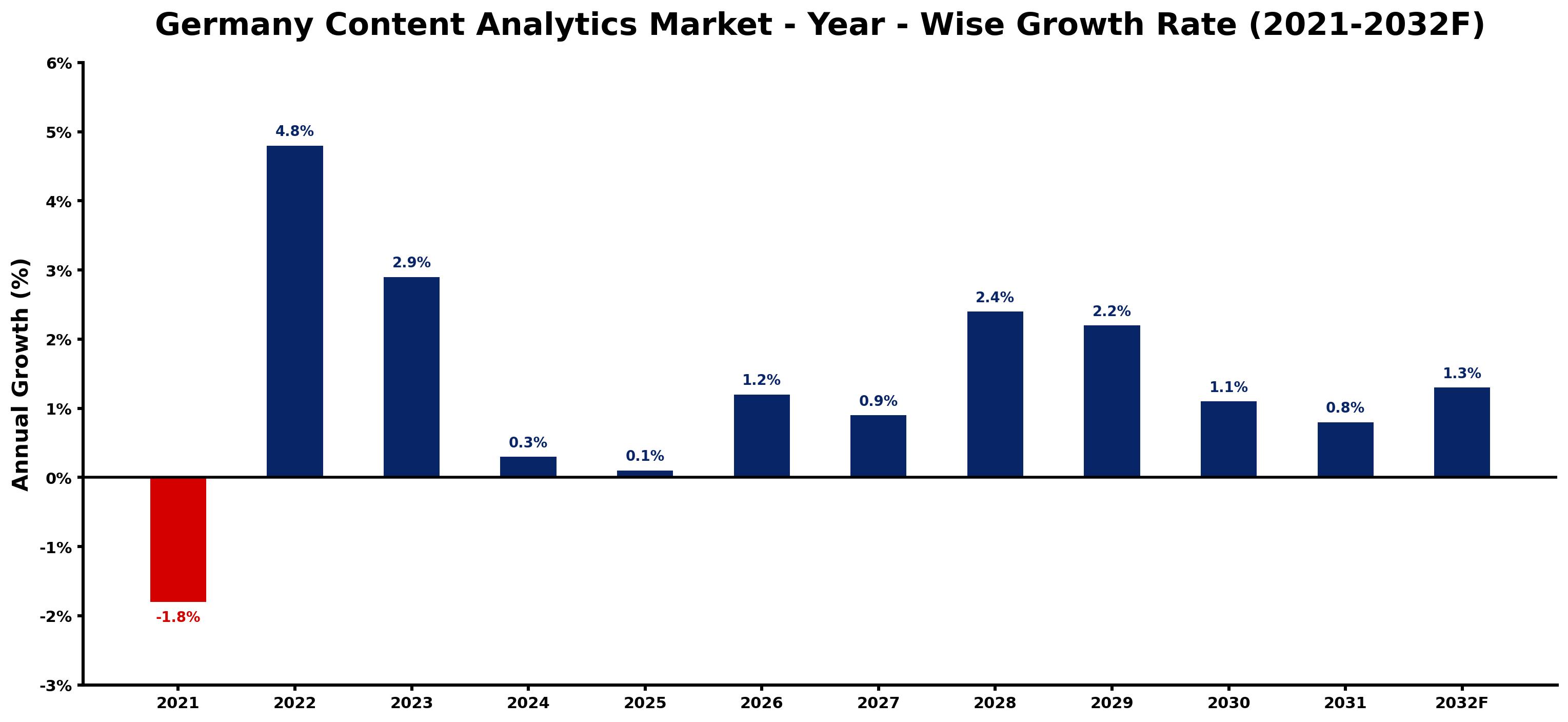
The table below presents the year‑wise growth rates along with the key drivers influencing the market
| Year | Growth Rate | Major Drivers |
| 2021 | -1.8% | GDPR compliance costs hindered innovative content analytics solutions. |
| 2022 | 4.8% | Data privacy regulations spurring demand for analytics tools. |
| 2023 | 2.9% | Increased media consumption driving content optimization needs. |
| 2024 | 0.3% | Rising use of AI technologies in content curation. |
| 2025 | 0.1% | Growing emphasis on personalized marketing strategies in Germany. |
| 2026 | 1.2% | Local startups innovating in content analytics applications. |
| 2027 | 0.9% | Evolving consumer behavior necessitating enhanced content insights. |
| 2028 | 2.4% | Increased focus on brand reputation management strategies. |
| 2029 | 2.2% | Adoption of advanced data visualization tools by enterprises. |
| 2030 | 1.1% | Germany's strong publishing sector boosting analytics requirements. |
| 2031 | 0.8% | Regulatory focus on data transparency encouraging content analysis. |
| 2032 | 1.3% | Corporate investments in audience engagement analytics solutions. |
Note: Market size estimations and growth projections presented in this report are based on 6Wresearch's proprietary forecasting methodology, utilizing the latest available industry data, government publications, and primary research inputs.
Germany Content Analytics Market Key Takeaways
Below are some of the specific key takeaways from the market, including:
- Organizations are increasingly utilizing content analytics to derive insights from digital content.
- The market is driven by the need for data-driven decision-making across various industries.
- Challenges exist in integrating diverse data sources and ensuring compliance with data protection regulations.
- Investment in technologies like machine learning and natural language processing is essential for market growth.
- Government policies are supporting the advancement of content analytics through research and development initiatives.
Evaluation of Restraints in Germany Content Analytics Market
Despite the market's potential, several restraints hinder its growth trajectory. One of the most pressing challenges is the complexity of analyzing varied content types. Organizations often struggle to find analytics tools that can efficiently process and interpret diverse formats, such as text, images, and videos. This limitation can impede the ability to extract actionable insights quickly.
on top of that, data privacy concerns, especially in light of stringent regulations like GDPR, complicate the implementation of content analytics solutions. Companies must navigate compliance intricacies while seeking to maximize the value derived from their data assets. These challenges necessitate a focus on developing scalable, compliant analytics frameworks that can adapt to evolving market demands.
Germany Content Analytics Market Trends
A notable trend is the increasing adoption of artificial intelligence within content analytics platforms. Businesses are leveraging AI to enhance data processing capabilities, enabling faster and more accurate analysis. This shift is not just about improving efficiency; it’s about deriving deeper insights that can shape business strategy.
on top of that, the integration of real-time analytics is gaining traction, allowing organizations to respond swiftly to market changes. This capability is particularly vital in sectors like retail and finance, where customer preferences and market conditions can shift rapidly. As the demand for agility grows, so does the need for advanced analytical solutions that can keep pace.
Germany Content Analytics Market Opportunities
Amidst the challenges, there are considerable opportunities for growth in the content analytics market. The rise of e-commerce and digital marketing has created a wealth of unstructured data ripe for analysis. Organizations that can harness this data will have a competitive edge in understanding customer behavior and preferences.
Investment in user-friendly analytics tools presents another opportunity. Businesses increasingly seek solutions that simplify data interpretation, making insights accessible to non-technical users. This democratization of data analytics can drive widespread adoption across sectors, leading to broader market growth.
Government Initiatives in the Germany Content Analytics Market
The German government recognizes the strategic importance of content analytics in enhancing innovation and economic performance. Policies are being designed to facilitate the integration of advanced analytics into various sectors, thereby boosting competitiveness. As businesses face regulatory pressures, government support is crucial for fostering a conducive environment for data-driven practices.
- A recently completed initiative focused on establishing a national framework for data sharing to promote innovation in analytics.
- Currently ongoing efforts include a public-private partnership aimed at developing educational programs in data analytics for the workforce.
- A planned initiative expected to launch in 2026 will provide funding for startups specializing in content analytics technologies.
- Recent regulatory updates have emphasized the importance of data privacy, influencing how businesses implement content analytics solutions.
- Ongoing collaboration with academic institutions is fostering research into new content analytics methodologies and tools.
Future Insights of the Germany Content Analytics Market
Looking ahead to 2026-2032, the Germany Content Analytics Market is set to undergo transformative changes. The integration of advanced technologies like AI and machine learning will likely redefine how businesses interpret data. As organizations continue to realize the importance of agile decision-making, the demand for sophisticated analytics tools will rise.
on top of that, as more industries embrace digital transformation, the necessity for content analytics will only increase. Companies that invest in innovative solutions now will be better positioned to leverage data for competitive advantage in the future.
Germany Content Analytics Market Latest Developments
In the past year, the Germany Content Analytics Market has seen significant activity as companies seek to enhance their analytical capabilities. A surge in interest around AI-driven tools has prompted various technology providers to accelerate product development. Organizations are increasingly investing in analytics platforms that offer deeper insights into customer behavior and operational efficiency.
- A leading technology vendor launched a new AI-powered content analytics platform in Q1 2025, aimed at improving data interpretation for businesses.
- An initiative that began in early 2025 focuses on creating industry-specific analytics solutions, currently underway with several pilot projects.
- A major regional operator is expanding its analytics service offerings, with plans to roll out enhanced features by mid-2026.
- In early 2025, a consortium of companies announced a collaborative effort to develop standardized metrics for content analytics, enhancing interoperability.
- A planned conference in late 2026 will bring together stakeholders to discuss the future of content analytics in Germany and share best practices.
Germany Content Analytics Market - Key Attractiveness of the Report
- 10 Years of Market Numbers
- Historical Data Starting from 2022 to 2025
- Base Year: 2025
- Forecast Data until 2032
- Key Performance Indicators Impacting the Market
- Major Upcoming Developments and Projects
Key Highlights of the Report:
- Germany Content Analytics Market Outlook
- Market Size of Germany Content Analytics Market, 2025
- Forecast of Germany Content Analytics Market, 2032
- Historical Data and Forecast of Germany Content Analytics Revenues & Volume for the Period 2022-2032F
- Germany Content Analytics Market Trend Evolution
- Germany Content Analytics Market Drivers and Challenges
- Germany Content Analytics Price Trends
- Germany Content Analytics Porter's Five Forces
- Germany Content Analytics Industry Life Cycle
- Historical Data and Forecast of Germany Content Analytics Market Revenues & Volume By Application for the Period 2022-2032F
- Historical Data and Forecast of Germany Content Analytics Market Revenues & Volume By Speech Analytics for the Period 2022-2032F
- Historical Data and Forecast of Germany Content Analytics Market Revenues & Volume By Text Analytics for the Period 2022-2032F
- Historical Data and Forecast of Germany Content Analytics Market Revenues & Volume By Web Analytics for the Period 2022-2032F
- Historical Data and Forecast of Germany Content Analytics Market Revenues & Volume By Social Media Analytics for the Period 2022-2032F
- Historical Data and Forecast of Germany Content Analytics Market Revenues & Volume By Others for the Period 2022-2032F
- Historical Data and Forecast of Germany Content Analytics Market Revenues & Volume By Deployment Type for the Period 2022-2032F
- Historical Data and Forecast of Germany Content Analytics Market Revenues & Volume By On-Premises for the Period 2022-2032F
- Historical Data and Forecast of Germany Content Analytics Market Revenues & Volume By Cloud/Hosted for the Period 2022-2032F
- Historical Data and Forecast of Germany Content Analytics Market Revenues & Volume By Vertical for the Period 2022-2032F
- Historical Data and Forecast of Germany Content Analytics Market Revenues & Volume By BFSI (Banking, Financial Services and Insurance) for the Period 2022-2032F
- Historical Data and Forecast of Germany Content Analytics Market Revenues & Volume By Retail & Consumer Goods for the Period 2022-2032F
- Historical Data and Forecast of Germany Content Analytics Market Revenues & Volume By IT & Telecom for the Period 2022-2032F
- Historical Data and Forecast of Germany Content Analytics Market Revenues & Volume By Healthcare for the Period 2022-2032F
- Historical Data and Forecast of Germany Content Analytics Market Revenues & Volume By Media & Entertainment for the Period 2022-2032F
- Historical Data and Forecast of Germany Content Analytics Market Revenues & Volume By Government for the Period 2022-2032F
- Historical Data and Forecast of Germany Content Analytics Market Revenues & Volume By Travel & Hospitality for the Period 2022-2032F
- Historical Data and Forecast of Germany Content Analytics Market Revenues & Volume By Others for the Period 2022-2032F
- Germany Content Analytics Import Export Trade Statistics
- Market Opportunity Assessment By Application
- Market Opportunity Assessment By Deployment Type
- Market Opportunity Assessment By Vertical
- Germany Content Analytics Top Companies Market Share
- Germany Content Analytics Competitive Benchmarking By Technical and Operational Parameters
- Germany Content Analytics Company Profiles
- Germany Content Analytics Key Strategic Recommendations






































