Germany Docker Monitoring Market Size & Growth Rate (2026-2032)
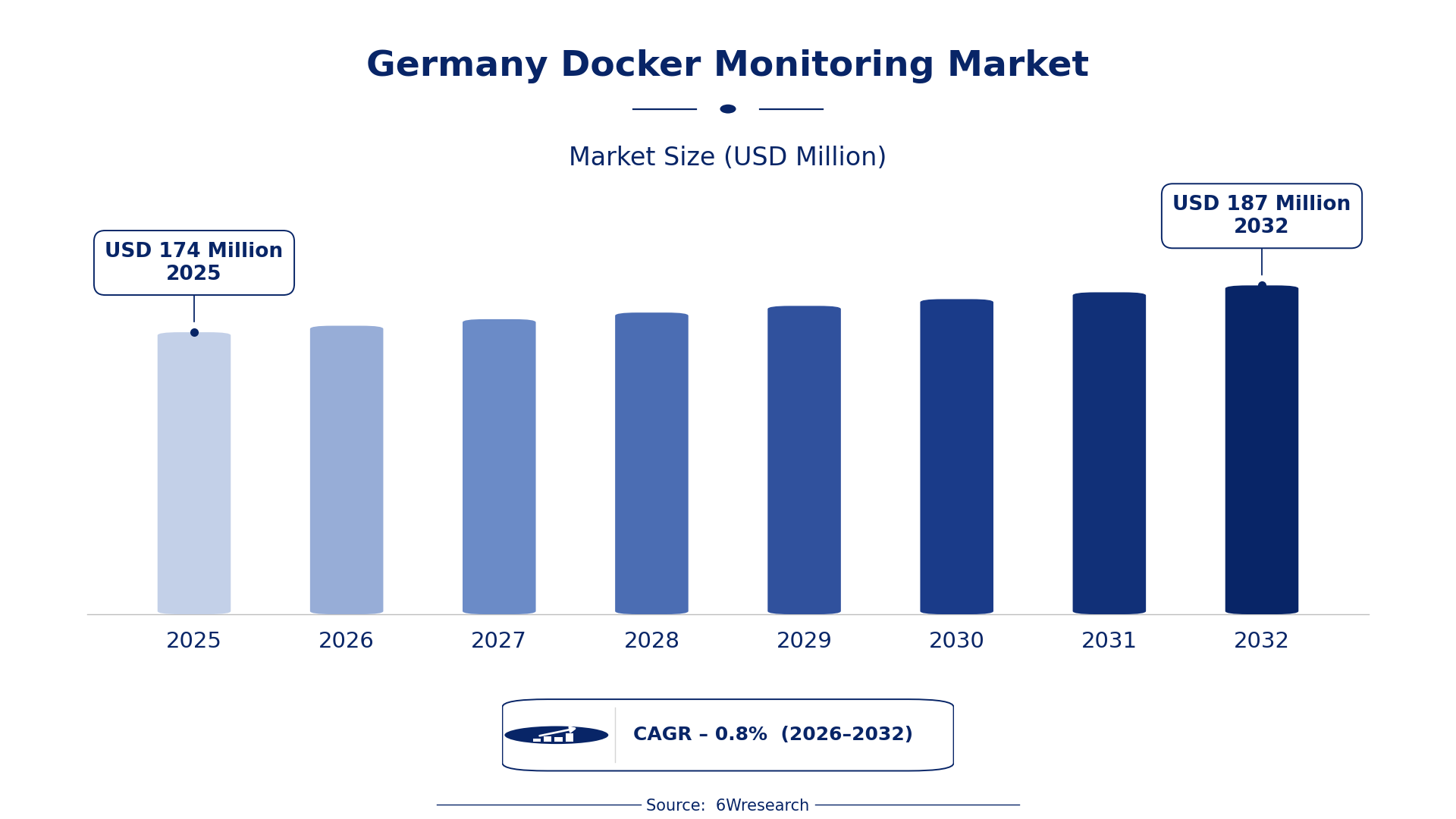
The Germany Docker Monitoring Market was estimated at USD 174 Million in 2025 and is projected to reach USD 187 Million by 2032, growing at a CAGR of 0.8% from 2026 to 2032.
Germany Docker Monitoring Market Synopsis
The adoption of Docker containers is reshaping the operational frameworks of many businesses in Germany. As organizations increasingly seek to enhance their agility and scalability, effective monitoring solutions have become essential for maintaining the health and performance of containerized applications.
With a growing emphasis on DevOps practices and the integration of cloud-native technologies, the Germany Docker Monitoring Market is thriving. Companies are recognizing the necessity of real-time insights into Docker container performance, thereby driving demand for sophisticated monitoring tools tailored to meet the unique challenges of container orchestration.
Germany Docker Monitoring Market Year-wise Growth Rate and Key Drivers
This graph illustrates the annual growth rates of the Germany Docker Monitoring Market from 2021 to 2032, highlighting a steady upward trajectory and projected expansion over the forecast period.
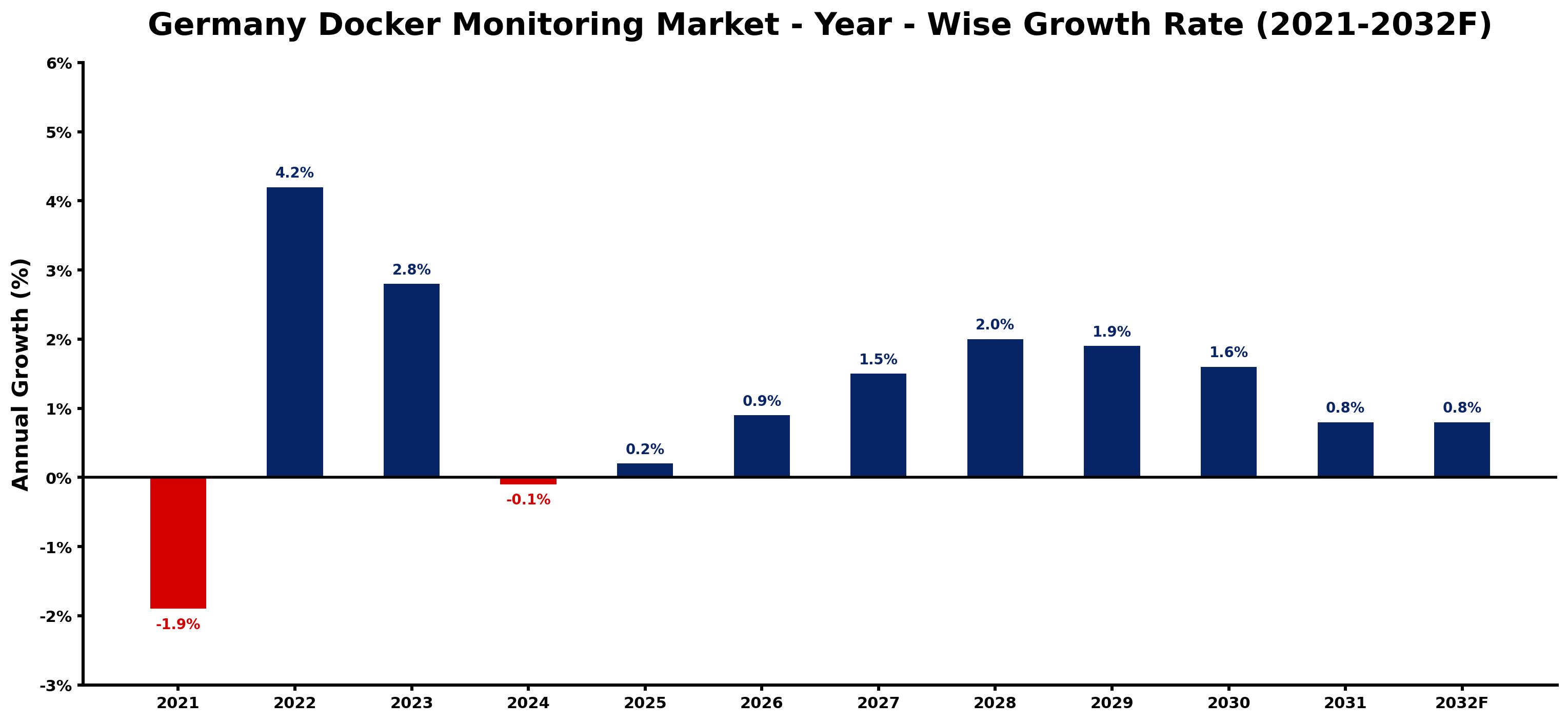
The table below presents the year‑wise growth rates along with the key drivers influencing the market
| Year | Growth Rate | Major Drivers |
| 2021 | -1.9% | EU data privacy regulations impact monitoring software adoption |
| 2022 | 4.2% | Increased adoption of microservices in German enterprises. |
| 2023 | 2.8% | Enhanced Kubernetes integration for efficient container management. |
| 2024 | -0.1% | Reduced enterprise spending on IT infrastructure amid economic uncertainty |
| 2025 | 0.2% | Strong government backing for open-source software initiatives. |
| 2026 | 0.9% | Rise in remote work fueling container monitoring needs. |
| 2027 | 1.5% | Growing focus on application security compliance regulations. |
| 2028 | 2.0% | Adoption of AI-driven monitoring solutions in digital transformation. |
| 2029 | 1.9% | Development of local startups specializing in container orchestration. |
| 2030 | 1.6% | Greater emphasis on cloud-native applications in industries. |
| 2031 | 0.8% | Increased investment in IT infrastructure modernization projects. |
| 2032 | 0.8% | Emergence of industry-specific monitoring solutions for efficiency. |
Note: Market size estimations and growth projections presented in this report are based on 6Wresearch's proprietary forecasting methodology, utilizing the latest available industry data, government publications, and primary research inputs.
Germany Docker Monitoring Market Key Takeaways
Below are some of the specific key takeaways from the market, including:
- The market is driven by the increasing complexity of containerized environments and the need for efficient performance monitoring.
- Real-time monitoring solutions are gaining traction, particularly in industries that prioritize application performance and security.
- There is a notable shift towards cloud-based monitoring solutions, aligning with digital transformation efforts.
- Vendors are focusing on developing tools that offer insights into application dependencies and resource utilization.
- Regulatory compliance, particularly with GDPR, is influencing the development of secure monitoring solutions.
Evaluation of Restraints in Germany Docker Monitoring Market
Despite its promising outlook, the Germany Docker Monitoring Market faces notable constraints. The rapid deployment of containers introduces a complexity that can overwhelm traditional monitoring systems. Many organizations struggle to maintain visibility across numerous dynamic containers, which can lead to performance bottlenecks and security vulnerabilities.
on top of that, the lack of standardized metrics specific to Docker environments complicates effective monitoring. As companies scale their container usage, ensuring compliance with evolving security regulations adds another layer of difficulty. To thrive in this environment, businesses must adopt specialized monitoring solutions that are equipped to handle the unique demands of containerized infrastructures.
Germany Docker Monitoring Market Trends
Current trends in the Germany Docker Monitoring Market are increasingly focused on enhancing visibility and performance. The demand for real-time analytics has surged, as organizations prioritize operational efficiency in their containerized applications. Additionally, the integration of AI and machine learning technologies into monitoring tools is emerging, promising to enhance predictive capabilities and automate performance management.
on top of that, as more companies adopt microservices architectures, the need for advanced monitoring solutions that can effectively manage application dependencies and network performance is intensifying. This trend indicates a shift toward more comprehensive, intelligent monitoring platforms that provide deeper insights into application health.
Germany Docker Monitoring Market Opportunities
The landscape presents several growth opportunities for vendors specializing in Docker monitoring solutions. The increasing focus on cloud migration opens avenues for the development of cloud-native monitoring tools. These tools can offer scalability and flexibility that align with evolving business needs.
Additionally, as companies embrace DevOps methodologies, there is a pressing need for monitoring solutions that integrate seamlessly into continuous integration and continuous deployment (CI/CD) pipelines. Vendors who can create tailored solutions for specific industries, such as finance or healthcare, will likely find a receptive market as compliance and security requirements remain paramount.
Government Initiatives in the Germany Docker Monitoring Market
Government policy in Germany plays a crucial role in shaping the Docker monitoring market. With stringent regulations around data protection, particularly the General Data Protection Regulation (GDPR), companies must adapt their monitoring strategies to comply with legal requirements. The German government is actively promoting cybersecurity initiatives, which include support for secure and compliant monitoring practices in Docker environments.
- A recently completed national cybersecurity strategy aims to enhance data protection frameworks, directly impacting the Docker monitoring market.
- Currently ongoing efforts include workshops and seminars aimed at educating businesses about compliance with GDPR and its implications for monitoring practices.
- Upcoming initiatives plan to establish a regulatory framework that mandates enhanced data transparency in monitoring tools by late 2026.
- The government is also investing in public-private partnerships to develop secure digital infrastructures that support containerization technologies.
- Proposals for a cybersecurity innovation fund are underway, which will focus on developing advanced monitoring solutions for containerized applications.
Future Insights of the Germany Docker Monitoring Market
Looking ahead, the Germany Docker Monitoring Market is expected to evolve significantly by 2032. The shift toward cloud-native architectures and the increasing adoption of microservices will further catalyze demand for specialized monitoring solutions. As organizations continue to refine their DevOps practices, the focus will likely be on tools that not only monitor but also provide actionable insights for performance optimization.
Investment in AI-driven monitoring technologies will become essential, as predictive analytics can help organizations anticipate issues before they escalate. As compliance requirements tighten, vendors offering secure and compliant monitoring solutions will be in a strong position to capture market share.
Germany Docker Monitoring Market Latest Developments
Recent activity in the Germany Docker Monitoring Market highlights a strong push towards innovation and compliance. In the last year, companies have focused on enhancing their monitoring capabilities to keep pace with the demands of containerized applications. This trend reflects a broader commitment to operational excellence and regulatory adherence.
- A major technology vendor launched an advanced Docker monitoring tool in Q1 2025 that integrates AI for predictive analytics and real-time performance management.
- An initiative that began in late 2025 focuses on developing a comprehensive compliance framework for monitoring solutions tailored to GDPR requirements.
- In early 2026, a leading regional operator is expected to roll out a new cloud-based monitoring service designed for scalable Docker deployments.
- A partnership formed in mid-2025 between two technology firms aims to enhance interoperability between monitoring tools and container orchestration platforms.
- Upcoming in late 2026 is a pilot program to evaluate the effectiveness of blockchain technology in securing Docker monitoring processes.
Germany Docker Monitoring Market - Key Attractiveness of the Report
- 10 Years of Market Numbers
- Historical Data Starting from 2022 to 2025
- Base Year: 2025
- Forecast Data until 2032
- Key Performance Indicators Impacting the Market
- Major Upcoming Developments and Projects
Key Highlights of the Report:
- Germany Docker Monitoring Market Outlook
- Market Size of Germany Docker Monitoring Market, 2025
- Forecast of Germany Docker Monitoring Market, 2032
- Historical Data and Forecast of Germany Docker Monitoring Revenues & Volume for the Period 2022-2032F
- Germany Docker Monitoring Market Trend Evolution
- Germany Docker Monitoring Market Drivers and Challenges
- Germany Docker Monitoring Price Trends
- Germany Docker Monitoring Porter's Five Forces
- Germany Docker Monitoring Industry Life Cycle
- Historical Data and Forecast of Germany Docker Monitoring Market Revenues & Volume By Component for the Period 2022-2032F
- Historical Data and Forecast of Germany Docker Monitoring Market Revenues & Volume By Solution for the Period 2022-2032F
- Historical Data and Forecast of Germany Docker Monitoring Market Revenues & Volume By Services for the Period 2022-2032F
- Historical Data and Forecast of Germany Docker Monitoring Market Revenues & Volume By Industry Vertical for the Period 2022-2032F
- Historical Data and Forecast of Germany Docker Monitoring Market Revenues & Volume By Information Technology (IT) and telecom for the Period 2022-2032F
- Historical Data and Forecast of Germany Docker Monitoring Market Revenues & Volume By Banking, Financial Services, and Insurance (BFSI) for the Period 2022-2032F
- Historical Data and Forecast of Germany Docker Monitoring Market Revenues & Volume By eCommerce and Retail for the Period 2022-2032F
- Historical Data and Forecast of Germany Docker Monitoring Market Revenues & Volume By Media and Entertainment for the Period 2022-2032F
- Historical Data and Forecast of Germany Docker Monitoring Market Revenues & Volume By Travel and Hospitality for the Period 2022-2032F
- Historical Data and Forecast of Germany Docker Monitoring Market Revenues & Volume By Healthcare and Life Sciences for the Period 2022-2032F
- Historical Data and Forecast of Germany Docker Monitoring Market Revenues & Volume By Others for the Period 2022-2032F
- Historical Data and Forecast of Germany Docker Monitoring Market Revenues & Volume By Deployment Type for the Period 2022-2032F
- Historical Data and Forecast of Germany Docker Monitoring Market Revenues & Volume By On-premises for the Period 2022-2032F
- Historical Data and Forecast of Germany Docker Monitoring Market Revenues & Volume By Cloud for the Period 2022-2032F
- Historical Data and Forecast of Germany Docker Monitoring Market Revenues & Volume By Organization Size for the Period 2022-2032F
- Historical Data and Forecast of Germany Docker Monitoring Market Revenues & Volume By Small and Medium-sized Enterprises (SMEs) for the Period 2022-2032F
- Historical Data and Forecast of Germany Docker Monitoring Market Revenues & Volume By Large Enterprises for the Period 2022-2032F
- Germany Docker Monitoring Import Export Trade Statistics
- Market Opportunity Assessment By Component
- Market Opportunity Assessment By Industry Vertical
- Market Opportunity Assessment By Deployment Type
- Market Opportunity Assessment By Organization Size
- Germany Docker Monitoring Top Companies Market Share
- Germany Docker Monitoring Competitive Benchmarking By Technical and Operational Parameters
- Germany Docker Monitoring Company Profiles
- Germany Docker Monitoring Key Strategic Recommendations






































