Germany Heat Pump Market: Import Trend Analysis
In 2024, Germany`s heat pump market saw a notable increase in imports. This trend was driven by a growing demand for energy-efficient heating solutions, prompting the market to rely more on imported heat pumps to meet consumer needs.
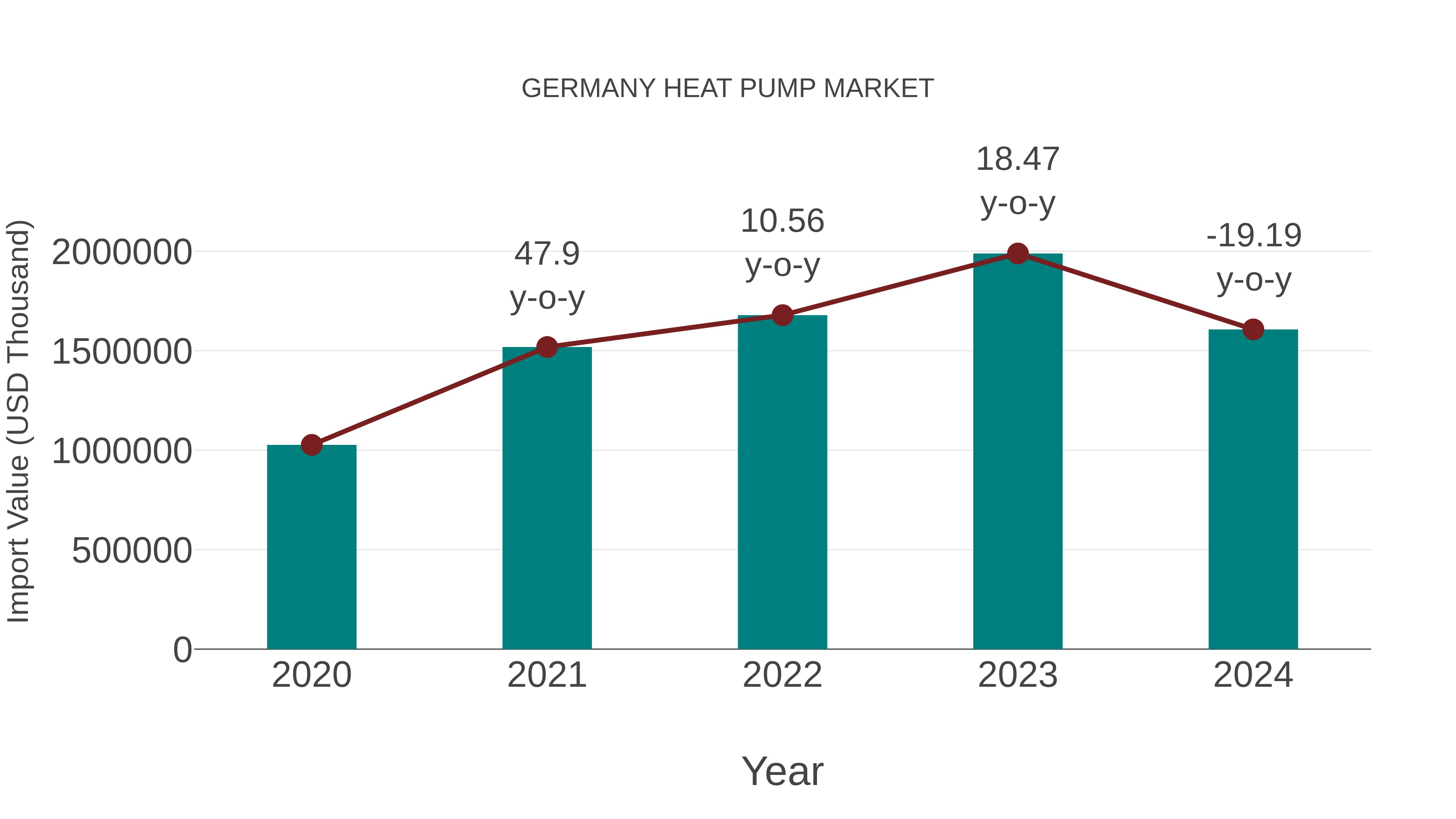
Germany Heat Pump Market Growth Rate
According to 6Wresearch internal database and industry insights, the Germany Heat Pump Market is projected to grow at a compound annual growth rate (CAGR) of 9% during the forecast period from 2026 to 2032.
Topics Covered in the Germany Heat Pump Market Report
The Germany Heat Pump Market report thoroughly covers the market by type, refrigerant, rated capacity, and end-user, providing an unbiased and detailed analysis of ongoing market trends, opportunities, challenges, and market drivers, helping stakeholders align their strategies with current and future market dynamics.
Germany Heat Pump Market Highlights
| Report Name | Germany Heat Pump Market |
| Forecast period | 2026-2032 |
| CAGR | 9% |
| Growing Sector | Heat Pumps |
Germany Heat Pump Market Synopsis
The Germany Heat Pump Market is experiencing rapid growth as people want energy-efficient heating systems and the country prioritizes sustainable development. The residential, commercial and industrial sectors are expanding their operations which leads to increased demand for heat pumps. Government incentives and regulations which support renewable energy development make heat pumps an attractive solution. The increasing need to decrease carbon emissions has made heat pumps the preferred solution as they provide efficient and environmentally friendly heating options which drive market expansion.
Evaluation of Growth Drivers in the Germany Heat Pump Market
Below mentioned are some prominent drivers and their impact on the market dynamics:
| Drivers | Primary Segments Affected | Why It Matters (Evidence) |
| Energy Efficiency Demand | All Product Types | The growing focus on reducing energy consumption is driving adoption across all segments. |
| Government Subsidies | All Product Types | Incentives and financial support are making heat pumps more affordable for consumers. |
| Focus on Carbon Emission Reduction | Air-to-Water, Water Source | Heat pumps are gratified to have been designed impeccably for sustainability goals, thus having a carbon-efficient advantage. |
| Growing Residential and Commercial Demand | Air-to-Air, Air-to-Water, Geothermal | There is a growing demand for energy-efficient and environmentally friendly heating solutions in both residential and commercial markets. |
| Technological Advancements in Heat Pump Systems | Hybrid, Water Source | The continued trend towards heat pump technology means a higher level of effectiveness and efficiency in relation to performance. |
The Germany Heat Pump Market Size is projected to grow at a CAGR of 9% from 2026 to 2032. The Germany Heat Pump Market exists as customers want heating systems which operate using less energy and provide environmental benefits. Government incentives and regulations which support renewable energy adoption are creating new business opportunities. The market experiences growth as more consumers understand how their activities affect carbon emissions and how they can save energy. However, the development of hybrid and smart systems has led to better heat pump efficiency which results in improved performance and reduced operational expenses.
Evaluation of Restraints in the Germany Heat Pump Market
Below mentioned are some major restraints and their influence on the market dynamics:
| Restraints | Primary Segments Affected | What This Means (Evidence) |
| High Initial Investment Cost | All Product Types | The upfront cost of purchasing and installing heat pump systems can be prohibitive for some consumers. |
| Awareness Gaps | Air-to-Water, Geothermal | A lack of understanding about the long-term advantages and cost savings of heat pumps which cannot be understood as they require time to show results will stop their widespread use. |
| Regulatory Challenges | All Product Types | The implementation of strict regulatory standards will result in higher operational expenses which will prevent organizations from achieving rapid implementation of their systems. |
| Installation Complexity | Water Source, Geothermal | Complex installation processes for certain heat pump types can increase time and costs. |
| Limited Availability in Rural Areas | All Product Types | Poor availability of installation services in rural areas can deter progress alone. |
Germany Heat Pump Market Challenges
The Germany Heat Pump Industry faces several challenges, including the high initial costs associated with installation and the complexity of the systems, especially for geothermal and water-source pumps. People need better information about heat pumps' long-term advantages and their energy-saving capabilities as this knowledge gap prevents people from adopting heat pumps. The market growth potential gets affected by two factors, which include the complicated regulations and the insufficient installation service coverage in different areas. The organization needs to educate its consumers while developing better technology and providing system adoption incentives to achieve its main objectives.
Germany Heat Pump Market Trends
Here are some major trends changing the Germany Heat Pump Market Growth dynamics:
- Shift Toward Sustainable Energy Solutions: The current focus on renewable energy and carbon footprint reduction leads to increased adoption of heat pumps which provide an eco-friendly heating system that uses less energy than conventional heating systems.
- Government Incentives and Subsidies: The German government maintains its support for energy-efficient systems through subsidies and grants which create increased demand for heat pumps in residential and commercial applications.
- Technological Advancements: Heat pump technology advances through new innovations which develop hybrid systems that merge air-source and geothermal functions to create more efficient and effective heat pump systems that attract more consumer interest.
Investment Opportunities in the Germany Heat Pump Market
The Germany Heat Pump Market presents several investment opportunities, including:
- Investment in Technological Research and Development: Companies will develop better products through their research work on advanced heat pump systems which will provide them with superior operational performance and extended product lifespan at reduced manufacturing expenses.
- Expansion of Residential Market: The residential market represents a major growth opportunity through its existing customer base and governmental financial support which targets residential customers.
- Smart Heat Pump Solutions: The growing demand for home automation and energy management systems will be met through our investments in IoT-enabled smart heat pump systems.
Top 5 Leading Players in the Germany Heat Pump Market
Below is the list of prominent companies leading the Germany Heat Pump Market Share:
1. Vaillant Group
| Company Name | Vaillant Group |
| Established Year | 1874 |
| Headquarters | Remscheid, Germany |
| Official Website | Click Here |
Vaillant is a leading manufacturer of heating, ventilation, and air conditioning (HVAC) systems, specializing in energy-efficient heat pump technologies for residential and commercial applications.
2. Bosch Thermotechnology
| Company Name | Bosch Thermotechnology |
| Established Year | 1886 |
| Headquarters | Wernau, Germany |
| Official Website | Click Here |
Bosch offers a wide range of heat pump solutions for residential and commercial heating needs, focusing on sustainability, efficiency, and cost-effectiveness.
3. Stiebel Eltron
| Company Name | Stiebel Eltron |
| Established Year | 1924 |
| Headquarters | Holzminden, Germany |
| Official Website | Click Here |
Stiebel Eltron is a major player in the German heat pump market, providing a diverse range of energy-efficient heat pump systems, including air-to-water, water-source, and hybrid models.
4. Fujitsu General Ltd.
| Company Name | Fujitsu General Ltd. |
| Established Year | 1936 |
| Headquarters | Tokyo, Japan |
| Official Website | Click Here |
Fujitsu is a global leader in air-conditioning and heating technologies, including heat pump systems that are known for their reliability and energy efficiency.
5. Daikin Industries Ltd.
| Company Name | Daikin Industries Ltd. |
| Established Year | 1924 |
| Headquarters | Osaka, Japan |
| Official Website | Click Here |
Daikin is a prominent manufacturer of HVAC solutions, including heat pump systems, with a strong focus on innovation and energy-efficient technologies.
Government Regulations Introduced in the Germany Heat Pump Market
According to German government data, the German government has established multiple programs to assist with heat pump implementation which includes the KfW Energy Efficiency Program that offers funding support for energy-efficient system installations. The German Renewable Energy Act (EEG) requires renewable energy sources to be used which provides a financial incentive for heat pump operation. The government mandates the use of energy-efficient technologies in new buildings and renovations via its Energy Saving Ordinance (EnEV), enforcing stringent building codes.
Future Insights of the Germany Heat Pump Market
Due to improvements in energy efficiency, an increase in sustainable heat sources of heating, and supportive government policies throughout the entire Market. The Growth potential of the heat pump industry is very promising. The heat pump industry will continue to grow significantly due to the increasing number of consumers who are concerned with the energy efficiency and sustainability of their home heating systems and the continued introduction of hybrid and smart technology into this customer base.
Market Segmentation Analysis
The report offers a comprehensive study of the following market segments and their leading categories:
By Type - Air-to-Water to Dominate the Market
According to Ritika Kalra, Senior Research Analyst, 6Wresearch, Air-to-water heat pumps are expected to dominate the market due to their cost-effectiveness and versatility in both residential and commercial heating applications. With their straightforward installation, dual heating and cooling capabilities, these systems are perfect for year-round use.
By Refrigerant - R410A to Dominate the Market
The market transition will center on R410A refrigerant which provides both energy efficient performance and environmental benefits. The modern heat pump systems select R410A as their refrigerant as it delivers better heat transfer performance than traditional refrigerants.
By Rated Capacity - Up to10 kW to Dominate the Market
Heat pumps with a rated capacity of up to 10 kW will become the most common system as they work best for residential heating needs. The smaller systems provide the best solution for single-family homes that need energy-efficient heating.
By End User - Residential to Dominate the Market
The residential segment is expected to dominate the market as more households now use heat pumps for their heating needs. The combination of rising demand for energy-efficient heating solutions and governmental funding programs is leading to increased adoption of heat pumps in residential areas.
Key Attractiveness of the Report
- 10 Years of Market Numbers
- Historical Data Starting from 2022 to 2025
- Base Year: 2025
- Forecast Data until 2032
- Key Performance Indicators Impacting the Market
- Major Upcoming Developments and Projects
Key Highlights of the Report:
- Germany Heat Pump Market Outlook
- Market Size of Germany Heat Pump Market, 2025
- Forecast of Germany Heat Pump Market, 2032
- Historical Data and Forecast of Germany Heat Pump Revenues & Volume for the Period 2022 - 2032F
- Germany Heat Pump Market Trend Evolution
- Germany Heat Pump Market Drivers and Challenges
- Germany Heat Pump Price Trends
- Germany Heat Pump Porter's Five Forces
- Germany Heat Pump Industry Life Cycle
- Historical Data and Forecast of Germany Heat Pump Market Revenues & Volume By Type for the Period 2022 - 2032F
- Historical Data and Forecast of Germany Heat Pump Market Revenues & Volume By Air-to-Air for the Period 2022 - 2032F
- Historical Data and Forecast of Germany Heat Pump Market Revenues & Volume By Air-to-Water for the Period 2022 - 2032F
- Historical Data and Forecast of Germany Heat Pump Market Revenues & Volume By Water Source for the Period 2022 - 2032F
- Historical Data and Forecast of Germany Heat Pump Market Revenues & Volume By Geothermal for the Period 2022 - 2032F
- Historical Data and Forecast of Germany Heat Pump Market Revenues & Volume By Hybrid for the Period 2022 - 2032F
- Historical Data and Forecast of Germany Heat Pump Market Revenues & Volume By Refrigerant for the Period 2022 - 2032F
- Historical Data and Forecast of Germany Heat Pump Market Revenues & Volume By R410A for the Period 2022 - 2032F
- Historical Data and Forecast of Germany Heat Pump Market Revenues & Volume By R407C for the Period 2022 - 2032F
- Historical Data and Forecast of Germany Heat Pump Market Revenues & Volume By R744 for the Period 2022 - 2032F
- Historical Data and Forecast of Germany Heat Pump Market Revenues & Volume By Rated Capacity for the Period 2022 - 2032F
- Historical Data and Forecast of Germany Heat Pump Market Revenues & Volume By Up to 10 kW for the Period 2022 - 2032F
- Historical Data and Forecast of Germany Heat Pump Market Revenues & Volume By 10-20 kW for the Period 2022 - 2032F
- Historical Data and Forecast of Germany Heat Pump Market Revenues & Volume By 20-30 kW for the Period 2022 - 2032F
- Historical Data and Forecast of Germany Heat Pump Market Revenues & Volume By >30 kW for the Period 2022 - 2032F
- Historical Data and Forecast of Germany Heat Pump Market Revenues & Volume By End User for the Period 2022 - 2032F
- Historical Data and Forecast of Germany Heat Pump Market Revenues & Volume By Residential for the Period 2022 - 2032F
- Historical Data and Forecast of Germany Heat Pump Market Revenues & Volume By Commercial for the Period 2022 - 2032F
- Historical Data and Forecast of Germany Heat Pump Market Revenues & Volume By Industrial for the Period 2022 - 2032F
- Germany Heat Pump Import Export Trade Statistics
- Market Opportunity Assessment By Type
- Market Opportunity Assessment By Refrigerant
- Market Opportunity Assessment By Rated Capacity
- Market Opportunity Assessment By End User
- Germany Heat Pump Top Companies Market Share
- Germany Heat Pump Competitive Benchmarking By Technical and Operational Parameters
- Germany Heat Pump Company Profiles
- Germany Heat Pump Key Strategic Recommendations
Market Covered
The report offers a comprehensive study of the subsequent market segments:
By Type
- Air-to-Air
- Air-to-Water
- Water Source
- Geothermal
- Hybrid
By Refrigerant
- R410A
- R407C
- R744
By Rated Capacity
- Up to 10 kW
- 10-20 kW
- 20-30 kW
- 30 kW
By End User
- Residential
- Commercial
- Industrial






































