Germany Imitation Jewelry Market Size (2020-2030)
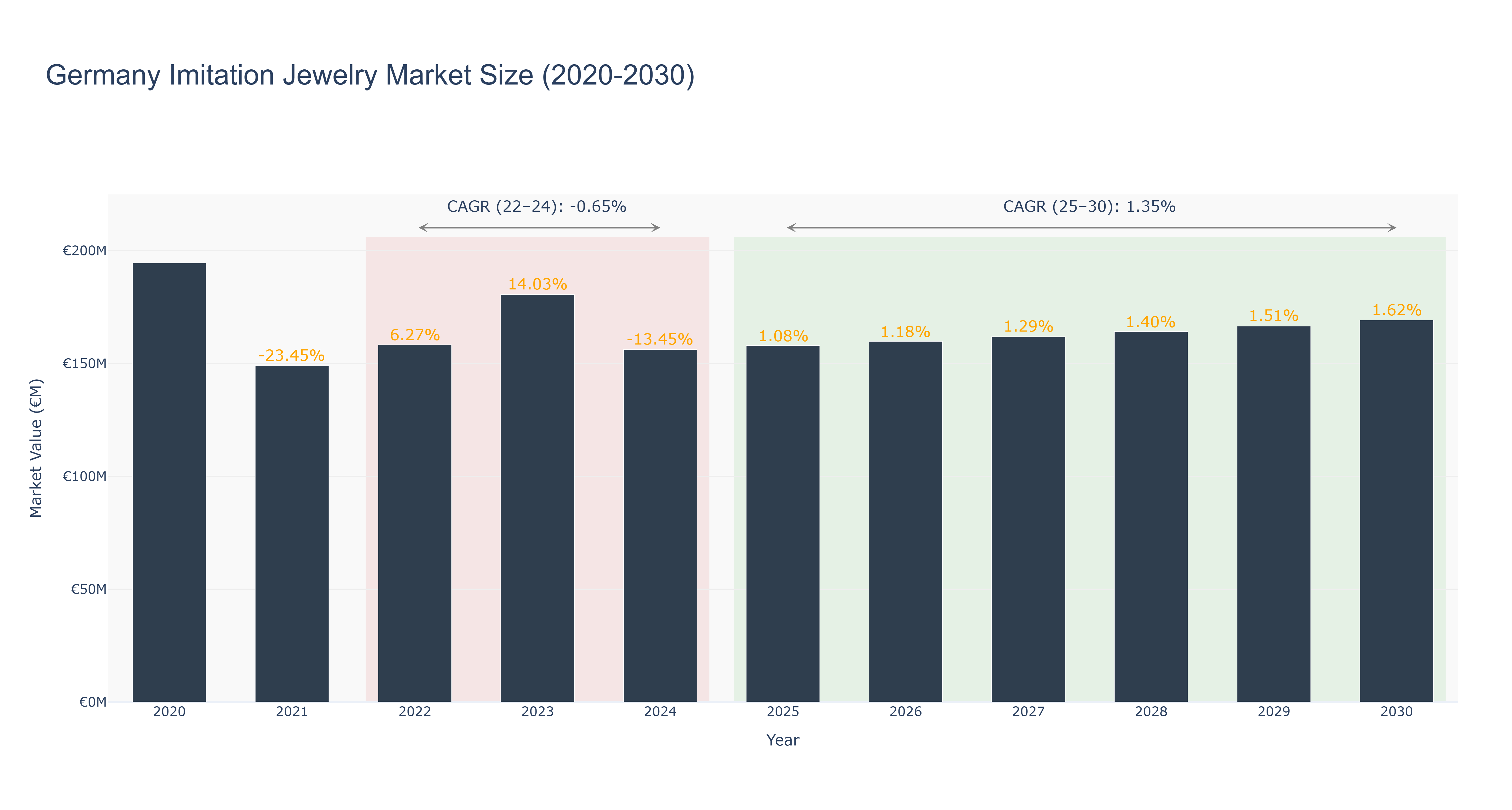
Germany's Imitation Jewelry Market experienced fluctuations in recent years. The market peaked at €180.52 million in 2023, showing a growth rate of 14.03%. However, it declined to €156.25 million in 2024, a decrease of -13.45%. From 2025 to 2030, the market is forecasted to grow steadily, with a CAGR of 1.35%. The recent growth can be attributed to changing consumer preferences and increasing disposable income. Looking ahead, the market is expected to see further growth driven by innovative product offerings and expanding distribution channels. In the near future, Germany's Imitation Jewelry Market is set to witness the launch of sustainable jewelry lines to cater to the growing demand for eco-friendly products in the fashion industry.
Germany Imitation Jewelry Market: Production & Trade Performance (2019-2025)
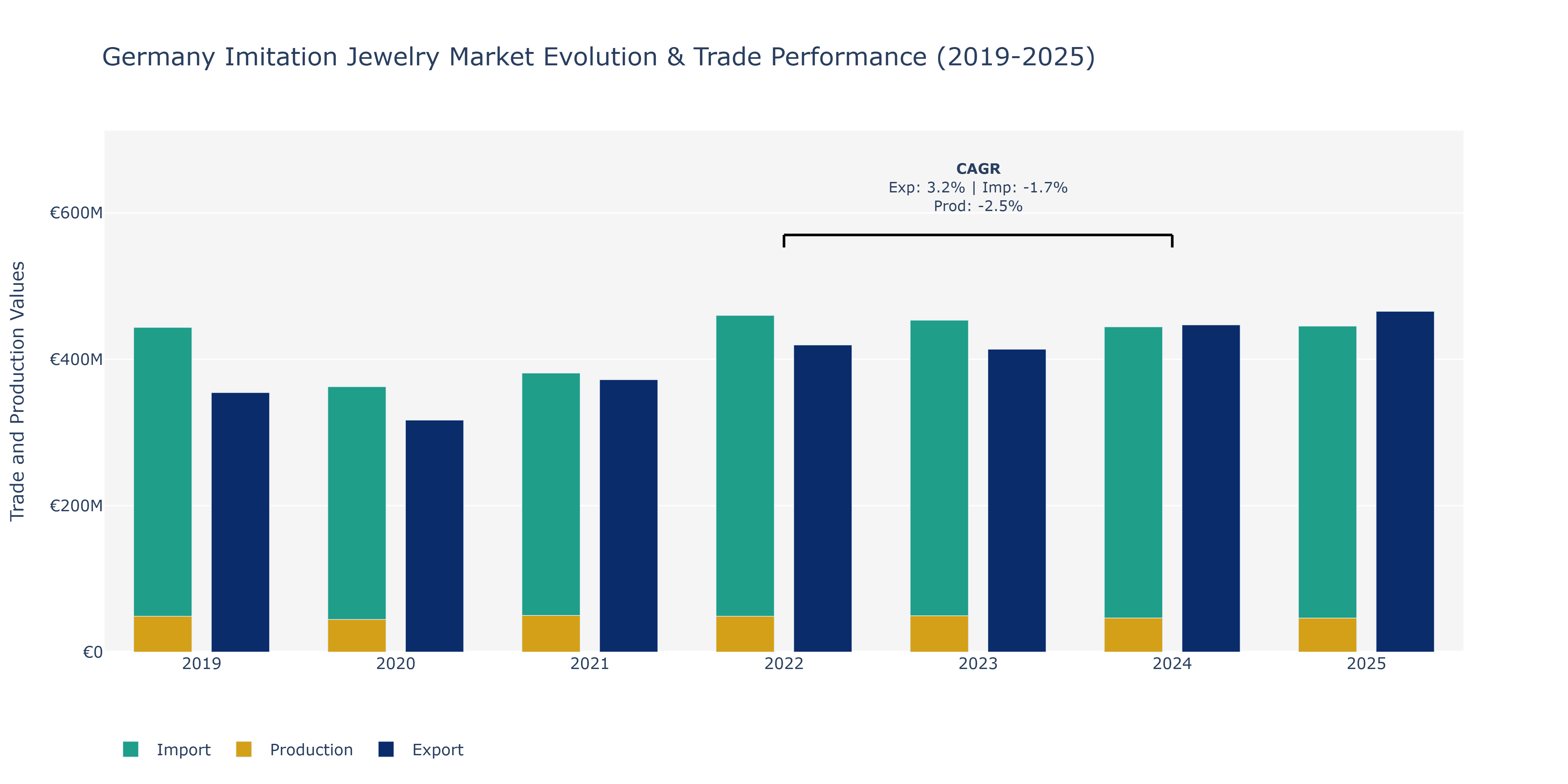
In the Germany Imitation Jewelry Market, from 2019 to 2025, exports exhibited a fluctuating trend, starting at €354.46 million and reaching €465.52 million in 2025, showing a consistent increase with a peak in the final year. Imports, on the other hand, fluctuated as well, starting at €443.54 million in 2019, decreasing in 2020, and then stabilizing around the €445 million mark from 2023 to 2025. Production levels peaked in 2021 at €50.04 million before declining slightly in the following years. The market's performance reflects global economic conditions dictating consumer demand for imitation jewelry, with export growth possibly driven by international fashion trends and marketing efforts. The fluctuations in imports could be influenced by changing consumer preferences or shifts in the supply chain. The stability in production levels after 2021 might suggest market saturation or optimization of manufacturing processes to meet demand more efficiently.
Germany Imitation Jewelry Market Overview
The Germany Imitation Jewelry Market is a thriving sector within the fashion industry, offering consumers affordable and trendy accessories that mimic the look of fine jewelry. The market is driven by factors such as changing fashion trends, increasing disposable income, and growing preference for versatile and cost-effective jewelry options. Key players in the market include both domestic and international manufacturers and retailers, offering a wide range of imitation jewelry products including earrings, necklaces, bracelets, and rings. With a focus on quality craftsmanship and innovative designs, the Germany Imitation Jewelry Market caters to a diverse consumer base looking to accessorize their outfits without breaking the bank. Online retail channels and social media influencers play a significant role in promoting these products and driving consumer demand.
Germany Imitation Jewelry Market Trends
The Germany Imitation Jewelry Market is experiencing a surge in demand for sustainable and ethically sourced products, with consumers increasingly seeking environmentally friendly options. Additionally, there is a growing preference for minimalist and versatile designs that can be easily paired with various outfits, reflecting a shift towards timeless and classic pieces. Personalization and customization options are also gaining popularity, as consumers look for unique jewelry pieces that reflect their individual style. The market is also witnessing an increase in online sales, as e-commerce platforms offer convenience and a wider range of choices for customers. Overall, the Germany Imitation Jewelry Market is evolving to cater to the changing preferences of consumers towards sustainability, versatility, personalization, and online shopping experiences.
Germany Imitation Jewelry Market Challenges
In the Germany Imitation Jewelry Market, some key challenges include increasing competition from low-cost manufacturers in other countries, the rising trend of consumers preferring authentic and sustainable jewelry pieces, and the difficulty in maintaining quality standards while keeping prices competitive. Additionally, the market faces regulatory challenges related to ensuring compliance with strict quality and safety standards for jewelry products. Another challenge is the need for continuous innovation and product differentiation to stand out in the crowded market and attract discerning consumers. Overall, companies operating in the Germany Imitation Jewelry Market must navigate these challenges by focusing on product quality, sustainability, innovation, and effective marketing strategies to remain competitive in the evolving market landscape.
Germany Imitation Jewelry Market Investment Opportunities
The Germany Imitation Jewelry Market presents several investment opportunities for potential investors. With a growing trend towards affordable fashion accessories, there is a high demand for imitation jewelry in the market. Investing in this sector allows for capitalizing on the changing consumer preferences and increasing disposable income. Additionally, the rise of e-commerce platforms has made it easier for imitation jewelry brands to reach a wider audience, further boosting sales potential. Collaborating with local designers or influencers can also help in creating unique and trendy collections that cater to specific market segments. Overall, investing in the Germany Imitation Jewelry Market offers a promising opportunity to tap into a growing market with potential for expansion and profitability.
Germany Imitation Jewelry Market Government Policy
In Germany, the imitation jewelry market is regulated by various government policies aimed at ensuring consumer safety and fair competition. The implementation of the EU Regulation on nickel content in jewelry restricts the amount of nickel that can be used in imitation jewelry to prevent allergic reactions. Additionally, German consumer protection laws require accurate labeling and disclosure of materials used in jewelry products. Import and export regulations also play a role in monitoring the quality and authenticity of imitation jewelry entering and leaving the country. Furthermore, laws related to intellectual property rights protect designs and trademarks in the imitation jewelry market, promoting innovation and preventing counterfeiting. Overall, the German government`s policies in this sector focus on safeguarding consumer health, promoting transparency, and maintaining a level playing field for businesses.
Germany Imitation Jewelry Market Future Outlook
The future outlook for the Germany Imitation Jewelry Market appears promising, driven by factors such as increasing fashion consciousness among consumers, growing preference for affordable yet stylish accessories, and the rise of online retail channels. The market is expected to witness steady growth as consumers seek cost-effective alternatives to fine jewelry. Additionally, the trend of sustainability and ethical sourcing in the fashion industry may further boost the demand for imitation jewelry made from eco-friendly materials. With the ongoing innovation in design and materials, coupled with the convenience of online shopping platforms, the Germany Imitation Jewelry Market is likely to expand and attract a wider customer base in the coming years.
Key Highlights of the Report:
- Germany Imitation Jewelry Market Outlook
- Market Size of Germany Imitation Jewelry Market, 2021
- Forecast of Germany Imitation Jewelry Market, 2031
- Historical Data and Forecast of Germany Imitation Jewelry Revenues & Volume for the Period 2018 - 2031
- Germany Imitation Jewelry Market Trend Evolution
- Germany Imitation Jewelry Market Drivers and Challenges
- Germany Imitation Jewelry Price Trends
- Germany Imitation Jewelry Porter's Five Forces
- Germany Imitation Jewelry Industry Life Cycle
- Historical Data and Forecast of Germany Imitation Jewelry Market Revenues & Volume By Product Type for the Period 2018 - 2031
- Historical Data and Forecast of Germany Imitation Jewelry Market Revenues & Volume By Necklaces & Chains for the Period 2018 - 2031
- Historical Data and Forecast of Germany Imitation Jewelry Market Revenues & Volume By Earrings for the Period 2018 - 2031
- Historical Data and Forecast of Germany Imitation Jewelry Market Revenues & Volume By Rings for the Period 2018 - 2031
- Historical Data and Forecast of Germany Imitation Jewelry Market Revenues & Volume By Bracelets for the Period 2018 - 2031
- Historical Data and Forecast of Germany Imitation Jewelry Market Revenues & Volume By Cufflinks & Studs for the Period 2018 - 2031
- Historical Data and Forecast of Germany Imitation Jewelry Market Revenues & Volume By End-User for the Period 2018 - 2031
- Historical Data and Forecast of Germany Imitation Jewelry Market Revenues & Volume By Men for the Period 2018 - 2031
- Historical Data and Forecast of Germany Imitation Jewelry Market Revenues & Volume By Women for the Period 2018 - 2031
- Historical Data and Forecast of Germany Imitation Jewelry Market Revenues & Volume By Unisex for the Period 2018 - 2031
- Historical Data and Forecast of Germany Imitation Jewelry Market Revenues & Volume By Distribution Channel for the Period 2018 - 2031
- Historical Data and Forecast of Germany Imitation Jewelry Market Revenues & Volume By Store Based for the Period 2018 - 2031
- Historical Data and Forecast of Germany Imitation Jewelry Market Revenues & Volume By Non Store Based for the Period 2018 - 2031
- Germany Imitation Jewelry Import Export Trade Statistics
- Market Opportunity Assessment By Product Type
- Market Opportunity Assessment By End-User
- Market Opportunity Assessment By Distribution Channel
- Germany Imitation Jewelry Top Companies Market Share
- Germany Imitation Jewelry Competitive Benchmarking By Technical and Operational Parameters
- Germany Imitation Jewelry Company Profiles
- Germany Imitation Jewelry Key Strategic Recommendations






































