Germany Infrared Imaging Market Size, Share & Growth Rate
The Germany Infrared Imaging Market was estimated at USD 109 Million in 2025 and is projected to reach USD 117 Million by 2032, growing at a CAGR of 1.0% from 2026 to 2032. This steady growth trajectory is being fueled by the escalating demand for non-invasive temperature visualization technologies across key sectors such as healthcare, military, automotive, and industrial automation. With increasing investments in advanced infrared camera technology and the integration of thermal imaging in consumer electronics, the market is set to expand further, particularly in applications ranging from medical diagnostics to security.
Germany Infrared Imaging Market Year-wise Growth Rate and Key Drivers
This graph highlights how the Germany Infrared Imaging Market has steadily grown over the years, supported by major growth factors.
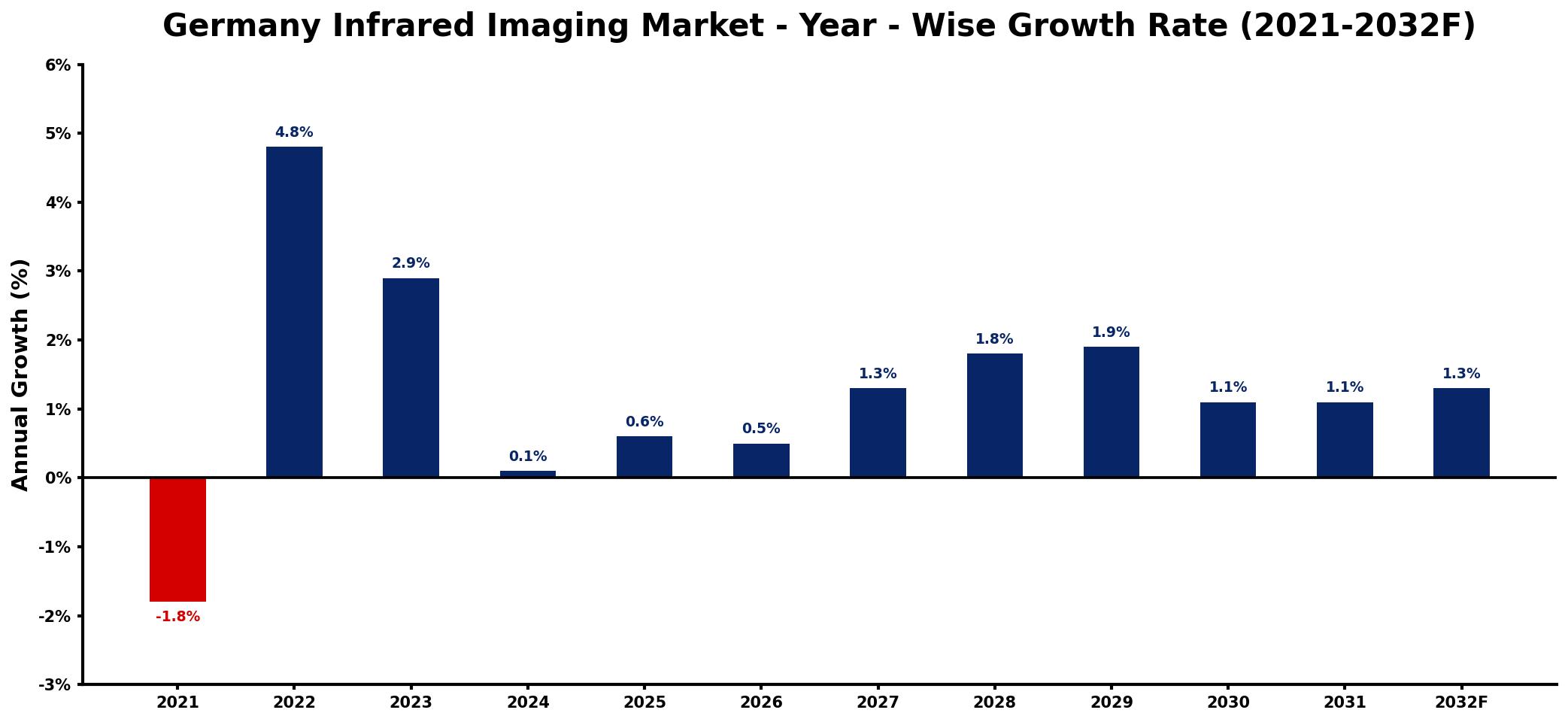
The table below presents the year‑wise growth rates along with the key drivers influencing the market
| Year | Growth Rate | Major Drivers |
| 2021 | -1.8% | decreased investment in technology sectors |
| 2022 | 4.8% | growing demand for thermal applications |
| 2023 | 2.9% | expansion in industrial automation solutions |
| 2024 | 0.1% | increased focus on energy efficiency |
| 2025 | 0.6% | rising adoption in healthcare diagnostics |
| 2026 | 0.5% | growth in construction safety regulations |
| 2027 | 1.3% | surge in renewable energy projects |
| 2028 | 1.8% | enhanced military and defense spending |
| 2029 | 1.9% | development of smart building technologies |
| 2030 | 1.1% | increased research funding in academia |
| 2031 | 1.1% | expansion of telecommunications infrastructure |
| 2032 | 1.3% | growing interest in environmental monitoring |
Note: Market size estimations and growth projections presented in this report are based on 6Wresearch's proprietary forecasting methodology, utilizing the latest available industry data, government publications, and primary research inputs.
Germany Infrared Imaging Market Synopsis
The German infrared imaging market is experiencing transformative growth as industries recognize the technology's potential to enhance operational efficiencies. The adoption of thermal imaging for applications like predictive maintenance and surveillance is gaining momentum, driven by the need for proactive measures in equipment management and security.
Additionally, the healthcare sector's increasing reliance on infrared imaging for diagnosing chronic diseases showcases the technology's versatility. The integration of AI and cloud connectivity into infrared systems is further revolutionizing the landscape, paving the way for enhanced capabilities and user experience.
Germany Infrared Imaging Market Key Takeaways
- The market is significantly driven by advancements in thermal imaging technology across various sectors.
- Healthcare applications, particularly in chronic disease diagnostics, are rapidly expanding the market reach.
- Integration with AI and cloud technology enhances system capabilities, offering advanced analytics.
- Predictive maintenance applications are fostering a shift toward proactive operational strategies.
- Government initiatives are promoting R&D, fostering innovation in infrared imaging technologies.
Evaluation of Restraints in Germany Infrared Imaging Market
Despite its promising growth, the Germany infrared imaging market grapples with certain constraints that inhibit broader adoption. Key issues revolve around achieving high-resolution imaging capabilities while maintaining affordability. The demand for enhanced image clarity necessitates ongoing innovations in detector technology and optics, which can be cost-prohibitive for some sectors. Furthermore, the competition from alternative imaging technologies may deter investments in infrared systems, compelling stakeholders to balance performance with cost-effectiveness.
Germany Infrared Imaging Market Trends
The market is currently shaped by notable trends including a rise in portable thermal cameras and UAV-based infrared systems. As industries look to enhance operational agility, the demand for compact and lightweight imaging solutions is on the rise. Additionally, integration with mobile technologies is creating new avenues for infrared imaging applications, with smartphones increasingly equipped with thermal sensors.
Furthermore, there is a growing emphasis on intelligent analytics, where AI-driven algorithms are utilized to interpret thermal data. This trend not only enhances the accuracy of diagnostics and surveillance but also significantly reduces the time taken for anomaly detection and response in critical situations.
Germany Infrared Imaging Market Opportunities
The landscape of the Germany infrared imaging market is ripe with opportunities for innovation and investment. As the demand for smart building technologies surges, infrared imaging's role in building diagnostics and energy efficiency assessments is becoming increasingly vital. There is also potential for growth in the automotive sector, particularly in advanced driver-assistance systems (ADAS) that leverage thermal imaging for enhanced safety features.
Moreover, as industries continue to prioritize predictive maintenance, the development of sophisticated infrared solutions that offer real-time monitoring and analytics is poised to attract investment. With ongoing government support for technological advancements, these opportunities will further solidify the market's potential.
Government Initiatives in the Germany Infrared Imaging Market
The German government actively promotes the advancement of infrared imaging technologies through various initiatives, including grants and subsidies. Collaborative projects between industry leaders and research institutions aim to drive innovation, enhancing the performance and applicability of infrared imaging solutions. This supportive policy environment encourages technology transfer into commercial markets, addressing not only the advancement of imaging resolution but also ethical considerations surrounding the use of such technology in surveillance and diagnostics.
Future Insights of the Germany Infrared Imaging Market
Looking ahead to 2026-2032, the Germany infrared imaging market is set to undergo significant evolution driven by technological advancements and increasing adoption across diverse sectors. A focus on miniaturization and integration with emerging technologies will be pivotal. The growing emphasis on sustainability and energy efficiency is likely to propel demand for infrared applications in building diagnostics and industrial processes. As healthcare continues to evolve, the role of thermal imaging in patient monitoring and diagnostics will likely expand, solidifying its critical role in future healthcare frameworks.
Germany Infrared Imaging Market Latest Developments (2025 - 2026)
In recent months, the German infrared imaging market has seen increased collaboration between technology firms and academic institutions focusing on next-generation imaging solutions. Advances in miniaturization have led to the development of highly portable infrared devices, catering to sectors like field surveillance and emergency response. Furthermore, the integration of advanced analytics within imaging systems is becoming a focal point of innovation, offering enhanced capabilities for real-time data processing and interpretation.
Germany Infrared Imaging Market - Key Attractiveness of the Report
- 10 Years of Market Numbers
- Historical Data Starting from 2022 to 2025
- Base Year: 2025
- Forecast Data until 2032
- Key Performance Indicators Impacting the Market
- Major Upcoming Developments and Projects
Key Highlights of the Report:
- Germany Infrared Imaging Market Outlook
- Market Size of Germany Infrared Imaging Market, 2025
- Forecast of Germany Infrared Imaging Market, 2032
- Historical Data and Forecast of Germany Infrared Imaging Revenues & Volume for the Period 2022-2032F
- Germany Infrared Imaging Market Trend Evolution
- Germany Infrared Imaging Market Drivers and Challenges
- Germany Infrared Imaging Price Trends
- Germany Infrared Imaging Porter's Five Forces
- Germany Infrared Imaging Industry Life Cycle
- Historical Data and Forecast of Germany Infrared Imaging Market Revenues & Volume By Technology for the Period 2022-2032F
- Historical Data and Forecast of Germany Infrared Imaging Market Revenues & Volume By Cooled Infrared Imaging for the Period 2022-2032F
- Historical Data and Forecast of Germany Infrared Imaging Market Revenues & Volume By Uncooled Infrared Imaging for the Period 2022-2032F
- Historical Data and Forecast of Germany Infrared Imaging Market Revenues & Volume By Wavelength for the Period 2022-2032F
- Historical Data and Forecast of Germany Infrared Imaging Market Revenues & Volume By Near Infrared for the Period 2022-2032F
- Historical Data and Forecast of Germany Infrared Imaging Market Revenues & Volume By Shortwave Infrared for the Period 2022-2032F
- Historical Data and Forecast of Germany Infrared Imaging Market Revenues & Volume By Mid-wave Infrared for the Period 2022-2032F
- Historical Data and Forecast of Germany Infrared Imaging Market Revenues & Volume By Long-wave Infrared for the Period 2022-2032F
- Historical Data and Forecast of Germany Infrared Imaging Market Revenues & Volume By Application for the Period 2022-2032F
- Historical Data and Forecast of Germany Infrared Imaging Market Revenues & Volume By Security & Surveillance for the Period 2022-2032F
- Historical Data and Forecast of Germany Infrared Imaging Market Revenues & Volume By Monitoring & Inspection for the Period 2022-2032F
- Historical Data and Forecast of Germany Infrared Imaging Market Revenues & Volume By Detection for the Period 2022-2032F
- Historical Data and Forecast of Germany Infrared Imaging Market Revenues & Volume By Vertical for the Period 2022-2032F
- Historical Data and Forecast of Germany Infrared Imaging Market Revenues & Volume By Industrial for the Period 2022-2032F
- Historical Data and Forecast of Germany Infrared Imaging Market Revenues & Volume By Nonindustrial for the Period 2022-2032F
- Germany Infrared Imaging Import Export Trade Statistics
- Market Opportunity Assessment By Technology
- Market Opportunity Assessment By Wavelength
- Market Opportunity Assessment By Application
- Market Opportunity Assessment By Vertical
- Germany Infrared Imaging Top Companies Market Share
- Germany Infrared Imaging Competitive Benchmarking By Technical and Operational Parameters
- Germany Infrared Imaging Company Profiles
- Germany Infrared Imaging Key Strategic Recommendations






































