Germany IoT Data Management Market Size & Growth Rate (2026-2032)
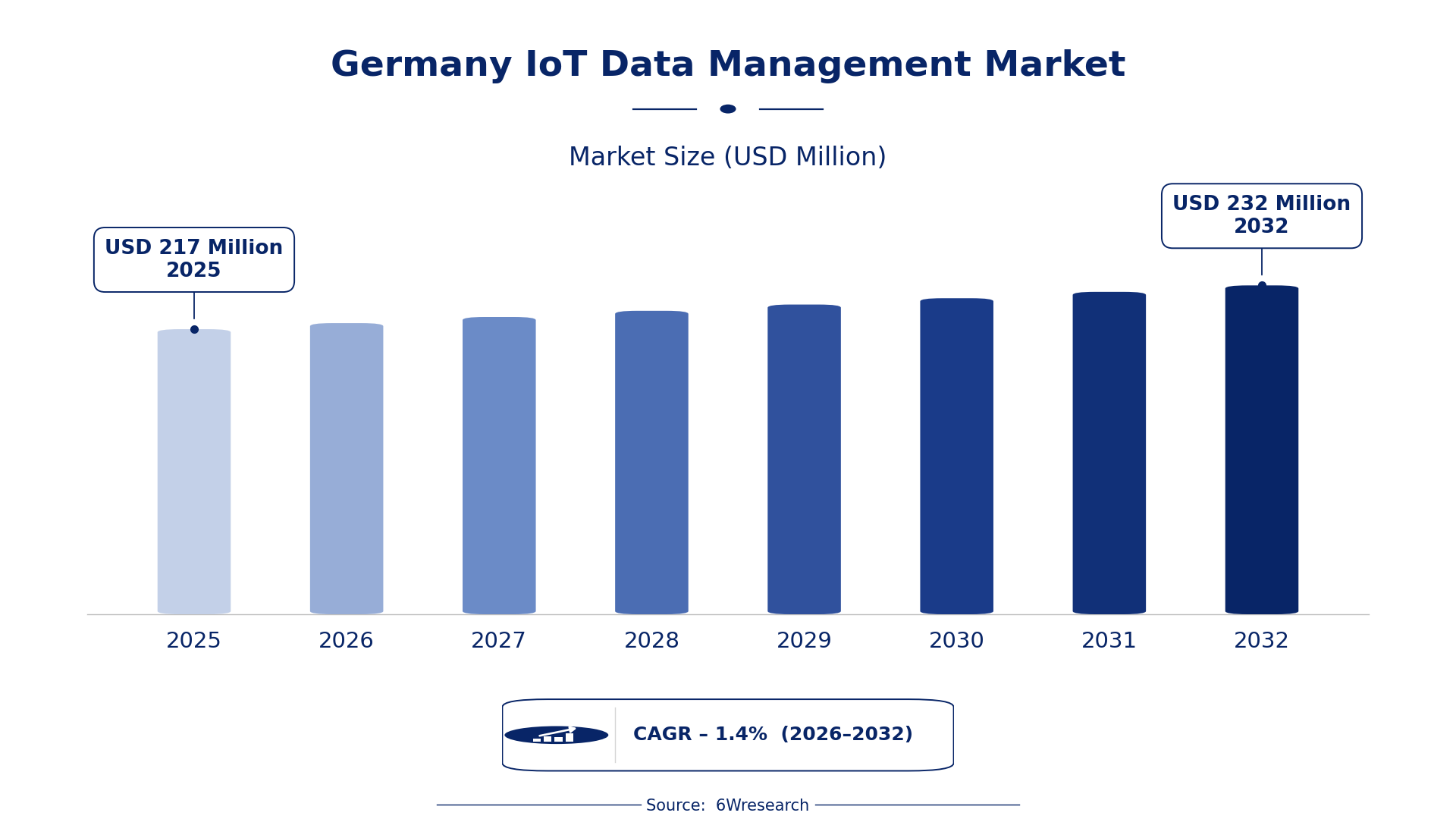
The Germany IoT Data Management Market was estimated at USD 217 Million in 2025 and is projected to reach USD 232 Million by 2032, growing at a CAGR of 1.4% from 2026 to 2032.
Germany IoT Data Management Market Synopsis
The Germany IoT Data Management Market is currently navigating a phase of steady growth, fueled by the widespread adoption of IoT devices across critical sectors like manufacturing and healthcare. Companies are increasingly prioritizing data management solutions that not only enhance operational efficiency but also ensure compliance with stringent data protection regulations.
A notable trend is the heightened focus on real-time data analytics. Organizations are recognizing the need for actionable insights derived from the vast amounts of data generated by connected devices. This drive for improved data utility is propelling investment in advanced data management systems that prioritize security and compliance.
Germany IoT Data Management Market Year-wise Growth Rate and Key Drivers
This graph illustrates the annual growth rates of the Germany IoT Data Management Market from 2021 to 2032, highlighting a steady upward trajectory and projected expansion over the forecast period.
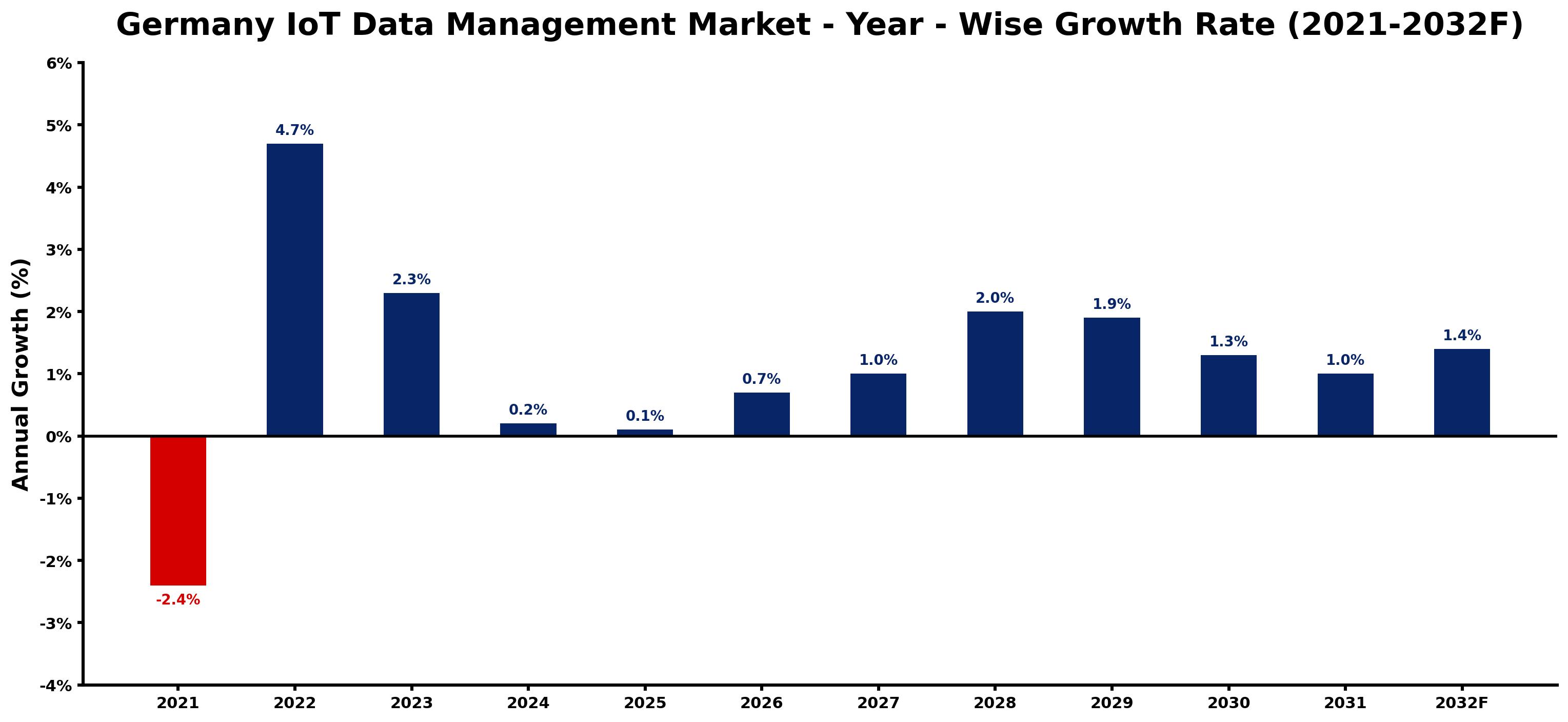
The table below presents the year‑wise growth rates along with the key drivers influencing the market
| Year | Growth Rate | Major Drivers |
| 2021 | -2.4% | Data privacy regulations from Bundesbeauftragter für den Datenschutz |
| 2022 | 4.7% | Germany's Industry 4.0 initiative boosts IoT adoption. |
| 2023 | 2.3% | EU GDPR compliance drives increased data management needs. |
| 2024 | 0.2% | Local automotive sector integrates IoT for smart manufacturing. |
| 2025 | 0.1% | Government funding for smart city IoT projects expands. |
| 2026 | 0.7% | Wireless communication advancements enhance IoT connectivity. |
| 2027 | 1.0% | Increased remote work accelerates demand for data solutions. |
| 2028 | 2.0% | Boost in healthcare IoT applications during aging populations. |
| 2029 | 1.9% | Sustainability regulations promote data-driven energy management. |
| 2030 | 1.3% | Smart home devices surge amidst rising consumer interest. |
| 2031 | 1.0% | Digital twin technology adoption in manufacturing increases. |
| 2032 | 1.4% | Cybersecurity concerns spur investment in robust IoT data solutions. |
Note: Market size estimations and growth projections presented in this report are based on 6Wresearch's proprietary forecasting methodology, utilizing the latest available industry data, government publications, and primary research inputs.
Germany IoT Data Management Market Key Takeaways
Below are some of the specific key takeaways from the market, including:
- The market is experiencing a surge in demand for real-time analytics and cloud-based solutions.
- Edge computing is becoming increasingly relevant for processing data closer to its source.
- Compliance with GDPR is a critical driver for investment in data management technologies.
- Investment opportunities are emerging in sectors like smart manufacturing and healthcare.
- Interoperability challenges among IoT devices remain a significant concern for organizations.
Evaluation of Restraints in Germany IoT Data Management Market
One of the primary restraints in the Germany IoT Data Management Market is the challenge of maintaining data security and privacy. With regulations like GDPR mandating strict data handling protocols, companies are under pressure to ensure compliance while managing the large volumes of data generated by IoT devices. on top of that, the complexity of integrating disparate IoT systems can hinder effective data management and analysis, requiring companies to invest heavily in robust infrastructure and skilled personnel.
Germany IoT Data Management Market Trends
The market is currently witnessing several key trends shaping its future. The demand for real-time data analytics is escalating, compelling organizations to implement data management systems that can process and analyze data instantaneously. Additionally, edge computing is gaining traction as companies seek to reduce latency and enhance data processing efficiency. The emphasis on data security is also driving investments in solutions that ensure compliance with GDPR and other data protection frameworks.
Germany IoT Data Management Market Opportunities
Investment opportunities within the Germany IoT Data Management Market are abundant. The rise in smart manufacturing technologies presents a fertile ground for innovative data management solutions. Healthcare, too, is emerging as a sector ripe for investment, particularly in data analytics platforms that can improve patient outcomes. As organizations increasingly adopt edge computing technologies, opportunities for vendors offering specialized data integration and cybersecurity solutions are likely to expand.
Government Initiatives in the Germany IoT Data Management Market
Government policies are actively shaping the dynamics of the Germany IoT Data Management Market. With a focus on enhancing data security and privacy, regulatory frameworks like the General Data Protection Regulation (GDPR) are paramount. These policies not only mandate compliance but also encourage innovation, as businesses must adapt to the evolving regulatory landscape to maintain consumer trust.
- A regulatory framework introduced in 2025 mandating stricter controls on data handling and processing.
- A national digital infrastructure upgrade program is currently underway, aimed at improving connectivity and data management capabilities.
- Planned public-private partnerships to promote the development of smart city initiatives expected to commence in 2026.
- The Federal Data Protection Act (BDSG) supplements GDPR, providing additional regulations focused on data protection.
- Recent initiatives to increase awareness and training around GDPR compliance among IoT stakeholders.
Future Insights of the Germany IoT Data Management Market
Looking ahead, the Germany IoT Data Management Market is set for significant evolution driven by technological advancements. As artificial intelligence and machine learning become increasingly integrated into data management solutions, organizations will be better equipped to leverage their data for strategic decision-making. The ongoing push towards digital transformation, particularly in line with Industry 4.0 initiatives, will further drive demand for sophisticated data management systems, ensuring that businesses remain competitive in a data-centric world.
Germany IoT Data Management Market Latest Developments
In the past year, the Germany IoT Data Management Market has seen notable developments reflecting its growth trajectory. Companies are rapidly adapting to market demands by innovating their offerings and enhancing capabilities. These advancements indicate a strong commitment to addressing the evolving needs of businesses in managing IoT data.
- A major technology vendor launched a new cloud-based data management platform in early 2025, targeting the healthcare sector for enhanced patient data handling.
- An initiative that began in mid-2025 aims to integrate edge computing solutions within manufacturing environments, improving data processing speeds.
- A rollout expected to begin in Q3 2026 will introduce a new regulatory compliance framework tailored for IoT data management.
- Recent collaborations between data management firms and automotive companies have been established to improve real-time data analytics capabilities.
- A pilot program to enhance data security measures for IoT devices is currently underway, expected to conclude by late 2025.
Germany IoT Data Management Market - Key Attractiveness of the Report
- 10 Years of Market Numbers
- Historical Data Starting from 2022 to 2025
- Base Year: 2025
- Forecast Data until 2032
- Key Performance Indicators Impacting the Market
- Major Upcoming Developments and Projects
Key Highlights of the Report:
- Germany IoT Data Management Market Outlook
- Market Size of Germany IoT Data Management Market, 2025
- Forecast of Germany IoT Data Management Market, 2032
- Historical Data and Forecast of Germany IoT Data Management Revenues & Volume for the Period 2022-2032F
- Germany IoT Data Management Market Trend Evolution
- Germany IoT Data Management Market Drivers and Challenges
- Germany IoT Data Management Price Trends
- Germany IoT Data Management Porter's Five Forces
- Germany IoT Data Management Industry Life Cycle
- Historical Data and Forecast of Germany IoT Data Management Market Revenues & Volume By Solution for the Period 2022-2032F
- Historical Data and Forecast of Germany IoT Data Management Market Revenues & Volume By Data integration for the Period 2022-2032F
- Historical Data and Forecast of Germany IoT Data Management Market Revenues & Volume By Data analytics and visualization for the Period 2022-2032F
- Historical Data and Forecast of Germany IoT Data Management Market Revenues & Volume By Metadata management for the Period 2022-2032F
- Historical Data and Forecast of Germany IoT Data Management Market Revenues & Volume By Data security for the Period 2022-2032F
- Historical Data and Forecast of Germany IoT Data Management Market Revenues & Volume By Data migration for the Period 2022-2032F
- Historical Data and Forecast of Germany IoT Data Management Market Revenues & Volume By Others (data governance, data quality, and data orchestration) for the Period 2022-2032F
- Historical Data and Forecast of Germany IoT Data Management Market Revenues & Volume By Component for the Period 2022-2032F
- Historical Data and Forecast of Germany IoT Data Management Market Revenues & Volume By Solutions for the Period 2022-2032F
- Historical Data and Forecast of Germany IoT Data Management Market Revenues & Volume By Services for the Period 2022-2032F
- Historical Data and Forecast of Germany IoT Data Management Market Revenues & Volume By Service for the Period 2022-2032F
- Historical Data and Forecast of Germany IoT Data Management Market Revenues & Volume By Managed services for the Period 2022-2032F
- Historical Data and Forecast of Germany IoT Data Management Market Revenues & Volume By Consulting services for the Period 2022-2032F
- Historical Data and Forecast of Germany IoT Data Management Market Revenues & Volume By Support and maintenance services for the Period 2022-2032F
- Historical Data and Forecast of Germany IoT Data Management Market Revenues & Volume By Deployment Type for the Period 2022-2032F
- Historical Data and Forecast of Germany IoT Data Management Market Revenues & Volume By Public cloud for the Period 2022-2032F
- Historical Data and Forecast of Germany IoT Data Management Market Revenues & Volume By Private cloud for the Period 2022-2032F
- Historical Data and Forecast of Germany IoT Data Management Market Revenues & Volume By Hybrid cloud for the Period 2022-2032F
- Historical Data and Forecast of Germany IoT Data Management Market Revenues & Volume By Organization Size for the Period 2022-2032F
- Historical Data and Forecast of Germany IoT Data Management Market Revenues & Volume By Small and Medium-sized Enterprises (SMEs) for the Period 2022-2032F
- Historical Data and Forecast of Germany IoT Data Management Market Revenues & Volume By Large enterprises for the Period 2022-2032F
- Historical Data and Forecast of Germany IoT Data Management Market Revenues & Volume By Application Area for the Period 2022-2032F
- Historical Data and Forecast of Germany IoT Data Management Market Revenues & Volume By Smart energy and utilities for the Period 2022-2032F
- Historical Data and Forecast of Germany IoT Data Management Market Revenues & Volume By Smart manufacturing for the Period 2022-2032F
- Historical Data and Forecast of Germany IoT Data Management Market Revenues & Volume By Building and home automation for the Period 2022-2032F
- Historical Data and Forecast of Germany IoT Data Management Market Revenues & Volume By Smart healthcare for the Period 2022-2032F
- Historical Data and Forecast of Germany IoT Data Management Market Revenues & Volume By Smart retail for the Period 2022-2032F
- Historical Data and Forecast of Germany IoT Data Management Market Revenues & Volume By Smart mobility and transportation for the Period 2022-2032F
- Historical Data and Forecast of Germany IoT Data Management Market Revenues & Volume By Connected logistics for the Period 2022-2032F
- Historical Data and Forecast of Germany IoT Data Management Market Revenues & Volume By Others for the Period 2022-2032F
- Germany IoT Data Management Import Export Trade Statistics
- Market Opportunity Assessment By Solution
- Market Opportunity Assessment By Component
- Market Opportunity Assessment By Service
- Market Opportunity Assessment By Deployment Type
- Market Opportunity Assessment By Organization Size
- Market Opportunity Assessment By Application Area
- Germany IoT Data Management Top Companies Market Share
- Germany IoT Data Management Competitive Benchmarking By Technical and Operational Parameters
- Germany IoT Data Management Company Profiles
- Germany IoT Data Management Key Strategic Recommendations






































