Germany IoT Security Market Size & Growth Rate (2026-2032)
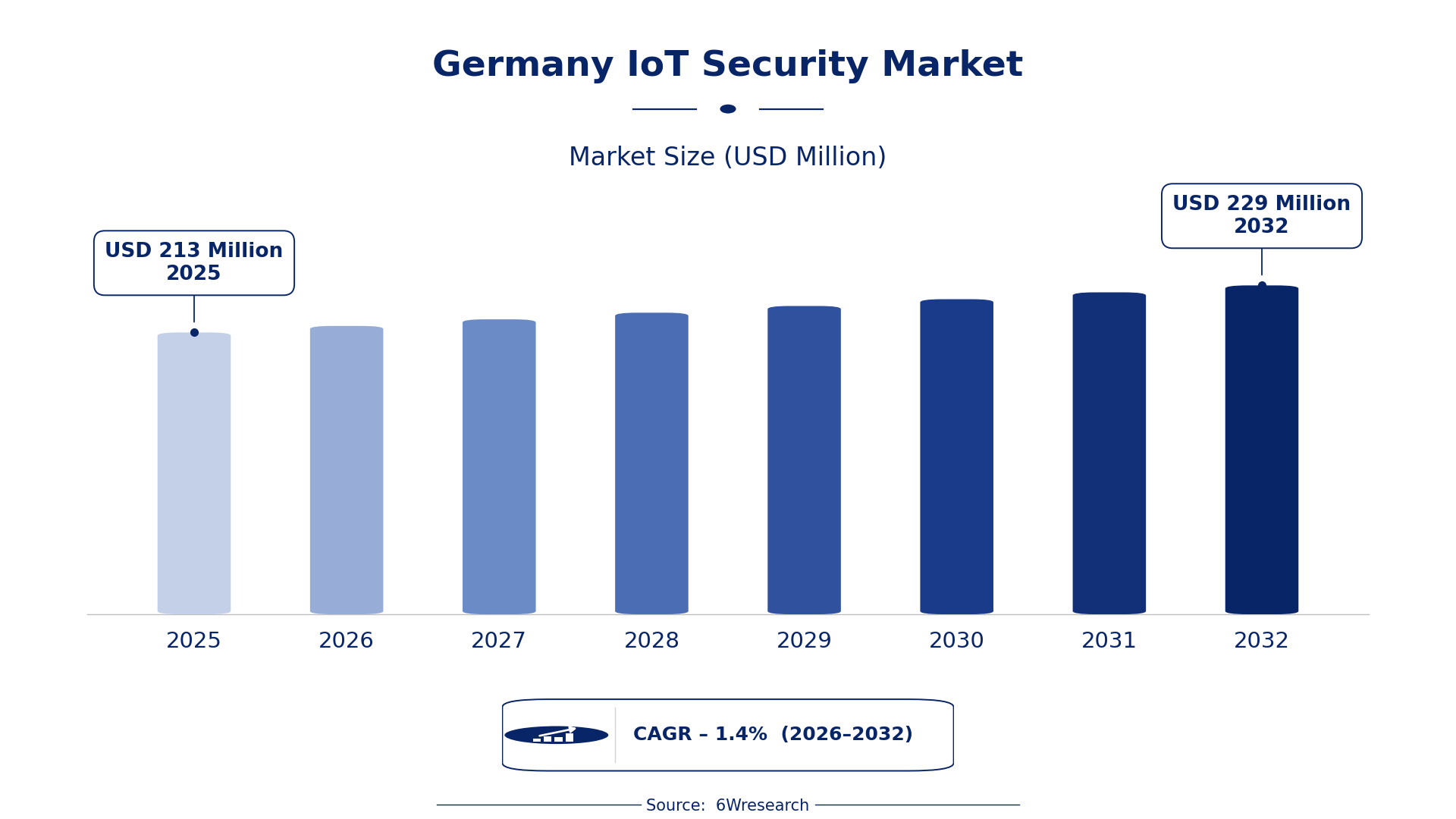
The Germany IoT Security Market was estimated at USD 213 Million in 2025 and is projected to reach USD 229 Million by 2032, growing at a CAGR of 1.4% from 2026 to 2032.
Germany IoT Security Market Synopsis
The escalating concerns around cybersecurity threats are the primary driving force in the Germany IoT Security Market. As connected devices proliferate across various sectors, the imperative to secure these ecosystems is more pressing than ever.
With critical infrastructure and industrial systems increasingly reliant on IoT technologies, safeguarding sensitive data is paramount. Companies are investing heavily in security measures, responding to vulnerabilities and the complexities of interconnectivity that pose significant risks.
Germany IoT Security Market Year-wise Growth Rate and Key Drivers
This graph illustrates the annual growth rates of the Germany IoT Security Market from 2021 to 2032, highlighting a steady upward trajectory and projected expansion over the forecast period.
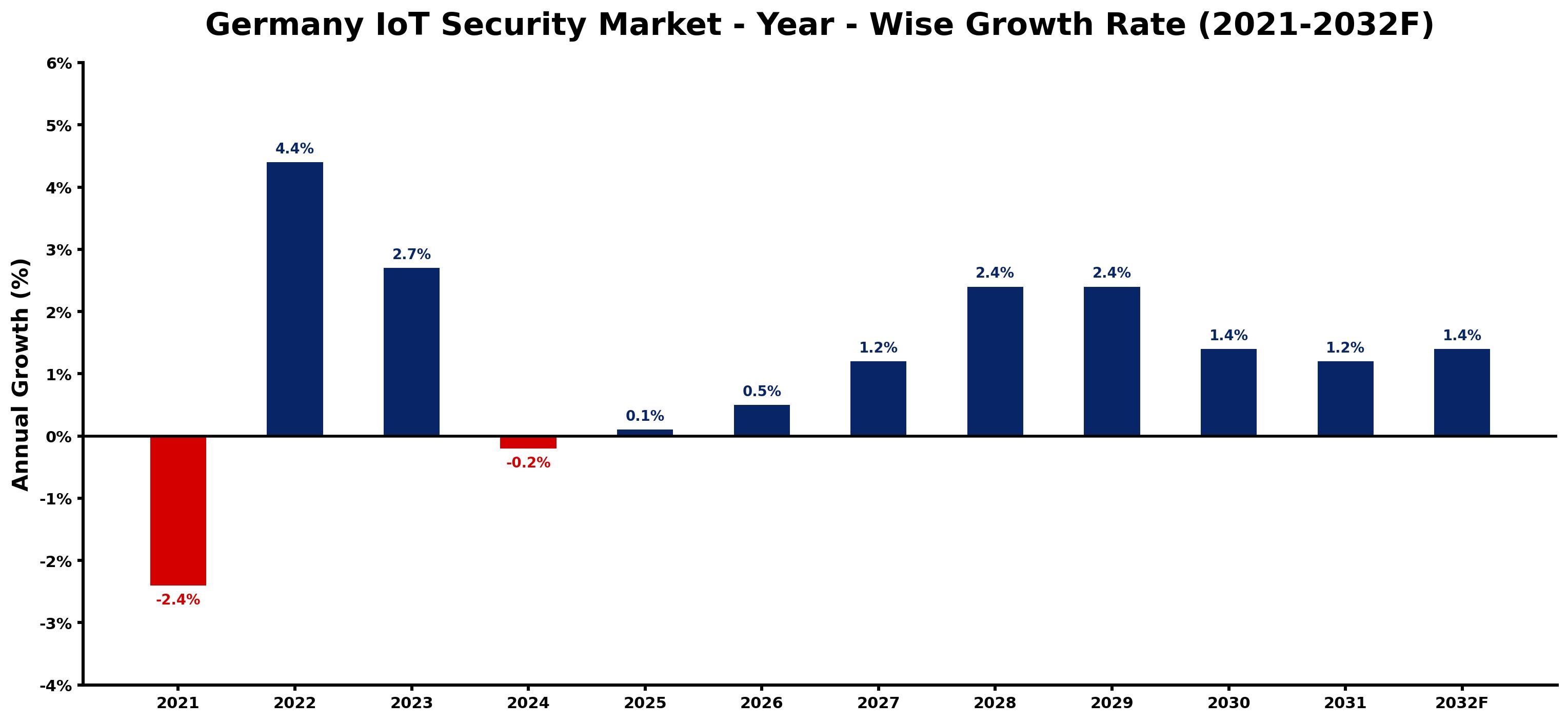
The table below presents the year‑wise growth rates along with the key drivers influencing the market
| Year | Growth Rate | Major Drivers |
| 2021 | -2.4% | GDPR compliance costs deter IoT security investments. |
| 2022 | 4.4% | EU Cybersecurity Act mandates stricter IoT security standards |
| 2023 | 2.7% | Increased smart home device adoption driving security investments |
| 2024 | -0.2% | Increasing reliance on outdated, insecure legacy systems. |
| 2025 | 0.1% | German companies enhancing IoT networks post-cyberattack awareness |
| 2026 | 0.5% | Growing public sector focus on smart infrastructure security |
| 2027 | 1.2% | Rising awareness of data privacy regulations among consumers |
| 2028 | 2.4% | Industry 4.0 initiatives emphasizing secure IoT applications |
| 2029 | 2.4% | Investment in autonomous vehicle security infrastructure expansion |
| 2030 | 1.4% | Regulatory incentives for secure connected device manufacturers |
| 2031 | 1.2% | Growing collaboration between tech firms and cybersecurity startups |
| 2032 | 1.4% | Surge in demand for telehealth services necessitating secure IoT |
Note: Market size estimations and growth projections presented in this report are based on 6Wresearch's proprietary forecasting methodology, utilizing the latest available industry data, government publications, and primary research inputs.
Germany IoT Security Market Key Takeaways
Below are some of the specific key takeaways from the market, including:
- The market is driven by the need for enhanced security measures against cyber threats targeting IoT devices.
- Regulatory frameworks like GDPR are accelerating the adoption of comprehensive security solutions.
- Key security challenges include device vulnerabilities and the need for effective data privacy measures.
- Investments in encryption, authentication, and security analytics are on the rise.
- Government initiatives are fostering innovation and promoting best practices in IoT security.
Evaluation of Restraints in Germany IoT Security Market
Despite the strong growth trajectory, the Germany IoT Security Market faces notable constraints. Security measures can sometimes hinder usability, leading to friction in user experience. on top of that, the rapid pace of technological advancement can outstrip the development of adequate security protocols, leaving potential vulnerabilities unaddressed. Balancing security with functionality remains a persistent challenge that companies must navigate.
Germany IoT Security Market Trends
Several trends are currently shaping the Germany IoT Security Market. The rise of edge computing is encouraging localized data processing, which can enhance security by reducing the amount of data transmitted over networks. Additionally, artificial intelligence and machine learning are increasingly being integrated into security solutions, providing real-time threat detection and response capabilities. on top of that, as IoT adoption continues to spread across various sectors, a growing emphasis on compliance with stringent regulatory frameworks is driving the demand for advanced security technologies.
Germany IoT Security Market Opportunities
The market offers lucrative opportunities for growth, particularly in sectors like healthcare, manufacturing, and smart cities. The integration of IoT devices in healthcare is creating demand for specialized security solutions to protect sensitive patient data. Similarly, industrial IoT applications are ripe for investment, as organizations seek to secure critical infrastructure from cyber threats. As more companies prioritize cybersecurity, there is ample opportunity for innovative security startups to capture market share by providing tailored solutions.
Government Initiatives in the Germany IoT Security Market
The German government is actively engaged in shaping the IoT Security Market through a range of initiatives aimed at enhancing cybersecurity. By collaborating with industry stakeholders, the government is establishing frameworks and standards that promote the secure deployment of IoT technologies. This proactive stance is critical as it not only fosters innovation but also instills confidence among consumers and businesses regarding the safety of IoT applications.
- A national digital infrastructure upgrade program launched in early 2025 aims to improve the security of connected devices across public services.
- Currently, an initiative is underway to develop cybersecurity guidelines that provide best practices for IoT security across various sectors.
- A regulatory framework introduced in late 2025 mandates that all IoT devices meet minimum security standards before market entry.
- Planned collaborations with academic institutions to support research in IoT security technologies are set to begin in 2026.
Future Insights of the Germany IoT Security Market
Looking ahead to 2026-2032, the Germany IoT Security Market is expected to evolve significantly. As technology advances and cyber threats become more sophisticated, the demand for innovative security solutions will continue to rise. Organizations will increasingly prioritize security in their IoT strategies, leading to more investment in advanced technologies such as blockchain for secure transactions and AI for predictive analytics. This growing focus on security will drive market expansion as businesses and governments alike recognize that robust cybersecurity is essential for the successful implementation of IoT systems.
Germany IoT Security Market Latest Developments
In recent months, the Germany IoT Security Market has seen a flurry of activity aimed at enhancing security measures and responding to emerging threats. The focus has been on collaboration and innovation, with various stakeholders working together to address the unique challenges posed by IoT devices.
- A major technology vendor announced an ongoing initiative to integrate AI-driven security analytics into existing IoT platforms, expected to enhance threat detection capabilities by mid-2026.
- A leading regional operator is currently rolling out a new encryption standard for IoT communications, aimed at improving data protection across its services.
- In Q1 2026, a public-private partnership will launch a pilot program to assess the effectiveness of new security measures in smart city applications.
- A service upgrade that began in early 2025 aims to incorporate multi-factor authentication across all IoT devices managed by a major utility provider.
Germany IoT Security Market - Key Attractiveness of the Report
- 10 Years of Market Numbers
- Historical Data Starting from 2022 to 2025
- Base Year: 2025
- Forecast Data until 2032
- Key Performance Indicators Impacting the Market
- Major Upcoming Developments and Projects
Key Highlights of the Report:
- Germany IoT Security Market Outlook
- Market Size of Germany IoT Security Market, 2025
- Forecast of Germany IoT Security Market, 2032
- Historical Data and Forecast of Germany IoT Security Revenues & Volume for the Period 2022-2032F
- Germany IoT Security Market Trend Evolution
- Germany IoT Security Market Drivers and Challenges
- Germany IoT Security Price Trends
- Germany IoT Security Porter's Five Forces
- Germany IoT Security Industry Life Cycle
- Historical Data and Forecast of Germany IoT Security Market Revenues & Volume By Type for the Period 2022-2032F
- Historical Data and Forecast of Germany IoT Security Market Revenues & Volume By Network Security for the Period 2022-2032F
- Historical Data and Forecast of Germany IoT Security Market Revenues & Volume By Endpoint Security for the Period 2022-2032F
- Historical Data and Forecast of Germany IoT Security Market Revenues & Volume By Application Security for the Period 2022-2032F
- Historical Data and Forecast of Germany IoT Security Market Revenues & Volume By Cloud Security for the Period 2022-2032F
- Historical Data and Forecast of Germany IoT Security Market Revenues & Volume By Other Security Types for the Period 2022-2032F
- Historical Data and Forecast of Germany IoT Security Market Revenues & Volume By Deployment Mode for the Period 2022-2032F
- Historical Data and Forecast of Germany IoT Security Market Revenues & Volume By Small and Medium Enterprises for the Period 2022-2032F
- Historical Data and Forecast of Germany IoT Security Market Revenues & Volume By Large Enterprises for the Period 2022-2032F
- Historical Data and Forecast of Germany IoT Security Market Revenues & Volume By Component for the Period 2022-2032F
- Historical Data and Forecast of Germany IoT Security Market Revenues & Volume By Solutions for the Period 2022-2032F
- Historical Data and Forecast of Germany IoT Security Market Revenues & Volume By Services for the Period 2022-2032F
- Historical Data and Forecast of Germany IoT Security Market Revenues & Volume By Solution for the Period 2022-2032F
- Historical Data and Forecast of Germany IoT Security Market Revenues & Volume By Identity and Access Management for the Period 2022-2032F
- Historical Data and Forecast of Germany IoT Security Market Revenues & Volume By Data Encryption and Tokenization for the Period 2022-2032F
- Historical Data and Forecast of Germany IoT Security Market Revenues & Volume By Intrusion Detection System/Intrusion Prevention System for the Period 2022-2032F
- Historical Data and Forecast of Germany IoT Security Market Revenues & Volume By Device Authentication and Management for the Period 2022-2032F
- Historical Data and Forecast of Germany IoT Security Market Revenues & Volume By Secure Communications for the Period 2022-2032F
- Historical Data and Forecast of Germany IoT Security Market Revenues & Volume By PKI Lifecycle Management for the Period 2022-2032F
- Historical Data and Forecast of Germany IoT Security Market Revenues & Volume By Distributed Denial of Service Protection for the Period 2022-2032F
- Historical Data and Forecast of Germany IoT Security Market Revenues & Volume By Security Analytics for the Period 2022-2032F
- Historical Data and Forecast of Germany IoT Security Market Revenues & Volume By Application Area for the Period 2022-2032F
- Historical Data and Forecast of Germany IoT Security Market Revenues & Volume By Smart Manufacturing for the Period 2022-2032F
- Historical Data and Forecast of Germany IoT Security Market Revenues & Volume By Smart Energy and Utilities for the Period 2022-2032F
- Historical Data and Forecast of Germany IoT Security Market Revenues & Volume By Connected Logistics for the Period 2022-2032F
- Historical Data and Forecast of Germany IoT Security Market Revenues & Volume By Smart Home and Consumer Electronics for the Period 2022-2032F
- Historical Data and Forecast of Germany IoT Security Market Revenues & Volume By Connected Healthcare for the Period 2022-2032F
- Historical Data and Forecast of Germany IoT Security Market Revenues & Volume By Smart Government and Defense for the Period 2022-2032F
- Historical Data and Forecast of Germany IoT Security Market Revenues & Volume By Smart Retail for the Period 2022-2032F
- Historical Data and Forecast of Germany IoT Security Market Revenues & Volume By Other Application Areas for the Period 2022-2032F
- Historical Data and Forecast of Germany IoT Security Market Revenues & Volume By Organization Size for the Period 2022-2032F
- Historical Data and Forecast of Germany IoT Security Market Revenues & Volume By Small and Medium-sized Enterprises for the Period 2022-2032F
- Historical Data and Forecast of Germany IoT Security Market Revenues & Volume By Large Enterprises for the Period 2022-2032F
- Historical Data and Forecast of Germany IoT Security Market Revenues & Volume By Service for the Period 2022-2032F
- Historical Data and Forecast of Germany IoT Security Market Revenues & Volume By Professional Services for the Period 2022-2032F
- Historical Data and Forecast of Germany IoT Security Market Revenues & Volume By Managed Services for the Period 2022-2032F
- Germany IoT Security Import Export Trade Statistics
- Market Opportunity Assessment By Type
- Market Opportunity Assessment By Deployment Mode
- Market Opportunity Assessment By Component
- Market Opportunity Assessment By Solution
- Market Opportunity Assessment By Application Area
- Market Opportunity Assessment By Organization Size
- Market Opportunity Assessment By Service
- Germany IoT Security Top Companies Market Share
- Germany IoT Security Competitive Benchmarking By Technical and Operational Parameters
- Germany IoT Security Company Profiles
- Germany IoT Security Key Strategic Recommendations






































