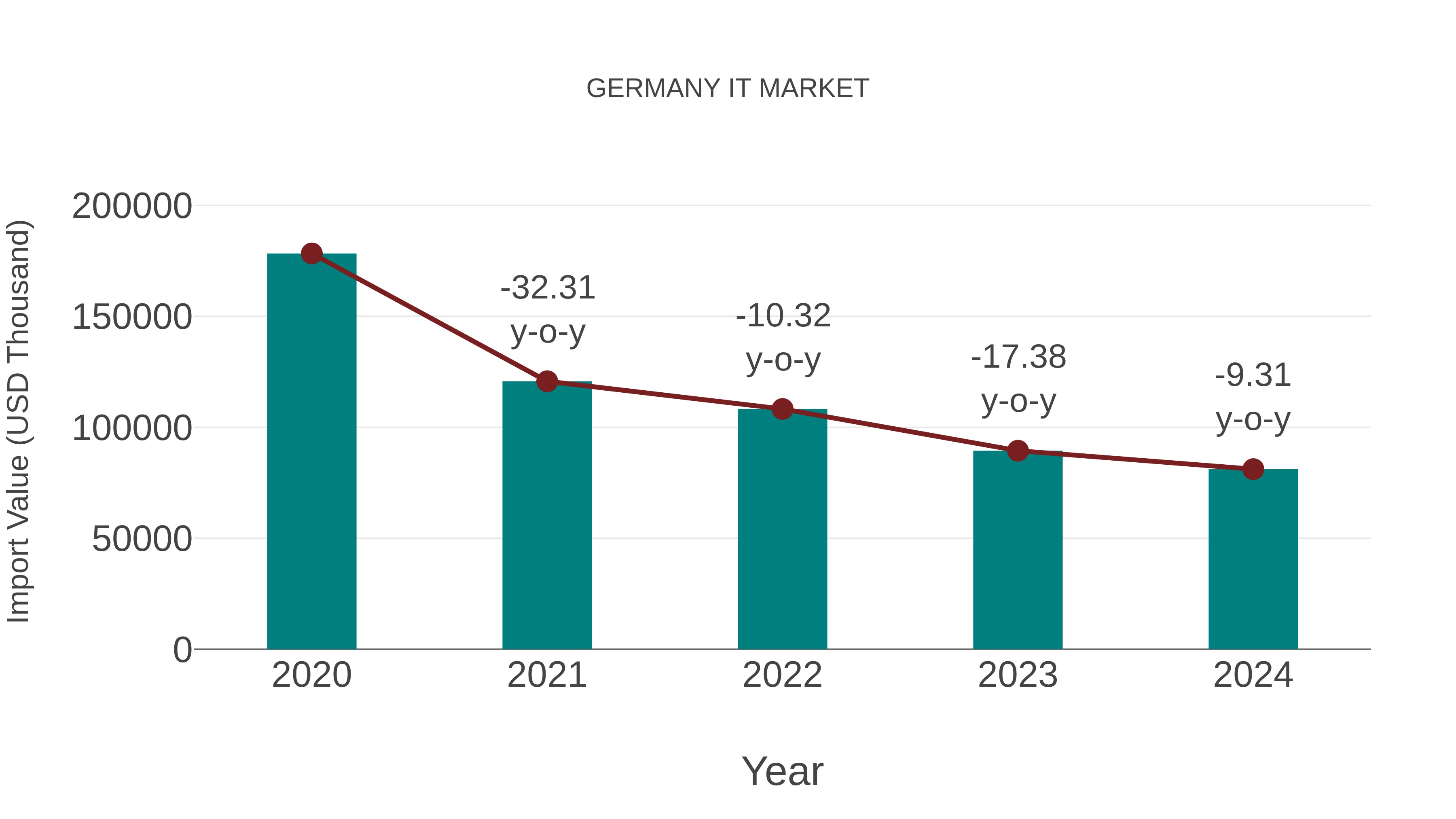
Germany It Market: Import Trend Analysis
In 2024, Germany`s IT market saw a consistent upward trend in imports, driven by strong demand for technology products and services. The market experienced steady growth in imported IT goods, reflecting a robust appetite for innovative solutions and a competitive global landscape.
Germany IT Market Growth Rate
According to 6Wresearch internal database and industry insights, the Germany IT Market is projected to grow at a compound annual growth rate (CAGR) of 5.7% during the forecast period 2026–2032.
Five-Year Growth Trajectory of the Germany IT Market with Core Drivers
Below mentioned are the evaluation of year-wise growth rate along with key drivers:
| Year | Est. Annual Growth (%) | Growth Drivers |
| 2021 | 4.3% | Economic recovery and increasing demand for digital transformation solutions. |
| 2022 | 4.5% | Increase in cloud computing and big data analytics usage by businesses. |
| 2023 | 4.8% | Expansion of 5G infrastructure and digital usage across industries. |
| 2024 | 5% | High demand for cybersecurity solutions and data privacy protection. |
| 2025 | 5.2% | Increase in government spending on digital programs and innovations that are AI-driven. |
Topics Covered in the Germany IT Market Report
The Germany IT Market report thoroughly covers the market by enterprise size, end-user. It provides an unbiased and detailed analysis of ongoing market trends, opportunities, challenges, and market drivers, helping stakeholders align their strategies with current and future market dynamics.
Germany IT Market Highlights
| Report Name | Germany IT Market |
| Forecast Period | 2026–2032 |
| CAGR | 5.70% |
| Growing Sector | Cloud Computing and Cybersecurity |
Germany IT Market Synopsis
Germany IT Market is expected to grow rapidly due to high demand for digital transformation in many enterprises, increasing need for data security, and the strong government push toward development of infrastructure. Germany’s advanced economy, large number of businesses, and high adoption of IT solutions make it an attractive market for both domestic and international players. The market is also benefiting from advancements in cloud computing, 5G technologies, and artificial intelligence (AI). With increasing government investments in digital infrastructure and a focus on innovation, the market is set for robust growth.
Evaluation of Growth Drivers in the Germany IT Market
Below mentioned are some prominent drivers and their influence on the Germany IT Market dynamics:
| Drivers | Primary Segment Affected | Why It Matters (Evidence) |
| Digital Transformation Adoption | All Segments | Across all enterprise sizes, businesses are adopting digital solutions to improve operational efficiency and customer experience. |
| Government Support | All Segments | The government is encouraging digitalization through investments in infrastructure and innovation programs. |
| Cybersecurity Threats | Cybersecurity Solutions | Increasing frequency of cyberattacks is driving demand for more robust security solutions. |
| AI and Big Data Analytics | All Segments | AI and big data solutions are helping businesses optimize operations and decision-making. |
| Cloud Adoption | Small and Medium Enterprises | Cloud-based solutions are cost-effective and scalable, driving adoption among SMEs. |
Germany IT Market Size is projected to grow at a compound annual growth rate (CAGR) of 5.7%from 2026 to 2032. The market is being driven by rising investments in IT infrastructure, cloud computing adoption, and increased government support for digital innovation. The demand for cybersecurity solutions will continue to rise due to growing security concerns and the need to protect sensitive data. Technological advancements, such as artificial intelligence, 5G infrastructure, and automation, will further fuel market demand. The regulatory environment in Germany also plays an important role in creating favourable conditions for the growth of IT companies.
Evaluation of Restraints in the Germany IT Market
Below mentioned are some major restraints and their influence on the Germany IT Market dynamics:
| Restraints | Primary Segment Affected | What This Means (Evidence) |
| High Competition | IT Providers | Intense competition among IT companies may lead to price wars and reduced margins. |
| Data Privacy Concerns | IT Solutions | Increasing concerns over data privacy may discourage businesses from fully adopting IT solutions. |
| High Operational Costs | IT Providers | Expensive infrastructure and operational costs can limit profitability for small and medium-sized enterprises. |
| Talent Shortage | All Segments | Lack of skilled IT professionals may delay projects and hinder innovation. |
| Regulatory Compliance | IT Providers | Adherence to strict regulations on data protection and software standards increases operational costs and delays product launches. |
Germany IT Market Challenges
Germany IT Market faces challenges such as high competition, complex data privacy laws, and a shortage of skilled talent. Companies need to invest heavily in innovation, cybersecurity, and talent development. Strict regulatory compliance requirements also add to operational costs, and the complex landscape can be a challenge for smaller IT firms.
Germany IT Market Trends
Several notable trends are shaping the Germany IT Market dynamics:
- Cloud Adoption: The shift toward cloud computing continues to dominate, with businesses increasingly moving to cloud-based solutions for cost savings and scalability
- Cybersecurity Demand: As cyber threats rise globally, the demand for cybersecurity solutions is accelerating. Companies are investing heavily in protecting their networks, systems, and data, with solutions ranging from firewalls to advanced encryption and AI-powered security technologies.
- Government Support for Digital Transformation: The German government is driving digital transformation with initiatives such as the Digital Strategy 2025 and significant investments in AI, 5G, and data infrastructure.
- AI and Big Data Integration: Artificial intelligence and big data analytics are transforming various industries, including retail, BFSI, and government. Companies are utilizing these technologies to enhance decision-making, predict trends, and optimize operations.
- 5G Infrastructure: The rollout of 5G networks in Germany is creating opportunities for IT companies to deliver faster, more reliable services, enabling the expansion of IoT applications and autonomous technologies.
Investment Opportunities in the Germany IT Industry
Some notable investment opportunities in the Germany IT Industry are:
- Cloud Computing: Investing in cloud infrastructure and services to cater to the growing demand for scalable, on-demand computing resources.
- Cybersecurity: Investing in cybersecurity technologies, including AI-driven security solutions, encryption, and threat detection systems, to protect businesses from cyber threats.
- AI and Automation: Supporting AI startups focused on machine learning, natural language processing, and automation tools that enhance operational efficiency.
- 5G Networks and IoT: Investing in 5G infrastructure and IoT applications, as these will be crucial for the digital economy's future growth.
- Government Initiatives: Collaborating with the government on digitalization programs and securing funding for digital infrastructure projects.
Top 5 Leading Players in the Germany IT Market
Below is the list of prominent companies leading in the Germany IT Market:
1. SAP SE
| Company Name | SAP SE |
| Established Year | Walldorf, Germany |
| Headquarters | 1972 |
| Official Website | Click Here |
SAP has played a significant role in helping businesses adopt digital solutions, offering cloud-based solutions to enterprises across various industries. SAP is known for its strong presence in the German IT market, offering solutions for digital transformation, cloud computing, and data analytics.
2. Software AG
| Company Name | Software AG |
| Established Year | Darmstadt, Germany |
| Headquarters | 1969 |
| Official Website | Click Here |
Software AG provides IT solutions for integration, cloud computing, and big data analytics. They are one of the leading providers of enterprise software in Germany and across Europe. Software AG is a key player in helping businesses modernize their IT systems through integration platforms and cloud technologies.
3. Deutsche Telekom AG
| Company Name | Deutsche Telekom AG |
| Established Year | Bonn, Germany |
| Headquarters | 1995 |
| Official Website | Click Here |
Deutsche Telekom is one of the world’s largest telecommunications companies and a leading provider of IT services, particularly in cloud computing and 5G infrastructure. Deutsche Telekom provides cloud, network, and security services, playing a significant role in advancing Germany’s digital transformation.
4. Atos SE
| Company Name | Atos SE |
| Established Year | Bezons, France (Strong presence in Germany) |
| Headquarters | 1997 |
| Official Website | Click Here |
Atos provides IT consulting and digital transformation solutions, with a strong focus on cloud computing, AI, and cybersecurity. Atos has a significant presence in Germany, helping businesses modernize their IT systems with innovative solutions and digital transformation strategies.
5. IBM Germany
| Company Name | IBM Germany |
| Established Year | Ehningen, Germany |
| Headquarters | 1911 |
| Official Website | Click Here |
IBM is a multinational IT company that offers a wide range of solutions, including cloud computing, AI, and data analytics. IBM provides cutting-edge solutions in cloud services, AI, and blockchain technology, supporting German businesses’ digital transformation efforts.
Government Regulations Introduced in the Germany IT Market
According to Germany’s government data, the government has launched several initiatives to support the growth of the IT sector. These include funding for companies that are investing in digital infrastructure, helping in tax reductions for those businesses who are using AI, and starting rules that increase competition and innovation in the market. For example, the Digital Strategy 2025 aims to enhance the digital economy through investments in 5G, AI, and blockchain technologies. Additionally, the German government is providing subsidies for businesses to modernize their IT infrastructure and increase digital adoption.
Future Insights of the Germany IT Market
Germany IT Market is expected to grow steadily with rising demand for cloud computing, cybersecurity, and AI-driven solutions. The government's continued focus on digital transformation and infrastructure investment will play a pivotal role in the market's development. Moreover, businesses across sectors are embracing technological advancements to enhance operational efficiency and customer experience. The market’s future will be shaped by the increasing demand for data-driven solutions, cloud computing, and cybersecurity services.
Market Segmentation Analysis
The report offers a comprehensive study of the following market segments and their leading categories:
By Enterprise Size - Large Enterprises to dominate the market
According to Lakshita, Senior Research Analyst, 6Wresearch, Large enterprises are expected to dominate the market due to their ability to invest in advanced IT infrastructure and digital transformation initiatives. These companies benefit from scale and are increasingly adopting cloud, AI, and cybersecurity solutions.
By End-user - BFSI to dominate the market
BFSI (Banking, Financial Services, and Insurance) sector is expected to dominate the market due to its reliance on technology for secure transactions, data analytics, and customer service.
Key Attractiveness of the Report
- 10 Years of Market Numbers.
- Historical Data Starting from 2022 to 2025.
- Base Year: 2025.
- Forecast Data until 2032.
- Key Performance Indicators Impacting the Market.
- Major Upcoming Developments and Projects.
Key Highlights of the Report:
- Germany IT Market Outlook
- Market Size of Germany IT Market, 2025
- Forecast of Germany IT Market, 2032
- Historical Data and Forecast of Germany IT Revenues & Volume for the Period 2022- 2032F
- Germany IT Market Trend Evolution
- Germany IT Market Drivers and Challenges
- Germany IT Price Trends
- Germany IT Porter's Five Forces
- Germany IT Industry Life Cycle
- Historical Data and Forecast of Germany IT Market Revenues & Volume By Enterprise Size for the Period 2022- 2032F
- Historical Data and Forecast of Germany IT Market Revenues & Volume By Small and Medium Enterprises for the Period 2022- 2032F
- Historical Data and Forecast of Germany IT Market Revenues & Volume By Large Enterprises for the Period 2022- 2032F
- Historical Data and Forecast of Germany IT Market Revenues & Volume By End-user for the Period 2022- 2032F
- Historical Data and Forecast of Germany IT Market Revenues & Volume By Retail for the Period 2022- 2032F
- Historical Data and Forecast of Germany IT Market Revenues & Volume By Manufacturing for the Period 2022- 2032F
- Historical Data and Forecast of Germany IT Market Revenues & Volume By BFSI for the Period 2022- 2032F
- Historical Data and Forecast of Germany IT Market Revenues & Volume By Government for the Period 2022- 2032F
- Historical Data and Forecast of Germany IT Market Revenues & Volume By IT and Telecom for the Period 2022- 2032F
- Historical Data and Forecast of Germany IT Market Revenues & Volume By Other for the Period 2022- 2032F
- Germany IT Import Export Trade Statistics
- Market Opportunity Assessment By Enterprise Size
- Market Opportunity Assessment By End-user
- Germany IT Top Companies Market Share
- Germany IT Competitive Benchmarking By Technical and Operational Parameters
- Germany IT Company Profiles
- Germany IT Key Strategic Recommendations
Market Covered
The report offers a comprehensive study of the following Germany IT Market segments:
By Enterprise Size
- Small and Medium Enterprises
- Large Enterprises
By End-user
- Retail
- Manufacturing
- BFSI
- Government
- IT and Telecom
- Other Distribution Channels






































