Germany Metal Recycling Market Summary
The germany metal recycling market was estimated at USD 202 Million in 2025 and is projected to reach USD 217 Million by 2032, growing at a CAGR of 0.6% from 2026 to 2032.
Germany Metal Recycling Market Year-wise Growth Rate and Key Drivers
This graph highlights how the Germany Metal Recycling Market has steadily grown over the past five years, supported by major growth factors.
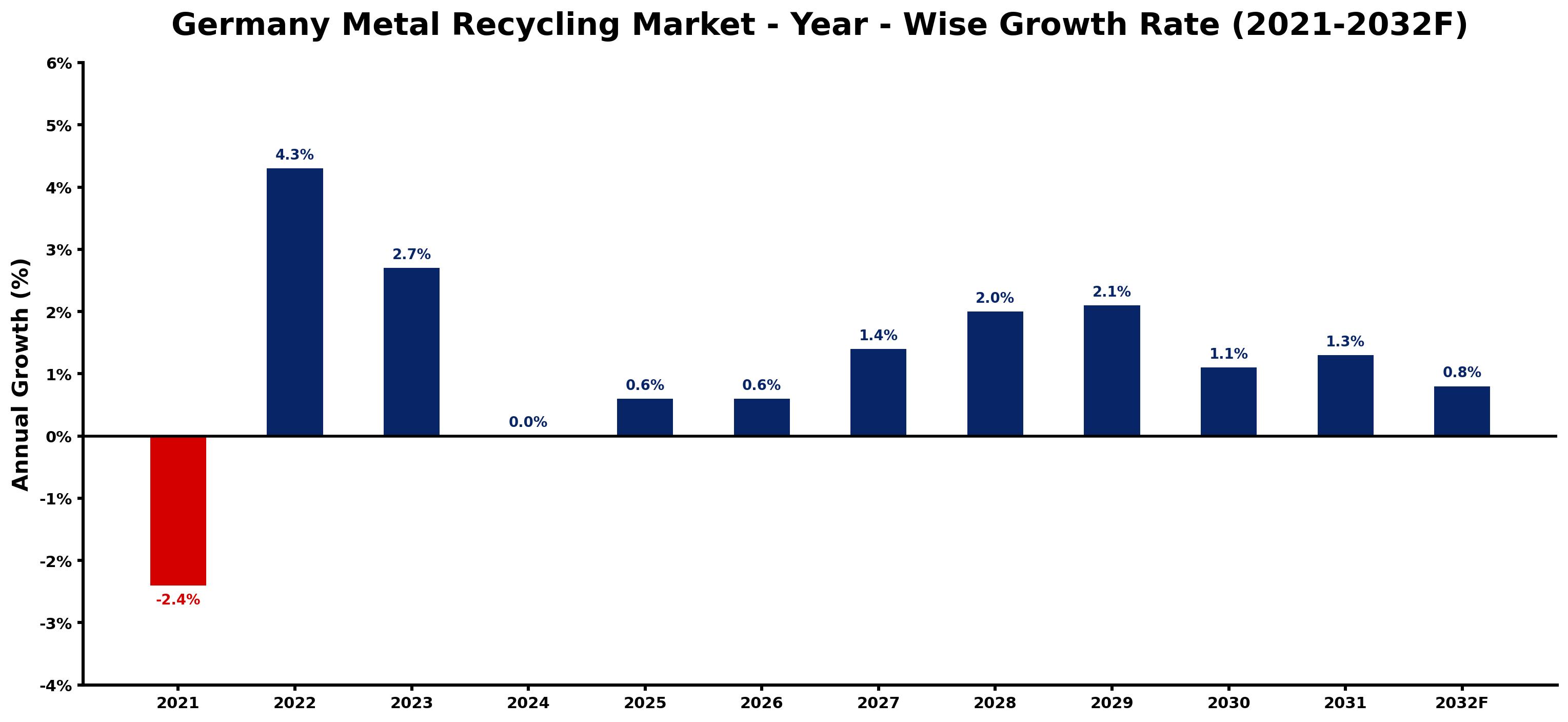
The table below presents the year wise growth rates along with the key drivers influencing the market
| Year | Growth Rate | Major Drivers |
| 2021 | -2.4% | Decreased industrial output due to supply chain disruptions diminished the demand for recycled metal products. |
| 2022 | 4.3% | Expanding electric vehicle production increased demand for recycled metals in automotive sectors. |
| 2023 | 2.7% | Technological innovations in dismantling and sorting technologies improved recycling efficiency dramatically. |
| 2024 | 0.0% | Circular economy initiatives encouraged businesses to invest more in recycling infrastructures. |
| 2025 | 0.6% | Increased consumer awareness about environmental sustainability influenced purchasing preferences toward recycled products. |
| 2026 | 0.6% | International trade policies favored recycled materials, enhancing Germany's export capabilities. |
| 2027 | 1.4% | Industrial automation in recycling facilities streamlined operations, reducing costs and increasing output. |
| 2028 | 2.0% | Emerging partnerships between tech firms and recyclers enabled smarter resource management solutions. |
| 2029 | 2.1% | Green financing options emerged, funding innovative recycling projects across various sectors. |
| 2030 | 1.1% | Shifting corporate responsibility strategies prompted companies to prioritize sustainable material sourcing. |
| 2031 | 1.3% | Enhanced recycling regulations were enforced to boost compliance among metal processing entities. |
| 2032 | 0.8% | Anticipated shortages in raw materials underscored the necessity for robust recycling systems. |
Note - Market size estimations and growth projections presented in this report are based on 6Wresearch's advanced forecasting approach, validated with industry datasets as of June 2026.
Germany Metal Recycling Market Synopsis
The Germany Metal Recycling Market is projected to reach 0.6% and witness significant growth during the forecast period (2026-2032). This market is bolstered by a robust recycling infrastructure, stringent regulatory frameworks, and a high level of environmental awareness among stakeholders. As a leader in sustainability, Germany's metal recycling sector plays a vital role in conserving natural resources, minimizing energy consumption, and reducing the environmental footprint associated with primary metal production.
Germany Metal Recycling Market Growth Drivers
The growth of the Germany metal recycling market is primarily driven by several critical factors:
- The increasing emphasis on sustainability has significantly shaped consumer and industrial preferences, favoring recycled materials over virgin resources.
- Regulatory frameworks aimed at environmental protection encourage recycling practices and promote the circular economy by mandating specific recycling targets and processes.
- Technological advancements in recycling processes enhance the efficiency and economic viability of metal recovery, making recycling a more attractive option for businesses.
- Growing industrial demand for recycled metals such as steel, aluminum, and copper reflects the pressing need for sustainable material sourcing, further fuelling market growth.
- Public awareness surrounding environmental issues and the benefits of recycling is leading to increased participation in recycling programs and initiatives, which positively impacts collection rates.
Germany Metal Recycling Market Challenges and Restraints
Despite its growth prospects, the Germany metal recycling market faces several challenges that could hinder its progress:
- Fragmented collection systems across various regions complicate the efficient gathering of recyclable materials, leading to lost opportunities for recovery.
- Material contamination further complicates recycling efforts, making the sorting and processing of metals more difficult and expensive.
- Fluctuating global metal prices introduce uncertainty for recyclers, affecting their profitability and investment capacity.
- Market demand for recycled metals can be volatile, influenced by broader economic conditions and changing industrial production levels.
- Stakeholders are required to invest in innovative technologies and infrastructure enhancements to address these challenges, driving up operational costs.
Germany Metal Recycling Market Government Investment and Initiatives
Government policies in Germany play a pivotal role in shaping the metal recycling market. Initiatives aimed at environmental preservation and resource conservation underscore the importance of effective waste management systems. Recent legislations focus on:
- Establishing ambitious recycling targets to promote higher recovery rates of metals and reduce landfill waste.
- Providing financial incentives for public and private sector investments in recycling technology and collection infrastructure to enhance operational efficiencies.
- Encouraging research and innovation in recycling processes and technologies to improve the economic viability of recycled materials.
- Implementing stricter regulations on waste disposal to ensure compliance with recycling guidelines, thereby fostering a more robust recycling ecosystem.
- Promoting awareness and educational campaigns to inform the public on the benefits of recycling and sustainable practices.
Germany Metal Recycling Market Latest Developments (May 2025 - June 2026)
In the period between May 2025 and June 2026, several critical developments have shaped the landscape of the Germany metal recycling market:
- Enhanced regulatory measures have been adopted to streamline the recycling processes, which have spurred improvements in material recovery rates.
- Innovations in recycling technologies have been introduced, enabling more efficient sorting and processing of metals, thus reducing operational costs.
- Growing collaborations between industries and recycling firms have emerged, allowing for the sharing of best practices and resources to optimize recycling impacts.
- Public sector investments have been made to bolster recycling infrastructure, particularly in urban areas where collection systems were previously inadequate.
- Market dynamics have shown a trend towards increased consumer acceptance of recycled materials, positively influencing demand and sales across various sectors.
Germany Metal Recycling Market - Key Attractiveness of the Report
- 10 Years of Market Numbers
- Historical Data Starting from 2022 to 2025
- Base Year: 2025
- Forecast Data until 2032
- Key Performance Indicators Impacting the Market
- Major Upcoming Developments and Projects
Key Highlights of the Report:
- Germany Metal Recycling Market Outlook
- Market Size of Germany Metal Recycling Market, 2025
- Forecast of Germany Metal Recycling Market, 2032
- Historical Data and Forecast of Germany Metal Recycling Revenues & Volume for the Period 2022-2032F
- Germany Metal Recycling Market Trend Evolution
- Germany Metal Recycling Market Drivers and Challenges
- Germany Metal Recycling Price Trends
- Germany Metal Recycling Porter's Five Forces
- Germany Metal Recycling Industry Life Cycle
- Historical Data and Forecast of Germany Metal Recycling Market Revenues & Volume By Metal Type for the Period 2022-2032F
- Historical Data and Forecast of Germany Metal Recycling Market Revenues & Volume By Ferrous Metal for the Period 2022-2032F
- Historical Data and Forecast of Germany Metal Recycling Market Revenues & Volume By Non-ferrous Metal for the Period 2022-2032F
- Historical Data and Forecast of Germany Metal Recycling Market Revenues & Volume By Scrap Types for the Period 2022-2032F
- Historical Data and Forecast of Germany Metal Recycling Market Revenues & Volume By Old Scrap for the Period 2022-2032F
- Historical Data and Forecast of Germany Metal Recycling Market Revenues & Volume By New Scrap for the Period 2022-2032F
- Historical Data and Forecast of Germany Metal Recycling Market Revenues & Volume By Equipment Types for the Period 2022-2032F
- Historical Data and Forecast of Germany Metal Recycling Market Revenues & Volume By Shears for the Period 2022-2032F
- Historical Data and Forecast of Germany Metal Recycling Market Revenues & Volume By Shredders for the Period 2022-2032F
- Historical Data and Forecast of Germany Metal Recycling Market Revenues & Volume By Briquette Machines for the Period 2022-2032F
- Historical Data and Forecast of Germany Metal Recycling Market Revenues & Volume By Granulating Machines for the Period 2022-2032F
- Historical Data and Forecast of Germany Metal Recycling Market Revenues & Volume By Others for the Period 2022-2032F
- Historical Data and Forecast of Germany Metal Recycling Market Revenues & Volume By End-users for the Period 2022-2032F
- Historical Data and Forecast of Germany Metal Recycling Market Revenues & Volume By Building & Construction for the Period 2022-2032F
- Historical Data and Forecast of Germany Metal Recycling Market Revenues & Volume By Packaging for the Period 2022-2032F
- Historical Data and Forecast of Germany Metal Recycling Market Revenues & Volume By Automotive for the Period 2022-2032F
- Historical Data and Forecast of Germany Metal Recycling Market Revenues & Volume By Industrial Machinery for the Period 2022-2032F
- Historical Data and Forecast of Germany Metal Recycling Market Revenues & Volume By Electronics & Electrical Equipment for the Period 2022-2032F
- Historical Data and Forecast of Germany Metal Recycling Market Revenues & Volume By Shipbuilding for the Period 2022-2032F
- Historical Data and Forecast of Germany Metal Recycling Market Revenues & Volume By Others for the Period 2022-2032F
- Germany Metal Recycling Import Export Trade Statistics
- Market Opportunity Assessment By Metal Type
- Market Opportunity Assessment By Scrap Types
- Market Opportunity Assessment By Equipment Types
- Market Opportunity Assessment By End-users
- Germany Metal Recycling Top Companies Market Share
- Germany Metal Recycling Competitive Benchmarking By Technical and Operational Parameters
- Germany Metal Recycling Company Profiles
- Germany Metal Recycling Key Strategic Recommendations






































