Germany Pasta And Noodles Market Size (2020-2030)
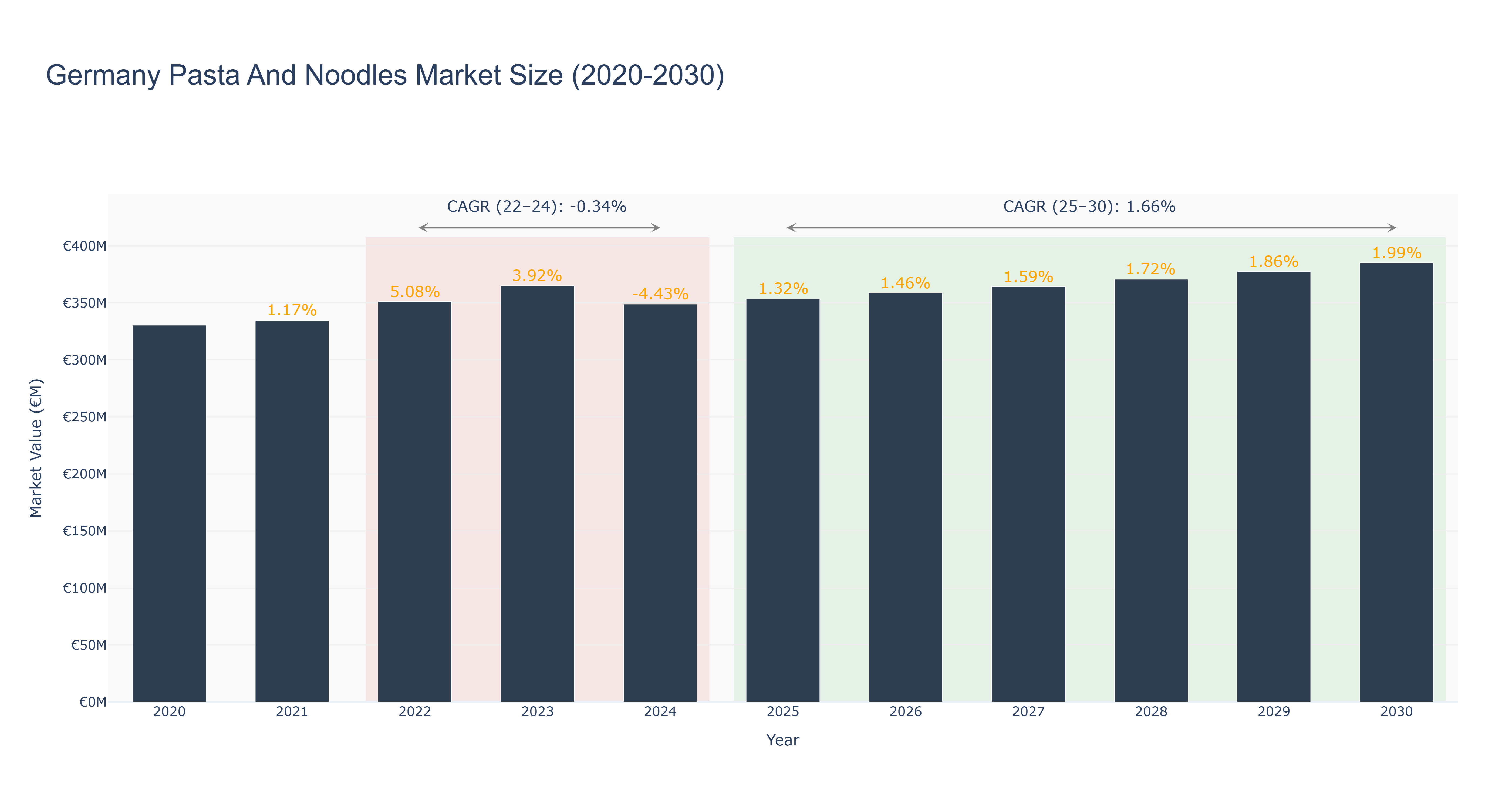
Germany Pasta And Noodles Market has shown a fluctuating trend in recent years. The market reached its peak size of €365.17 million in 2023, experiencing a slight decline in 2024 to €348.99 million. However, a positive growth trajectory resumed from 2025 onwards, with a forecasted market size of €385.17 million in 2030. The CAGR for the period 2022-24 was -0.34%, reflecting a temporary downturn, while the CAGR for 2025-30 is projected at 1.66%, indicating steady growth. The market's resilience can be attributed to changing consumer preferences towards convenience foods and the increasing popularity of pasta and noodles as staple food items. Looking ahead, Germany is set to witness investments in sustainable packaging solutions and innovative product offerings in the pasta and noodles segment to cater to evolving consumer demands.
Germany Pasta And Noodles Market: Production & Trade Performance (2019-2025)
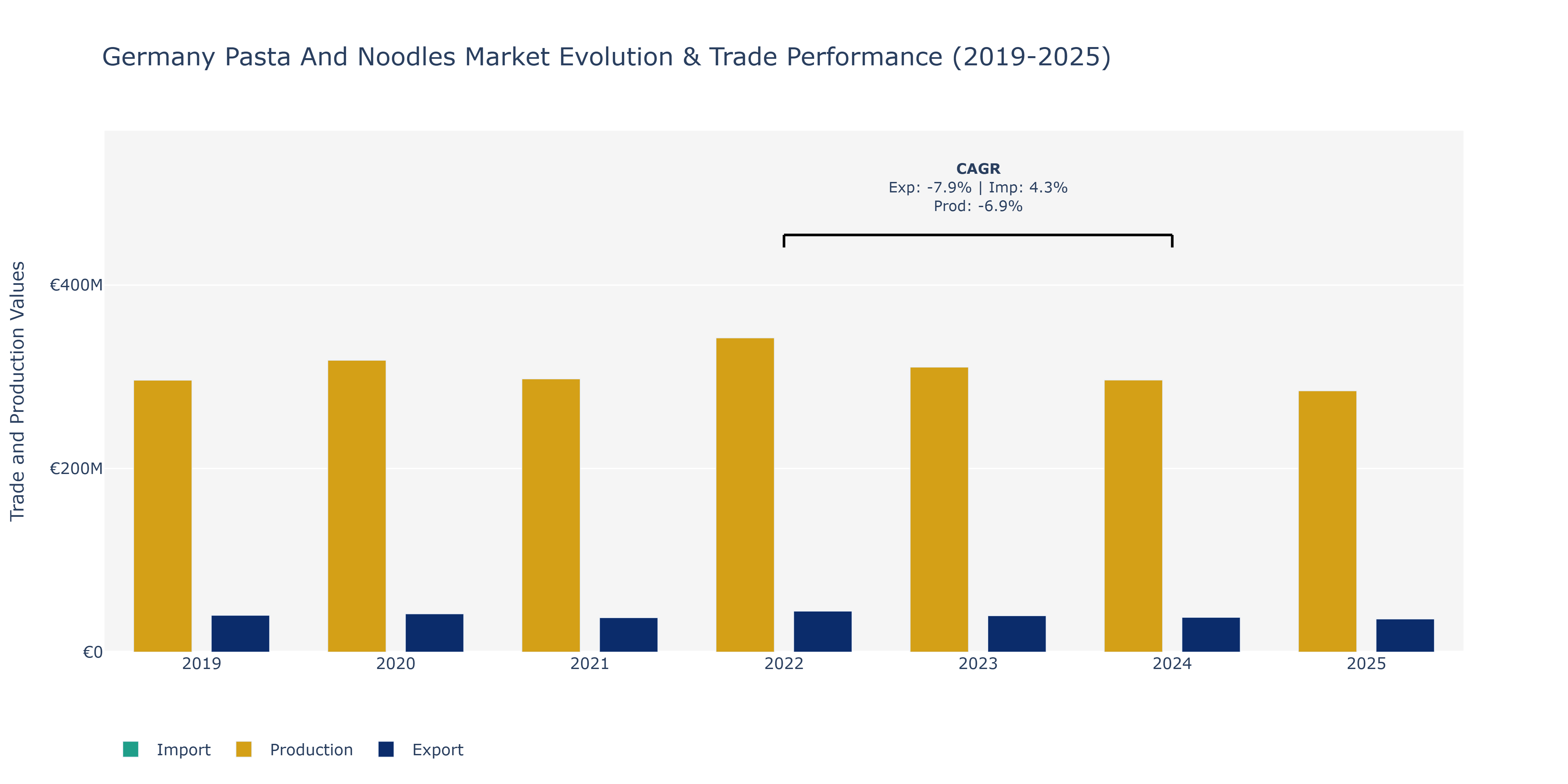
In the Germany Pasta and Noodles Market, from 2019 to 2025, there were fluctuations in Exports, Imports, and Production. Exports showed a declining trend from 2019 to 2021, with a peak in 2022 at €44.5 million, before decreasing again. This fluctuation could be attributed to changing consumer preferences for healthier alternatives impacting traditional pasta and noodle exports. Imports, on the other hand, generally increased over the years, reaching €72.69 million in 2025, possibly driven by a growing demand for diverse pasta and noodle varieties in the German market. Production experienced a decline from 2019 to 2021, followed by a notable peak in 2022 at €342.35 million, indicating potential industry expansions or technological advancements. The subsequent decline might be linked to market saturation or operational challenges faced by manufacturers. To sustain growth, market players could focus on product innovation to cater to evolving consumer tastes and preferences, aligning with the global trend towards healthier and convenient food options.
Germany Pasta and Noodles Market Overview
The Germany Pasta and Noodles Market is a mature and competitive industry characterized by a wide variety of product offerings and a strong consumer demand for convenience and healthy options. The market is dominated by established brands, but there is also a growing trend towards premium and organic products. German consumers are increasingly seeking healthier alternatives with higher nutritional value, driving the demand for whole grain and vegetable-based pasta and noodles. In addition, the market has seen an increase in gluten-free and protein-enriched products to cater to changing dietary preferences. Retail channels, such as supermarkets and hypermarkets, remain the primary distribution channels for pasta and noodles in Germany, but online sales are also gaining traction. Overall, the Germany Pasta and Noodles Market is expected to continue evolving to meet the changing needs and preferences of consumers.
Germany Pasta and Noodles Market Trends
The Germany Pasta and Noodles Market is experiencing several key trends. There is a growing demand for healthier and more nutritious pasta and noodle products, leading to an increase in the production and consumption of whole grain, gluten-free, and vegetable-based options. Convenience and ready-to-eat pasta and noodle products are also seeing a rise in popularity among busy consumers. Sustainability and ethical sourcing practices are becoming important considerations for German consumers, leading to a shift towards organic and locally sourced pasta and noodle products. Additionally, innovative flavors and unique pasta shapes are gaining traction, appealing to adventurous consumers seeking new culinary experiences. Overall, the market is evolving to cater to changing consumer preferences towards health, sustainability, convenience, and variety in the Germany Pasta and Noodles Market.
Germany Pasta and Noodles Market Challenges
In the Germany Pasta and Noodles Market, some of the challenges faced include intense competition among both domestic and international brands, the increasing health consciousness among consumers leading to a demand for healthier pasta and noodle options, fluctuating raw material prices affecting production costs, and the impact of changing consumer preferences and dietary trends. Additionally, the market is also influenced by regulatory changes regarding food labeling, packaging, and sustainability practices. Adapting to these challenges requires companies to innovate with product offerings, invest in marketing strategies that emphasize health benefits and sustainability, and maintain competitive pricing strategies. Keeping up with evolving consumer preferences and regulatory requirements while ensuring product quality and differentiation are crucial for success in the Germany Pasta and Noodles Market.
Germany Pasta and Noodles Market Investment Opportunities
Investment opportunities in the Germany Pasta and Noodles Market include the potential for growth in the premium and organic segments, as consumers are increasingly seeking healthier and higher quality options. Investing in innovative product offerings such as gluten-free pasta, plant-based noodles, or alternative grains can capture the attention of health-conscious consumers. Additionally, expanding distribution channels to reach a wider audience, such as online platforms or specialty stores, can drive sales growth. With the rising trend of home cooking and convenience, investing in ready-to-eat pasta and noodle products or meal kits could also be a lucrative opportunity. Overall, focusing on product innovation, quality, and convenience can position investors well to capitalize on the evolving preferences of German consumers in the pasta and noodles market.
Germany Pasta and Noodles Market Government Policy
Government policies related to the Germany Pasta and Noodles Market primarily focus on food safety regulations, labeling requirements, and trade agreements. The German government, through regulatory bodies like the Federal Ministry of Food and Agriculture (BMEL), ensures that pasta and noodle products meet strict quality and safety standards, including guidelines on ingredient sourcing, production processes, and packaging. Additionally, labeling regulations mandate clear and accurate information on product packaging, such as nutritional content and allergen warnings. Germany`s participation in trade agreements like the European Union`s Common Agricultural Policy (CAP) also influences market dynamics by providing subsidies and promoting fair competition within the industry. Overall, these government policies play a crucial role in shaping the operational landscape and consumer confidence within the Germany Pasta and Noodles Market.
Germany Pasta and Noodles Market Future Outlook
The Germany Pasta and Noodles Market is projected to continue experiencing steady growth in the coming years, driven by factors such as changing consumer preferences towards convenient and ready-to-eat meals, the increasing popularity of international cuisine, and the rising demand for healthier and organic pasta and noodle products. Additionally, the growing trend of home cooking and meal preparation during the COVID-19 pandemic has further boosted the market. Manufacturers are expected to focus on product innovation, including the development of gluten-free, plant-based, and fortified pasta and noodle varieties, to cater to evolving consumer preferences and dietary requirements. E-commerce platforms are also likely to play a significant role in expanding market reach and accessibility. Overall, the Germany Pasta and Noodles Market is poised for sustained growth and innovation in the foreseeable future.
Key Highlights of the Report:
- Germany Pasta and Noodles Market Outlook
- Market Size of Germany Pasta and Noodles Market, 2021
- Forecast of Germany Pasta and Noodles Market, 2031
- Historical Data and Forecast of Germany Pasta and Noodles Revenues & Volume for the Period 2018 - 2031
- Germany Pasta and Noodles Market Trend Evolution
- Germany Pasta and Noodles Market Drivers and Challenges
- Germany Pasta and Noodles Price Trends
- Germany Pasta and Noodles Porter's Five Forces
- Germany Pasta and Noodles Industry Life Cycle
- Historical Data and Forecast of Germany Pasta and Noodles Market Revenues & Volume By Product for the Period 2018 - 2031
- Historical Data and Forecast of Germany Pasta and Noodles Market Revenues & Volume By Ambient for the Period 2018 - 2031
- Historical Data and Forecast of Germany Pasta and Noodles Market Revenues & Volume By Dried for the Period 2018 - 2031
- Historical Data and Forecast of Germany Pasta and Noodles Market Revenues & Volume By Chilled for the Period 2018 - 2031
- Germany Pasta and Noodles Import Export Trade Statistics
- Market Opportunity Assessment By Product
- Germany Pasta and Noodles Top Companies Market Share
- Germany Pasta and Noodles Competitive Benchmarking By Technical and Operational Parameters
- Germany Pasta and Noodles Company Profiles
- Germany Pasta and Noodles Key Strategic Recommendations






































