Germany Proactive Services Market Size & Growth Rate (2026-2032)
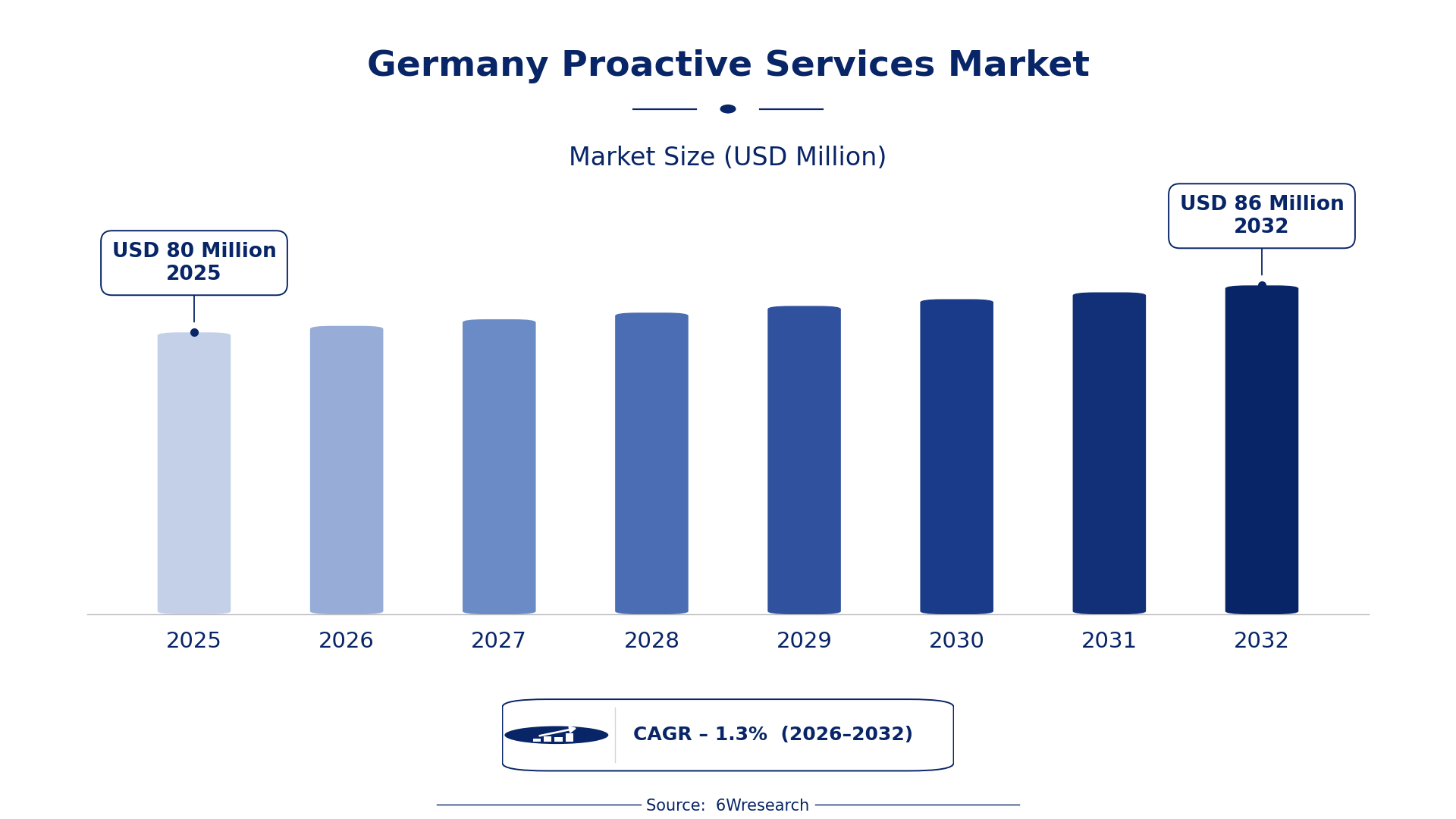
The Germany Proactive Services Market was estimated at USD 80 Million in 2025 and is projected to reach USD 86 Million by 2032, growing at a CAGR of 1.3% from 2026 to 2032.
Germany Proactive Services Market Synopsis
The Germany Proactive Services Market is on a promising trajectory, fueled by the growing integration of technologies like artificial intelligence and predictive analytics. Businesses across sectors are increasingly embracing proactive service models to enhance efficiency, minimize downtime, and elevate customer satisfaction.
As organizations seek to stay competitive, the demand for innovative solutions that allow for real-time monitoring and predictive maintenance is rising. This trend is not just about keeping systems running; it is about creating a customer-centric approach that anticipates needs and prevents issues before they arise.
Germany Proactive Services Market Year-wise Growth Rate and Key Drivers
This graph illustrates the annual growth rates of the Germany Proactive Services Market from 2021 to 2032, highlighting a steady upward trajectory and projected expansion over the forecast period.
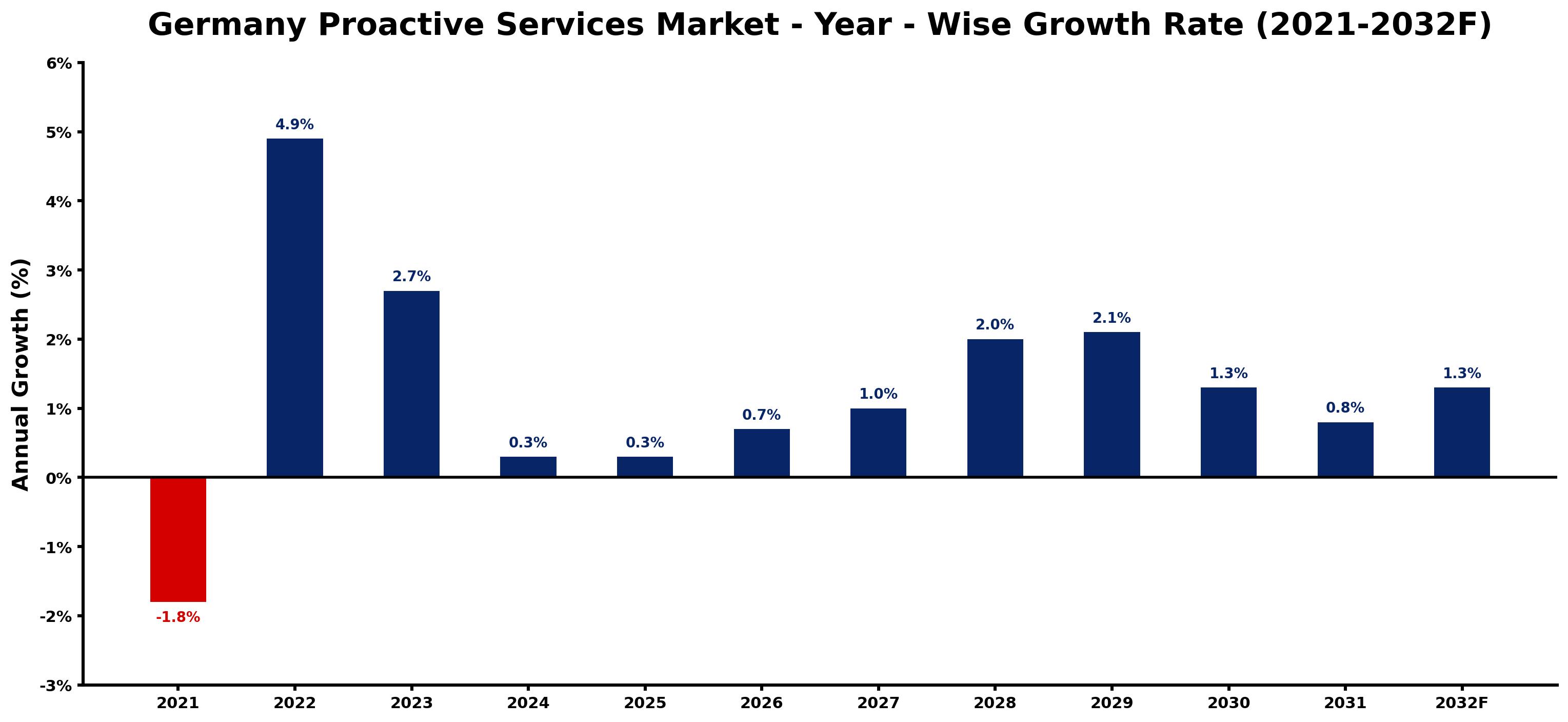
The table below presents the year‑wise growth rates along with the key drivers influencing the market
| Year | Growth Rate | Major Drivers |
| 2021 | -1.8% | Increased labor costs from German minimum wage rise |
| 2022 | 4.9% | Increased demand for IT security compliance in Germany. |
| 2023 | 2.7% | Government backing for digital health service innovations. |
| 2024 | 0.3% | Growing focus on preventative health measures post-pandemic. |
| 2025 | 0.3% | Stronger cybersecurity regulations from BSI boosting services. |
| 2026 | 0.7% | Rising adoption of AI-driven proactive support tools. |
| 2027 | 1.0% | Increased corporate investments in employee wellness initiatives. |
| 2028 | 2.0% | Boost from EU funding towards digital healthcare advancements. |
| 2029 | 2.1% | Surge in adoption of cloud-based service management solutions. |
| 2030 | 1.3% | Demand for remote monitoring solutions in aging population. |
| 2031 | 0.8% | Growing emphasis on customer experience in digital services. |
| 2032 | 1.3% | Local startups driving innovation in healthcare proactive services. |
Note: Market size estimations and growth projections presented in this report are based on 6Wresearch's proprietary forecasting methodology, utilizing the latest available industry data, government publications, and primary research inputs.
Germany Proactive Services Market Key Takeaways
Below are some of the specific key takeaways from the market, including:
- Rapid adoption of AI and machine learning is enhancing proactive service capabilities.
- Personalization of services is becoming a focus area to cater to diverse customer needs.
- Proactive cybersecurity solutions are in high demand due to increasing threat levels.
- Managed services are on the rise as companies outsource their proactive monitoring needs.
- Investment opportunities are expanding in predictive analytics and automation technologies.
Evaluation of Restraints in Germany Proactive Services Market
Complexity in technology infrastructures presents a significant barrier for many businesses. As systems become more intricate, the need for specialized expertise increases, which can deter smaller organizations from implementing proactive services. The challenge lies not only in monitoring and managing these systems effectively but also in delivering high-quality services while controlling costs. Companies are continuously pushed to demonstrate the value of their proactive solutions, making it imperative to innovate and adapt to the evolving technological landscape.
Germany Proactive Services Market Trends
A notable trend is the increasing use of artificial intelligence to predict issues, allowing businesses to shift from reactive to proactive approaches. This shift enhances operational efficiency and customer loyalty. Additionally, companies are tailoring their proactive services to address specific customer requirements, leading to more personalized interactions.
on top of that, the demand for proactive cybersecurity services is surging, driven by the growing awareness of vulnerabilities in digital infrastructures. This focus on security is shaping the development of innovative solutions that not only respond to threats but also anticipate them.
Germany Proactive Services Market Opportunities
The proactive services market in Germany presents ample investment opportunities, particularly in IT services, technology solutions, and customer support sectors. The increasing focus on operational efficiency and customer satisfaction drives demand for predictive analytics and automation technologies. Additionally, the emphasis on data security opens avenues for investments in proactive monitoring and cybersecurity solutions.
Government Initiatives in the Germany Proactive Services Market
Government initiatives play a crucial role in shaping the Proactive Services Market in Germany. Policies promoting digitalization and technological advancement create a supportive environment for businesses. This focus on innovation is essential as organizations strive to enhance their service offerings and maintain competitiveness.
- A national digital infrastructure upgrade programme is currently underway to enhance connectivity and support proactive service deployment.
- The Digital Agenda 2025 initiative was launched recently to promote digital innovation and improve market competitiveness.
- Current policies include regulations ensuring data privacy and security, crucial for enhancing trust in proactive service solutions.
- Planned investments are anticipated to support research and development in proactive service technologies, fostering collaboration between industry and academia.
Future Insights of the Germany Proactive Services Market
Looking ahead to 2026-2032, the Germany Proactive Services Market is set for continued growth, driven by technological advancements and a shift towards more proactive operational models. Companies will increasingly rely on predictive maintenance and proactive support services to mitigate risks and enhance efficiency.
As digital transformation efforts gain momentum across industries, service providers will have opportunities to innovate and develop tailored solutions that meet evolving client needs. The focus will not only be on minimizing downtime but also on delivering superior customer experiences, which will be key to maintaining a competitive edge in the market.
Germany Proactive Services Market Latest Developments
Recent developments in the Germany Proactive Services Market indicate a vigorous push towards enhanced service offerings and technological integration. Over the last year, companies have been actively exploring partnerships and investing in new technologies to stay ahead.
- A new predictive maintenance solution was launched in Q2 2025, enabling businesses to significantly reduce downtime.
- An initiative to integrate AI-driven analytics into existing service platforms is currently underway, enhancing monitoring capabilities.
- Proactive cybersecurity measures have been bolstered by a major technology vendor, with a rollout expected to begin in early 2026.
- A collaboration between service providers and technology firms to develop next-gen automation tools is planned for mid-2026.
Germany Proactive Services Market - Key Attractiveness of the Report
- 10 Years of Market Numbers
- Historical Data Starting from 2022 to 2025
- Base Year: 2025
- Forecast Data until 2032
- Key Performance Indicators Impacting the Market
- Major Upcoming Developments and Projects
Key Highlights of the Report:
- Germany Proactive Services Market Outlook
- Market Size of Germany Proactive Services Market, 2025
- Forecast of Germany Proactive Services Market, 2032
- Historical Data and Forecast of Germany Proactive Services Revenues & Volume for the Period 2022-2032F
- Germany Proactive Services Market Trend Evolution
- Germany Proactive Services Market Drivers and Challenges
- Germany Proactive Services Price Trends
- Germany Proactive Services Porter's Five Forces
- Germany Proactive Services Industry Life Cycle
- Historical Data and Forecast of Germany Proactive Services Market Revenues & Volume By Application for the Period 2022-2032F
- Historical Data and Forecast of Germany Proactive Services Market Revenues & Volume By Network Management for the Period 2022-2032F
- Historical Data and Forecast of Germany Proactive Services Market Revenues & Volume By Customer Experience Management for the Period 2022-2032F
- Historical Data and Forecast of Germany Proactive Services Market Revenues & Volume By Data Center Management for the Period 2022-2032F
- Historical Data and Forecast of Germany Proactive Services Market Revenues & Volume By Cloud Management for the Period 2022-2032F
- Historical Data and Forecast of Germany Proactive Services Market Revenues & Volume By Application Management for the Period 2022-2032F
- Historical Data and Forecast of Germany Proactive Services Market Revenues & Volume By Device / Endpoint Management for the Period 2022-2032F
- Historical Data and Forecast of Germany Proactive Services Market Revenues & Volume By Service for the Period 2022-2032F
- Historical Data and Forecast of Germany Proactive Services Market Revenues & Volume By Managed Services for the Period 2022-2032F
- Historical Data and Forecast of Germany Proactive Services Market Revenues & Volume By Technical Support for the Period 2022-2032F
- Historical Data and Forecast of Germany Proactive Services Market Revenues & Volume By Design and Consulting for the Period 2022-2032F
- Historical Data and Forecast of Germany Proactive Services Market Revenues & Volume By Technology Type for the Period 2022-2032F
- Historical Data and Forecast of Germany Proactive Services Market Revenues & Volume By Big Data Analytics for the Period 2022-2032F
- Historical Data and Forecast of Germany Proactive Services Market Revenues & Volume By Business Intelligence for the Period 2022-2032F
- Historical Data and Forecast of Germany Proactive Services Market Revenues & Volume By Machine Intelligence for the Period 2022-2032F
- Historical Data and Forecast of Germany Proactive Services Market Revenues & Volume By Organization Size for the Period 2022-2032F
- Historical Data and Forecast of Germany Proactive Services Market Revenues & Volume By Small and Medium-sized Enterprises (SMEs) for the Period 2022-2032F
- Historical Data and Forecast of Germany Proactive Services Market Revenues & Volume By Large enterprises for the Period 2022-2032F
- Historical Data and Forecast of Germany Proactive Services Market Revenues & Volume By Vertical for the Period 2022-2032F
- Historical Data and Forecast of Germany Proactive Services Market Revenues & Volume By Banking, Financial Services, and Insurance (BFSI) for the Period 2022-2032F
- Historical Data and Forecast of Germany Proactive Services Market Revenues & Volume By Telecommunication for the Period 2022-2032F
- Historical Data and Forecast of Germany Proactive Services Market Revenues & Volume By Retail for the Period 2022-2032F
- Historical Data and Forecast of Germany Proactive Services Market Revenues & Volume By Healthcare for the Period 2022-2032F
- Historical Data and Forecast of Germany Proactive Services Market Revenues & Volume By Government and Defense for the Period 2022-2032F
- Historical Data and Forecast of Germany Proactive Services Market Revenues & Volume By Media and Entertainment for the Period 2022-2032F
- Historical Data and Forecast of Germany Proactive Services Market Revenues & Volume By Others for the Period 2022-2032F
- Germany Proactive Services Import Export Trade Statistics
- Market Opportunity Assessment By Application
- Market Opportunity Assessment By Service
- Market Opportunity Assessment By Technology Type
- Market Opportunity Assessment By Organization Size
- Market Opportunity Assessment By Vertical
- Germany Proactive Services Top Companies Market Share
- Germany Proactive Services Competitive Benchmarking By Technical and Operational Parameters
- Germany Proactive Services Company Profiles
- Germany Proactive Services Key Strategic Recommendations






































