Germany Procurement Analytics Market Size & Growth Rate (2026-2032)
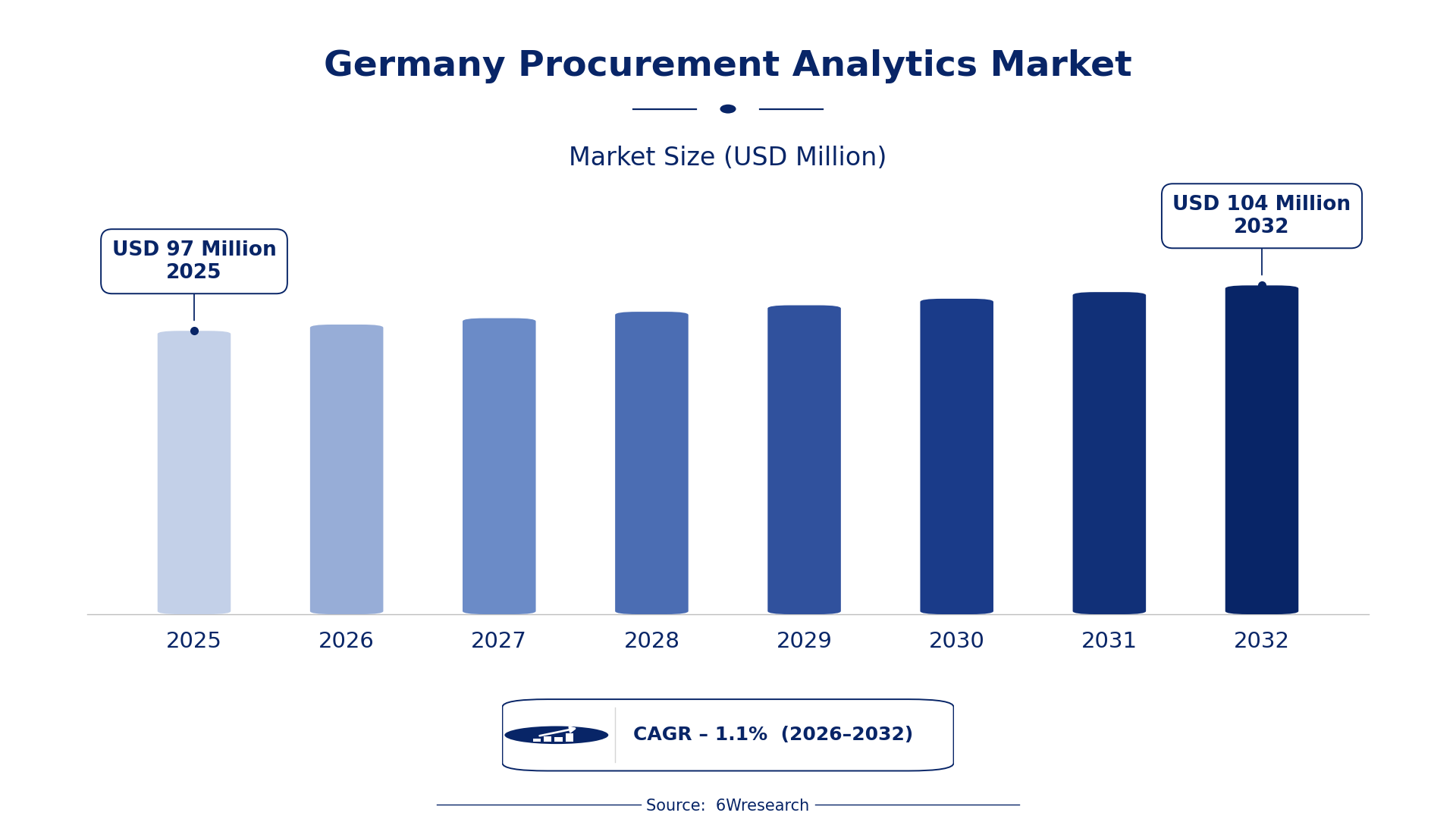
The Germany Procurement Analytics Market was estimated at USD 97 Million in 2025 and is projected to reach USD 104 Million by 2032, growing at a CAGR of 1.1% from 2026 to 2032.
Germany Procurement Analytics Market Synopsis
Germany's procurement analytics market is currently witnessing considerable growth driven by the increasing need for data-driven procurement strategies. Enterprises are increasingly adopting analytics solutions to refine their procurement processes, providing an avenue for significant cost savings and efficiency.
However, as organizations strive for optimization, they are also faced with challenges that could hinder progress. Issues surrounding data integration, quality, and talent availability pose real barriers, suggesting that while momentum is strong, a careful approach to overcoming these hurdles will be crucial for sustained market growth.
Germany Procurement Analytics Market Year-wise Growth Rate and Key Drivers
This graph illustrates the annual growth rates of the Germany Procurement Analytics Market from 2021 to 2032, highlighting a steady upward trajectory and projected expansion over the forecast period.
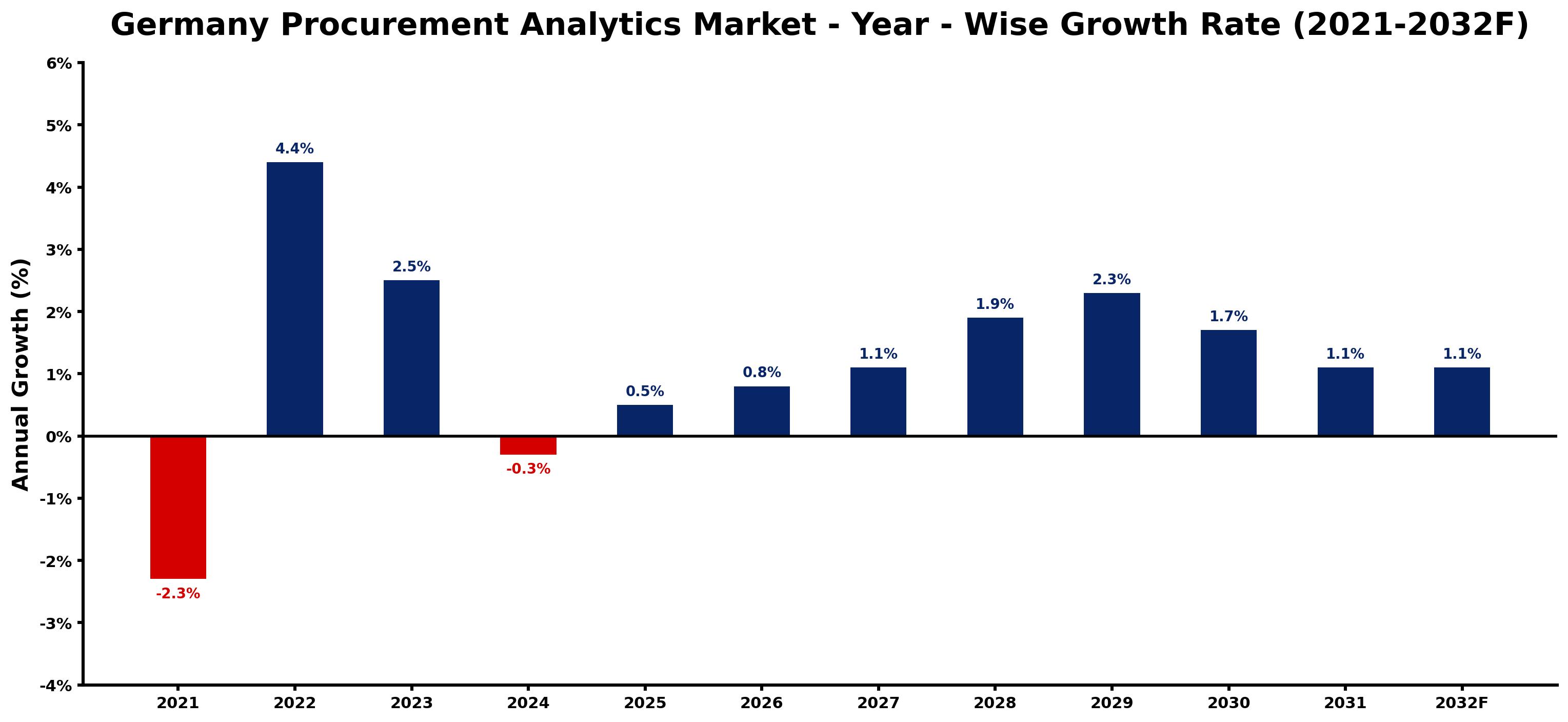
The table below presents the year‑wise growth rates along with the key drivers influencing the market
| Year | Growth Rate | Major Drivers |
| 2021 | -2.3% | Shift towards in-house procurement processes by major firms |
| 2022 | 4.4% | Increased emphasis on sustainable procurement practices. |
| 2023 | 2.5% | Government push for digitization in public procurement processes. |
| 2024 | -0.3% | Reduced investment in analytics following GDPR compliance costs |
| 2025 | 0.5% | Growing need for data-driven decision-making in procurement. |
| 2026 | 0.8% | Rising interest in supplier diversity metrics among companies. |
| 2027 | 1.1% | Adoption of AI technologies in supply chain optimization. |
| 2028 | 1.9% | Enhanced regulations for transparency in procurement reporting. |
| 2029 | 2.3% | Expanding e-procurement platforms among mid-sized enterprises. |
| 2030 | 1.7% | Focus on cost reduction amidst high inflation pressures. |
| 2031 | 1.1% | Increased collaboration between industry and research institutions. |
| 2032 | 1.1% | Demand for real-time analytics in procurement strategies. |
Note: Market size estimations and growth projections presented in this report are based on 6Wresearch's proprietary forecasting methodology, utilizing the latest available industry data, government publications, and primary research inputs.
Germany Procurement Analytics Market Key Takeaways
Below are some of the specific key takeaways from the market, including:
- Increased adoption of analytics solutions is shaping procurement strategies across sectors.
- Data privacy and compliance issues are central concerns for solution providers.
- Advanced technologies like AI are enhancing the capabilities of procurement analytics.
- Government policies are increasingly supporting transparency and efficiency in procurement processes.
- The demand for actionable insights is driving innovation in analytics solutions.
Evaluation of Restraints in Germany Procurement Analytics Market
While the growth potential in the Germany procurement analytics market is evident, several restraints are hampering progress. A major hurdle is the challenge of data integration; many organizations struggle to synthesize information from diverse sources into a cohesive analytics framework. on top of that, data quality remains a pressing issue, with many organizations lacking the necessary infrastructure to ensure high-quality data inputs. There is also a noticeable talent shortage, as companies find it increasingly difficult to source skilled professionals who can effectively leverage analytics tools. Lastly, concerns regarding data privacy and compliance with stringent regulations further complicate the landscape for both solution providers and users.
Germany Procurement Analytics Market Trends
Recent trends indicate a significant shift toward the use of advanced analytics and AI technologies. Companies are not just looking for historical data analysis but are increasingly interested in predictive analytics to forecast future procurement needs. The rise of cloud-based solutions has also gained traction, allowing for more flexible and scalable analytics platforms. on top of that, organizations are placing greater emphasis on sustainability metrics within procurement analytics, reflecting a broader societal push towards responsible sourcing.
Germany Procurement Analytics Market Opportunities
With the challenges come opportunities. As organizations seek to enhance procurement efficiency, there is a growing market for innovative analytics solutions that can integrate various data sources seamlessly. Additionally, the increasing focus on sustainability opens new avenues for analytics tailored to measuring and improving environmental impact. Companies that can deliver actionable insights and align with compliance requirements will find themselves well-positioned to capture market share.
Government Initiatives in the Germany Procurement Analytics Market
Government policy plays a crucial role in shaping the procurement analytics market in Germany. By promoting transparency and efficiency, these regulations aim to enhance procurement practices across the public and private sectors. The focus on data protection and compliance ensures that analytics solutions adhere to stringent legal frameworks, ultimately fostering a secure environment for data-driven decision-making.
- A national digital infrastructure upgrade programme now in its rollout phase is enhancing data accessibility for analytics solutions.
- Current regulations emphasize procurement transparency requirements, ensuring that organizations follow best practices in data management.
- A regulatory framework introduced in 2025 mandates billing transparency, which aids in better analytics of procurement costs.
- A planned public-private initiative expected to expand analytics capabilities in procurement by 2028 is currently being developed.
- Government investments in data analytics infrastructure are ongoing, aimed at bolstering the skills necessary for effective procurement analytics.
Future Insights of the Germany Procurement Analytics Market
Looking ahead to 2026-2032, the Germany procurement analytics market is expected to evolve significantly. The increasing complexity of supply chains will likely necessitate more sophisticated analytics solutions, emphasizing the need for real-time data analysis and predictive capabilities. As organizations continue to prioritize cost efficiency, the demand for procurement analytics will grow, driving innovation and investment in this sector. The integration of AI and machine learning technologies will further enhance the ability to derive actionable insights, positioning analytics as an indispensable tool in procurement strategy.
Germany Procurement Analytics Market Latest Developments
Over the past year, the Germany procurement analytics market has seen a surge of activity as companies strive to optimize their procurement processes. There has been a notable increase in partnerships focused on developing advanced analytics solutions, as well as a rise in investments aimed at enhancing existing platforms. Organizations are also exploring new technologies to improve data integration and usability, responding to the growing demand for actionable insights.
- A major technology vendor launched a new procurement analytics platform in Q2 2025, aimed at enhancing data visualization and usability.
- An initiative that began in early 2025 and remains underway focuses on integrating AI capabilities into existing procurement analytics solutions.
- A collaborative project between public and private sectors to improve data privacy measures is expected to conclude by late 2025.
- Several companies are currently piloting machine learning algorithms to enhance predictive analytics capabilities, with results expected by mid-2026.
- A rollout expected to begin in early 2026 aims to expand the availability of cloud-based procurement analytics solutions across various industries.
Germany Procurement Analytics Market - Key Attractiveness of the Report
- 10 Years of Market Numbers
- Historical Data Starting from 2022 to 2025
- Base Year: 2025
- Forecast Data until 2032
- Key Performance Indicators Impacting the Market
- Major Upcoming Developments and Projects
Key Highlights of the Report:
- Germany Procurement Analytics Market Outlook
- Market Size of Germany Procurement Analytics Market, 2025
- Forecast of Germany Procurement Analytics Market, 2032
- Historical Data and Forecast of Germany Procurement Analytics Revenues & Volume for the Period 2022-2032F
- Germany Procurement Analytics Market Trend Evolution
- Germany Procurement Analytics Market Drivers and Challenges
- Germany Procurement Analytics Price Trends
- Germany Procurement Analytics Porter's Five Forces
- Germany Procurement Analytics Industry Life Cycle
- Historical Data and Forecast of Germany Procurement Analytics Market Revenues & Volume By Component for the Period 2022-2032F
- Historical Data and Forecast of Germany Procurement Analytics Market Revenues & Volume By Solutions for the Period 2022-2032F
- Historical Data and Forecast of Germany Procurement Analytics Market Revenues & Volume By Services for the Period 2022-2032F
- Historical Data and Forecast of Germany Procurement Analytics Market Revenues & Volume By Organization Size for the Period 2022-2032F
- Historical Data and Forecast of Germany Procurement Analytics Market Revenues & Volume By Large Enterprises for the Period 2022-2032F
- Historical Data and Forecast of Germany Procurement Analytics Market Revenues & Volume By SMEs for the Period 2022-2032F
- Historical Data and Forecast of Germany Procurement Analytics Market Revenues & Volume By Deployment Mode for the Period 2022-2032F
- Historical Data and Forecast of Germany Procurement Analytics Market Revenues & Volume By Cloud for the Period 2022-2032F
- Historical Data and Forecast of Germany Procurement Analytics Market Revenues & Volume By On-premises for the Period 2022-2032F
- Historical Data and Forecast of Germany Procurement Analytics Market Revenues & Volume By Application for the Period 2022-2032F
- Historical Data and Forecast of Germany Procurement Analytics Market Revenues & Volume By Supply Chain Analytics for the Period 2022-2032F
- Historical Data and Forecast of Germany Procurement Analytics Market Revenues & Volume By Risk Analytics for the Period 2022-2032F
- Historical Data and Forecast of Germany Procurement Analytics Market Revenues & Volume By Spend Analytics for the Period 2022-2032F
- Historical Data and Forecast of Germany Procurement Analytics Market Revenues & Volume By Demand Forecasting for the Period 2022-2032F
- Historical Data and Forecast of Germany Procurement Analytics Market Revenues & Volume By Contract Management for the Period 2022-2032F
- Historical Data and Forecast of Germany Procurement Analytics Market Revenues & Volume By Vendor Management for the Period 2022-2032F
- Historical Data and Forecast of Germany Procurement Analytics Market Revenues & Volume By Category Management for the Period 2022-2032F
- Historical Data and Forecast of Germany Procurement Analytics Market Revenues & Volume By Industry Vertical for the Period 2022-2032F
- Historical Data and Forecast of Germany Procurement Analytics Market Revenues & Volume By BFSI for the Period 2022-2032F
- Historical Data and Forecast of Germany Procurement Analytics Market Revenues & Volume By Retail and eCommerce for the Period 2022-2032F
- Historical Data and Forecast of Germany Procurement Analytics Market Revenues & Volume By Telecom and IT for the Period 2022-2032F
- Historical Data and Forecast of Germany Procurement Analytics Market Revenues & Volume By Manufacturing for the Period 2022-2032F
- Historical Data and Forecast of Germany Procurement Analytics Market Revenues & Volume By Healthcare and Life Sciences for the Period 2022-2032F
- Historical Data and Forecast of Germany Procurement Analytics Market Revenues & Volume By Energy and Utilities for the Period 2022-2032F
- Historical Data and Forecast of Germany Procurement Analytics Market Revenues & Volume By Government and Defense for the Period 2022-2032F
- Germany Procurement Analytics Import Export Trade Statistics
- Market Opportunity Assessment By Component
- Market Opportunity Assessment By Organization Size
- Market Opportunity Assessment By Deployment Mode
- Market Opportunity Assessment By Application
- Market Opportunity Assessment By Industry Vertical
- Germany Procurement Analytics Top Companies Market Share
- Germany Procurement Analytics Competitive Benchmarking By Technical and Operational Parameters
- Germany Procurement Analytics Company Profiles
- Germany Procurement Analytics Key Strategic Recommendations






































