Germany Smart Learning Market Size & Growth Rate (2026-2032)
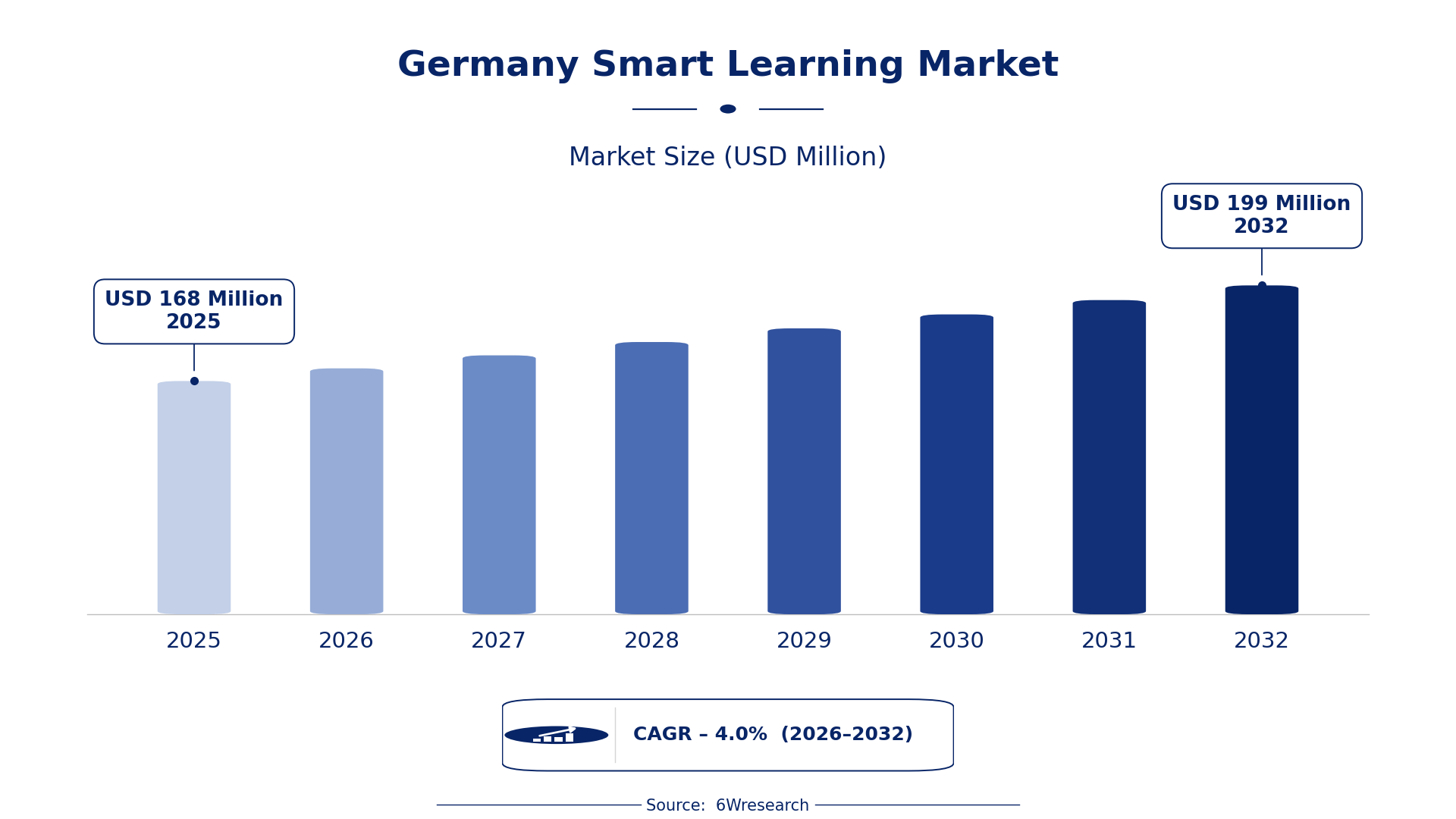
The Germany Smart Learning Market was estimated at USD 168 Million in 2025 and is projected to reach USD 199 Million by 2032, growing at a CAGR of 4.0% from 2026 to 2032.
Germany Smart Learning Market Synopsis
The adoption of digital technologies in education is rapidly reshaping the Germany Smart Learning Market. This shift is marked by an increasing demand for e-learning solutions and personalized learning platforms that cater to diverse student needs. As educational institutions embrace these innovations, the market is witnessing a notable transformation.
on top of that, the impact of the COVID-19 pandemic has accelerated the transition to online learning, highlighting the importance of flexibility and accessibility in education. With a strong emphasis on enhancing student engagement and improving learning outcomes, stakeholders in the German education sector are prioritizing investment in smart learning technologies.
Germany Smart Learning Market Year-wise Growth Rate and Key Drivers
This graph illustrates the annual growth rates of the Germany Smart Learning Market from 2021 to 2032, highlighting a steady upward trajectory and projected expansion over the forecast period.
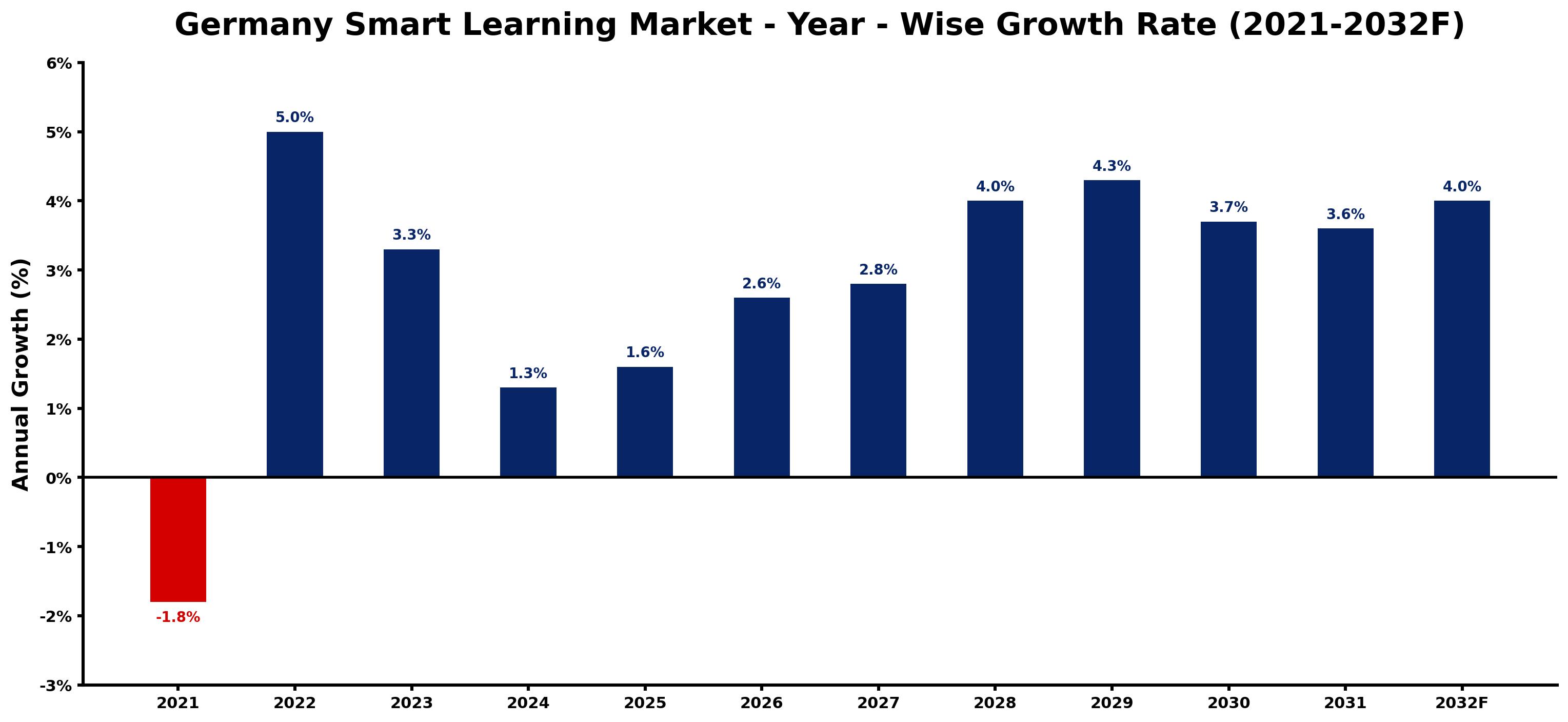
The table below presents the year‑wise growth rates along with the key drivers influencing the market
| Year | Growth Rate | Major Drivers |
| 2021 | -1.8% | Regulatory hurdles from German data protection laws. |
| 2022 | 5.0% | Increased funding for digital transformation in education |
| 2023 | 3.3% | Launch of nationwide 'DigitalPakt Schule' program |
| 2024 | 1.3% | Adoption of AI-based tutoring systems in schools |
| 2025 | 1.6% | Growth in educational technology startups receiving investment |
| 2026 | 2.6% | Rising interest in gamified learning experiences |
| 2027 | 2.8% | Government incentives for educational software development |
| 2028 | 4.0% | Collaboration with international edtech companies expands |
| 2029 | 4.3% | Increased focus on STEM education in schools |
| 2030 | 3.7% | Demand for multilingual learning platforms rises |
| 2031 | 3.6% | Integration of virtual reality in classroom settings |
| 2032 | 4.0% | Support for lifelong learning initiatives from local governments |
Note: Market size estimations and growth projections presented in this report are based on 6Wresearch's proprietary forecasting methodology, utilizing the latest available industry data, government publications, and primary research inputs.
Germany Smart Learning Market Key Takeaways
Below are some of the specific key takeaways from the market, including:
- The market is projected to grow steadily, driven by increasing digital adoption in education.
- Personalized learning experiences and adaptive technologies are gaining traction.
- Government initiatives are significantly supporting infrastructure and resource development.
- There is a rising focus on upskilling and reskilling to meet workforce demands.
- Challenges related to data privacy and equal access must be addressed for sustainable growth.
Evaluation of Restraints in Germany Smart Learning Market
Despite the promising growth trajectory, the Germany Smart Learning Market faces several constraints. Infrastructure challenges hinder the widespread adoption of advanced technologies in schools. Resistance to moving away from traditional teaching methods persists, with some educators hesitant to embrace digital tools fully. Additionally, data privacy concerns remain a significant barrier, as educational institutions must ensure compliance with stringent regulations. Equal access to digital learning tools is another pressing issue, particularly for students from disadvantaged backgrounds. Addressing these restraints is essential for the successful implementation of smart learning solutions across the educational spectrum.
Germany Smart Learning Market Trends
Current trends in the Germany Smart Learning Market are marked by a strong demand for personalized and adaptive learning experiences. Educational institutions are increasingly integrating artificial intelligence and machine learning technologies into their curricula, enhancing the interactivity and engagement of learning materials. The shift towards mobile learning platforms is also notable, as students prefer the flexibility of accessing educational resources on their devices. on top of that, gamified learning applications and virtual reality solutions are emerging as innovative tools to boost student engagement and knowledge retention.
Germany Smart Learning Market Opportunities
The market presents significant opportunities for growth and investment. The development of innovative EdTech solutions is crucial, particularly those that utilize virtual reality and gamification to create immersive learning experiences. Collaborations between smart learning providers and businesses to deliver tailored upskilling and reskilling programs are also on the rise. As educational institutions continue to embrace digital transformation, there is ample room for new entrants to offer unique solutions that address the evolving needs of both students and educators.
Government Initiatives in the Germany Smart Learning Market
The German government plays a proactive role in shaping the Smart Learning Market through various initiatives aimed at promoting digital education. With a focus on enhancing educational quality and accessibility, these policies are designed to foster technological innovation in schools and universities. The regulatory framework is currently prioritizing the integration of digital tools in teaching methodologies, ensuring that students are well-prepared for a technology-driven future.
- A recently completed initiative, the DigitalPakt Schule, provided substantial funding for schools to upgrade their digital infrastructure and resources.
- Currently underway is the National Education Pact 2025, aimed at improving educational quality through technology integration.
- A planned public-private initiative focuses on expanding access to digital learning tools for underserved communities by 2027.
- Ongoing efforts include a national digital literacy program targeting both students and educators to enhance technological competencies.
- Upcoming regulations are expected to mandate the incorporation of digital learning standards across all educational institutions by 2028.
Future Insights of the Germany Smart Learning Market
Looking ahead to 2026-2032, the Germany Smart Learning Market is set to experience substantial growth. The increasing emphasis on personalized learning, along with the rise of online education platforms, will continue to shape the market's direction. As the demand for advanced technologies like artificial intelligence and virtual reality in educational processes grows, stakeholders are likely to invest heavily in these innovations. The ongoing shift towards hybrid learning models will further accelerate the need for smart learning solutions, positioning Germany as a leader in educational technology across Europe.
Germany Smart Learning Market Latest Developments
Recent activity in the Germany Smart Learning Market reflects a dynamic shift towards innovation and enhanced educational delivery methods. Stakeholders are increasingly focused on integrating advanced technologies to improve learning experiences. This trend is evident in various developments over the past year, underscoring the commitment to modernizing education.
- A major technology vendor launched an AI-powered learning management system in early 2025, enhancing personalized learning pathways.
- In mid-2025, a partnership between educational institutions and EdTech companies was established to create gamified learning applications, which are currently in pilot testing.
- An initiative aimed at training educators in digital tools began in Q2 2025 and remains ongoing, with positive feedback from participants.
- A rollout of a mobile learning platform is expected to begin in late 2025, enhancing accessibility for students across Germany.
- By early 2026, a new framework for assessing digital competencies in students is planned for implementation, aiming to standardize educational outcomes.
Germany Smart Learning Market - Key Attractiveness of the Report
- 10 Years of Market Numbers
- Historical Data Starting from 2022 to 2025
- Base Year: 2025
- Forecast Data until 2032
- Key Performance Indicators Impacting the Market
- Major Upcoming Developments and Projects
Key Highlights of the Report:
- Germany Smart Learning Market Outlook
- Market Size of Germany Smart Learning Market, 2025
- Forecast of Germany Smart Learning Market, 2032
- Historical Data and Forecast of Germany Smart Learning Revenues & Volume for the Period 2022-2032F
- Germany Smart Learning Market Trend Evolution
- Germany Smart Learning Market Drivers and Challenges
- Germany Smart Learning Price Trends
- Germany Smart Learning Porter's Five Forces
- Germany Smart Learning Industry Life Cycle
- Historical Data and Forecast of Germany Smart Learning Market Revenues & Volume By Component for the Period 2022-2032F
- Historical Data and Forecast of Germany Smart Learning Market Revenues & Volume By Hardware for the Period 2022-2032F
- Historical Data and Forecast of Germany Smart Learning Market Revenues & Volume By Software for the Period 2022-2032F
- Historical Data and Forecast of Germany Smart Learning Market Revenues & Volume By Services for the Period 2022-2032F
- Historical Data and Forecast of Germany Smart Learning Market Revenues & Volume By End User for the Period 2022-2032F
- Historical Data and Forecast of Germany Smart Learning Market Revenues & Volume By Academic for the Period 2022-2032F
- Historical Data and Forecast of Germany Smart Learning Market Revenues & Volume By Enterprises for the Period 2022-2032F
- Historical Data and Forecast of Germany Smart Learning Market Revenues & Volume By Government for the Period 2022-2032F
- Historical Data and Forecast of Germany Smart Learning Market Revenues & Volume By Learning type for the Period 2022-2032F
- Historical Data and Forecast of Germany Smart Learning Market Revenues & Volume By Synchronous learning for the Period 2022-2032F
- Historical Data and Forecast of Germany Smart Learning Market Revenues & Volume By Asynchronous learning for the Period 2022-2032F
- Historical Data and Forecast of Germany Smart Learning Market Revenues & Volume By Services for the Period 2022-2032F
- Historical Data and Forecast of Germany Smart Learning Market Revenues & Volume By Consulting for the Period 2022-2032F
- Historical Data and Forecast of Germany Smart Learning Market Revenues & Volume By Implementation for the Period 2022-2032F
- Historical Data and Forecast of Germany Smart Learning Market Revenues & Volume By Support and maintenance for the Period 2022-2032F
- Germany Smart Learning Import Export Trade Statistics
- Market Opportunity Assessment By Component
- Market Opportunity Assessment By End User
- Market Opportunity Assessment By Learning type
- Market Opportunity Assessment By Services
- Germany Smart Learning Top Companies Market Share
- Germany Smart Learning Competitive Benchmarking By Technical and Operational Parameters
- Germany Smart Learning Company Profiles
- Germany Smart Learning Key Strategic Recommendations






































