Germany Spirits Market: Import Trend Analysis
In the Germany spirits market, the import trend exhibited a growth rate of 1.35% from 2023 to 2024, with a compound annual growth rate (CAGR) of 7.16% for the period 2020-2024. This upward momentum can be attributed to evolving consumer preferences and a stable trade environment, driving sustained demand for imported spirits within the German market.
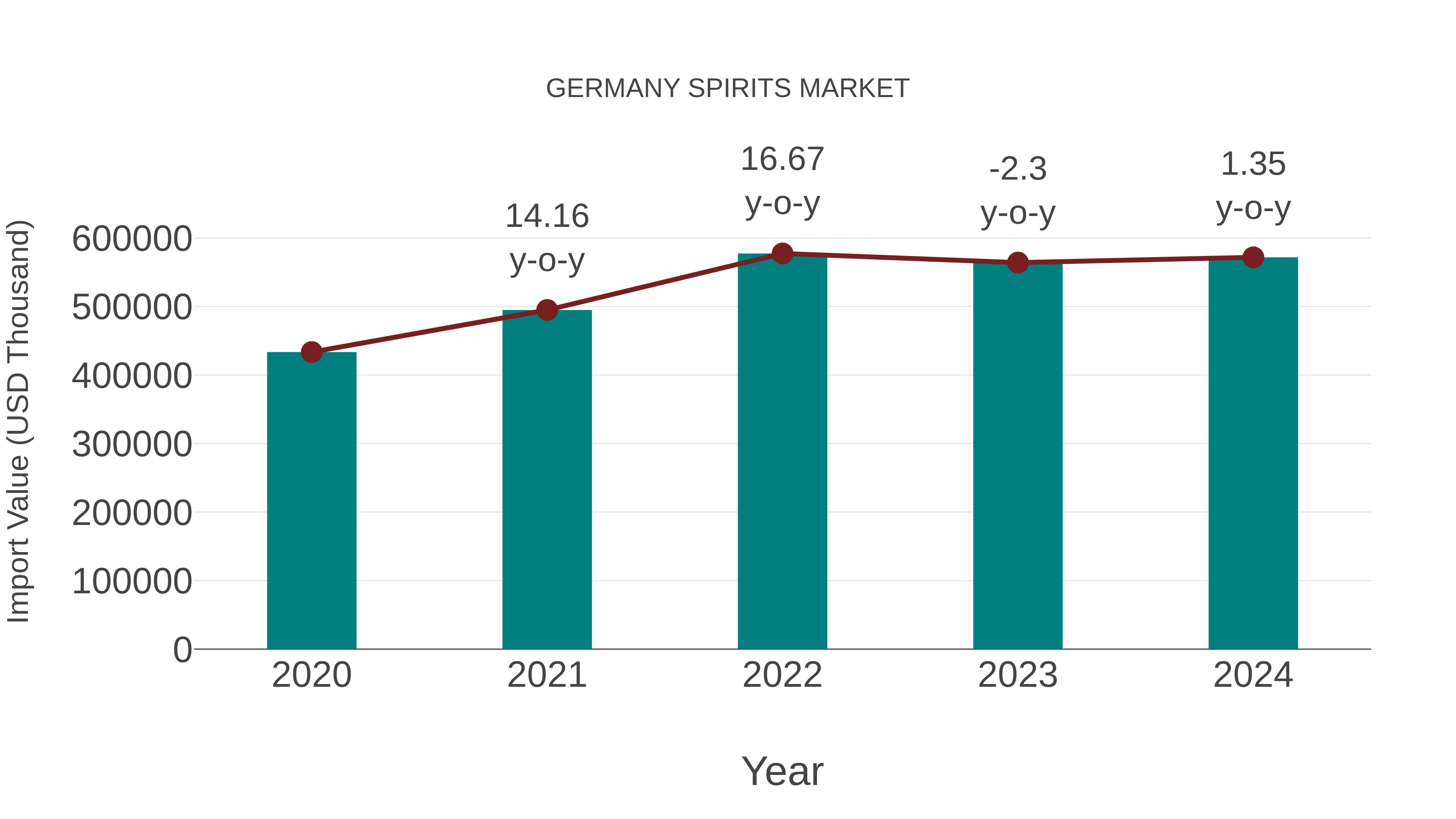
Germany Spirits Market Growth Rate
According to 6Wresearch internal database and industry insights, the Germany Spirits Market is projected to grow at a compound annual growth rate (CAGR) of 4.6% during the forecast period (2026-2032).
Five-Year Growth Trajectory of the Germany Spirits Market with Core Drivers
Below mentioned is the evaluation of year-wise growth rate along with key growth drivers:
| Year | Est. Annual Growth (%) | Growth Drivers |
| 2021 | 290.00% | Stable domestic consumption and strong spirits heritage |
| 2022 | 340.00% | Rising demand for premium and craft spirits |
| 2023 | 390.00% | Expansion of on-trade consumption and tourism recovery |
| 2024 | 4.30% | Growth of online alcohol retail platforms |
| 2025 | 4.80% | Increasing preference for premium whiskey and brandy |
Topics Covered in the Germany Spirits Market Report
The Germany Spirits Market report thoroughly covers the market by product type and distribution channel. The market report provides an unbiased and detailed analysis of ongoing market trends, opportunities/high growth areas, and market drivers, which help stakeholders devise and align their strategies with evolving consumer preferences, premiumization trends, regulatory frameworks, and retail developments influencing the Germany Spirits Market.
Germany Spirits Market Highlights
| Parameter | Details |
| Report Name | Germany Spirits Market |
| Forecast Period | 2026–2032 |
| CAGR | 4.60% |
| Growing Sector | On-Trade (Bars, Pubs, Clubs & Restaurants) |
Germany Spirits Market Synopsis
Germany Spirits Market is anticipated to record steady growth due to spirits are widely accepted in many cultures, there is a growing demand for high-end alcoholic drinks, and people are becoming more interested in craft distillation. Along with traditional spirits, whiskey and herbal liqueurs are becoming more popular. Furthermore, the market is strengthening across both urban and rural areas, driven by expanding online sales channels, rising tourism activity, and supportive government policies that encourage the growth of small distilleries.
Evaluation of Growth Drivers in the Germany Spirits Market
Below mentioned are some prominent drivers and their influence on the market dynamics:
| Drivers | Primary Segments Affected | Why it Matters (Evidence) |
| Premiumization Trend | Whiskey; Brandy | Consumers increasingly prefer high-quality and aged spirits. |
| Growth of Craft Distilleries | Other; Whiskey | Local production enhances product variety and authenticity. |
| Expansion of Online Alcohol Sales | Vodka; Rum | E-commerce platforms improve convenience and reach. |
| Tourism and Hospitality Demand | All Types; On-Trade | Bars and restaurants drive spirits consumption. |
| Supportive SME Policies | Other; Domestic Brands | Government grants encourage local distillery growth. |
Germany Spirits Market is expected to grow at the CAGR of 4.6% during the forecast period of 2026-2032. Growth is driven by premium spirit adoption, expanding retail accessibility, and evolving consumer tastes favoring craft and imported spirits. Additional support comes from tourism-driven demand and strong on-trade consumption across hospitality sector. In addition, increasing focus on sustainability, premium brand positioning, and experiential drinking culture is further enhancing value growth in the market.
Evaluation of Restraints in the Germany Spirits Market
Below mentioned are some major restraints and their influence on the market dynamics:
| Restraints | Primary Segments Affected | What This Means (Evidence) |
| High Alcohol Taxation | All Types | Higher excise duties increase retail prices, reduce affordability, and constrain volume growth |
| Strict Advertising Laws | All Types | Limitations on marketing channels reduce brand visibility and slow new product adoption |
| Health-Conscious Consumers | All Types | Growing wellness awareness leads to moderated alcohol intake and shifts demand toward premium consumption |
| Strong Beer & Wine Competition | All Types | Widely available and lower-priced alternatives divert consumer spending away from spirits |
| Compliance Costs for SMEs | Craft Spirits | Regulatory and licensing expenses increase operating costs, limiting scalability for small distillers |
Germany Spirits Industry Challenges
Despite steady growth, the Germany Spirits Industry faces challenges such as high taxes, strict rules for advertising, and strong competition from the beer and wine markets. Additionally, traditional spirits producers face increasing pressure from rising compliance costs, growing demand for environmentally sustainable products, and a shift away from high-alcohol beverages. Small craft distillers also struggle with scaling distribution networks and maintaining profitability.
Germany Spirits Market Trends
Some Key trends influencing the Germany Spirits Market Growth are:
- Craft Distillation: The German spirits is witnessing growth in craft distillation, with local producers introducing innovative flavors and herbal blend compositions.
- Digital Alcohol Retailing: Online alcohol retailing through licensed platforms is gradually expanding, supported by consumer demand for convenience, wider product access, and home delivery services.
- Sustainability Focus: Manufacturers are adopting environmentally friendly packaging and renewable energy usage to align with regulatory requirements and growing consumer preference.
- Experiential On-Trade Consumption: The rising popularity of cocktail culture, tasting events, and curated bar experiences is driving higher sales of premium and craft spirits.
Investment Opportunities in the Germany Spirits Market
Some major investment avenues in the Germany Spirits Market are:
- Distillery Investments: Small distilleries are investing in capacity expansion and export-oriented growth, while strong craft branding attracts premium consumers and supports higher margins
- E-commerce Alcohol Platforms: Technological advancements in digital retail are enabling wider national reach, improved distribution efficiency, and scalable growth for spirits brands
- Sustainable Packaging Solutions: Adoption of eco-friendly packaging helps reduce emissions and long-term costs while aligning closely with stringent EU sustainability regulations.
Top 5 Leading Players in the Germany Spirits Market
Some leading players operating in the Germany Spirits Market include:
1. Diageo plc
| Company Name | Diageo plc |
| Established Year | 1997 |
| Headquarters | London, United Kingdom |
| Official Website | Click Here |
Diageo maintains a strong presence in Germany with premium whiskey and vodka brands, focusing on innovation, sustainability, and strong on-trade partnerships.
2. Pernod Ricard
| Company Name | Pernod Ricard |
| Established Year | 1975 |
| Headquarters | Paris, France |
| Official Website | Click Here |
Pernod Ricard offers a diverse spirits portfolio in Germany, emphasizing premium positioning, responsible consumption, and extensive retail distribution.
3. Jagermeister
| Company Name | Jagermeister |
| Established Year | 1934 |
| Headquarters | Wolfenbüttel, Germany |
| Official Website | Click Here |
Jagermeister is a leading German herbal liqueur brand with strong domestic and international presence, driven by iconic branding and nightlife consumption.
4. Beam Suntory
| Company Name | Beam Suntory |
| Established Year | 2014 |
| Headquarters | Chicago, USA |
| Official Website | Click Here |
Beam Suntory supplies premium bourbon and whiskey brands in Germany, leveraging heritage branding and strong distributor networks.
5. Brown-Forman
| Company Name | Brown-Forman |
| Established Year | 1870 |
| Headquarters | Louisville, USA |
| Official Website | Click Here |
Brown-Forman is known for premium whiskey brands in Germany, focusing on long-term brand equity and premium on-trade presence.
Government Regulations Introduced in the Germany Spirits Market
According to the on Germany government data, initiatives such as SME support grants, distillery modernization programs, and strict quality certification standards are aimed at strengthening the spirits sector. Furthermore, regulations promoting responsible alcohol consumption and sustainability continue to shape market practices. In addition, export promotion schemes and regional funding support enable spirits manufacturers to expand their presence in international markets while maintaining high quality and compliance standards.
Future Insights of the Germany Spirits Market
The Outlook of the Germany Spirits Market looks promising due to, with rising premium consumption, digital e-commerce expansion, and an increase in interest in craft/heritage spirits.The rise in tourism, advancements in flavor innovation, and sustainability-focused production methods are anticipated to generate new avenues for growth. Continued government support for SMEs and export promotion will further enhance long-term market competitiveness.
Market Segmentation Analysis
The report offers a comprehensive study of the subsequent market segments and their leading categories.
Whiskey to Dominate the Market – By Product Type
According to Mohit, Senior Research Analyst, 6Wresearch, Whiskey dominates the Germany Spirits Market Share due to increasing demand for premium and aged variants. consumers really like single malts and whiskey brands from other countries. Whiskey is the best product category as it benefits from the culture of giving gifts, being consumed in bars, and having higher profit margins.
Key Attractiveness of the Report
- 10 Years of Market Numbers.
- Historical Data Starting from 2022 to 2025.
- Base Year: 2025.
- Forecast Data until 2032.
- Key Performance Indicators Impacting the Market.
- Major Upcoming Developments and Projects.
Key Highlights of the Report:
- Germany Spirits Market Outlook
- Market Size of Germany Spirits Market, 2025
- Forecast of Germany Spirits Market, 2032
- Historical Data and Forecast of Germany Spirits Revenues & Volume for the Period 2022- 2032F
- Germany Spirits Market Trend Evolution
- Germany Spirits Market Drivers and Challenges
- Germany Spirits Price Trends
- Germany Spirits Porter's Five Forces
- Germany Spirits Industry Life Cycle
- Historical Data and Forecast of Germany Spirits Market Revenues & Volume By Product Type for the Period 2022- 2032F
- Historical Data and Forecast of Germany Spirits Market Revenues & Volume By Whiskey for the Period 2022- 2032F
- Historical Data and Forecast of Germany Spirits Market Revenues & Volume By Vodka for the Period 2022- 2032F
- Historical Data and Forecast of Germany Spirits Market Revenues & Volume By Rum for the Period 2022- 2032F
- Historical Data and Forecast of Germany Spirits Market Revenues & Volume By Brandy for the Period 2022- 2032F
- Historical Data and Forecast of Germany Spirits Market Revenues & Volume By Other for the Period 2022- 2032F
- Historical Data and Forecast of Germany Spirits Market Revenues & Volume By Distribution Channel for the Period 2022- 2032F
- Historical Data and Forecast of Germany Spirits Market Revenues & Volume By Specialty/Liquor Stores for the Period 2022- 2032F
- Historical Data and Forecast of Germany Spirits Market Revenues & Volume By Online Retail Stores for the Period 2022- 2032F
- Historical Data and Forecast of Germany Spirits Market Revenues & Volume By On-Trade for the Period 2022- 2032F
- Historical Data and Forecast of Germany Spirits Market Revenues & Volume By Other for the Period 2022- 2032F
- Germany Spirits Import Export Trade Statistics
- Market Opportunity Assessment By Product Type
- Market Opportunity Assessment By Distribution Channel
- Germany Spirits Top Companies Market Share
- Germany Spirits Competitive Benchmarking By Technical and Operational Parameters
- Germany Spirits Company Profiles
- Germany Spirits Key Strategic Recommendations
Market Covered
The report offers a comprehensive study of the subsequent market segments:
By Product Type
- Whiskey
- Vodka
- Rum
- Brandy
- Other
By Distribution Channel
- Specialty/Liquor Stores
- Online Retail Stores
- On-Trade
- Others






































