Germany Technical Textile Market: Import Trend Analysis
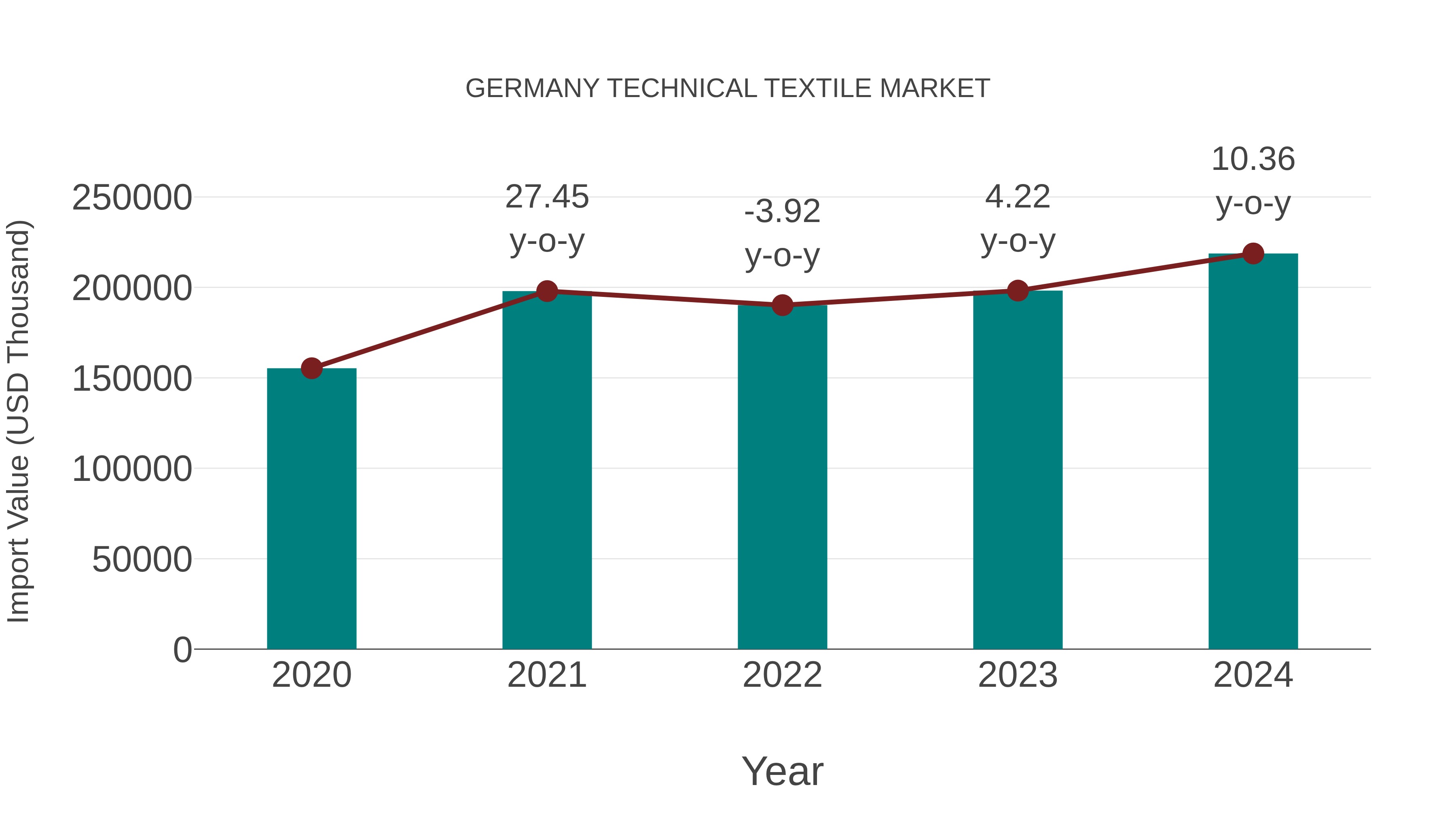
Germany`s technical textile market witnessed a notable import trend from 2023 to 2024, with a growth rate of 10.36%. The compound annual growth rate (CAGR) for imports during the period 2020-2024 stood at 8.94%. This momentum could be attributed to a combination of factors such as increased demand for specialized technical textiles, evolving trade policies, and a recovering market post-pandemic disruptions.
Germany Technical Textile Market Overview
The Germany technical textile market is a dynamic and rapidly growing sector within the country`s textile industry. With a focus on innovation and advanced manufacturing processes, Germany is a key player in producing technical textiles for a wide range of industries including automotive, construction, healthcare, and sports. The market is driven by increasing demand for high-performance and functional textiles that offer properties such as durability, strength, and resistance to extreme conditions. Key players in the market are investing heavily in research and development to create cutting-edge products that meet the evolving needs of various end-user industries. The Germany technical textile market is characterized by a strong emphasis on sustainability and eco-friendly practices, with a growing trend towards the use of recycled materials and environmentally friendly production processes.
Germany Technical Textile Market Trends
The Germany Technical Textile Market is experiencing several key trends currently. One major trend is the growing demand for smart textiles that offer advanced functionalities such as temperature regulation, moisture management, and biometric monitoring. Sustainable and eco-friendly materials are also gaining traction in the market as consumers become more environmentally conscious. Additionally, there is a shift towards customization and personalization in technical textiles, driven by the increasing need for tailored solutions in various industries such as automotive, healthcare, and sports. Market players are focusing on innovation and research to develop high-performance textiles that meet the evolving needs of end-users. Overall, the Germany Technical Textile Market is witnessing a shift towards more advanced, sustainable, and specialized products to cater to the changing demands of consumers and industries.
Germany Technical Textile Market Challenges
In the Germany Technical Textile Market, several challenges are faced that impact the industry`s growth and development. One significant challenge is the increasing competition from other countries, leading to price wars and margin pressures for German technical textile manufacturers. Additionally, the market is highly dependent on technology and innovation, requiring continuous research and development investments to stay competitive. Regulatory hurdles and compliance requirements also pose challenges, particularly with stringent environmental standards and regulations that technical textile companies must adhere to. Moreover, the rapidly changing consumer preferences and market trends demand flexibility and adaptability from manufacturers, further adding to the complexity of the market landscape in Germany. Overall, navigating these challenges while maintaining product quality and innovation remains crucial for sustained success in the German Technical Textile Market.
Germany Technical Textile Market Investment Opportunities
The Germany Technical Textile Market presents several promising investment opportunities due to its strong industrial base and innovative manufacturing capabilities. Sectors such as automotive, construction, healthcare, and sports are driving the demand for advanced technical textiles in the country. Investing in companies that specialize in functional textiles for high-performance applications, such as protective clothing, composites, and geotextiles, could be lucrative. Additionally, with the growing focus on sustainability and eco-friendly practices, there is a rising demand for recyclable and biodegradable technical textiles in Germany. Investors can explore opportunities in companies developing sustainable textile solutions or investing in research and development to stay ahead in this competitive market landscape.
Germany Technical Textile Market Government Policy
The German government has implemented various policies to support the Technical Textile Market in the country. These policies focus on promoting innovation and sustainability within the industry. The government provides funding and grants for research and development activities, aiming to drive technological advancements and product innovation. Additionally, there are regulations in place to ensure environmental sustainability and worker safety in the production of technical textiles. The government also supports initiatives that promote the use of technical textiles in various sectors such as automotive, construction, and healthcare, aiming to boost the market growth and competitiveness of German companies in the global market.
Germany Technical Textile Market Future Outlook
The future outlook for the Germany Technical Textile Market appears promising, with anticipated growth driven by advancements in technology, increasing demand for high-performance and sustainable materials across various industries such as automotive, construction, healthcare, and sports. The market is expected to benefit from the country`s strong manufacturing base, research and development capabilities, and emphasis on innovation. The growing focus on sustainability and eco-friendly practices is likely to further fuel the demand for technical textiles in Germany, as consumers and industries alike seek more environmentally friendly solutions. Additionally, the adoption of smart textiles and digitalization trends are poised to create new opportunities for market expansion and product development, making Germany a key player in the global technical textile industry.
Key Highlights of the Report:
- Germany Technical Textile Market Outlook
- Market Size of Germany Technical Textile Market, 2021
- Forecast of Germany Technical Textile Market, 2031
- Historical Data and Forecast of Germany Technical Textile Revenues & Volume for the Period 2018 - 2031
- Germany Technical Textile Market Trend Evolution
- Germany Technical Textile Market Drivers and Challenges
- Germany Technical Textile Price Trends
- Germany Technical Textile Porter's Five Forces
- Germany Technical Textile Industry Life Cycle
- Historical Data and Forecast of Germany Technical Textile Market Revenues & Volume By Material for the Period 2018 - 2031
- Historical Data and Forecast of Germany Technical Textile Market Revenues & Volume By Natural Fiber for the Period 2018 - 2031
- Historical Data and Forecast of Germany Technical Textile Market Revenues & Volume By Synthetic polymers/fibers for the Period 2018 - 2031
- Historical Data and Forecast of Germany Technical Textile Market Revenues & Volume By Mineral fiber for the Period 2018 - 2031
- Historical Data and Forecast of Germany Technical Textile Market Revenues & Volume By Regenerated Fiber for the Period 2018 - 2031
- Historical Data and Forecast of Germany Technical Textile Market Revenues & Volume By Metal fiber for the Period 2018 - 2031
- Historical Data and Forecast of Germany Technical Textile Market Revenues & Volume By Others for the Period 2018 - 2031
- Historical Data and Forecast of Germany Technical Textile Market Revenues & Volume By Technology for the Period 2018 - 2031
- Historical Data and Forecast of Germany Technical Textile Market Revenues & Volume By Woven for the Period 2018 - 2031
- Historical Data and Forecast of Germany Technical Textile Market Revenues & Volume By Knitted for the Period 2018 - 2031
- Historical Data and Forecast of Germany Technical Textile Market Revenues & Volume By Non-Woven for the Period 2018 - 2031
- Historical Data and Forecast of Germany Technical Textile Market Revenues & Volume By others for the Period 2018 - 2031
- Historical Data and Forecast of Germany Technical Textile Market Revenues & Volume By End Use Application for the Period 2018 - 2031
- Historical Data and Forecast of Germany Technical Textile Market Revenues & Volume By MobilTech for the Period 2018 - 2031
- Historical Data and Forecast of Germany Technical Textile Market Revenues & Volume By InduTech for the Period 2018 - 2031
- Historical Data and Forecast of Germany Technical Textile Market Revenues & Volume By SporTech for the Period 2018 - 2031
- Historical Data and Forecast of Germany Technical Textile Market Revenues & Volume By BuildTech for the Period 2018 - 2031
- Historical Data and Forecast of Germany Technical Textile Market Revenues & Volume By HomeTech for the Period 2018 - 2031
- Historical Data and Forecast of Germany Technical Textile Market Revenues & Volume By ClothTech for the Period 2018 - 2031
- Historical Data and Forecast of Germany Technical Textile Market Revenues & Volume By MediTech for the Period 2018 - 2031
- Historical Data and Forecast of Germany Technical Textile Market Revenues & Volume By Others for the Period 2018 - 2031
- Germany Technical Textile Import Export Trade Statistics
- Market Opportunity Assessment By Material
- Market Opportunity Assessment By Technology
- Market Opportunity Assessment By End Use Application
- Germany Technical Textile Top Companies Market Share
- Germany Technical Textile Competitive Benchmarking By Technical and Operational Parameters
- Germany Technical Textile Company Profiles
- Germany Technical Textile Key Strategic Recommendations






































