Ghana 5G Core Market Size, Share & Growth Rate
The Ghana 5G Core Market was estimated at USD 212 Million in 2025 and is projected to reach USD 295 Million by 2032, growing at a CAGR of 4.8% from 2026 to 2032. This trajectory is primarily driven by the escalating demand for high-speed and reliable connectivity, alongside government initiatives aimed at fostering digital transformation. As telecom operators invest in infrastructure to support the rollout of 5G, the market is poised for substantial growth, impacting numerous sectors across the country.
Ghana 5G Core Market Year-wise Growth Rate and Key Drivers
This graph highlights how the Ghana 5G Core Market has steadily grown over the years, supported by major growth factors.
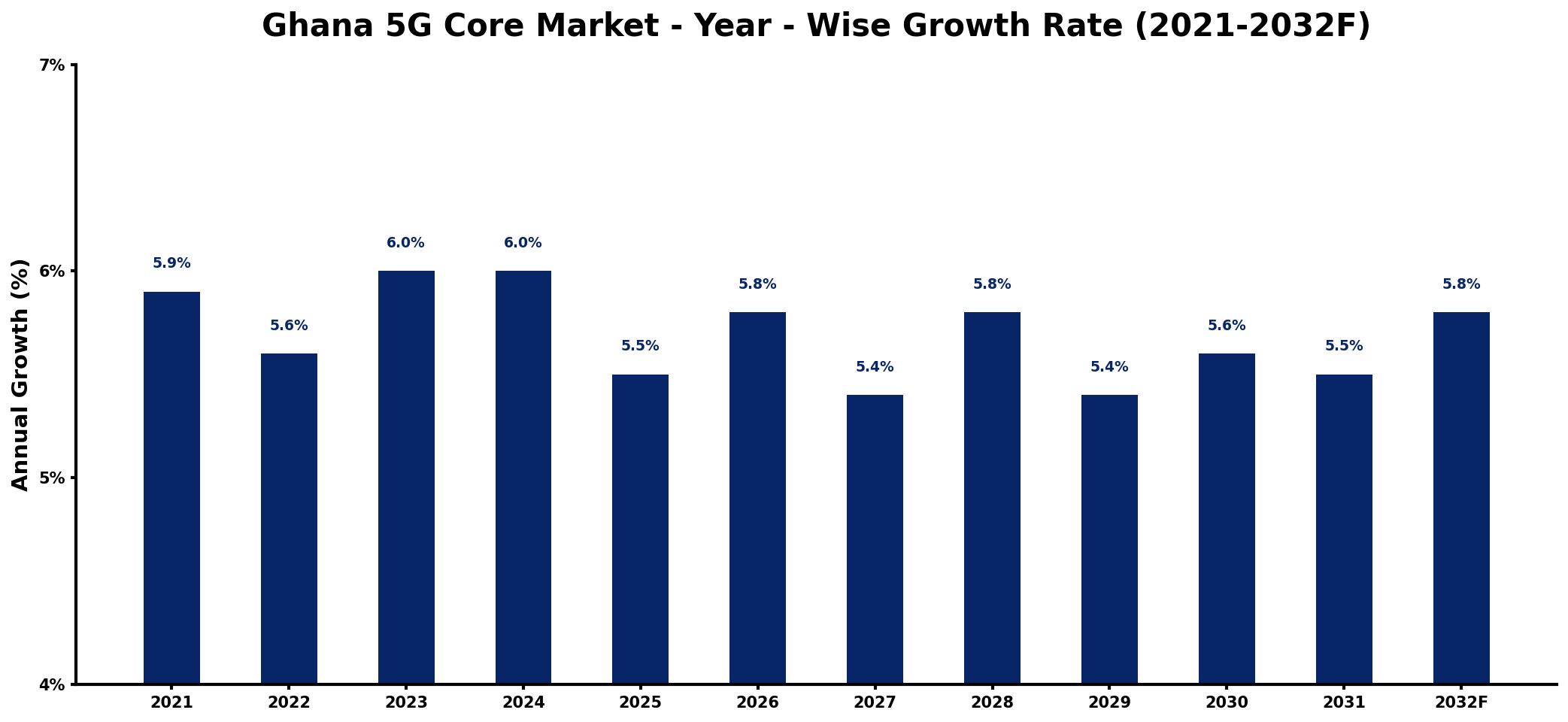
The table below presents the year‑wise growth rates along with the key drivers influencing the market
| Year | Growth Rate | Major Drivers |
| 2021 | 5.9% | Rising demand for mobile connectivity |
| 2022 | 5.6% | Increased investment in infrastructure |
| 2023 | 6.0% | Growing adoption of IoT devices |
| 2024 | 6.0% | Expansion of digital services market |
| 2025 | 5.5% | Emergence of smart city projects |
| 2026 | 5.8% | Enhanced focus on cybersecurity solutions |
| 2027 | 5.4% | Boost in remote work technologies |
| 2028 | 5.8% | Development of advanced applications |
| 2029 | 5.4% | Increased collaboration among telecom players |
| 2030 | 5.6% | Growth in data-intensive applications |
| 2031 | 5.5% | Rise of 5G-enabled industries |
| 2032 | 5.8% | Advancements in cloud computing services |
Note: Market size estimations and growth projections presented in this report are based on 6Wresearch's proprietary forecasting methodology, utilizing the latest available industry data, government publications, and primary research inputs.
Ghana 5G Core Market Synopsis
The Ghana 5G Core Market is currently witnessing significant momentum, underpinned by advancements in telecommunications and increasing consumer expectations for enhanced connectivity. With the country poised to embrace 5G technology, the focus is shifting from initial deployment to maximizing network capabilities and coverage.
In the coming years, the market is expected to transition into a phase of rapid innovation, where emerging applications in areas such as healthcare and smart agriculture will drive deeper penetration of 5G services. This transformation signifies a pivotal shift for the telecommunications landscape in Ghana, opening avenues for increased investment and technological collaboration.
Ghana 5G Core Market Key Takeaways
- The market is projected to grow at a CAGR of 4.8% from 2026 to 2032.
- Increased infrastructure investment is essential for comprehensive 5G deployment across Ghana.
- Government policies are aimed at creating a supportive regulatory framework for 5G adoption.
- Emerging sectors such as healthcare and smart cities are key drivers of 5G adoption.
- Cloud-native architectures and AI integration are pivotal trends shaping the market.
Evaluation of Restraints in Ghana 5G Core Market
Despite its promising growth, the Ghana 5G Core Market faces significant restraints that hinder swift progress. Chief among these are the limitations in existing infrastructure, which are often inadequate to support the demands of 5G technology. The necessity for substantial investment in new equipment and upgrades cannot be overstated. Additionally, the scarcity of available spectrum for efficient 5G operations presents potential congestion challenges that could impede optimal performance. Regulatory hurdles further complicate the landscape, requiring careful navigation to foster a conducive environment for investment and innovation.
Ghana 5G Core Market Trends
Several key trends are emerging within the Ghana 5G Core Market, indicating a shift toward more sophisticated technology solutions. Notably, the adoption of cloud-native architecture is becoming increasingly common, enabling more agile and scalable network management. Furthermore, the integration of artificial intelligence and machine learning is enhancing network performance and reliability, making it easier for operators to manage resources effectively. The rise of edge computing is another significant trend, facilitating low-latency applications that are crucial for industries reliant on real-time data processing.
Ghana 5G Core Market Opportunities
As the Ghana 5G Core Market expands, numerous investment opportunities are emerging across various sectors. Telecom companies are leading the charge, making considerable infrastructure upgrades to support the deployment of 5G technology. This paves the way for investment in complementary sectors, such as cybersecurity and network optimization solutions. Additionally, industries like education, transportation, and healthcare stand to benefit substantially from the high-speed and low-latency capabilities of 5G, presenting further avenues for investors looking to capitalize on the potential of advanced connectivity solutions.
Government Initiatives in the Ghana 5G Core Market
The Ghanaian government is actively supporting the development of the 5G core market through a series of initiatives designed to promote innovation and digital transformation. The National Communications Authority (NCA) has been pivotal in spectrum allocation for 5G services, aiming to encourage investment and foster competition. The government is also committed to creating a favorable regulatory environment, focusing on data security and privacy while encouraging collaboration with industry stakeholders to drive growth and technological advancement in the 5G landscape.
Future Insights of the Ghana 5G Core Market
Looking ahead to the period from 2026 to 2032, the Ghana 5G Core Market is expected to experience robust growth driven by continued infrastructure investment and the rapid adoption of IoT applications. The growing digital economy and the proliferation of smart devices will heighten demand for advanced connectivity solutions, further encouraging telecom operators and technology vendors to innovate. As Ghana positions itself as a competitive player in the global 5G arena, the potential for enhanced connectivity and transformative applications across various sectors remains vast and enticing.
Ghana 5G Core Market Latest Developments (2025 - 2026)
In recent months, the Ghana 5G Core Market has seen significant developments focused on enhancing network infrastructure and expanding service coverage. Initiatives aimed at testing and deploying 5G technologies have gained momentum, spurred by increased collaboration between telecom operators and technology providers. Additionally, discussions around regulatory frameworks have intensified, with a focus on optimizing spectrum allocation and creating a conducive environment for market growth. The commitment to fostering innovation has never been more evident as stakeholders work together to realize the potential of 5G in Ghana.
Ghana 5G Core Market - Key Attractiveness of the Report
- 10 Years of Market Numbers
- Historical Data Starting from 2022 to 2025
- Base Year: 2025
- Forecast Data until 2032
- Key Performance Indicators Impacting the Market
- Major Upcoming Developments and Projects
Key Highlights of the Report:
- Ghana 5G Core Market Outlook
- Market Size of Ghana 5G Core Market, 2025
- Forecast of Ghana 5G Core Market, 2032
- Historical Data and Forecast of Ghana 5G Core Revenues & Volume for the Period 2022-2032F
- Ghana 5G Core Market Trend Evolution
- Ghana 5G Core Market Drivers and Challenges
- Ghana 5G Core Price Trends
- Ghana 5G Core Porter's Five Forces
- Ghana 5G Core Industry Life Cycle
- Historical Data and Forecast of Ghana 5G Core Market Revenues & Volume By Component for the Period 2022-2032F
- Historical Data and Forecast of Ghana 5G Core Market Revenues & Volume By Solutions for the Period 2022-2032F
- Historical Data and Forecast of Ghana 5G Core Market Revenues & Volume By Services for the Period 2022-2032F
- Historical Data and Forecast of Ghana 5G Core Market Revenues & Volume By Network Function for the Period 2022-2032F
- Historical Data and Forecast of Ghana 5G Core Market Revenues & Volume By Access for the Period 2022-2032F
- Historical Data and Forecast of Ghana 5G Core Market Revenues & Volume By Mobility Management Function for the Period 2022-2032F
- Historical Data and Forecast of Ghana 5G Core Market Revenues & Volume By Policy Control Function for the Period 2022-2032F
- Historical Data and Forecast of Ghana 5G Core Market Revenues & Volume By Unified Data Management for the Period 2022-2032F
- Historical Data and Forecast of Ghana 5G Core Market Revenues & Volume By Deployment Model for the Period 2022-2032F
- Historical Data and Forecast of Ghana 5G Core Market Revenues & Volume By Cloud for the Period 2022-2032F
- Historical Data and Forecast of Ghana 5G Core Market Revenues & Volume By On-premises for the Period 2022-2032F
- Historical Data and Forecast of Ghana 5G Core Market Revenues & Volume By End User for the Period 2022-2032F
- Historical Data and Forecast of Ghana 5G Core Market Revenues & Volume By Telecom Operators for the Period 2022-2032F
- Historical Data and Forecast of Ghana 5G Core Market Revenues & Volume By Enterprises for the Period 2022-2032F
- Ghana 5G Core Import Export Trade Statistics
- Market Opportunity Assessment By Component
- Market Opportunity Assessment By Network Function
- Market Opportunity Assessment By Deployment Model
- Market Opportunity Assessment By End User
- Ghana 5G Core Top Companies Market Share
- Ghana 5G Core Competitive Benchmarking By Technical and Operational Parameters
- Ghana 5G Core Company Profiles
- Ghana 5G Core Key Strategic Recommendations






































