Ghana Aerosol Market Size, Share & Growth Rate
The Ghana Aerosol Market was estimated at USD 368 Million in 2025 and is projected to reach USD 520 Million by 2032, growing at a CAGR of 5.1% from 2026 to 2032. This growth trajectory is propelled by heightened consumer awareness regarding hygiene and the increasing preference for convenient aerosol solutions. As urbanization accelerates, the demand for various aerosol products including personal care items and household cleaners is expected to surge, further enhancing market dynamics.
Ghana Aerosol Market Year-wise Growth Rate and Key Drivers
This graph highlights how the Ghana Aerosol Market has steadily grown over the years, supported by major growth factors.
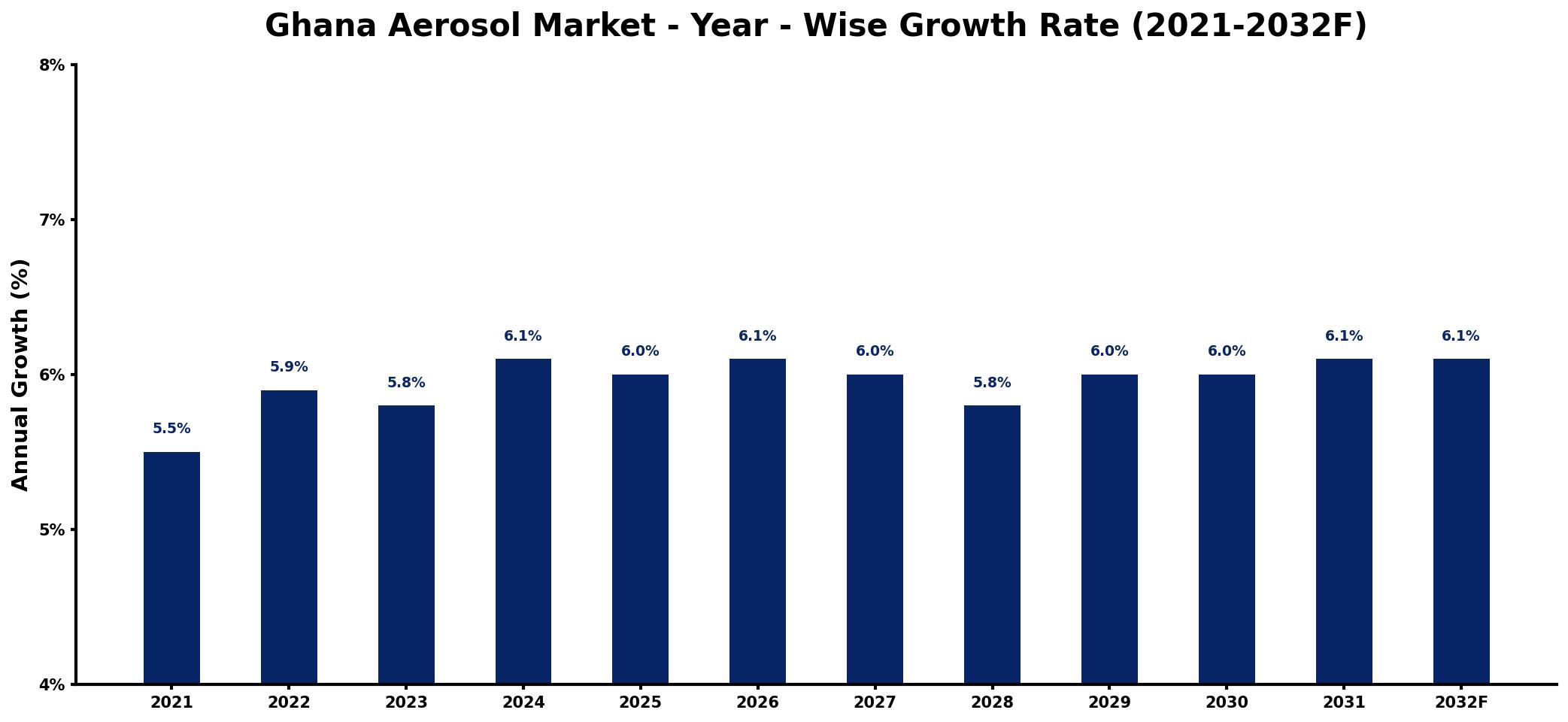
The table below presents the year‑wise growth rates along with the key drivers influencing the market
| Year | Growth Rate | Major Drivers |
| 2021 | 5.5% | Rising consumer health awareness |
| 2022 | 5.9% | Increase in household cleaning needs |
| 2023 | 5.8% | Growth of personal care segment |
| 2024 | 6.1% | Expansion of retail distribution channels |
| 2025 | 6.0% | Higher demand for convenience products |
| 2026 | 6.1% | Surge in outdoor recreational activities |
| 2027 | 6.0% | Adoption of innovative packaging solutions |
| 2028 | 5.8% | rising procurement volume requirements |
| 2029 | 6.0% | Growth in industrial applications demand |
| 2030 | 6.0% | Rising popularity of eco-friendly options |
| 2031 | 6.1% | rising demand from electronics |
| 2032 | 6.1% | Increased focus on home improvement |
Note: Market size estimations and growth projections presented in this report are based on 6Wresearch's proprietary forecasting methodology, utilizing the latest available industry data, government publications, and primary research inputs.
Ghana Aerosol Market Synopsis
The Ghana Aerosol Market is currently experiencing a vibrant phase, characterized by a significant rise in consumer demand across a broad spectrum of aerosol products. This momentum is expected to continue, with forecasts suggesting a shift towards innovative, eco-friendly formulations that appeal to environmentally conscious consumers.
As competition intensifies between local and international brands, the market is poised for transformation. Retail channels are evolving, with an increasing focus on e-commerce and supermarkets that cater to diverse consumer preferences, providing a platform for growth and product diversification.
Ghana Aerosol Market Key Takeaways
- The market is experiencing growth driven by rising consumer awareness of hygiene and sanitation.
- Innovation in product development is key, with a focus on eco-friendly formulations and convenient packaging.
- Competition between local and international brands is intensifying, creating opportunities for product differentiation.
- The market is benefiting from increased urbanization and disposable income among consumers.
- Distribution channels are diversifying, with a notable rise in online retailing.
Evaluation of Restraints in Ghana Aerosol Market
Despite its promising prospects, the Ghana Aerosol Market faces several constraints that could limit its growth. Regulatory hurdles pose significant challenges, as companies must navigate complex product registration processes and comply with stringent quality standards. Moreover, inconsistent enforcement of these standards can lead to market inefficiencies and a lack of consumer trust. The prevalence of counterfeit products further complicates the landscape, threatening the safety and reputation of legitimate brands. Additionally, supply chain disruptions, particularly related to transportation and import restrictions, can hinder access to raw materials and finished products, affecting overall market stability.
Ghana Aerosol Market Trends
Several emerging trends are shaping the Ghana Aerosol Market. The increasing consumer focus on health and hygiene, particularly in the wake of global health crises, has driven demand for disinfectants and sanitizers in aerosol form. Furthermore, the shift towards sustainable practices is influencing consumer purchasing decisions, with many opting for products featuring natural ingredients and recyclable packaging. Innovations in fragrance offerings and packaging design are also becoming pivotal in capturing consumer interest. Overall, these trends reflect a broader commitment to health, wellness, and environmental responsibility.
Ghana Aerosol Market Opportunities
The Ghana Aerosol Market presents significant growth and investment opportunities, particularly within segments like personal care, household cleaning, and insect repellents. As urban centers expand, there is a growing consumer base eager for innovative, convenient, and hygiene-focused products. Brands that can introduce eco-friendly aerosol options are likely to capture consumer attention and loyalty. Additionally, strategic partnerships with local distributors and online retailers will be crucial for brands aiming to penetrate the market effectively. With the regulatory landscape becoming more favorable, investors have the potential to achieve substantial returns by tapping into this burgeoning market.
Government Initiatives in the Ghana Aerosol Market
The Ghanaian government has put forth several policies aimed at regulating the aerosol market to ensure consumer safety and environmental protection. The Environmental Protection Agency (EPA) plays a crucial role in overseeing the registration of aerosol products, enforcing compliance with labeling and disposal regulations. Additionally, the Ghana Standards Authority (GSA) sets essential quality and safety standards for aerosol products, aiming to maintain high consumer protection levels. These initiatives reflect the governments commitment to fostering a safe and sustainable environment for both consumers and producers in the aerosol industry.
Future Insights of the Ghana Aerosol Market
Looking ahead to 2026-2032, the Ghana Aerosol Market is well-positioned for steady growth. Urbanization will continue to drive demand for a variety of aerosol products, with increasing disposable incomes further expanding the consumer base. The heightened focus on hygiene will persist, especially in the context of infectious disease awareness, ensuring sustained demand for cleaning and personal care aerosol items. As manufacturers prioritize product innovation and sustainability, the market is expected to evolve, presenting numerous opportunities for brands willing to adapt to shifting consumer preferences and regulatory requirements.
Ghana Aerosol Market Latest Developments (2025 - 2026)
Recent developments in the Ghana Aerosol Market indicate a shift towards enhanced product offerings and sustainable practices. Companies are increasingly investing in R&D to create eco-friendly formulations that align with consumer expectations for environmental responsibility. Additionally, there is a growing emphasis on multi-channel distribution strategies, with businesses expanding their online presence to reach a broader audience. Recent promotional campaigns have also highlighted the importance of personal hygiene, further propelling aerosol product sales across various segments.
Ghana Aerosol Market - Key Attractiveness of the Report
- 10 Years of Market Numbers
- Historical Data Starting from 2022 to 2025
- Base Year: 2025
- Forecast Data until 2032
- Key Performance Indicators Impacting the Market
- Major Upcoming Developments and Projects
Key Highlights of the Report:
- Ghana Aerosol Market Outlook
- Market Size of Ghana Aerosol Market, 2025
- Forecast of Ghana Aerosol Market, 2032
- Historical Data and Forecast of Ghana Aerosol Revenues & Volume for the Period 2022-2032F
- Ghana Aerosol Market Trend Evolution
- Ghana Aerosol Market Drivers and Challenges
- Ghana Aerosol Price Trends
- Ghana Aerosol Porter's Five Forces
- Ghana Aerosol Industry Life Cycle
- Historical Data and Forecast of Ghana Aerosol Market Revenues & Volume By Material for the Period 2022-2032F
- Historical Data and Forecast of Ghana Aerosol Market Revenues & Volume By Steel for the Period 2022-2032F
- Historical Data and Forecast of Ghana Aerosol Market Revenues & Volume By Aluminum for the Period 2022-2032F
- Historical Data and Forecast of Ghana Aerosol Market Revenues & Volume By Others for the Period 2022-2032F
- Historical Data and Forecast of Ghana Aerosol Market Revenues & Volume By Type for the Period 2022-2032F
- Historical Data and Forecast of Ghana Aerosol Market Revenues & Volume By Bag-In-Valve for the Period 2022-2032F
- Historical Data and Forecast of Ghana Aerosol Market Revenues & Volume By Standard for the Period 2022-2032F
- Historical Data and Forecast of Ghana Aerosol Market Revenues & Volume By Application for the Period 2022-2032F
- Historical Data and Forecast of Ghana Aerosol Market Revenues & Volume By Personal Care for the Period 2022-2032F
- Historical Data and Forecast of Ghana Aerosol Market Revenues & Volume By Household for the Period 2022-2032F
- Historical Data and Forecast of Ghana Aerosol Market Revenues & Volume By Automotive & Industrial for the Period 2022-2032F
- Historical Data and Forecast of Ghana Aerosol Market Revenues & Volume By Food for the Period 2022-2032F
- Historical Data and Forecast of Ghana Aerosol Market Revenues & Volume By Paints for the Period 2022-2032F
- Historical Data and Forecast of Ghana Aerosol Market Revenues & Volume By Medical for the Period 2022-2032F
- Historical Data and Forecast of Ghana Aerosol Market Revenues & Volume By Others for the Period 2022-2032F
- Ghana Aerosol Import Export Trade Statistics
- Market Opportunity Assessment By Material
- Market Opportunity Assessment By Type
- Market Opportunity Assessment By Application
- Ghana Aerosol Top Companies Market Share
- Ghana Aerosol Competitive Benchmarking By Technical and Operational Parameters
- Ghana Aerosol Company Profiles
- Ghana Aerosol Key Strategic Recommendations






































