Ghana Armored Vehicle Market Size, Share & Growth Rate
The Ghana Armored Vehicle Market was estimated at USD 384 Million in 2025 and is projected to reach USD 527 Million by 2032, growing at a CAGR of 4.6% from 2026 to 2032. This growth is propelled by escalating security concerns, including political instability and rising crime rates, which necessitate enhanced protective measures. The market's expansion is further supported by a growing demand from government agencies and private security firms looking for reliable armored solutions.
Ghana Armored Vehicle Market Year-wise Growth Rate and Key Drivers
This graph highlights how the Ghana Armored Vehicle Market has steadily grown over the years, supported by major growth factors.
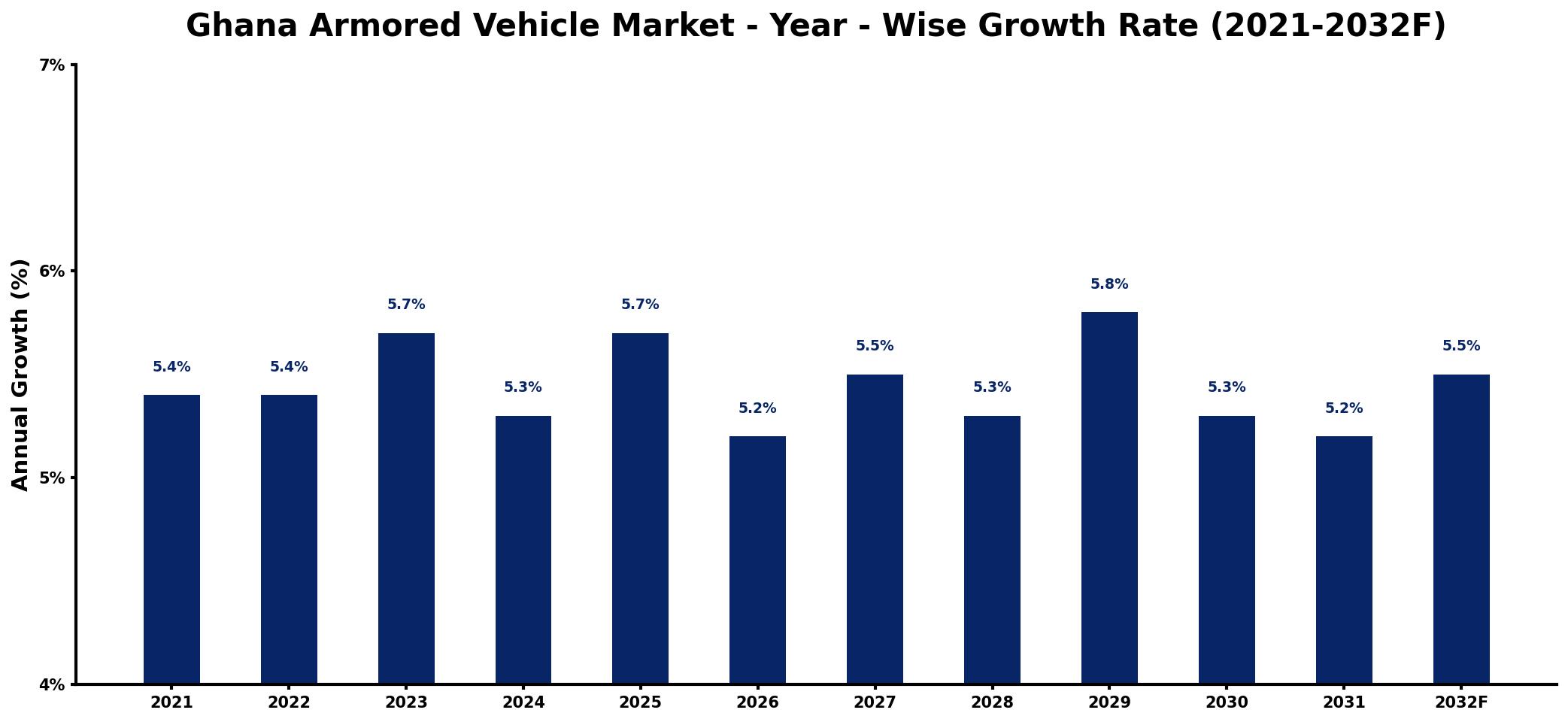
The table below presents the year‑wise growth rates along with the key drivers influencing the market
| Year | Growth Rate | Major Drivers |
| 2021 | 5.4% | Rising government defense spending |
| 2022 | 5.4% | Increased regional security concerns |
| 2023 | 5.7% | Growing private security investments |
| 2024 | 5.3% | Expansion of defense partnerships |
| 2025 | 5.7% | Surge in infrastructure projects |
| 2026 | 5.2% | Heightened demand for protection |
| 2027 | 5.5% | strengthening international trade flows |
| 2028 | 5.3% | Emergence of new threats |
| 2029 | 5.8% | Boost in military modernization efforts |
| 2030 | 5.3% | Growing awareness of safety |
| 2031 | 5.2% | Increased foreign direct investment |
| 2032 | 5.5% | increased capital investment inflows |
Note: Market size estimations and growth projections presented in this report are based on 6Wresearch's proprietary forecasting methodology, utilizing the latest available industry data, government publications, and primary research inputs.
Ghana Armored Vehicle Market Synopsis
In recent years, the Ghana armored vehicle market has experienced consistent growth, largely fueled by increasing security threats. Looking ahead, the trajectory suggests a continued uptick, driven by advancements in vehicle technology and changing consumer preferences for agility and mobility.
As the market evolves, stakeholders are likely to focus on sourcing more sophisticated vehicles that can serve both civilian and military needs. This dual applicability underscores the importance of armored vehicles in safeguarding high-profile individuals and essential infrastructure.
Ghana Armored Vehicle Market Key Takeaways
- Steady growth projected through 2032, fueled by rising security demands.
- Government and private entities are significant market drivers.
- Technological advancements lead to a preference for lighter, agile armored vehicles.
- International manufacturers dominate the market landscape.
- Investments in local manufacturing can enhance market accessibility.
Evaluation of Restraints in Ghana Armored Vehicle Market
The Ghana armored vehicle market faces several constraints that could impede growth. Limited domestic manufacturing capabilities force a reliance on imports, resulting in higher costs and prolonged delivery times. Additionally, navigating the intricate regulatory landscape for importing such vehicles creates hurdles for market participants. The lack of awareness regarding the advantages of armored vehicles among potential buyers further complicates market dynamics. As a result, educating customers and establishing local partnerships will be vital for overcoming these barriers.
Ghana Armored Vehicle Market Trends
Current trends in the Ghana armored vehicle market reflect a shift toward technologically advanced solutions that address modern security challenges. There's a pronounced demand for vehicles that offer both civilian and military functionality, aligning with the needs of government agencies and security firms. Furthermore, the increasing focus on lightweight and maneuverable vehicles is driven by the necessity for operational effectiveness in urban settings, allowing for rapid response and improved mobility.
Ghana Armored Vehicle Market Opportunities
The Ghana armored vehicle market is ripe with investment opportunities as security concerns escalate. Suppliers have a substantial opportunity to cater to government agencies, embassies, and private security firms looking to enhance their protective measures. Furthermore, forging partnerships with local manufacturers can facilitate market entry and align offerings with the specific needs of Ghanaian customers, creating a sustainable business model in this growing sector.
Government Initiatives in the Ghana Armored Vehicle Market
While the Ghanaian government does not have explicit policies targeting the armored vehicle market, broader security and defense initiatives play a significant role. The government allocates budgets for defense spending and engages in procurement processes for military equipment to bolster national security. These measures indirectly stimulate the demand for armored vehicles, as state agencies seek advanced solutions for internal stability and counter-terrorism efforts.
Future Insights of the Ghana Armored Vehicle Market
Looking towards 2026-2032, the Ghana armored vehicle market is set to expand further, driven by heightened security threats and increased defense budgets. The emphasis on modernizing military capabilities is anticipated to elevate the demand for robust armored solutions. As technology evolves, market participants are expected to innovate, enhancing vehicle capabilities to effectively address changing security requirements, thereby positioning the market for a resilient future.
Ghana Armored Vehicle Market Latest Developments (2025 - 2026)
Recent developments in the Ghana armored vehicle market indicate a steady evolution toward greater sophistication and adaptability. The industry is witnessing a surge in interest from both governmental and private entities, aiming to invest in advanced armored solutions. Innovations in vehicle technology are emerging, with a focus on enhancing mobility and protection for diverse applications. Partnerships between local and international stakeholders are also beginning to form, promising to bridge the gap in manufacturing capabilities.
Ghana Armored Vehicle Market - Key Attractiveness of the Report
- 10 Years of Market Numbers
- Historical Data Starting from 2022 to 2025
- Base Year: 2025
- Forecast Data until 2032
- Key Performance Indicators Impacting the Market
- Major Upcoming Developments and Projects
Key Highlights of the Report:
- Ghana Armored Vehicle Market Outlook
- Market Size of Ghana Armored Vehicle Market, 2025
- Forecast of Ghana Armored Vehicle Market, 2032
- Historical Data and Forecast of Ghana Armored Vehicle Revenues & Volume for the Period 2022-2032F
- Ghana Armored Vehicle Market Trend Evolution
- Ghana Armored Vehicle Market Drivers and Challenges
- Ghana Armored Vehicle Price Trends
- Ghana Armored Vehicle Porter's Five Forces
- Ghana Armored Vehicle Industry Life Cycle
- Historical Data and Forecast of Ghana Armored Vehicle Market Revenues & Volume By Platform for the Period 2022-2032F
- Historical Data and Forecast of Ghana Armored Vehicle Market Revenues & Volume By Combat Vehicles for the Period 2022-2032F
- Historical Data and Forecast of Ghana Armored Vehicle Market Revenues & Volume By Combat Support Vehicles for the Period 2022-2032F
- Historical Data and Forecast of Ghana Armored Vehicle Market Revenues & Volume By Unmanned Armored Ground Vehicles for the Period 2022-2032F
- Historical Data and Forecast of Ghana Armored Vehicle Market Revenues & Volume By Mobility for the Period 2022-2032F
- Historical Data and Forecast of Ghana Armored Vehicle Market Revenues & Volume By Wheeled for the Period 2022-2032F
- Historical Data and Forecast of Ghana Armored Vehicle Market Revenues & Volume By Tracked for the Period 2022-2032F
- Historical Data and Forecast of Ghana Armored Vehicle Market Revenues & Volume By System for the Period 2022-2032F
- Historical Data and Forecast of Ghana Armored Vehicle Market Revenues & Volume By Engine for the Period 2022-2032F
- Historical Data and Forecast of Ghana Armored Vehicle Market Revenues & Volume By Drive System for the Period 2022-2032F
- Historical Data and Forecast of Ghana Armored Vehicle Market Revenues & Volume By Ballistic Armor for the Period 2022-2032F
- Historical Data and Forecast of Ghana Armored Vehicle Market Revenues & Volume By Turret Drives for the Period 2022-2032F
- Historical Data and Forecast of Ghana Armored Vehicle Market Revenues & Volume By Ammunition Handling System for the Period 2022-2032F
- Historical Data and Forecast of Ghana Armored Vehicle Market Revenues & Volume By Fire Control Systems (FCS) for the Period 2022-2032F
- Historical Data and Forecast of Ghana Armored Vehicle Market Revenues & Volume By Armaments for the Period 2022-2032F
- Historical Data and Forecast of Ghana Armored Vehicle Market Revenues & Volume By Countermeasure System for the Period 2022-2032F
- Ghana Armored Vehicle Import Export Trade Statistics
- Market Opportunity Assessment By Platform
- Market Opportunity Assessment By Mobility
- Market Opportunity Assessment By System
- Ghana Armored Vehicle Top Companies Market Share
- Ghana Armored Vehicle Competitive Benchmarking By Technical and Operational Parameters
- Ghana Armored Vehicle Company Profiles
- Ghana Armored Vehicle Key Strategic Recommendations






































