Ghana Asphalt Market Summary
The ghana asphalt market was estimated at USD 328 Million in 2025 and is projected to reach USD 430 Million by 2032, growing at a CAGR of 4.4% from 2026 to 2032.
Ghana Asphalt Market Year-wise Growth Rate and Key Drivers
This graph highlights how the Ghana Asphalt Market has steadily grown over the past five years, supported by major growth factors.
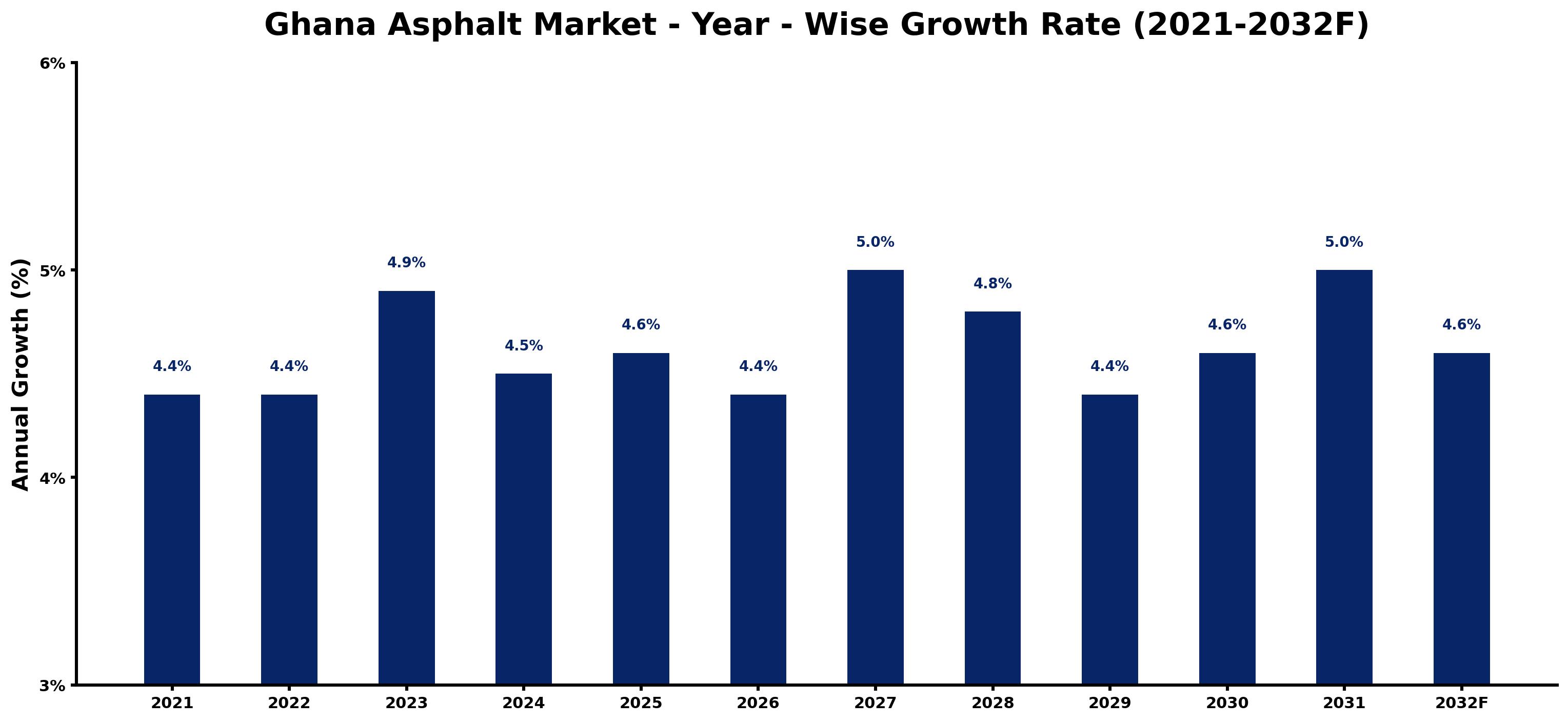
The table below presents the year wise growth rates along with the key drivers influencing the market
| Year | Growth Rate | Major Drivers |
| 2021 | 4.4% | Construction projects resumed post-lockdown, driving increased asphalt usage in urban developments. |
| 2022 | 4.4% | Infrastructure investments expanded significantly, enhancing road networks and requiring more asphalt. |
| 2023 | 4.9% | Public-private partnerships emerged, facilitating funding for critical roadway infrastructure enhancements. |
| 2024 | 4.5% | Local manufacturers improved production capacity, addressing supply chain challenges experienced previously. |
| 2025 | 4.6% | Urbanization trends continued to accelerate, increasing demand for reliable road construction materials. |
| 2026 | 4.4% | Innovative asphalt formulations became popular, enhancing pavement longevity and performance metrics. |
| 2027 | 5.0% | Environmental considerations led to the adoption of eco-friendly asphalt production techniques. |
| 2028 | 4.8% | Emerging technologies enabled efficient recycling of asphalt materials, reducing overall costs significantly. |
| 2029 | 4.4% | Regional trade agreements streamlined import processes, fostering competitive pricing for asphalt products. |
| 2030 | 4.6% | Growing automobile ownership and usage rates necessitated better road infrastructure and maintenance. |
| 2031 | 5.0% | Investment in smart city projects led to an uptick in specialized asphalt applications. |
| 2032 | 4.6% | Increased focus on resilient infrastructure tackled climate challenges, driving advanced asphalt solutions. |
Note - Market size estimations and growth projections presented in this report are based on 6Wresearch's advanced forecasting approach, validated with industry datasets as of June 2026.
Ghana Asphalt Market Synopsis
The Ghana Asphalt Market is projected to reach 4.4% and witness significant growth during the forecast period (2026-2032). This growth is primarily driven by the robust infrastructure development initiatives undertaken by the government and the increasing demand for durable road construction materials. The market dynamics are greatly influenced by road maintenance projects and efforts to enhance the overall transportation sector. As Ghana focuses on modernizing its infrastructure, the asphalt market is poised to expand significantly.
Ghana Asphalt Market Growth Drivers
The Ghana Asphalt Market is fortified by several growth drivers that underline its expansion prospects. Firstly, ongoing road construction projects are a catalyst for increased asphalt demand, as the government prioritizes the development of transport infrastructure. Secondly, the increasing focus on improving road conditions for safety and efficiency also propels the market forward. Thirdly, the growing urban population amplifies the need for better road networks to accommodate rising vehicular traffic. Additionally, international investment in infrastructure creates an environment conducive to growth in the asphalt sector. Finally, government policies promoting local asphalt production further support market development.
Ghana Asphalt Market Trends and Opportunities
Current trends in the Ghana Asphalt Market showcase a shift towards sustainability and innovation. There is a notable increase in the demand for environmentally-friendly asphalt solutions, with manufacturers exploring the use of recycled materials in asphalt production. This trend not only reduces the carbon footprint associated with asphalt manufacturing but also contributes to circular economy practices. Furthermore, technological advancements are being integrated to enhance the longevity and quality of asphalt roads, thereby reducing long-term maintenance costs.
- Recycling initiatives are gaining traction, spurring interest in the production of asphalt incorporating reclaimed materials.
- Investment in new technologies is leading to improved asphalt formulations that increase durability.
- Collaboration between public and private sectors is fostering innovation in asphalt production methods.
- Market players are increasingly adopting sustainable practices to align with global standards on environmental protection.
- The governmental push for infrastructure improvement is creating a ripe environment for investment opportunities in asphalt production.
Ghana Asphalt Market Challenges and Restraints
Despite its growth potential, the Ghana Asphalt Market faces various challenges that could hinder its progress. One significant challenge is the inconsistent quality of asphalt products, which often leads to durability issues and escalated maintenance costs. Moreover, inadequate infrastructure for the transportation and storage of asphalt exacerbates delays in project completion and compromises overall quality. Limited availability of raw materials can create bottlenecks in production, while fluctuations in global oil prices directly impact asphalt pricing. The rising competition from alternative road construction materials also presents a challenge for traditional asphalt solutions.
- Quality inconsistencies can lead to increased costs and dissatisfaction among stakeholders.
- Transportation infrastructure gaps compromise the timely delivery of asphalt products to construction sites.
- Supply chain disruptions due to raw material shortages can pose significant risks to asphalt production.
- Market operators must navigate volatile oil prices that affect overall production costs.
- Innovation and adaptation will be necessary to mitigate competition from alternative materials.
Ghana Asphalt Market Investment Opportunities
The Ghana Asphalt Market presents numerous investment opportunities, particularly for entities willing to engage with the local construction sector. Strategically partnering with construction firms can provide a foothold in the market by supplying high-quality asphalt for road projects. Additionally, establishing asphalt production plants within Ghana can address the growing demand for reliable road infrastructure, promoting local economic growth. Investing in research and development is also advantageous, as the introduction of innovative asphalt technologies can significantly enhance road performance and longevity. Overall, the market is primed for investors looking to contribute to Ghana's infrastructure development goals.
Ghana Asphalt Market Government Investment and Initiatives
The Ghanaian government has enacted various policies aimed at fostering the growth of the asphalt market. A significant initiative is the promotion of local asphalt production, which seeks to reduce dependence on imported materials and stimulate the domestic economy. Moreover, the government emphasizes the establishment of quality standards and regulatory frameworks to ensure product reliability and safety. These efforts are complemented by initiatives to encourage sustainable practices within the asphalt industry, focusing on environmental protection and adherence to safety measures. Additionally, the government is actively seeking private sector investment through incentives and partnerships, creating a collaborative environment conducive to market expansion.
Ghana Asphalt Market Latest Developments (May 2025 - June 2026)
In the recent period from May 2025 to June 2026, the Ghana Asphalt Market has experienced marked developments as infrastructure projects move forward. The government has ramped up efforts to improve the existing road network, prompting increased demand for asphalt products. Concurrently, there has been a pronounced shift towards sustainable production methods, with a growing number of asphalt manufacturers exploring recycled content in their formulations. Furthermore, public-private partnerships have emerged as a pivotal strategy to drive technological advancements in asphalt applications, aligning with global sustainability trends. These developments collectively underscore a proactive approach to addressing both current and future infrastructural needs in Ghana.
Ghana Asphalt Market - Key Attractiveness of the Report
- 10 Years of Market Numbers
- Historical Data Starting from 2022 to 2025
- Base Year: 2025
- Forecast Data until 2032
- Key Performance Indicators Impacting the Market
- Major Upcoming Developments and Projects
Key Highlights of the Report:
- Ghana Asphalt Market Outlook
- Market Size of Ghana Asphalt Market, 2025
- Forecast of Ghana Asphalt Market, 2032F
- Historical Data and Forecast of Ghana Asphalt Revenues & Volume for the Period 2022-2032F
- Ghana Asphalt Market Trend Evolution
- Ghana Asphalt Market Drivers and Challenges
- Ghana Asphalt Price Trends
- Ghana Asphalt Porter's Five Forces
- Ghana Asphalt Industry Life Cycle
- Historical Data and Forecast of Ghana Asphalt Market Revenues & Volume By Type for the Period 2022-2032F
- Historical Data and Forecast of Ghana Asphalt Market Revenues & Volume By Paving Petroleum Asphalt for the Period 2022-2032F
- Historical Data and Forecast of Ghana Asphalt Market Revenues & Volume By Industrial Petroleum Asphalt for the Period 2022-2032F
- Historical Data and Forecast of Ghana Asphalt Market Revenues & Volume By Others for the Period 2022-2032F
- Historical Data and Forecast of Ghana Asphalt Market Revenues & Volume By Application for the Period 2022-2032F
- Historical Data and Forecast of Ghana Asphalt Market Revenues & Volume By Paving for the Period 2022-2032F
- Historical Data and Forecast of Ghana Asphalt Market Revenues & Volume By Roofing for the Period 2022-2032F
- Historical Data and Forecast of Ghana Asphalt Market Revenues & Volume By Others for the Period 2022-2032F
- Ghana Asphalt Import Export Trade Statistics
- Market Opportunity Assessment By Type
- Market Opportunity Assessment By Application
- Ghana Asphalt Top Companies Market Share
- Ghana Asphalt Competitive Benchmarking By Technical and Operational Parameters
- Ghana Asphalt Company Profiles
- Ghana Asphalt Key Strategic Recommendations






































