Ghana Auto Parts And Accessories Market Size, Share & Growth Rate
The Ghana Auto Parts And Accessories Market was estimated at USD 210 Million in 2025 and is projected to reach USD 290 Million by 2032, growing at a CAGR of 4.7% from 2026 to 2032. This growth trajectory is primarily driven by an increase in vehicle ownership, spurred by the expanding middle class and enhanced economic conditions. As consumer preferences shift towards quality and durability, demand for both genuine and aftermarket auto parts is expected to surge, shaping a promising landscape for market participants.
Ghana Auto Parts And Accessories Market Year-wise Growth Rate and Key Drivers
This graph highlights how the Ghana Auto Parts And Accessories Market has steadily grown over the years, supported by major growth factors.
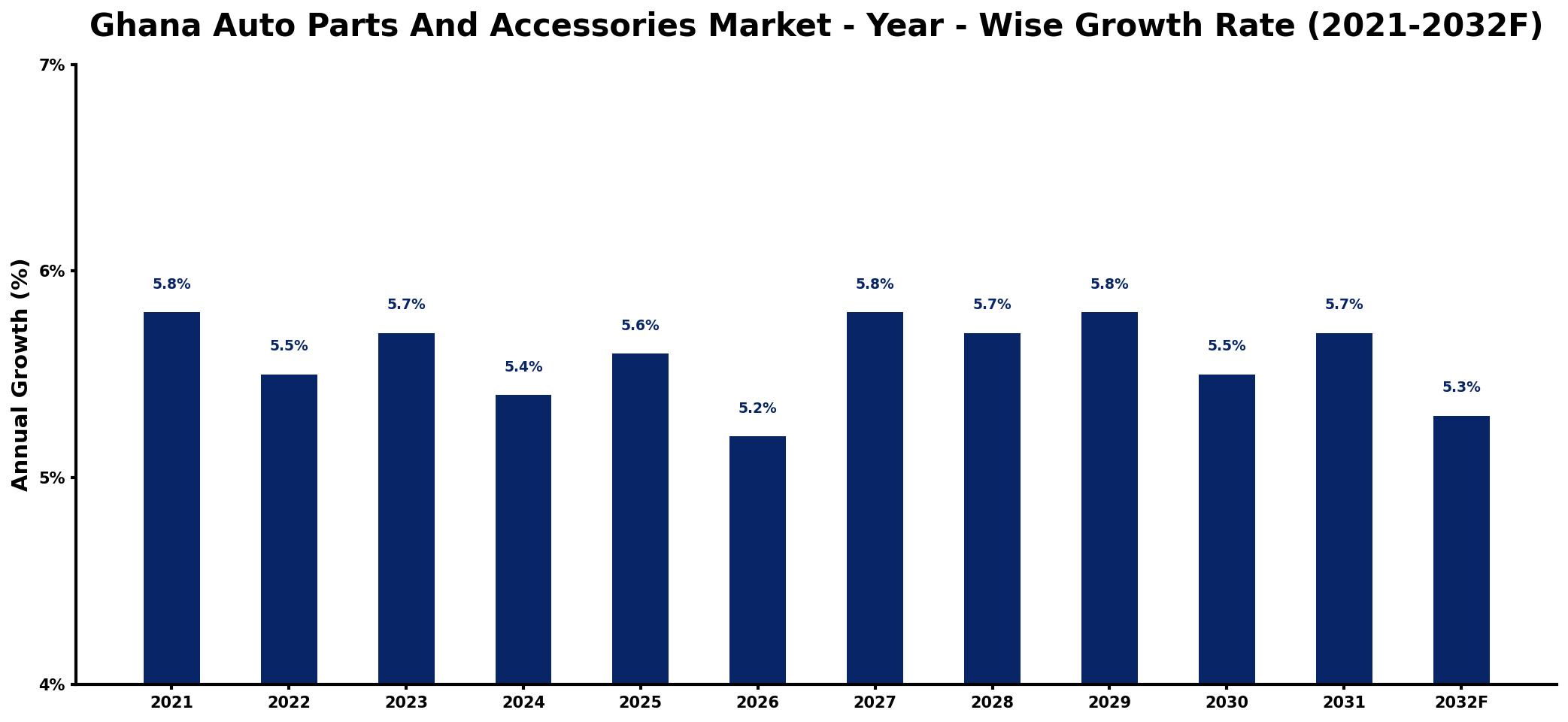
The table below presents the year‑wise growth rates along with the key drivers influencing the market
| Year | Growth Rate | Major Drivers |
| 2021 | 5.8% | Rising consumer vehicle ownership rates |
| 2022 | 5.5% | Increased local manufacturing initiatives |
| 2023 | 5.7% | Growing demand for sustainable solutions |
| 2024 | 5.4% | Expansion of transportation infrastructure projects |
| 2025 | 5.6% | Increased foreign investment opportunities |
| 2026 | 5.2% | Technological advancements in logistics |
| 2027 | 5.8% | Strengthening regional trade agreements |
| 2028 | 5.7% | enhanced product quality standards |
| 2029 | 5.8% | Growing popularity of electric vehicles |
| 2030 | 5.5% | growing emerging market penetration |
| 2031 | 5.7% | growing regional consumption patterns |
| 2032 | 5.3% | rising infrastructure development spending |
Note: Market size estimations and growth projections presented in this report are based on 6Wresearch's proprietary forecasting methodology, utilizing the latest available industry data, government publications, and primary research inputs.
Ghana Auto Parts And Accessories Market Synopsis
The Ghana Auto Parts and Accessories Market has seen considerable momentum, particularly due to the rising number of vehicles on Ghanaian roads. This growth is indicative of a broader trend towards increased mobility and vehicle utilization in the region. Moving forward, the market is poised for further development, with opportunities emerging as technological advancements and e-commerce integration reshape consumer purchasing behaviors.
As the automotive sector grows, so too does the demand for diverse auto parts, including both engine components and innovative accessories. The rise of an environmentally conscious consumer base is driving interest in sustainable products, while market players are encouraged to maintain high quality and reliability standards. Overall, the Ghana Auto Parts and Accessories Market is evolving to meet changing consumer needs and preferences.
Ghana Auto Parts And Accessories Market Key Takeaways
- Rising vehicle ownership and a growing middle class are key factors fueling market growth.
- There is a notable shift towards genuine and quality auto parts among consumers in Ghana.
- Technological advancements and e-commerce are reshaping the purchasing landscape.
- The market presents significant opportunities for both local manufacturing and importing.
- Government policies aim to balance protection for local manufacturers with access to high-quality parts.
Evaluation of Restraints in Ghana Auto Parts And Accessories Market
Despite its growth, the Ghana Auto Parts and Accessories Market faces several challenges that can hinder its potential. A substantial presence of counterfeit products in the market compromises quality and safety. Additionally, limited availability of high-quality parts and unreliable supply chains often lead to delays, frustrating consumers and retailers alike. Moreover, the dominance of a few major suppliers can create barriers to entry for new players, restricting competition and innovation.
The lack of standardized regulations can further exacerbate quality issues, making it difficult for consumers to navigate their options. Infrastructure challenges, particularly poor road conditions, also complicate logistics and distribution, ultimately impacting the overall efficiency of the market. Addressing these issues will be essential for ensuring sustainable growth and a robust competitive environment.
Ghana Auto Parts And Accessories Market Trends
In the Ghana Auto Parts and Accessories market, there is an emerging trend toward eco-friendly products, notably components for electric vehicles and energy-efficient accessories. This shift is indicative of a broader global movement toward sustainability, resonating with a population that increasingly values environmentally responsible choices. Additionally, consumers are gravitating towards technological innovation, with smart car accessories and connected devices gaining traction as part of the modern vehicle experience.
E-commerce platforms are revolutionizing the way consumers access auto parts, providing a convenient shopping experience alongside a wider array of products. This trend not only meets the needs of tech-savvy consumers but also fosters competition among suppliers, prompting enhancements in product offerings and customer service. The market's trajectory reflects an evolving landscape that prioritizes innovation, quality, and sustainability.
Ghana Auto Parts And Accessories Market Opportunities
Investment opportunities in the Ghana Auto Parts and Accessories Market are robust, propelled by rising vehicle ownership and the increasing demand for quality auto parts. Importing and distributing a diverse range of products can meet the needs of individual vehicle owners and commercial fleet operators alike. Additionally, local manufacturing presents a viable option to not only fulfill domestic demand but also support the country's industrial development.
Collaboration with local dealerships and service centers can enhance market reach, while establishing e-commerce platforms allows for greater accessibility to products. Innovative solutions tailored to the specific demands of the Ghanaian market will further position investors to capitalize on the growth potential and achieve significant profitability.
Government Initiatives in the Ghana Auto Parts And Accessories Market
The Ghanaian government has rolled out several initiatives aimed at regulating the auto parts and accessories market. These measures include the imposition of import duties and taxes designed to protect local manufacturers while ensuring quality standards for imported auto parts align with international practices. The government is also actively promoting local production through incentives and support programs, fostering an environment conducive to domestic manufacturing and innovation.
Future Insights of the Ghana Auto Parts And Accessories Market
Looking ahead to 2026-2032, the Ghana Auto Parts and Accessories Market appears poised for steady growth, bolstered by a continuing increase in vehicle ownership and a burgeoning middle class. With government initiatives aimed at improving road infrastructure and boosting the automotive sector, the market will likely benefit from enhanced logistical capabilities and accessibility. The rise of e-commerce and technological innovations will also play a critical role in expanding consumer choices and encouraging competition. However, vigilance regarding counterfeit products and supply chain vulnerabilities will be essential to ensure sustained progress.
Ghana Auto Parts And Accessories Market Latest Developments (2025 - 2026)
Recent developments in the Ghana Auto Parts and Accessories market reflect an industry adapting to new consumer preferences and technological advancements. E-commerce platforms are rapidly evolving, offering consumers unprecedented convenience in their shopping experiences. Furthermore, local manufacturers are increasingly focusing on quality control and innovation, responding to the market's growing demand for reliable and sustainable products. Overall, the landscape is changing, aligning more closely with global trends while addressing local needs.
Ghana Auto Parts And Accessories Market - Key Attractiveness of the Report
- 10 Years of Market Numbers
- Historical Data Starting from 2022 to 2025
- Base Year: 2025
- Forecast Data until 2032
- Key Performance Indicators Impacting the Market
- Major Upcoming Developments and Projects
Key Highlights of the Report:
- Ghana Auto Parts And Accessories Market Outlook
- Market Size of Ghana Auto Parts And Accessories Market, 2025
- Forecast of Ghana Auto Parts And Accessories Market, 2032
- Historical Data and Forecast of Ghana Auto Parts And Accessories Revenues & Volume for the Period 2022-2032F
- Ghana Auto Parts And Accessories Market Trend Evolution
- Ghana Auto Parts And Accessories Market Drivers and Challenges
- Ghana Auto Parts And Accessories Price Trends
- Ghana Auto Parts And Accessories Porter's Five Forces
- Ghana Auto Parts And Accessories Industry Life Cycle
- Historical Data and Forecast of Ghana Auto Parts And Accessories Market Revenues & Volume By Product for the Period 2022-2032F
- Historical Data and Forecast of Ghana Auto Parts And Accessories Market Revenues & Volume By Driveline & Powertrain for the Period 2022-2032F
- Historical Data and Forecast of Ghana Auto Parts And Accessories Market Revenues & Volume By Interiors & Exteriors for the Period 2022-2032F
- Historical Data and Forecast of Ghana Auto Parts And Accessories Market Revenues & Volume By Electronics for the Period 2022-2032F
- Historical Data and Forecast of Ghana Auto Parts And Accessories Market Revenues & Volume By Bodies & Chassis for the Period 2022-2032F
- Historical Data and Forecast of Ghana Auto Parts And Accessories Market Revenues & Volume By Wheel & Tires for the Period 2022-2032F
- Historical Data and Forecast of Ghana Auto Parts And Accessories Market Revenues & Volume By Others for the Period 2022-2032F
- Historical Data and Forecast of Ghana Auto Parts And Accessories Market Revenues & Volume By Application for the Period 2022-2032F
- Historical Data and Forecast of Ghana Auto Parts And Accessories Market Revenues & Volume By OEMs for the Period 2022-2032F
- Historical Data and Forecast of Ghana Auto Parts And Accessories Market Revenues & Volume By Aftermarket for the Period 2022-2032F
- Ghana Auto Parts And Accessories Import Export Trade Statistics
- Market Opportunity Assessment By Product
- Market Opportunity Assessment By Application
- Ghana Auto Parts And Accessories Top Companies Market Share
- Ghana Auto Parts And Accessories Competitive Benchmarking By Technical and Operational Parameters
- Ghana Auto Parts And Accessories Company Profiles
- Ghana Auto Parts And Accessories Key Strategic Recommendations






































