Ghana Aviation Test Equipment Market Size, Share & Growth Rate
The Ghana Aviation Test Equipment Market was estimated at USD 350 Million in 2025 and is projected to reach USD 485 Million by 2032, growing at a CAGR of 4.8% from 2026 to 2032. This upward trajectory is primarily fueled by the region's expanding aviation infrastructure, including the development of new airports and maintenance facilities. As the emphasis on aviation safety and operational efficiency intensifies, so too does the demand for advanced testing and calibration solutions tailored for a modernizing fleet.
Ghana Aviation Test Equipment Market Year-wise Growth Rate and Key Drivers
This graph highlights how the Ghana Aviation Test Equipment Market has steadily grown over the years, supported by major growth factors.
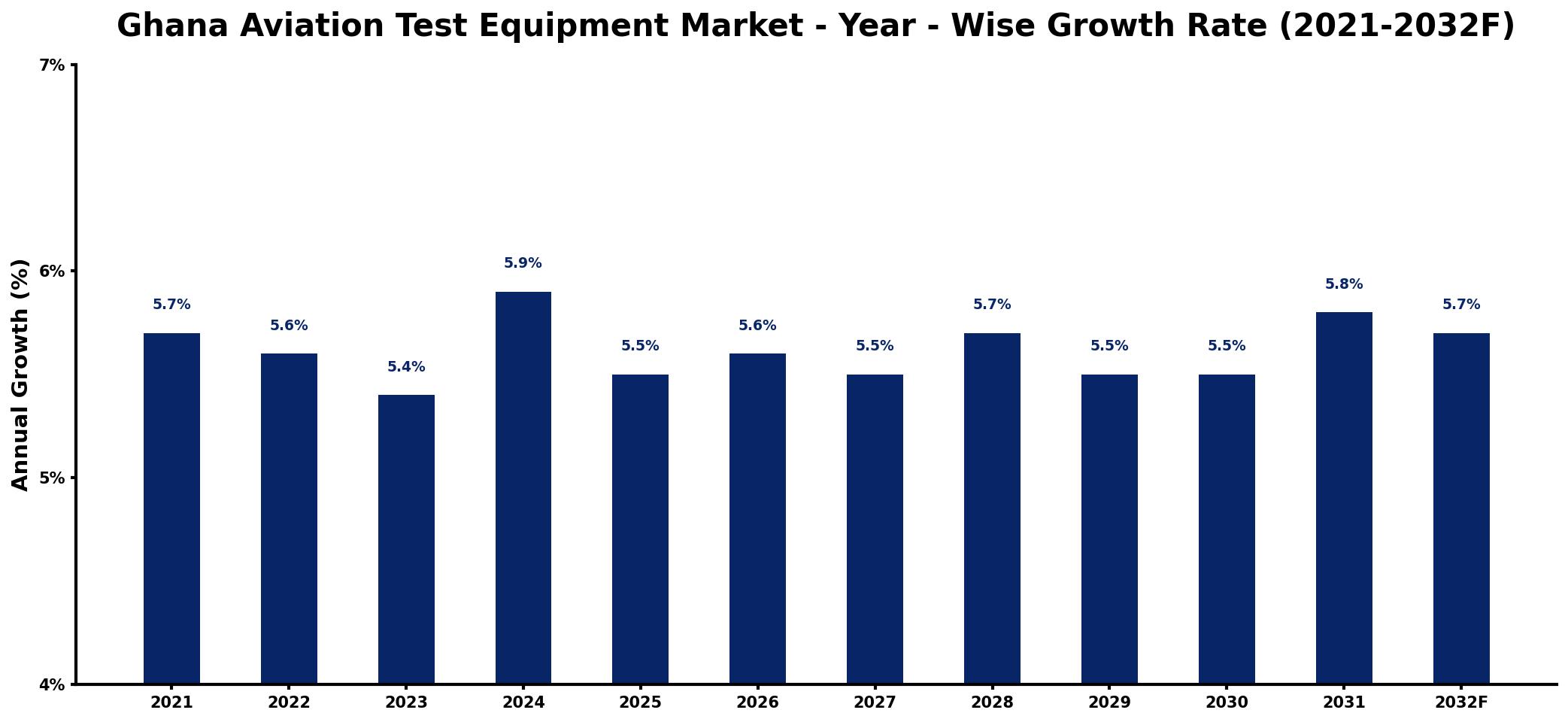
The table below presents the year‑wise growth rates along with the key drivers influencing the market
| Year | Growth Rate | Major Drivers |
| 2021 | 5.7% | Increased government defense spending initiatives |
| 2022 | 5.6% | rising infrastructure development spending |
| 2023 | 5.4% | Growth in pilot training programs |
| 2024 | 5.9% | New private sector investments emerging |
| 2025 | 5.5% | Expansion of regional airline networks |
| 2026 | 5.6% | Upgrades in airport infrastructure planned |
| 2027 | 5.5% | Technological advancements in simulation |
| 2028 | 5.7% | Higher demand for safety regulations |
| 2029 | 5.5% | Increased focus on environmental sustainability |
| 2030 | 5.5% | increased overall sector activity |
| 2031 | 5.8% | Emergence of new training facilities |
| 2032 | 5.7% | Rising interest in aerospace careers |
Note: Market size estimations and growth projections presented in this report are based on 6Wresearch's proprietary forecasting methodology, utilizing the latest available industry data, government publications, and primary research inputs.
Ghana Aviation Test Equipment Market Synopsis
The Ghana Aviation Test Equipment Market has experienced significant growth momentum, largely driven by an increase in air traffic and a rising number of aircraft operations. Recent developments in airport expansion and the enhancement of maintenance capabilities indicate a robust environment for continued investment and innovation within the sector.
As the aviation industry continues to modernize, the demand for state-of-the-art test equipment is expected to rise. This shift toward more sophisticated technology reflects not only the growing complexity of aircraft systems but also the necessity for stringent safety compliance, creating a favorable outlook for market participants.
Ghana Aviation Test Equipment Market Key Takeaways
- Significant growth in the market is projected due to increased air travel and airport development.
- Technological advancements in aviation test equipment are driving operational efficiencies and safety standards.
- The market is gravitating towards integrated and portable testing solutions for on-site applications.
- Investment opportunities abound for firms offering maintenance services in addition to test equipment.
- Government initiatives are enhancing the regulatory framework, promoting industry growth.
Evaluation of Restraints in Ghana Aviation Test Equipment Market
The Ghana Aviation Test Equipment Market faces several constraints that could impede its growth trajectory. One significant factor is the limited access to cutting-edge technology, which can restrict operators from utilizing the latest advancements in aviation safety. Moreover, the high costs associated with acquiring and maintaining test equipment can deter potential market entrants and smaller maintenance facilities. There is also a critical shortage of skilled technicians, which challenges the effective operation and maintenance of sophisticated testing systems. Furthermore, logistical barriers, such as delays in customs clearance, can disrupt supply chains and hinder market responsiveness.
Ghana Aviation Test Equipment Market Trends
Recent trends in the Ghana Aviation Test Equipment Market indicate a strong shift towards automated testing solutions. These advancements enhance accuracy, efficiency, and reliability in aircraft maintenance, essential in todays fast-paced aviation environment. Moreover, the growing preference for portable and handheld devices reflects the industry's need for flexibility, enabling on-the-go testing without compromising quality.
Furthermore, integrated testing platforms are gaining traction, providing comprehensive capabilities within a single system. This trend not only streamlines operations but also ensures compliance with regulatory standards, catering to the increasing demands for quality control across the aviation sector.
Ghana Aviation Test Equipment Market Opportunities
The Ghana Aviation Test Equipment Market presents diverse investment opportunities for companies eager to align with the aviation industry's expansion. The burgeoning demand for air travel, alongside airport and airline growth, underscores the necessity for advanced testing solutions. Businesses that focus on high-quality test equipment, particularly in areas such as avionics and ground support, are well-positioned to reap significant returns. Additionally, providing maintenance and calibration services for test equipment represents a lucrative avenue for growth, further tapping into the increasing complexity of aviation systems.
Government Initiatives in the Ghana Aviation Test Equipment Market
The Ghanaian government has enacted several policies to bolster growth in the aviation sector, including the aviation test equipment market. Key initiatives focus on enhancing safety standards and improving overall infrastructure. Collaborations with international organizations are prioritized to ensure adherence to global aviation regulations and standards. Moreover, various investment incentives and tax breaks are in place to attract foreign direct investment while promoting local manufacturing of aviation test equipment. These government efforts aim to create a conducive environment for sustainable development in the aviation landscape.
Future Insights of the Ghana Aviation Test Equipment Market
Looking ahead to 2026-2032, the Ghana Aviation Test Equipment Market is set to flourish amid a thriving aviation sector. As airport expansions and the influx of new airlines progress, the demand for advanced testing equipment will only escalate. The push for compliance with international safety standards, coupled with advancements in technology, will drive the market forward. Companies that can innovate and offer cost-effective, tailored solutions will find significant competitive advantages, ultimately fostering growth in this dynamic market.
Ghana Aviation Test Equipment Market Latest Developments (2025 - 2026)
Recent developments in the Ghana Aviation Test Equipment Market indicate a heightened focus on integrating innovative technologies into testing solutions. Industry players are increasingly exploring partnerships to enhance service offerings and streamline operations. Additionally, training programs aimed at developing skilled technicians are gaining momentum, responding to the industrys urgent need for expertise in operating advanced test equipment. These initiatives are expected to significantly contribute to overall market growth in the coming years.
Ghana Aviation Test Equipment Market - Key Attractiveness of the Report
- 10 Years of Market Numbers
- Historical Data Starting from 2022 to 2025
- Base Year: 2025
- Forecast Data until 2032
- Key Performance Indicators Impacting the Market
- Major Upcoming Developments and Projects
Key Highlights of the Report:
- Ghana Aviation Test Equipment Market Outlook
- Market Size of Ghana Aviation Test Equipment Market, 2025
- Forecast of Ghana Aviation Test Equipment Market, 2032
- Historical Data and Forecast of Ghana Aviation Test Equipment Revenues & Volume for the Period 2022-2032F
- Ghana Aviation Test Equipment Market Trend Evolution
- Ghana Aviation Test Equipment Market Drivers and Challenges
- Ghana Aviation Test Equipment Price Trends
- Ghana Aviation Test Equipment Porter's Five Forces
- Ghana Aviation Test Equipment Industry Life Cycle
- Historical Data and Forecast of Ghana Aviation Test Equipment Market Revenues & Volume By Product for the Period 2022-2032F
- Historical Data and Forecast of Ghana Aviation Test Equipment Market Revenues & Volume By Electrical Aviation Test Equipment for the Period 2022-2032F
- Historical Data and Forecast of Ghana Aviation Test Equipment Market Revenues & Volume By Hydraulic Aviation Test Equipment for the Period 2022-2032F
- Historical Data and Forecast of Ghana Aviation Test Equipment Market Revenues & Volume By Power Aviation Test Equipment for the Period 2022-2032F
- Historical Data and Forecast of Ghana Aviation Test Equipment Market Revenues & Volume By Pneumatic Aviation Test Equipment for the Period 2022-2032F
- Historical Data and Forecast of Ghana Aviation Test Equipment Market Revenues & Volume By End User for the Period 2022-2032F
- Historical Data and Forecast of Ghana Aviation Test Equipment Market Revenues & Volume By Commercial for the Period 2022-2032F
- Historical Data and Forecast of Ghana Aviation Test Equipment Market Revenues & Volume By Defense/Military Sector for the Period 2022-2032F
- Ghana Aviation Test Equipment Import Export Trade Statistics
- Market Opportunity Assessment By Product
- Market Opportunity Assessment By End User
- Ghana Aviation Test Equipment Top Companies Market Share
- Ghana Aviation Test Equipment Competitive Benchmarking By Technical and Operational Parameters
- Ghana Aviation Test Equipment Company Profiles
- Ghana Aviation Test Equipment Key Strategic Recommendations






































