Ghana Biomimetic Materials Market Size, Share & Growth Rate
The Ghana Biomimetic Materials Market was estimated at USD 178 Million in 2025 and is projected to reach USD 234 Million by 2032, growing at a CAGR of 4.0% from 2026 to 2032. This growth trajectory is primarily fueled by an increasing awareness of sustainable practices among consumers and businesses alike. The rising demand for eco-friendly materials across sectors such as healthcare, construction, and automotive is also playing a pivotal role in enhancing market dynamics.
Ghana Biomimetic Materials Market Year-wise Growth Rate and Key Drivers
This graph highlights how the Ghana Biomimetic Materials Market has steadily grown over the years, supported by major growth factors.
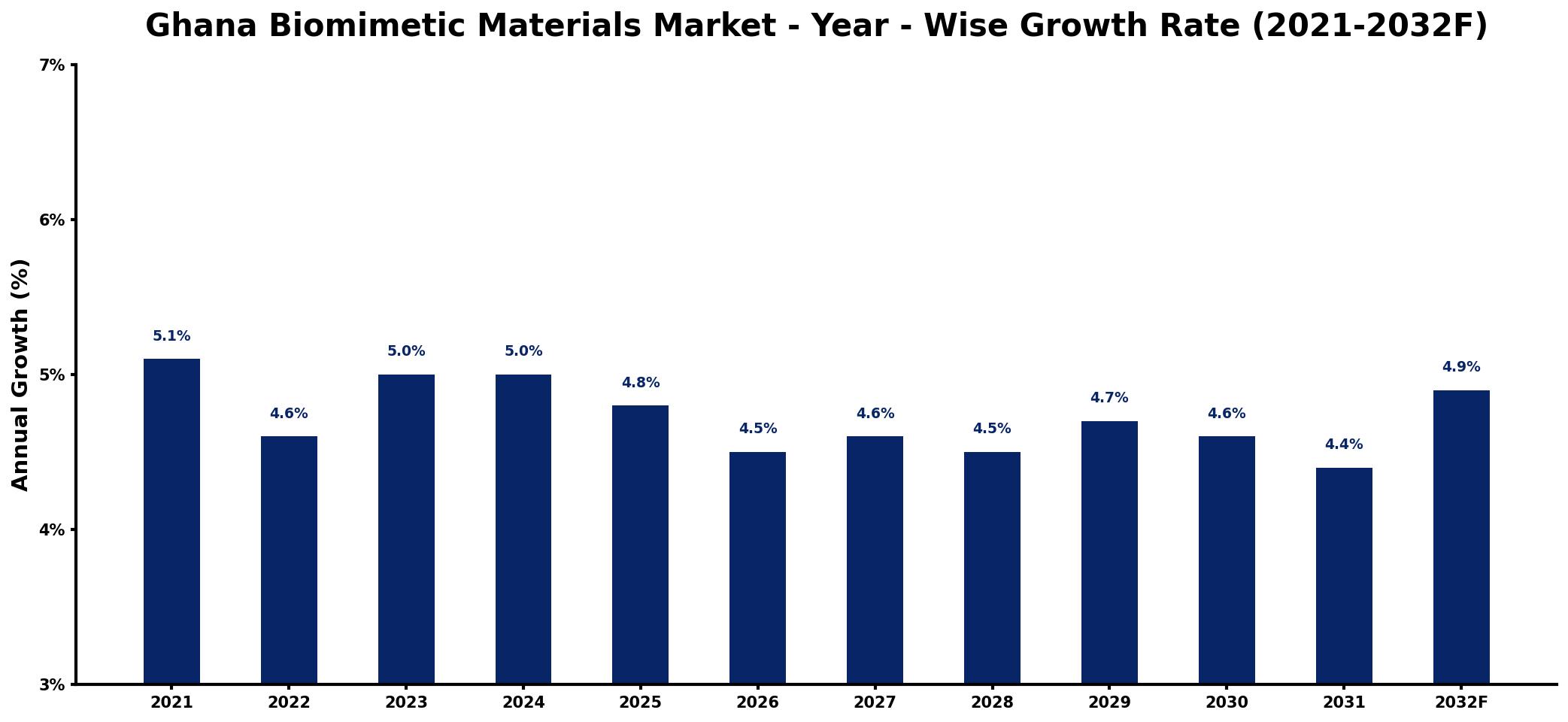
The table below presents the year‑wise growth rates along with the key drivers influencing the market
| Year | Growth Rate | Major Drivers |
| 2021 | 5.1% | Rising investments in sustainable technologies |
| 2022 | 4.6% | Increased demand for eco-friendly solutions |
| 2023 | 5.0% | Expansion of renewable energy initiatives |
| 2024 | 5.0% | Growing popularity of green building |
| 2025 | 4.8% | Surge in research funding allocations |
| 2026 | 4.5% | Development of innovative recycling processes |
| 2027 | 4.6% | Emergence of new industrial applications |
| 2028 | 4.5% | Strengthening of environmental regulations |
| 2029 | 4.7% | Boost in consumer awareness campaigns |
| 2030 | 4.6% | Collaboration among research institutions |
| 2031 | 4.4% | Heightened focus on circular economy |
| 2032 | 4.9% | Advancements in sustainable manufacturing practices |
Note: Market size estimations and growth projections presented in this report are based on 6Wresearch's proprietary forecasting methodology, utilizing the latest available industry data, government publications, and primary research inputs.
Ghana Biomimetic Materials Market Synopsis
The Ghana Biomimetic Materials Market is witnessing a transformative shift as organizations increasingly turn to nature-inspired solutions to tackle modern challenges. This growing sector is characterized by innovative applications that draw from biological processes, offering sustainable alternatives that resonate with current environmental needs.
As Ghana emphasizes sustainability and eco-conscious practices, the utilization of biomimetic materials is gaining traction in multiple industries. Healthcare, construction, and automotive applications are at the forefront, with companies investing in research and development to enhance the properties of these materials and expand their practical applications.
Ghana Biomimetic Materials Market Key Takeaways
- The market is driven by rising awareness of sustainability and eco-friendly products.
- Key applications include healthcare, construction, and automotive sectors.
- Collaborative efforts are growing between researchers, industries, and governmental bodies.
- The demand for innovative biomimetic solutions is increasing, particularly in urban development.
- Government policies are favoring the adoption of biomimetic materials in various manufacturing processes.
Evaluation of Restraints in Ghana Biomimetic Materials Market
Despite its promising prospects, the Ghana Biomimetic Materials Market faces significant restraints that hinder its growth. A primary challenge is the limited awareness and understanding of biomimetic materials among consumers and businesses. This lack of knowledge can lead to hesitancy in adopting these innovative solutions. Additionally, the dearth of specialized research and development facilities in Ghana further restricts local companies' ability to innovate in this arena. Coupled with high production costs compared to conventional materials, these factors create a complex environment that requires strategic interventions for market advancement.
Ghana Biomimetic Materials Market Trends
Emerging trends in the Ghana Biomimetic Materials Market are shaped by a collective push towards sustainability and innovation. The development of materials such as self-healing surfaces and water-repellent technologies are gaining attention as companies strive for enhanced performance while minimizing environmental impact. Collaborative research initiatives are increasingly common, fostering partnerships that leverage academic knowledge to accelerate advancements in biomimetic solutions. Furthermore, there is a noticeable increase in investment focusing on biodegradable polymers, further aligning with global sustainability objectives.
Ghana Biomimetic Materials Market Opportunities
The Ghana Biomimetic Materials Market presents a myriad of investment opportunities, particularly in bio-inspired materials tailored for specific applications such as construction and healthcare. The strong governmental focus on sustainability provides a favorable landscape for new entrants and existing companies to innovate. Opportunities exist for partnerships with local research institutions to develop tailored solutions that meet the unique needs of the Ghanaian market. These collaborative efforts could position investors at the forefront of a rapidly evolving sector with substantial growth potential.
Government Initiatives in the Ghana Biomimetic Materials Market
The Ghanaian government has shown a proactive interest in promoting sustainable practices, particularly in the biomimetic materials sector. Policies such as the National Biodiversity Strategy and Action Plan emphasize the integration of nature-inspired solutions to combat environmental issues. Additionally, incentives have been put in place to encourage businesses to adopt eco-friendly practices, including the use of biomimetic materials in manufacturing. These initiatives not only aim to drive economic growth but also create job opportunities while aligning with the countrys broader sustainability goals.
Future Insights of the Ghana Biomimetic Materials Market
Looking ahead to 2026-2032, the Ghana Biomimetic Materials Market is positioned for robust growth, driven by a confluence of factors including increased awareness of sustainable materials and the urgent need for innovation across multiple sectors. The alignment of industry objectives with government policies focused on environmental conservation will serve as a catalyst for market expansion. As more companies embrace biomimicry principles, the industry is expected to undergo transformative changes, paving the way for new product development and significant advancements in material science.
Ghana Biomimetic Materials Market Latest Developments (2025 - 2026)
In recent months, the Ghana Biomimetic Materials Market has seen several noteworthy developments, characterized by increased collaborations between academia and industry. New research initiatives are emerging that focus on the practical applications of biomimetic materials in sectors such as construction and healthcare. Various organizations are exploring innovative solutions that align with Ghana's sustainability goals, enhancing their competitive edge in both local and international markets. These trends indicate a growing momentum in the sector, fostering an environment ripe for innovation.
Ghana Biomimetic Materials Market - Key Attractiveness of the Report
- 10 Years of Market Numbers
- Historical Data Starting from 2022 to 2025
- Base Year: 2025
- Forecast Data until 2032
- Key Performance Indicators Impacting the Market
- Major Upcoming Developments and Projects
Key Highlights of the Report:
- Ghana Biomimetic Materials Market Outlook
- Market Size of Ghana Biomimetic Materials Market, 2025
- Forecast of Ghana Biomimetic Materials Market, 2032
- Historical Data and Forecast of Ghana Biomimetic Materials Revenues & Volume for the Period 2022-2032F
- Ghana Biomimetic Materials Market Trend Evolution
- Ghana Biomimetic Materials Market Drivers and Challenges
- Ghana Biomimetic Materials Price Trends
- Ghana Biomimetic Materials Porter's Five Forces
- Ghana Biomimetic Materials Industry Life Cycle
- Historical Data and Forecast of Ghana Biomimetic Materials Market Revenues & Volume By Material for the Period 2022-2032F
- Historical Data and Forecast of Ghana Biomimetic Materials Market Revenues & Volume By Biomimetic Polymers for the Period 2022-2032F
- Historical Data and Forecast of Ghana Biomimetic Materials Market Revenues & Volume By Biomimetic Ceramics & Glass for the Period 2022-2032F
- Historical Data and Forecast of Ghana Biomimetic Materials Market Revenues & Volume By Biomimetic Metals & Alloys for the Period 2022-2032F
- Historical Data and Forecast of Ghana Biomimetic Materials Market Revenues & Volume By Others for the Period 2022-2032F
- Historical Data and Forecast of Ghana Biomimetic Materials Market Revenues & Volume By Application for the Period 2022-2032F
- Historical Data and Forecast of Ghana Biomimetic Materials Market Revenues & Volume By Medical for the Period 2022-2032F
- Historical Data and Forecast of Ghana Biomimetic Materials Market Revenues & Volume By Automotive for the Period 2022-2032F
- Historical Data and Forecast of Ghana Biomimetic Materials Market Revenues & Volume By Defense for the Period 2022-2032F
- Historical Data and Forecast of Ghana Biomimetic Materials Market Revenues & Volume By Electronics for the Period 2022-2032F
- Historical Data and Forecast of Ghana Biomimetic Materials Market Revenues & Volume By Others for the Period 2022-2032F
- Ghana Biomimetic Materials Import Export Trade Statistics
- Market Opportunity Assessment By Material
- Market Opportunity Assessment By Application
- Ghana Biomimetic Materials Top Companies Market Share
- Ghana Biomimetic Materials Competitive Benchmarking By Technical and Operational Parameters
- Ghana Biomimetic Materials Company Profiles
- Ghana Biomimetic Materials Key Strategic Recommendations






































