Ghana Bottle Filling Machine Market Size, Share & Growth Rate
The Ghana Bottle Filling Machine Market was estimated at USD 1331 Million in 2025 and is projected to reach USD 1888 Million by 2032, growing at a CAGR of 5.1% from 2026 to 2032. This growth trajectory is fueled by an expanding beverage industry, rising consumer preferences for bottled products, and increasing disposable income among Ghanaians. The shift towards convenience and hygiene in consumption is also a significant driver, prompting local and multinational companies to enhance their production capabilities.
Ghana Bottle Filling Machine Market Year-wise Growth Rate and Key Drivers
This graph highlights how the Ghana Bottle Filling Machine Market has steadily grown over the years, supported by major growth factors.
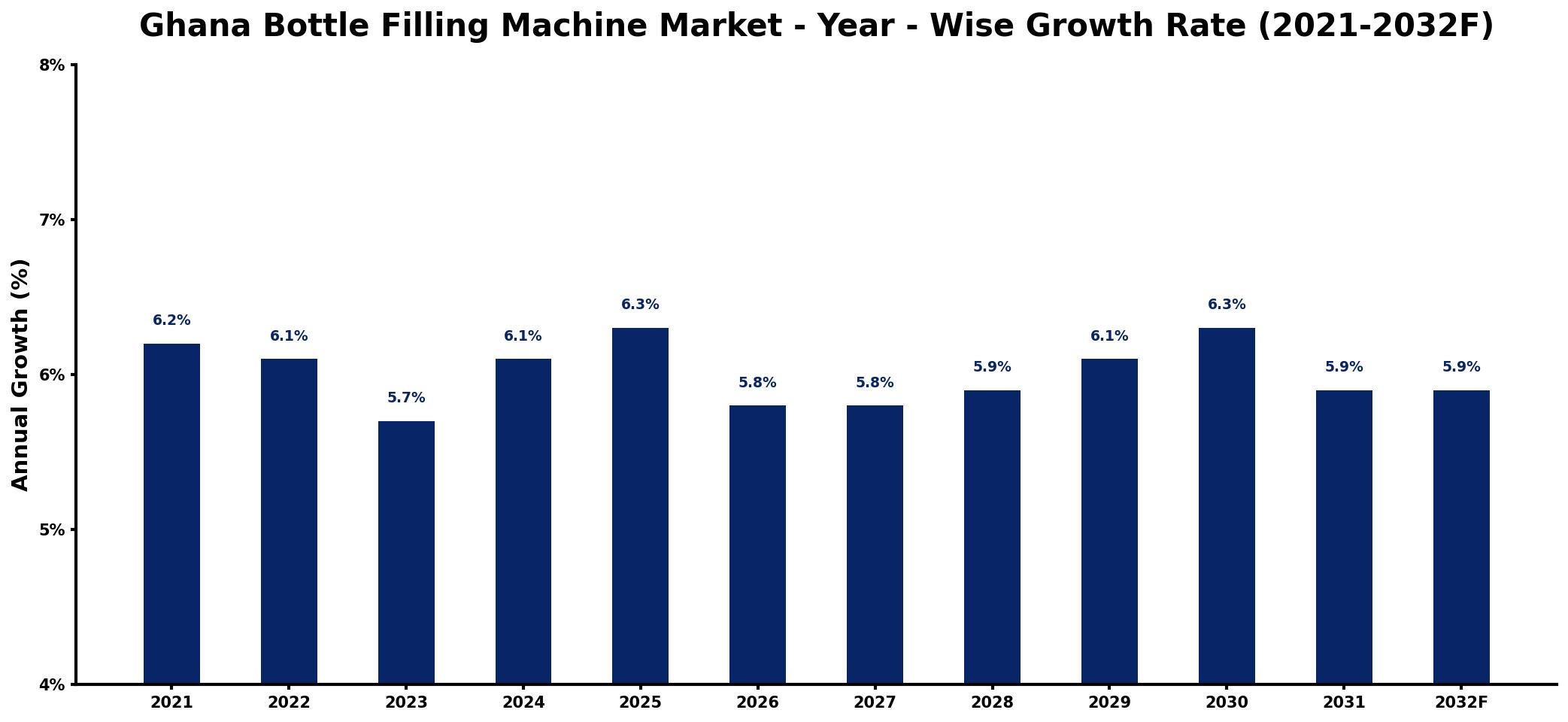
The table below presents the year‑wise growth rates along with the key drivers influencing the market
| Year | Growth Rate | Major Drivers |
| 2021 | 6.2% | Rising beverage consumption trends |
| 2022 | 6.1% | Increased investment in production |
| 2023 | 5.7% | Growing demand for eco-friendly solutions |
| 2024 | 6.1% | Expansion of local manufacturing capabilities |
| 2025 | 6.3% | Technological advancements in production |
| 2026 | 5.8% | Higher export opportunities emerging |
| 2027 | 5.8% | Strengthening local supply chains |
| 2028 | 5.9% | Increased focus on sustainability practices |
| 2029 | 6.1% | Rising consumer health consciousness |
| 2030 | 6.3% | Growing urbanization and population |
| 2031 | 5.9% | Emerging market for convenience products |
| 2032 | 5.9% | Innovations in packaging technologies |
Note: Market size estimations and growth projections presented in this report are based on 6Wresearch's proprietary forecasting methodology, utilizing the latest available industry data, government publications, and primary research inputs.
Ghana Bottle Filling Machine Market Synopsis
The Ghana Bottle Filling Machine Market has seen substantial momentum recently, with local bottling plants investing in modern technology to meet the rising demand for bottled beverages. As consumer preferences evolve, the market is heading towards a more automated and technologically advanced future, positioning itself to meet both current and future demands.
While the market currently benefits from robust investment and government support, the future appears even brighter. With ongoing initiatives aimed at enhancing local manufacturing capabilities and increasing sustainability, companies in the sector are gearing up for transformative changes that will redefine efficiency and production capacity.
Ghana Bottle Filling Machine Market Key Takeaways
- The market is driven by an increasing demand for bottled beverages, particularly among urban populations.
- Investment in automation and advanced technologies is paramount for improving production efficiency.
- Government incentives for local manufacturing are enhancing market competitiveness.
- Sustainability trends are prompting the adoption of energy-efficient and eco-friendly machinery.
- The lack of skilled technicians remains a challenge, hindering some companies' growth potential.
Evaluation of Restraints in Ghana Bottle Filling Machine Market
Despite its growth potential, the Ghana Bottle Filling Machine Market faces several restraints. High initial investment costs for advanced machinery can deter small and medium-sized enterprises from upgrading their production lines. Additionally, the limited availability of skilled technicians to operate and maintain these sophisticated systems impacts operational efficiency. Access to financing options is also limited, which may impede new market entrants or expansions. Lastly, inconsistent power supply in certain regions of Ghana can lead to operational disruptions, affecting overall productivity.
Ghana Bottle Filling Machine Market Trends
A noticeable trend in the Ghana Bottle Filling Machine Market is the increased emphasis on automation and efficiency. Manufacturers are adopting automated filling technologies to boost production speeds and reduce labor costs. Another vital trend is the push for eco-friendly solutions; companies are focusing on energy-efficient machines and materials that promote sustainability. Furthermore, the integration of IoT and data analytics is becoming more prevalent, allowing businesses to optimize production processes and enhance operational insights.
Ghana Bottle Filling Machine Market Opportunities
The Ghana Bottle Filling Machine Market offers significant investment opportunities, particularly as urbanization and changing lifestyles drive the demand for packaged beverages. Companies can benefit from investing in innovative filling machines designed for efficiency. Moreover, the governments commitment to local manufacturing and the establishment of free trade zones present a favorable environment for investors. Collaboration with beverage manufacturers looking to upgrade their production systems also provides pathways for strategic partnerships.
Government Initiatives in the Ghana Bottle Filling Machine Market
The Ghanaian government is actively promoting local manufacturing and economic growth through various supportive measures. Tax breaks and subsidies are available for companies investing in the production of bottle filling machines, with a focus on reducing import reliance. Additionally, policies encourage the use of energy-efficient technologies to enhance sustainability in manufacturing. There is also an emphasis on quality control and safety standards to build consumer trust and ensure market integrity, thus fostering a robust industrial environment.
Future Insights of the Ghana Bottle Filling Machine Market
The future outlook for the Ghana Bottle Filling Machine Market is optimistic as the demand for bottled beverages continues to rise. Factors such as an increasing focus on automation and technological advancements are expected to drive further adoption of advanced filling machines. As consumer preference trends toward hygiene and convenience persist, manufacturers will likely invest in smart, energy-efficient solutions. This evolving landscape presents significant growth opportunities for all stakeholders in the industry, setting the stage for an exciting phase of development from 2026 to 2032.
Ghana Bottle Filling Machine Market Latest Developments (2025 - 2026)
In recent months, the Ghana Bottle Filling Machine Market has observed a surge in innovations focused on efficiency and sustainability. Manufacturers are introducing new models that incorporate smart technologies, enabling real-time monitoring and management of production processes. Additionally, a heightened awareness of environmental issues is prompting businesses to invest in more sustainable practices, including the use of recyclable materials in bottle production. These developments indicate a transformative period for the industry as it aligns with global standards and consumer expectations.
Ghana Bottle Filling Machine Market - Key Attractiveness of the Report
- 10 Years of Market Numbers
- Historical Data Starting from 2022 to 2025
- Base Year: 2025
- Forecast Data until 2032
- Key Performance Indicators Impacting the Market
- Major Upcoming Developments and Projects
Key Highlights of the Report:
- Ghana Bottle Filling Machine Market Outlook
- Market Size of Ghana Bottle Filling Machine Market, 2025
- Forecast of Ghana Bottle Filling Machine Market, 2032
- Historical Data and Forecast of Ghana Bottle Filling Machine Revenues & Volume for the Period 2022-2032F
- Ghana Bottle Filling Machine Market Trend Evolution
- Ghana Bottle Filling Machine Market Drivers and Challenges
- Ghana Bottle Filling Machine Price Trends
- Ghana Bottle Filling Machine Porter's Five Forces
- Ghana Bottle Filling Machine Industry Life Cycle
- Historical Data and Forecast of Ghana Bottle Filling Machine Market Revenues & Volume By Bottle Type for the Period 2022-2032F
- Historical Data and Forecast of Ghana Bottle Filling Machine Market Revenues & Volume By PET Bottles for the Period 2022-2032F
- Historical Data and Forecast of Ghana Bottle Filling Machine Market Revenues & Volume By Glass Bottles for the Period 2022-2032F
- Historical Data and Forecast of Ghana Bottle Filling Machine Market Revenues & Volume By Others for the Period 2022-2032F
- Historical Data and Forecast of Ghana Bottle Filling Machine Market Revenues & Volume By Application for the Period 2022-2032F
- Historical Data and Forecast of Ghana Bottle Filling Machine Market Revenues & Volume By Food Products for the Period 2022-2032F
- Historical Data and Forecast of Ghana Bottle Filling Machine Market Revenues & Volume By Beverages for the Period 2022-2032F
- Historical Data and Forecast of Ghana Bottle Filling Machine Market Revenues & Volume By Chemicals & Pharmaceuticals for the Period 2022-2032F
- Historical Data and Forecast of Ghana Bottle Filling Machine Market Revenues & Volume By Cosmetics for the Period 2022-2032F
- Ghana Bottle Filling Machine Import Export Trade Statistics
- Market Opportunity Assessment By Bottle Type
- Market Opportunity Assessment By Application
- Ghana Bottle Filling Machine Top Companies Market Share
- Ghana Bottle Filling Machine Competitive Benchmarking By Technical and Operational Parameters
- Ghana Bottle Filling Machine Company Profiles
- Ghana Bottle Filling Machine Key Strategic Recommendations






































