Ghana Camera Tripods Market Size, Share & Growth Rate
The Ghana Camera Tripods Market was estimated at USD 317 Million in 2025 and is projected to reach USD 414 Million by 2032, growing at a CAGR of 3.9% from 2026 to 2032. This upward trajectory is primarily fueled by the increasing engagement in photography and videography among both amateur and professional enthusiasts. The proliferation of social media platforms has further amplified the demand for stable and reliable camera support, ensuring that the market remains robust and diverse.
Ghana Camera Tripods Market Year-wise Growth Rate and Key Drivers
This graph highlights how the Ghana Camera Tripods Market has steadily grown over the years, supported by major growth factors.
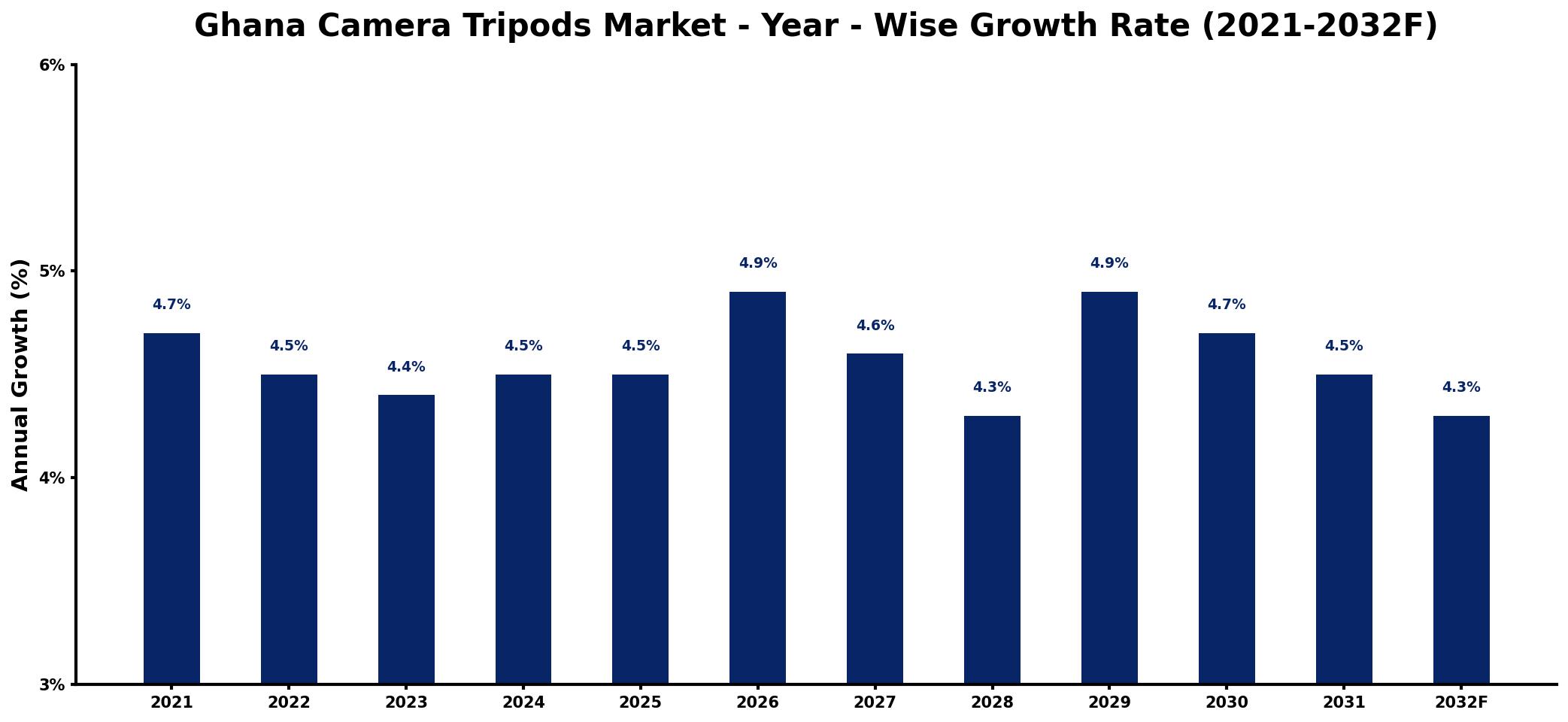
The table below presents the year‑wise growth rates along with the key drivers influencing the market
| Year | Growth Rate | Major Drivers |
| 2021 | 4.7% | Rise in photography enthusiasts |
| 2022 | 4.5% | Growth in social media content |
| 2023 | 4.4% | Increased demand for videography |
| 2024 | 4.5% | Expansion of influencer marketing |
| 2025 | 4.5% | Surge in online content creation |
| 2026 | 4.9% | Investment in digital storytelling |
| 2027 | 4.6% | Popularity of live streaming events |
| 2028 | 4.3% | Emergence of new photography styles |
| 2029 | 4.9% | growing downstream application demand |
| 2030 | 4.7% | Increase in travel photography |
| 2031 | 4.5% | Demand for professional equipment |
| 2032 | 4.3% | strengthening underlying market demand |
Note: Market size estimations and growth projections presented in this report are based on 6Wresearch's proprietary forecasting methodology, utilizing the latest available industry data, government publications, and primary research inputs.
Ghana Camera Tripods Market Synopsis
Recently, the Ghana Camera Tripods Market has seen a surge in demand driven by growing interest in photography as a hobby and profession. However, as the market evolves, it is transitioning toward the adoption of more innovative and versatile products that cater to a wider range of user needs.
As consumers increasingly seek lightweight and portable options, manufacturers are responding with a diverse array of products. The emphasis on user-friendly designs and advanced materials is indicative of a market that is not only growing but also adapting to the shifting needs of content creators across Ghana.
Ghana Camera Tripods Market Key Takeaways
- The market is experiencing consistent growth driven by the rise in photography and videography enthusiasts.
- Consumers are increasingly prioritizing lightweight and portable tripods for enhanced mobility.
- Innovative designs are emerging, incorporating advanced materials that improve durability and functionality.
- Social media influencers are significantly influencing tripod demand as they create high-quality visual content.
- Challenges such as limited brand variety and counterfeit products persist, impacting consumer trust.
Evaluation of Restraints in Ghana Camera Tripods Market
Despite the promising growth potential, several restraints impede the Ghana Camera Tripods Market. A key challenge is the limited consumer awareness regarding the benefits of using tripods, which can result in suboptimal demand for these products. Moreover, the market is often marked by a scarcity of diverse brands and models, creating a narrow scope for consumer choice. This lack of variety can hinder competitive pricing. Additionally, the prevalence of counterfeit products has raised concerns about quality, diminishing the trust consumers place in established brands. Addressing these limitations through targeted education and regulatory measures will be essential for unlocking the markets full potential.
Ghana Camera Tripods Market Trends
The trends within the Ghana Camera Tripods Market reflect a growing demand for multifunctional products that cater to various photography styles. Users are gravitating towards tripods that not only offer stability but also possess features like adjustable heights and compatibility with multiple devices. The emergence of smartphone tripods highlights the changing landscape, where content creation on mobile devices is becoming increasingly prevalent. As technology advances, the incorporation of smart features and enhanced durability into tripod designs is becoming a defining characteristic of new products.
Ghana Camera Tripods Market Opportunities
The Ghana Camera Tripods Market presents a plethora of investment opportunities, particularly as interest in photography and videography surges. With more individuals and businesses acquiring professional-grade cameras, the need for high-quality tripods is set to rise. There's a strategic advantage in offering a wide range of products that meet diverse consumer needs—be it affordability for amateurs or advanced features for professionals. Engaging with the burgeoning community of content creators and influencers can also yield fruitful returns, as these segments increasingly seek reliable equipment to enhance their visual storytelling.
Government Initiatives in the Ghana Camera Tripods Market
While there are no specific policies targeting the camera tripods market in Ghana, general trade regulations do influence it. Import duties and taxes on photographic equipment, including tripods, affect pricing and availability for consumers. Compliance with local quality standards is crucial for manufacturers and importers aiming to establish themselves in the market. As such, staying updated on trade policies is vital for businesses operating within this sector.
Future Insights of the Ghana Camera Tripods Market
Looking ahead to the period from 2026 to 2032, the Ghana Camera Tripods Market is anticipated to continue its growth trend, bolstered by the ongoing enthusiasm for visual content creation. As social media platforms evolve, the demand for high-quality support equipment like tripods will only intensify. Moreover, advancements in camera technology, including the rise of affordable DSLRs and mirrorless cameras, will likely contribute to an increasing need for reliable tripods. This growth is not merely a continuation of past trends but a dynamic expansion shaped by consumer preferences and technological innovations.
Ghana Camera Tripods Market Latest Developments (2025 - 2026)
Recent developments in the Ghana Camera Tripods Market indicate a shift towards more innovative designs and technologies. Manufacturers are increasingly focusing on creating tripods that are not only lightweight and portable but also boast advanced features to enhance user experience. There is a noticeable increase in collaborations and partnerships within the local creative community, fostering a richer understanding of consumer needs and preferences. These developments signal a vibrant and responsive market poised to cater to a diverse range of photography enthusiasts.
Ghana Camera Tripods Market - Key Attractiveness of the Report
- 10 Years of Market Numbers
- Historical Data Starting from 2022 to 2025
- Base Year: 2025
- Forecast Data until 2032
- Key Performance Indicators Impacting the Market
- Major Upcoming Developments and Projects
Key Highlights of the Report:
- Ghana Camera Tripods Market Outlook
- Market Size of Ghana Camera Tripods Market, 2025
- Forecast of Ghana Camera Tripods Market, 2032
- Historical Data and Forecast of Ghana Camera Tripods Revenues & Volume for the Period 2022-2032F
- Ghana Camera Tripods Market Trend Evolution
- Ghana Camera Tripods Market Drivers and Challenges
- Ghana Camera Tripods Price Trends
- Ghana Camera Tripods Porter's Five Forces
- Ghana Camera Tripods Industry Life Cycle
- Historical Data and Forecast of Ghana Camera Tripods Market Revenues & Volume By Product Type for the Period 2022-2032F
- Historical Data and Forecast of Ghana Camera Tripods Market Revenues & Volume By Travel for the Period 2022-2032F
- Historical Data and Forecast of Ghana Camera Tripods Market Revenues & Volume By Studio for the Period 2022-2032F
- Historical Data and Forecast of Ghana Camera Tripods Market Revenues & Volume By Pocket for the Period 2022-2032F
- Historical Data and Forecast of Ghana Camera Tripods Market Revenues & Volume By Others for the Period 2022-2032F
- Historical Data and Forecast of Ghana Camera Tripods Market Revenues & Volume By Distribution Channel for the Period 2022-2032F
- Historical Data and Forecast of Ghana Camera Tripods Market Revenues & Volume By Store Based for the Period 2022-2032F
- Historical Data and Forecast of Ghana Camera Tripods Market Revenues & Volume By Non Store Based for the Period 2022-2032F
- Ghana Camera Tripods Import Export Trade Statistics
- Market Opportunity Assessment By Product Type
- Market Opportunity Assessment By Distribution Channel
- Ghana Camera Tripods Top Companies Market Share
- Ghana Camera Tripods Competitive Benchmarking By Technical and Operational Parameters
- Ghana Camera Tripods Company Profiles
- Ghana Camera Tripods Key Strategic Recommendations






































