Ghana Car Air Fresheners Market Size, Share & Growth Rate
The Ghana Car Air Fresheners Market was estimated at USD 857 Million in 2025 and is projected to reach USD 1493 Million by 2032, growing at a CAGR of 8.3% from 2026 to 2032. This robust growth trajectory is fueled by a combination of increasing automotive ownership rates and a consumer shift towards enhancing the driving experience. As urban centers expand and disposable incomes rise, the demand for quality air freshening products continues to climb.
Ghana Car Air Fresheners Market Year-wise Growth Rate and Key Drivers
This graph highlights how the Ghana Car Air Fresheners Market has steadily grown over the years, supported by major growth factors.
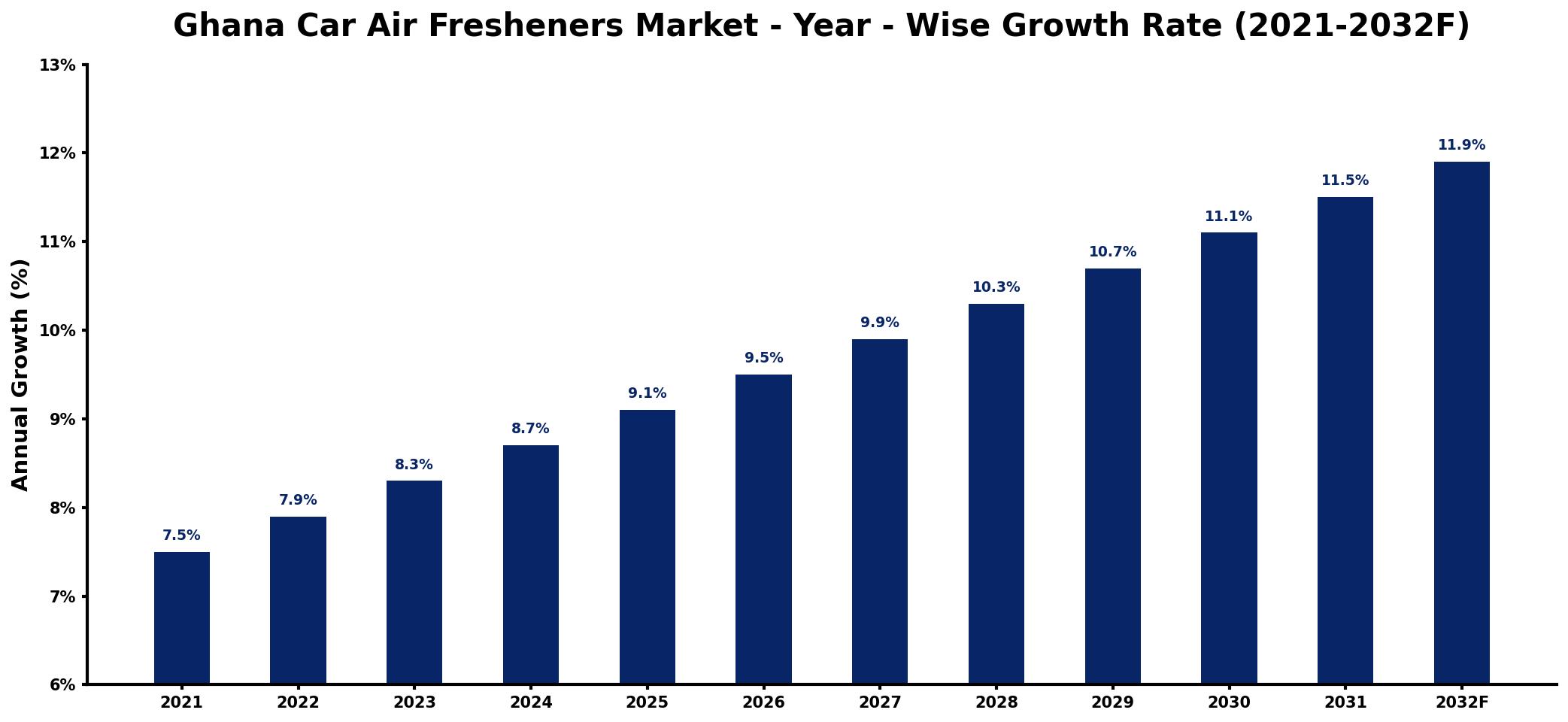
The table below presents the year‑wise growth rates along with the key drivers influencing the market
| Year | Growth Rate | Major Drivers |
| 2021 | 7.5% | Rising disposable income levels |
| 2022 | 7.9% | Increased urbanization trends observed |
| 2023 | 8.3% | Growing consumer health awareness |
| 2024 | 8.7% | Expansion of retail distribution channels |
| 2025 | 9.1% | Innovative product offerings emerging |
| 2026 | 9.5% | Strengthening online shopping platforms |
| 2027 | 9.9% | Surge in tourism activities noted |
| 2028 | 10.3% | Heightened environmental consciousness rising |
| 2029 | 10.7% | Increase in vehicle ownership rates |
| 2030 | 11.1% | Growing demand for luxury products |
| 2031 | 11.5% | Rising popularity of gift items |
| 2032 | 11.9% | growing regional consumption patterns |
Note: Market size estimations and growth projections presented in this report are based on 6Wresearch's proprietary forecasting methodology, utilizing the latest available industry data, government publications, and primary research inputs.
Ghana Car Air Fresheners Market Synopsis
The primary force driving the Ghana Car Air Fresheners Market is the burgeoning automotive sales, alongside an evolving consumer preference for a pleasant and inviting car environment. With the rising number of vehicles on the road, there is a growing need for products that cater to scent preferences and enhance personal comfort during drives.
In this competitive landscape, brands are diversifying their offerings, from vent clips and hanging air fresheners to sprays. This variety not only caters to differing preferences—like the popular fruity, floral, and musky scents—but also capitalizes on the trend towards eco-friendly and culturally inspired products, meeting the demands of a discerning consumer base.
Ghana Car Air Fresheners Market Key Takeaways
- Steady growth projected due to increasing automotive sales and urbanization.
- Rising consumer preference for eco-friendly and natural air fresheners.
- Growing demand for unique and culturally relevant fragrance options.
- Market characterized by intense competition from local and international brands.
- Potential for innovation in long-lasting and affordable air freshening solutions.
Evaluation of Restraints in Ghana Car Air Fresheners Market
Despite promising growth, the Ghana Car Air Fresheners Market faces certain constraints that could hinder progress. A significant challenge is the limited consumer awareness regarding the benefits of modern air freshening products compared to traditional methods. Many consumers still prefer homemade remedies due to a lack of education about the safety and effectiveness of branded options. The prevalence of low-cost alternatives and counterfeit products also complicates market dynamics, undermining consumer trust and confidence. Additionally, the perception of air fresheners as luxury items within a price-sensitive market can slow widespread adoption. Addressing these issues requires strategic marketing efforts to inform consumers and boost product visibility.
Ghana Car Air Fresheners Market Trends
Current trends in the Ghana Car Air Fresheners Market reflect a growing demand for sustainable, non-toxic products as consumers become more environmentally conscious. Natural and eco-friendly air fresheners are increasingly favored over synthetic alternatives. Additionally, the appeal of unique and culturally inspired scents is on the rise, reflecting a desire for personal expression and cultural connection. Customization is another emerging trend, with consumers looking for personalized options that resonate with their individual preferences.
Ghana Car Air Fresheners Market Opportunities
Investment opportunities within the Ghana Car Air Fresheners Market are plentiful. Brands can focus on introducing innovative and eco-friendly products that align with the rising consumer demand for sustainability. Collaborations with local artisans to create distinct scents could enhance market differentiation. Furthermore, leveraging digital marketing channels to reach wider audiences, coupled with strategic partnerships with automotive dealerships and service stations, can boost visibility and sales. Research and development aimed at formulating affordable and long-lasting air fresheners tailored to local conditions can also prove beneficial.
Government Initiatives in the Ghana Car Air Fresheners Market
Government policies in Ghana play a pivotal role in shaping the car air fresheners market. Regulatory measures implemented by the Ghana Standards Authority (GSA) ensure that products meet health and environmental safety standards. These regulations are designed to protect consumers and encourage responsible manufacturing practices. Additionally, the government promotes local manufacturing through various initiatives, which can provide an advantage for domestic brands in competing with international players. Tariffs on imports further influence market dynamics, impacting pricing strategies.
Future Insights of the Ghana Car Air Fresheners Market
Looking ahead to 2026-2032, the Ghana Car Air Fresheners Market is set for continued expansion, driven by rising car ownership and an increasing awareness of the benefits of a fresh driving environment. The market will likely see a broader array of product offerings, including innovative formats and unique scents that cater to the diverse preferences of consumers. As urbanization and disposable incomes continue to grow, the demand for sophisticated air fresheners will escalate, making this a dynamic sector ripe for investment.
Ghana Car Air Fresheners Market Latest Developments (2025 - 2026)
Recent developments in the Ghana Car Air Fresheners Market indicate a shift towards innovative product formulations and packaging. Brands are exploring new methods for promoting eco-friendly ingredients and sustainable sourcing practices. Meanwhile, online retail channels are gaining traction, providing consumers with convenient access to a broader selection of air freshener products. Theres also an emerging focus on collaborations with local scent experts to capture unique fragrance profiles that resonate with Ghanaian culture.
Ghana Car Air Fresheners Market - Key Attractiveness of the Report
- 10 Years of Market Numbers
- Historical Data Starting from 2022 to 2025
- Base Year: 2025
- Forecast Data until 2032
- Key Performance Indicators Impacting the Market
- Major Upcoming Developments and Projects
Key Highlights of the Report:
- Ghana Car Air Fresheners Market Outlook
- Market Size of Ghana Car Air Fresheners Market, 2025
- Forecast of Ghana Car Air Fresheners Market, 2032
- Historical Data and Forecast of Ghana Car Air Fresheners Revenues & Volume for the Period 2022-2032F
- Ghana Car Air Fresheners Market Trend Evolution
- Ghana Car Air Fresheners Market Drivers and Challenges
- Ghana Car Air Fresheners Price Trends
- Ghana Car Air Fresheners Porter's Five Forces
- Ghana Car Air Fresheners Industry Life Cycle
- Historical Data and Forecast of Ghana Car Air Fresheners Market Revenues & Volume By Product for the Period 2022-2032F
- Historical Data and Forecast of Ghana Car Air Fresheners Market Revenues & Volume By Gel & Cans for the Period 2022-2032F
- Historical Data and Forecast of Ghana Car Air Fresheners Market Revenues & Volume By Spray/Aerosol for the Period 2022-2032F
- Historical Data and Forecast of Ghana Car Air Fresheners Market Revenues & Volume By Paper Car Air Fresheners for the Period 2022-2032F
- Historical Data and Forecast of Ghana Car Air Fresheners Market Revenues & Volume By Vents & Clips for the Period 2022-2032F
- Historical Data and Forecast of Ghana Car Air Fresheners Market Revenues & Volume By End-User for the Period 2022-2032F
- Historical Data and Forecast of Ghana Car Air Fresheners Market Revenues & Volume By Sports Car for the Period 2022-2032F
- Historical Data and Forecast of Ghana Car Air Fresheners Market Revenues & Volume By Mid-range Car for the Period 2022-2032F
- Historical Data and Forecast of Ghana Car Air Fresheners Market Revenues & Volume By SUV for the Period 2022-2032F
- Historical Data and Forecast of Ghana Car Air Fresheners Market Revenues & Volume By Others for the Period 2022-2032F
- Historical Data and Forecast of Ghana Car Air Fresheners Market Revenues & Volume By Fragrance for the Period 2022-2032F
- Historical Data and Forecast of Ghana Car Air Fresheners Market Revenues & Volume By Scented for the Period 2022-2032F
- Historical Data and Forecast of Ghana Car Air Fresheners Market Revenues & Volume By UnScented for the Period 2022-2032F
- Ghana Car Air Fresheners Import Export Trade Statistics
- Market Opportunity Assessment By Product
- Market Opportunity Assessment By End-User
- Market Opportunity Assessment By Fragrance
- Ghana Car Air Fresheners Top Companies Market Share
- Ghana Car Air Fresheners Competitive Benchmarking By Technical and Operational Parameters
- Ghana Car Air Fresheners Company Profiles
- Ghana Car Air Fresheners Key Strategic Recommendations






































