Ghana Chatbot Market Size & Growth Rate (2026-2032)
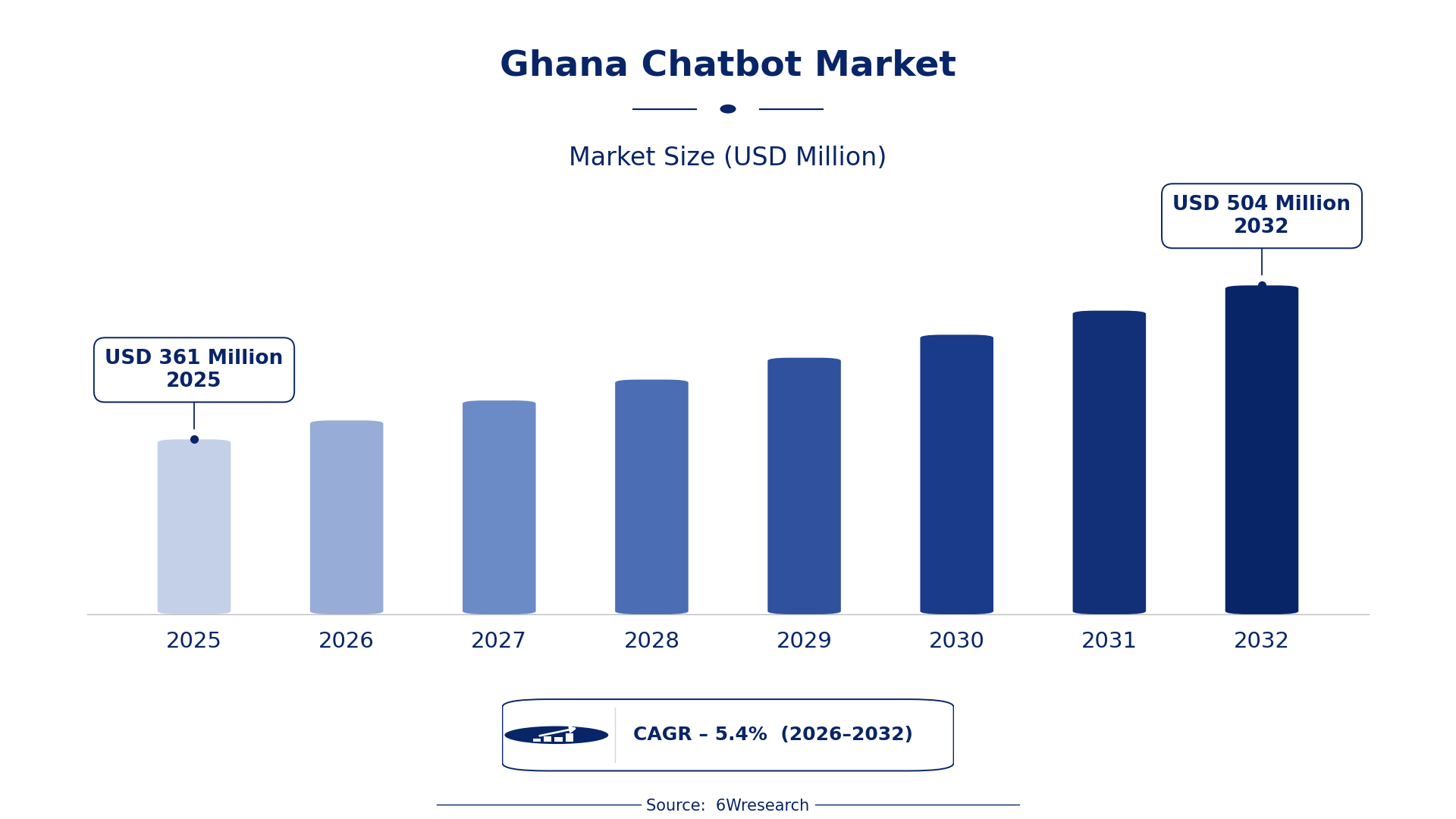
The Ghana Chatbot Market was estimated at USD 361 Million in 2025 and is projected to reach USD 504 Million by 2032, growing at a CAGR of 5.4% from 2026 to 2032.
Ghana Chatbot Market Synopsis
The Ghana chatbot market is currently experiencing a surge in interest, driven by advancements in artificial intelligence and a growing digital economy. As businesses recognize the potential of chatbots to enhance customer interactions, investments are ramping up in this sector.
Looking ahead, the market is set to expand even further as companies across various industries—from finance to healthcare—embrace automation. The combination of increasing smartphone penetration and the demand for personalized customer service creates a fertile ground for chatbot solutions.
Ghana Chatbot Market Year-wise Growth Rate and Key Drivers
This graph illustrates the annual growth rates of the Ghana Chatbot Market from 2021 to 2032, highlighting a steady upward trajectory and projected expansion over the forecast period.
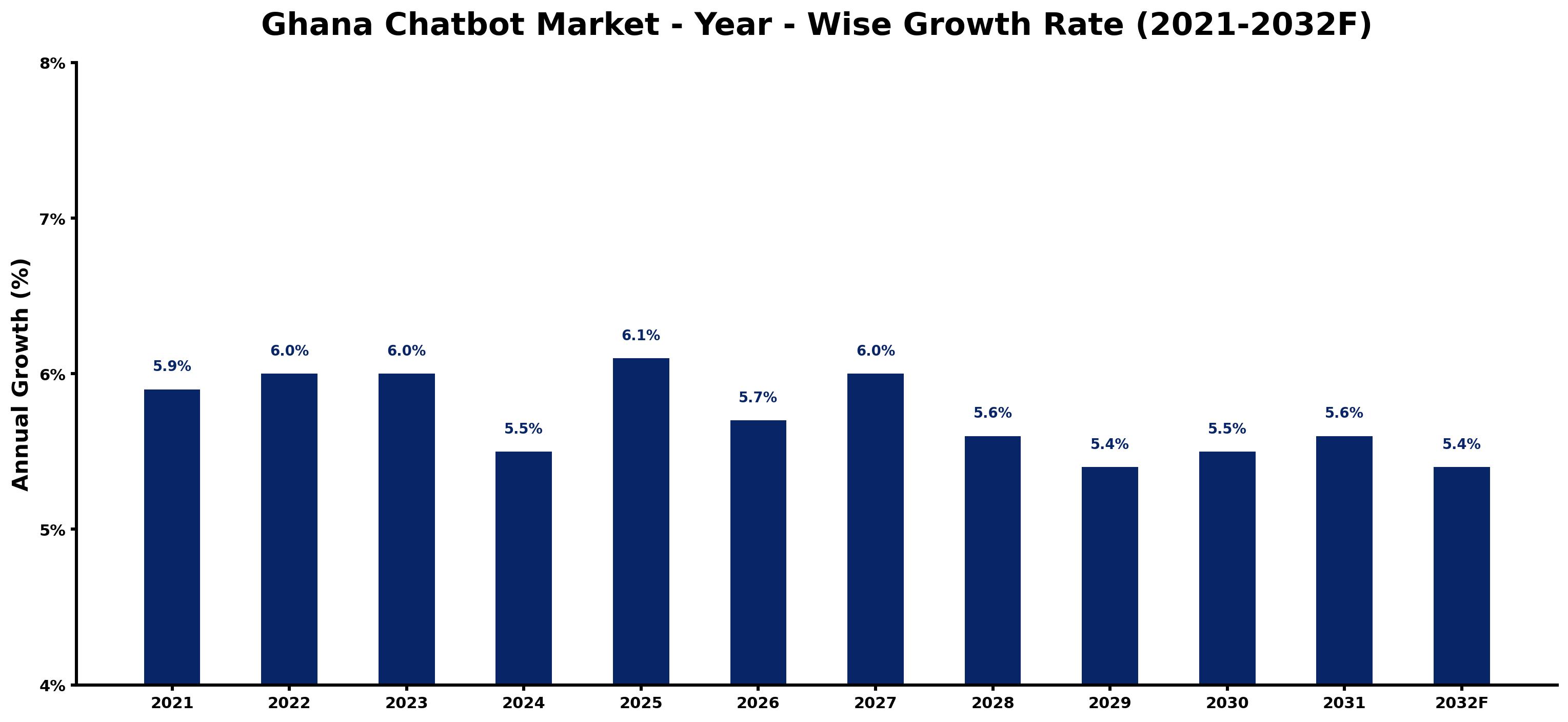
The table below presents the year‑wise growth rates along with the key drivers influencing the market
| Year | Growth Rate | Major Drivers |
| 2021 | 5.9% | Adoption of chatbots in banking sector by GhIPSS |
| 2022 | 6.0% | Government digitalization initiative boosting customer service automation |
| 2023 | 6.0% | Increased smartphone penetration enhancing chatbot usability |
| 2024 | 5.5% | Rise of e-commerce driving demand for customer support chatbots |
| 2025 | 6.1% | Enhanced internet connectivity promoting digital service interactions |
| 2026 | 5.7% | Growing awareness of cost-efficiency of chatbots for SMEs |
| 2027 | 6.0% | Telecom partnerships fostering chatbot integrations in customer service |
| 2028 | 5.6% | Education sector adopting chatbots for learning support |
| 2029 | 5.4% | CPD programs encouraging chatbot deployment in health services |
| 2030 | 5.5% | Rising consumer expectations for instant communication with brands |
| 2031 | 5.6% | Regulatory focus on improving user experience with services |
| 2032 | 5.4% | Local startups innovating chatbot solutions for various industries |
Note: Market size estimations and growth projections presented in this report are based on 6Wresearch's proprietary forecasting methodology, utilizing the latest available industry data, government publications, and primary research inputs.
Ghana Chatbot Market Key Takeaways
Below are some of the specific key takeaways from the market, including:
- Increasing investment in AI technology is transforming customer service in Ghana.
- Integration of machine learning is enhancing the capabilities of chatbots across sectors.
- The market is seeing a rise in multilingual chatbots to cater to Ghana's diverse population.
- Government initiatives are promoting the adoption of chatbot technology in various industries.
- Challenges such as internet access in rural areas need addressing for broader market growth.
Evaluation of Restraints in Ghana Chatbot Market
The Ghana chatbot market faces several hurdles that may impede its growth trajectory. Low internet penetration rates in rural areas create a significant barrier for widespread adoption. on top of that, limited awareness of chatbot technology among businesses hampers potential user engagement. Language diversity also poses challenges in developing effective solutions tailored to the local population's needs. Additionally, concerns regarding data privacy and a shortage of skilled professionals to implement and maintain chatbot systems further complicate the market landscape.
Ghana Chatbot Market Trends
Several trends are shaping the Ghana chatbot market. The rise of AI and machine learning is making chatbots smarter, allowing them to handle more complex queries. Voice-activated chatbots are gaining traction, responding to the demand for more intuitive user experiences. on top of that, businesses are increasingly exploring chatbot applications beyond traditional sectors, with education and e-commerce emerging as notable areas of growth.
Ghana Chatbot Market Opportunities
The market presents various opportunities for growth and investment. Small and medium-sized enterprises (SMEs) are particularly well-positioned to adopt chatbot solutions, enhancing their customer service capabilities with limited budgets. There's also a rising demand for chatbots that can support multiple languages, appealing to Ghana's diverse demographic. With an increasing focus on automating routine tasks, businesses can leverage chatbots to improve operational efficiency while reducing costs.
Government Initiatives in the Ghana Chatbot Market
Government policies in Ghana are increasingly focused on leveraging technology to enhance public service delivery, with chatbots playing a crucial role. These initiatives aim to foster innovation, improve access to services, and ensure data security within the chatbot framework. The regulatory environment is evolving, supporting both public and private sector efforts to adopt chatbot solutions effectively.
- A recently completed initiative under the National Digital Transformation Agenda emphasizes the use of chatbots in improving citizen services.
- A current ongoing project involves the Ghana Tech Lab, which is nurturing local chatbot developers through training and resources.
- Planned initiatives include a nationwide program expected to launch in 2026, aimed at enhancing digital infrastructure for better chatbot accessibility.
- Recent regulatory updates related to the Data Protection Act are being enforced to ensure user privacy in chatbot interactions.
- A public-private partnership is underway to expand chatbot applications in the healthcare sector, aimed for completion by mid-2026.
Future Insights of the Ghana Chatbot Market
The Ghana chatbot market is projected to thrive from 2026 to 2032 as businesses increasingly recognize the value of automated customer interactions. The convergence of improved internet access and smartphone usage will likely accelerate adoption rates. As technological advancements in natural language processing and AI continue to evolve, chatbots will become more adept at handling customer inquiries, thereby enhancing user satisfaction and driving market growth.
Ghana Chatbot Market Latest Developments
Over the past year, the Ghana chatbot market has seen notable activity, with various companies launching innovative solutions and partnerships. The emphasis on enhancing customer engagement through chatbots has become a focal point for many businesses looking to differentiate themselves in a competitive landscape.
- A leading technology vendor launched a new AI-powered chatbot solution in early 2025, targeting e-commerce businesses for improved customer interaction.
- An initiative that began in late 2024 and remains ongoing is focused on integrating chatbots into government services to streamline citizen engagement.
- A partnership between two major regional operators was announced in Q1 2025 to develop a multilingual chatbot catering to Ghana’s diverse linguistic groups.
- By mid-2025, a significant rollout of voice-activated chatbots is expected to enhance user experience across various sectors.
- A planned initiative is set to begin in late 2026 to provide training programs for developers in the chatbot space, aiming to build local capacity.
Ghana Chatbot Market - Key Attractiveness of the Report
- 10 Years of Market Numbers
- Historical Data Starting from 2022 to 2025
- Base Year: 2025
- Forecast Data until 2032
- Key Performance Indicators Impacting the Market
- Major Upcoming Developments and Projects
Key Highlights of the Report:
- Ghana Chatbot Market Outlook
- Market Size of Ghana Chatbot Market, 2025
- Forecast of Ghana Chatbot Market, 2032
- Historical Data and Forecast of Ghana Chatbot Revenues & Volume for the Period 2022-2032F
- Ghana Chatbot Market Trend Evolution
- Ghana Chatbot Market Drivers and Challenges
- Ghana Chatbot Price Trends
- Ghana Chatbot Porter's Five Forces
- Ghana Chatbot Industry Life Cycle
- Historical Data and Forecast of Ghana Chatbot Market Revenues & Volume By Component for the Period 2022-2032F
- Historical Data and Forecast of Ghana Chatbot Market Revenues & Volume By Solutions for the Period 2022-2032F
- Historical Data and Forecast of Ghana Chatbot Market Revenues & Volume By Services for the Period 2022-2032F
- Historical Data and Forecast of Ghana Chatbot Market Revenues & Volume By Type for the Period 2022-2032F
- Historical Data and Forecast of Ghana Chatbot Market Revenues & Volume By Rule Based for the Period 2022-2032F
- Historical Data and Forecast of Ghana Chatbot Market Revenues & Volume By AI Based for the Period 2022-2032F
- Historical Data and Forecast of Ghana Chatbot Market Revenues & Volume By Deployment Mode for the Period 2022-2032F
- Historical Data and Forecast of Ghana Chatbot Market Revenues & Volume By On-premises for the Period 2022-2032F
- Historical Data and Forecast of Ghana Chatbot Market Revenues & Volume By Cloud for the Period 2022-2032F
- Historical Data and Forecast of Ghana Chatbot Market Revenues & Volume By Channel Integration for the Period 2022-2032F
- Historical Data and Forecast of Ghana Chatbot Market Revenues & Volume By Websites for the Period 2022-2032F
- Historical Data and Forecast of Ghana Chatbot Market Revenues & Volume By Contact Centers for the Period 2022-2032F
- Historical Data and Forecast of Ghana Chatbot Market Revenues & Volume By Social Media for the Period 2022-2032F
- Historical Data and Forecast of Ghana Chatbot Market Revenues & Volume By Mobile Applications for the Period 2022-2032F
- Historical Data and Forecast of Ghana Chatbot Market Revenues & Volume By Organization Size for the Period 2022-2032F
- Historical Data and Forecast of Ghana Chatbot Market Revenues & Volume By Large Enterprises for the Period 2022-2032F
- Historical Data and Forecast of Ghana Chatbot Market Revenues & Volume By SMEs for the Period 2022-2032F
- Historical Data and Forecast of Ghana Chatbot Market Revenues & Volume By Business Function for the Period 2022-2032F
- Historical Data and Forecast of Ghana Chatbot Market Revenues & Volume By Information Technology Service Management for the Period 2022-2032F
- Historical Data and Forecast of Ghana Chatbot Market Revenues & Volume By Human Resources for the Period 2022-2032F
- Historical Data and Forecast of Ghana Chatbot Market Revenues & Volume By Sales and Marketing for the Period 2022-2032F
- Historical Data and Forecast of Ghana Chatbot Market Revenues & Volume By Finance for the Period 2022-2032F
- Historical Data and Forecast of Ghana Chatbot Market Revenues & Volume By Application for the Period 2022-2032F
- Historical Data and Forecast of Ghana Chatbot Market Revenues & Volume By Customer Service for the Period 2022-2032F
- Historical Data and Forecast of Ghana Chatbot Market Revenues & Volume By Personal Assistant for the Period 2022-2032F
- Historical Data and Forecast of Ghana Chatbot Market Revenues & Volume By Branding and Advertisement for the Period 2022-2032F
- Historical Data and Forecast of Ghana Chatbot Market Revenues & Volume By Customer Engagement and Retention for the Period 2022-2032F
- Historical Data and Forecast of Ghana Chatbot Market Revenues & Volume By Data Privacy and Compliance for the Period 2022-2032F
- Historical Data and Forecast of Ghana Chatbot Market Revenues & Volume By Employee Engagement and On Boarding for the Period 2022-2032F
- Historical Data and Forecast of Ghana Chatbot Market Revenues & Volume By Payment Processing for the Period 2022-2032F
- Historical Data and Forecast of Ghana Chatbot Market Revenues & Volume By Others for the Period 2022-2032F
- Historical Data and Forecast of Ghana Chatbot Market Revenues & Volume By Vertical for the Period 2022-2032F
- Historical Data and Forecast of Ghana Chatbot Market Revenues & Volume By BFSI for the Period 2022-2032F
- Historical Data and Forecast of Ghana Chatbot Market Revenues & Volume By IT and Telecom for the Period 2022-2032F
- Historical Data and Forecast of Ghana Chatbot Market Revenues & Volume By Retail and Ecommerce for the Period 2022-2032F
- Historical Data and Forecast of Ghana Chatbot Market Revenues & Volume By Healthcare and Life Sciences for the Period 2022-2032F
- Historical Data and Forecast of Ghana Chatbot Market Revenues & Volume By Transportation and Logistics for the Period 2022-2032F
- Historical Data and Forecast of Ghana Chatbot Market Revenues & Volume By Government for the Period 2022-2032F
- Historical Data and Forecast of Ghana Chatbot Market Revenues & Volume By Travel and Hospitality for the Period 2022-2032F
- Historical Data and Forecast of Ghana Chatbot Market Revenues & Volume By Media and Entertainment for the Period 2022-2032F
- Ghana Chatbot Import Export Trade Statistics
- Market Opportunity Assessment By Component
- Market Opportunity Assessment By Type
- Market Opportunity Assessment By Deployment Mode
- Market Opportunity Assessment By Channel Integration
- Market Opportunity Assessment By Organization Size
- Market Opportunity Assessment By Business Function
- Market Opportunity Assessment By Application
- Market Opportunity Assessment By Vertical
- Ghana Chatbot Top Companies Market Share
- Ghana Chatbot Competitive Benchmarking By Technical and Operational Parameters
- Ghana Chatbot Company Profiles
- Ghana Chatbot Key Strategic Recommendations






































