Ghana Cloud Security Market Size & Growth Rate (2026-2032)
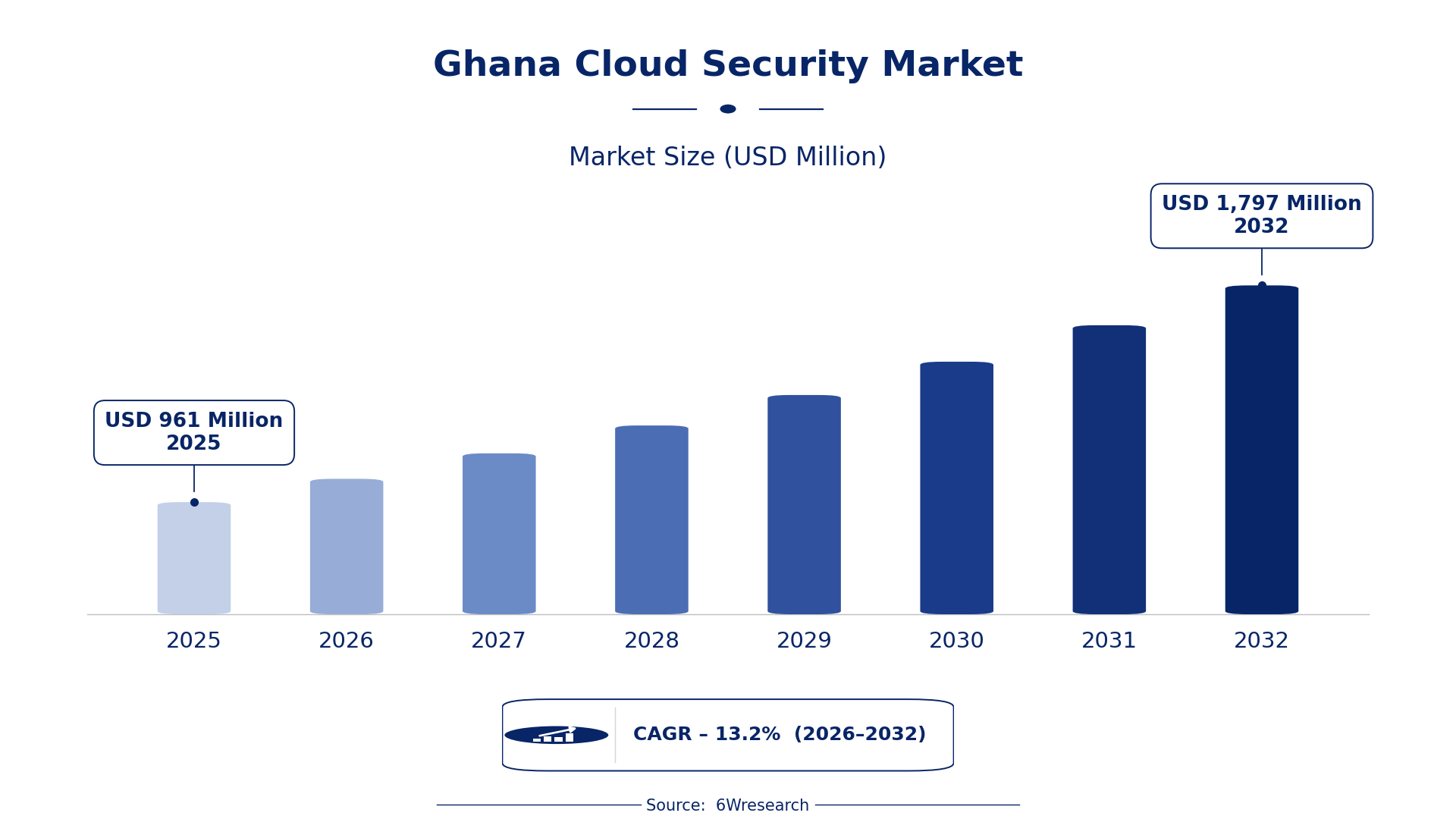
The Ghana Cloud Security Market was estimated at USD 961 Million in 2025 and is projected to reach USD 1797 Million by 2032, growing at a CAGR of 13.2% from 2026 to 2032.
Ghana Cloud Security Market Synopsis
The push towards cloud computing in Ghana has significantly highlighted the critical need for robust security measures. As businesses rapidly adopt cloud technologies, securing sensitive data against increasingly sophisticated cyber threats is becoming paramount.
In this climate, organizations are turning to diverse cloud security solutions, including encryption, endpoint protection, and identity management. This growing focus on security reflects a broader understanding that with the benefits of cloud adoption come substantial risks that require strategic investment in security infrastructure.
Ghana Cloud Security Market Year-wise Growth Rate and Key Drivers
This graph illustrates the annual growth rates of the Ghana Cloud Security Market from 2021 to 2032, highlighting a steady upward trajectory and projected expansion over the forecast period.
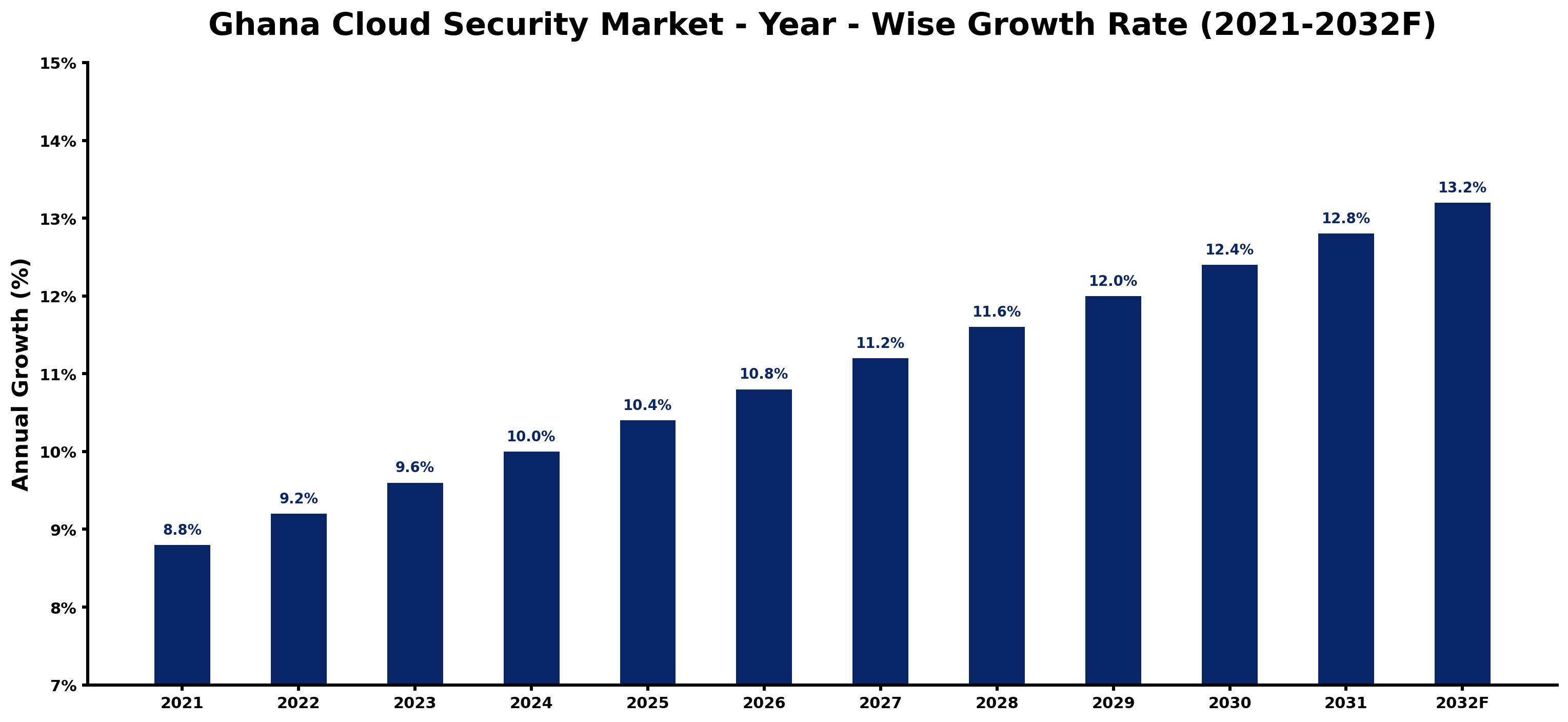
The table below presents the year‑wise growth rates along with the key drivers influencing the market
| Year | Growth Rate | Major Drivers |
| 2021 | 8.8% | National Cyber Security Policy promotes cloud protection measures. |
| 2022 | 9.2% | Increased mobile banking adoption drives cloud data security needs. |
| 2023 | 9.6% | Growing remote work trend necessitates advanced cloud security solutions. |
| 2024 | 10.0% | Government investment in digital infrastructure enhances cloud security adoption. |
| 2025 | 10.4% | Local businesses increasingly migrate to cloud for efficiency. |
| 2026 | 10.8% | Regulatory pressure on data protection boosts cloud security services. |
| 2027 | 11.2% | Emergence of fintech startups increases demand for secure cloud. |
| 2028 | 11.6% | Tech-savvy youth pushing for safer online environments boosts demand. |
| 2029 | 12.0% | Enhanced digital literacy initiatives spur cloud security awareness. |
| 2030 | 12.4% | Rising cyber threats prompt businesses to prioritize cloud security. |
| 2031 | 12.8% | Partnerships with international firms improve local cloud security standards. |
| 2032 | 13.2% | Increased smartphone penetration accelerates demand for cloud safeguards. |
Note: Market size estimations and growth projections presented in this report are based on 6Wresearch's proprietary forecasting methodology, utilizing the latest available industry data, government publications, and primary research inputs.
Ghana Cloud Security Market Key Takeaways
Below are some of the specific key takeaways from the market, including:
- The accelerating adoption of cloud technologies is driving significant growth in the Ghana Cloud Security Market.
- Data protection and compliance are primary concerns fueling investments in security solutions.
- The rise of remote work necessitates enhanced security protocols to protect organizational data.
- Government policies aimed at improving cybersecurity are shaping market dynamics.
- Skills shortages in cybersecurity fields present challenges to comprehensive cloud security adoption.
Evaluation of Restraints in Ghana Cloud Security Market
One of the foremost restraints hindering the growth of the Ghana Cloud Security Market is the rapidly evolving nature of cyber threats. Organizations often find themselves one step behind malicious actors, as new vulnerabilities continue to emerge. The increasing complexity of compliance requirements also poses a challenge, forcing businesses to invest in sophisticated solutions. Additionally, the current skills gap within the cybersecurity workforce leads to underutilization of available technologies and solutions, further stifling growth.
Ghana Cloud Security Market Trends
The Ghana Cloud Security Market is witnessing several notable trends. The integration of artificial intelligence and machine learning in security solutions is becoming more prevalent, enabling organizations to preemptively identify and mitigate threats. Another trend is the growing importance of data privacy regulations, pushing companies to prioritize compliance. on top of that, the collaboration between private and public sectors to enhance cybersecurity frameworks is gaining momentum, signaling a unified approach to tackling these challenges.
Ghana Cloud Security Market Opportunities
As businesses seek to enhance their cloud security frameworks, there are ample opportunities for growth and investment. The increasing emphasis on cloud security solutions positions companies that offer innovative and adaptable technologies at a competitive advantage. on top of that, the rising trend of digital transformation across various sectors creates a fertile ground for advanced security measures. Investment in talent development and training programs also presents a substantial opportunity to close the skills gap and enhance the market's overall capacity.
Government Initiatives in the Ghana Cloud Security Market
Government policies in Ghana are crucial in shaping the cloud security landscape. Authorities are increasingly focused on developing comprehensive regulatory frameworks that enhance cybersecurity and data privacy. By emphasizing public sector support, the government is actively working to establish a secure digital environment that fosters both trust and growth in cloud services.
- A national cybersecurity strategy launched in early 2025 aims to strengthen the security posture of cloud service providers.
- Currently ongoing is a capacity-building initiative for IT professionals and cybersecurity analysts to bolster local expertise in cloud security technologies.
- A planned public-private partnership expected to begin in late 2026 aims to improve overall cybersecurity infrastructure across sectors.
- A regulatory framework introduced in 2025 mandates data encryption for sensitive information stored in the cloud.
- The government has initiated a public awareness campaign on cyber threats and the importance of security measures, which began in Q2 2025.
Future Insights of the Ghana Cloud Security Market
Looking ahead to 2026-2032, the Ghana Cloud Security Market is set to experience transformative growth driven by an increasing dependency on digital services. Organizations will continue to adapt their security strategies in response to emerging threats and compliance demands. Investments in advanced technologies, particularly in AI-driven security solutions, are expected to shape a new paradigm of protection for cloud environments. As public and private sectors align their efforts, the stage is set for a secure and prosperous cloud ecosystem in Ghana.
Ghana Cloud Security Market Latest Developments
The last 12-14 months have seen a flurry of activity in the Ghana Cloud Security Market, with organizations and the government focusing on reinforcing cybersecurity measures. Recent initiatives underline a collective push to secure cloud infrastructures, amidst rising cyber threats and regulatory pressures.
- A major technology vendor launched a cutting-edge cloud security platform in early 2025 designed to enhance threat detection capabilities.
- An ongoing project initiated in mid-2025 aims to upgrade cybersecurity infrastructure across key governmental agencies.
- A public awareness campaign about cybersecurity risks and cloud security benefits is actively running, aimed at businesses and consumers alike.
- A rollout expected to commence in the second half of 2026 will implement new data protection regulations across all sectors.
- A collaborative research initiative between local universities and industry players began in early 2025, focusing on developing advanced security solutions tailored to local needs.
Ghana Cloud Security Market - Key Attractiveness of the Report
- 10 Years of Market Numbers
- Historical Data Starting from 2022 to 2025
- Base Year: 2025
- Forecast Data until 2032
- Key Performance Indicators Impacting the Market
- Major Upcoming Developments and Projects
Key Highlights of the Report:
- Ghana Cloud Security Market Outlook
- Market Size of Ghana Cloud Security Market, 2025
- Forecast of Ghana Cloud Security Market, 2032
- Historical Data and Forecast of Ghana Cloud Security Revenues & Volume for the Period 2022-2032F
- Ghana Cloud Security Market Trend Evolution
- Ghana Cloud Security Market Drivers and Challenges
- Ghana Cloud Security Price Trends
- Ghana Cloud Security Porter's Five Forces
- Ghana Cloud Security Industry Life Cycle
- Historical Data and Forecast of Ghana Cloud Security Market Revenues & Volume By Application for the Period 2022-2032F
- Historical Data and Forecast of Ghana Cloud Security Market Revenues & Volume By Visibility for the Period 2022-2032F
- Historical Data and Forecast of Ghana Cloud Security Market Revenues & Volume By Risk Assessment for the Period 2022-2032F
- Historical Data and Forecast of Ghana Cloud Security Market Revenues & Volume By User for the Period 2022-2032F
- Historical Data and Forecast of Ghana Cloud Security Market Revenues & Volume By Data Governance for the Period 2022-2032F
- Historical Data and Forecast of Ghana Cloud Security Market Revenues & Volume By Vertical for the Period 2022-2032F
- Historical Data and Forecast of Ghana Cloud Security Market Revenues & Volume By BFSI for the Period 2022-2032F
- Historical Data and Forecast of Ghana Cloud Security Market Revenues & Volume By IT for the Period 2022-2032F
- Historical Data and Forecast of Ghana Cloud Security Market Revenues & Volume By ITeS for the Period 2022-2032F
- Historical Data and Forecast of Ghana Cloud Security Market Revenues & Volume By Retail for the Period 2022-2032F
- Historical Data and Forecast of Ghana Cloud Security Market Revenues & Volume By Organization Size for the Period 2022-2032F
- Historical Data and Forecast of Ghana Cloud Security Market Revenues & Volume By Large Enterprises for the Period 2022-2032F
- Historical Data and Forecast of Ghana Cloud Security Market Revenues & Volume By SMEs for the Period 2022-2032F
- Historical Data and Forecast of Ghana Cloud Security Market Revenues & Volume By Security Type for the Period 2022-2032F
- Historical Data and Forecast of Ghana Cloud Security Market Revenues & Volume By Perimeter Security for the Period 2022-2032F
- Historical Data and Forecast of Ghana Cloud Security Market Revenues & Volume By Network Security for the Period 2022-2032F
- Historical Data and Forecast of Ghana Cloud Security Market Revenues & Volume By Endpoint Security for the Period 2022-2032F
- Historical Data and Forecast of Ghana Cloud Security Market Revenues & Volume By Application Security for the Period 2022-2032F
- Historical Data and Forecast of Ghana Cloud Security Market Revenues & Volume By Others for the Period 2022-2032F
- Historical Data and Forecast of Ghana Cloud Security Market Revenues & Volume By Service Model for the Period 2022-2032F
- Historical Data and Forecast of Ghana Cloud Security Market Revenues & Volume By IaaS for the Period 2022-2032F
- Historical Data and Forecast of Ghana Cloud Security Market Revenues & Volume By PaaS for the Period 2022-2032F
- Historical Data and Forecast of Ghana Cloud Security Market Revenues & Volume By SaaS for the Period 2022-2032F
- Ghana Cloud Security Import Export Trade Statistics
- Market Opportunity Assessment By Application
- Market Opportunity Assessment By Vertical
- Market Opportunity Assessment By Organization Size
- Market Opportunity Assessment By Security Type
- Market Opportunity Assessment By Service Model
- Ghana Cloud Security Top Companies Market Share
- Ghana Cloud Security Competitive Benchmarking By Technical and Operational Parameters
- Ghana Cloud Security Company Profiles
- Ghana Cloud Security Key Strategic Recommendations






































