Ghana Coated Fabric Market Size, Share & Growth Rate
The Ghana Coated Fabric Market was estimated at USD 431 Million in 2025 and is projected to reach USD 578 Million by 2032, growing at a CAGR of 4.3% from 2026 to 2032. This growth trajectory is primarily driven by increasing demand from the automotive sector, as vehicle production ramps up significantly within the country. Additionally, the ongoing infrastructure development projects are fueling the need for coated fabrics in construction and related applications.
Ghana Coated Fabric Market Year-wise Growth Rate and Key Drivers
This graph highlights how the Ghana Coated Fabric Market has steadily grown over the years, supported by major growth factors.
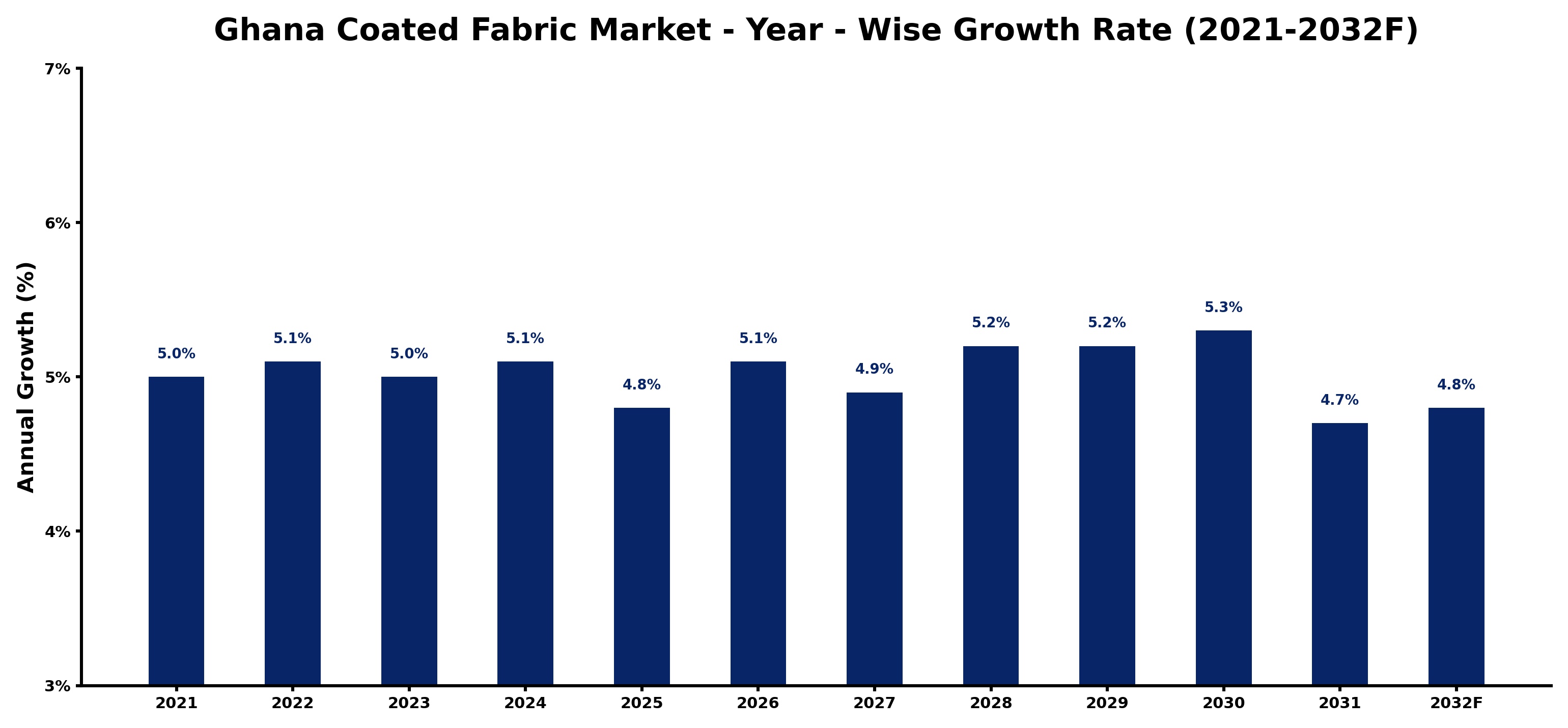
The table below presents the year‑wise growth rates along with the key drivers influencing the market
| Year | Growth Rate | Major Drivers |
| 2021 | 5.0% | Expansion of manufacturing activities |
| 2022 | 5.1% | Growing renewable energy integration projects |
| 2023 | 5.0% | Expansion of transportation and logistics networks |
| 2024 | 5.1% | Increasing smart city development projects |
| 2025 | 4.8% | Increasing industrial infrastructure investments |
| 2026 | 5.1% | Increasing adoption of advanced technologies |
| 2027 | 4.9% | Expansion of transportation and logistics networks |
| 2028 | 5.2% | Increasing industrial automation investments |
| 2029 | 5.2% | Rising electricity demand across industries |
| 2030 | 5.3% | Increasing smart city development projects |
| 2031 | 4.7% | Increasing industrial automation investments |
| 2032 | 4.8% | Increasing adoption of advanced technologies |
Note - Market size estimations and growth projections presented in this report are based on 6Wresearch's advanced forecasting approach, validated with industry datasets as of June 2026.
Ghana Coated Fabric Market Synopsis
A significant driver of the Ghana coated fabric market is the rising demand for high-performance materials across diverse sectors. Coated fabrics are increasingly sought after for their durability and versatility, making them suitable for applications ranging from automotive interiors to medical furnishings. Furthermore, the construction industry's robust growth demands innovative solutions for roofing and wall coverings, enhancing the coated fabric market's profile.
Local manufacturers are responding to this growing demand by innovating their product lines, particularly focusing on sustainability. This shift towards eco-friendly materials indicates a strong consumer preference for products that are both functional and have a minimal environmental impact, which is reshaping the competitive landscape in Ghana's coated fabric market.
Ghana Coated Fabric Market Key Takeaways
- The Ghana coated fabric market is set for sustained growth, driven by sectors such as automotive, construction, and healthcare.
- There is a marked trend towards the adoption of sustainable, eco-friendly coated fabrics among consumers and industries.
- Investment opportunities abound in manufacturing and distribution, catering to the burgeoning demand across various sectors.
- Government policies are supportive of local manufacturers, offering incentives to foster growth and protect local industries.
- Technological advancements in coating methods are enhancing product performance, creating new applications and consumer preferences.
Evaluation of Restraints in Ghana Coated Fabric Market
Despite its growth potential, the Ghana coated fabric market faces several significant restraints. Chief among these is the increasing competition from lower-priced imported products, which can undermine local manufacturers' market share and profitability. Additionally, fluctuations in raw material prices challenge consistent pricing strategies, affecting the overall stability of local businesses. Limited access to advanced manufacturing technologies further hampers efficiency and quality improvements, making it difficult for local firms to compete effectively on a global scale.
Ghana Coated Fabric Market Trends
One of the most notable trends in the Ghana coated fabric market is the consumer shift toward sustainable options. Manufacturers are actively developing eco-friendly coated fabrics that do not compromise on durability or performance. Another trend is the demand for high-performance coated fabrics equipped with features like UV protection and antimicrobial properties, which cater to the healthcare and automotive sectors. Moreover, technological innovations in coating processes are making it possible to produce aesthetically appealing fabrics with enhanced functionalities.
Ghana Coated Fabric Market Opportunities
The Ghana coated fabric market presents substantial investment opportunities, particularly in the automotive and construction sectors. As demand surges for versatile and durable fabrics, investors can explore avenues such as establishing local manufacturing facilities or creating partnerships with existing businesses to streamline distribution. The government's focus on infrastructure development further amplifies these opportunities, opening the door to innovative applications and products that align with local market needs.
Government Initiatives in the Ghana Coated Fabric Market
The Ghanaian government has rolled out several initiatives to regulate and enhance the coated fabric market. Policies aimed at quality control ensure that local products meet safety and performance standards. Import tariffs have been introduced to protect local manufacturers from foreign competition. Additionally, incentives such as tax breaks and subsidies are available for companies that adopt sustainable practices, further fostering a competitive landscape that benefits both consumers and producers alike.
Future Insights of the Ghana Coated Fabric Market
Looking ahead to 2026-2032, the Ghana coated fabric market is well-positioned for steady expansion. Factors driving this growth include rising disposable incomes and an increasing appetite for stylish, durable fabrics among consumers. As technology advances, manufacturers will likely continue to innovate, offering products with improved properties. The government's commitment to infrastructure and industrialization will undoubtedly create further opportunities for market players, ensuring a vibrant future for coated fabrics in Ghana.
Ghana Coated Fabric Market Latest Developments (May 2025 - June 2026)
In recent months, the Ghana coated fabric market has witnessed notable developments centered around innovation and sustainability. Manufacturers are focusing on enhancing the aesthetic appeal and functionality of coated fabrics through advanced coating technologies. Additionally, collaborations among industry stakeholders have emerged, aimed at sharing best practices and resources to address competition from imported products. These trends indicate a growing commitment to improving the local industry's resilience and competitiveness.
Ghana Coated Fabric Market - Key Attractiveness of the Report
- 10 Years of Market Numbers
- Historical Data Starting from 2022 to 2025
- Base Year: 2025
- Forecast Data until 2032
- Key Performance Indicators Impacting the Market
- Major Upcoming Developments and Projects
Key Highlights of the Report:
- Ghana Coated Fabric Market Outlook
- Market Size of Ghana Coated Fabric Market, 2025
- Forecast of Ghana Coated Fabric Market, 2032
- Historical Data and Forecast of Ghana Coated Fabric Revenues & Volume for the Period 2022-2032F
- Ghana Coated Fabric Market Trend Evolution
- Ghana Coated Fabric Market Drivers and Challenges
- Ghana Coated Fabric Price Trends
- Ghana Coated Fabric Porter's Five Forces
- Ghana Coated Fabric Industry Life Cycle
- Historical Data and Forecast of Ghana Coated Fabric Market Revenues & Volume By Product for the Period 2022-2032F
- Historical Data and Forecast of Ghana Coated Fabric Market Revenues & Volume By Polymer-coated Fabric for the Period 2022-2032F
- Historical Data and Forecast of Ghana Coated Fabric Market Revenues & Volume By Rubber-coated Fabric for the Period 2022-2032F
- Historical Data and Forecast of Ghana Coated Fabric Market Revenues & Volume By Fabric-backed Wall Coverings for the Period 2022-2032F
- Historical Data and Forecast of Ghana Coated Fabric Market Revenues & Volume By Application for the Period 2022-2032F
- Historical Data and Forecast of Ghana Coated Fabric Market Revenues & Volume By Transportation for the Period 2022-2032F
- Historical Data and Forecast of Ghana Coated Fabric Market Revenues & Volume By Protective Clothing for the Period 2022-2032F
- Historical Data and Forecast of Ghana Coated Fabric Market Revenues & Volume By Industrial for the Period 2022-2032F
- Historical Data and Forecast of Ghana Coated Fabric Market Revenues & Volume By Roofing, Awnings & Canopies for the Period 2022-2032F
- Historical Data and Forecast of Ghana Coated Fabric Market Revenues & Volume By Furniture & Seating for the Period 2022-2032F
- Historical Data and Forecast of Ghana Coated Fabric Market Revenues & Volume By Others for the Period 2022-2032F
- Ghana Coated Fabric Import Export Trade Statistics
- Market Opportunity Assessment By Product
- Market Opportunity Assessment By Application
- Ghana Coated Fabric Top Companies Market Share
- Ghana Coated Fabric Competitive Benchmarking By Technical and Operational Parameters
- Ghana Coated Fabric Company Profiles
- Ghana Coated Fabric Key Strategic Recommendations






































