Ghana Commercial Boiler Market Size, Share & Growth Rate
The Ghana Commercial Boiler Market was estimated at USD 338 Million in 2025 and is projected to reach USD 451 Million by 2032, growing at a CAGR of 4.2% from 2026 to 2032. This upward trajectory is largely driven by a combination of urbanization, rapid industrial expansion, and significant infrastructure development across the country. As Ghana continues to modernize its commercial sector, the demand for efficient and reliable heating solutions becomes increasingly critical.
Ghana Commercial Boiler Market Year-wise Growth Rate and Key Drivers
This graph highlights how the Ghana Commercial Boiler Market has steadily grown over the years, supported by major growth factors.
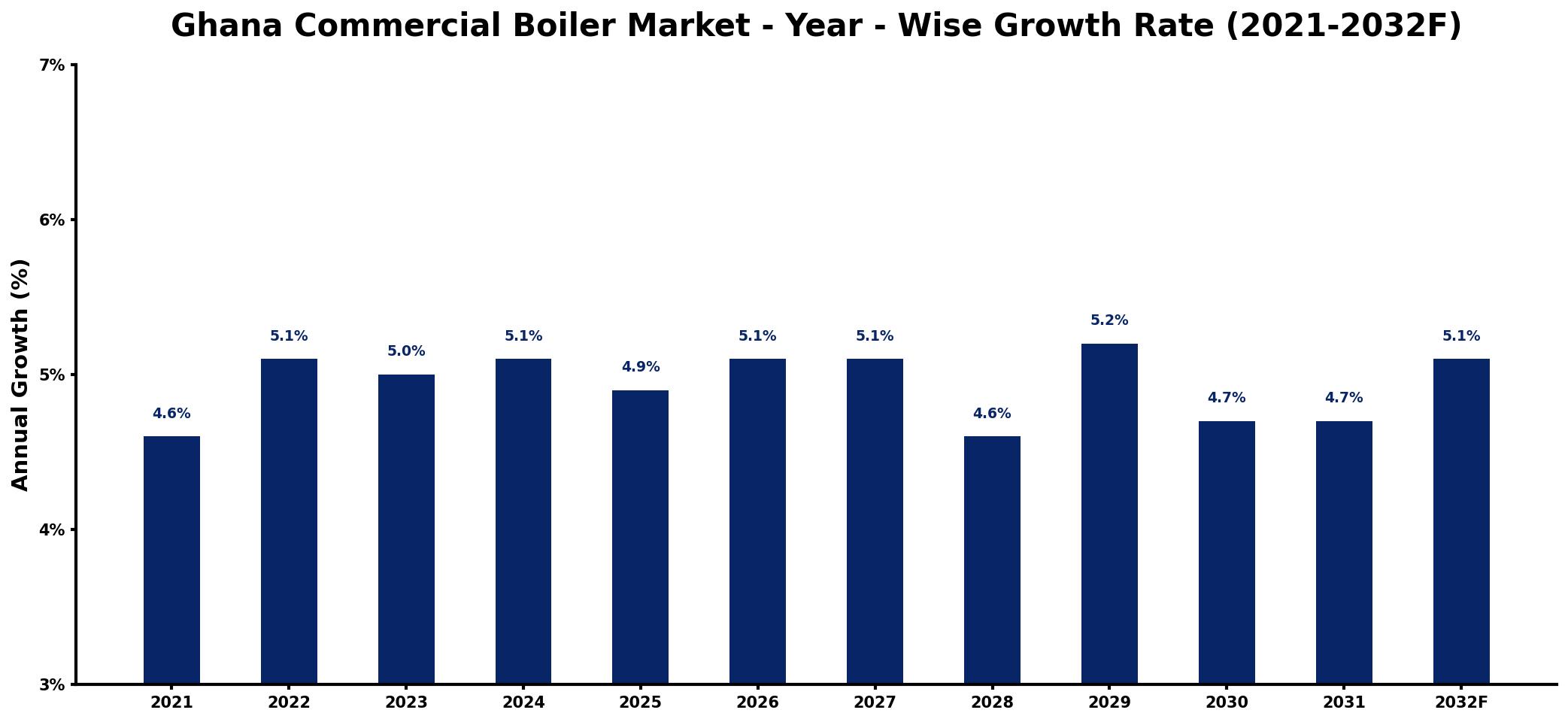
The table below presents the year‑wise growth rates along with the key drivers influencing the market
| Year | Growth Rate | Major Drivers |
| 2021 | 4.6% | Rising demand in manufacturing sector |
| 2022 | 5.1% | Increased investments in infrastructure |
| 2023 | 5.0% | Expansion of energy efficiency programs |
| 2024 | 5.1% | Growth in hospitality industry needs |
| 2025 | 4.9% | Surge in food processing sector |
| 2026 | 5.1% | Development of renewable energy projects |
| 2027 | 5.1% | Growing urbanization and industrialization |
| 2028 | 4.6% | Increased focus on sustainability initiatives |
| 2029 | 5.2% | growing automotive sector requirements |
| 2030 | 4.7% | Rising construction activities across region |
| 2031 | 4.7% | Growing need for residential applications |
| 2032 | 5.1% | Increased government energy regulations |
Note: Market size estimations and growth projections presented in this report are based on 6Wresearch's proprietary forecasting methodology, utilizing the latest available industry data, government publications, and primary research inputs.
Ghana Commercial Boiler Market Synopsis
In Ghana, the commercial boiler market is experiencing dynamic growth, underpinned by the rising need for dependable heating solutions across various industries. As urban centers expand and the industrial sector thrives, the importance of efficient heating systems in commercial settings such as hotels, hospitals, and manufacturing plants cannot be overstated.
The market is characterized by diverse offerings, including condensing, non-condensing, and biomass-fired boilers. This diversity reflects the demand for tailored solutions, with stakeholders aiming to meet the unique needs of different sectors while adhering to evolving energy standards and environmental concerns.
Ghana Commercial Boiler Market Key Takeaways
- Significant growth anticipated, with the market reaching USD 451 Million by 2032.
- Urbanization and industrialization are primary drivers of boiler demand.
- Adoption of eco-friendly technologies is on the rise due to renewable energy initiatives.
- High-efficiency heating technologies remain underutilized due to affordability challenges.
- Government policies are evolving to support energy efficiency and innovation in the boiler sector.
Evaluation of Restraints in Ghana Commercial Boiler Market
Despite a promising outlook, the Ghana Commercial Boiler Market faces notable restraints. Affordability remains a significant barrier for many potential buyers, limiting access to high-efficiency heating technologies. Furthermore, volatility in energy prices and occasional disruptions in fuel supply create uncertainty, hindering market competitiveness and the widespread adoption of advanced commercial boiler systems. Addressing these challenges is vital to unlocking the market's full potential.
Ghana Commercial Boiler Market Trends
Key trends shaping the Ghana Commercial Boiler Market include a growing emphasis on energy efficiency and sustainability. As businesses become more environmentally conscious, there is an increasing demand for eco-friendly boiler technologies that reduce emissions and align with global best practices. Additionally, the integration of smart technologies in boiler systems is gaining traction, enhancing operational efficiency and reliability for end-users.
Ghana Commercial Boiler Market Opportunities
Ghana presents genuine growth opportunities within the commercial boiler sector, particularly as the government seeks to foster a more sustainable industrial landscape. Investments in renewable energy solutions and technologies that improve heating efficiency can significantly expand market potential. Furthermore, the rising demand for boilers in underserved sectors, such as education and healthcare, indicates a broad base for future investment.
Government Initiatives in the Ghana Commercial Boiler Market
The government of Ghana is actively pursuing initiatives designed to stimulate the commercial boiler market. Policies aimed at enhancing energy efficiency standards are in development, alongside financial incentives for investments in high-efficiency boiler technologies. By facilitating access to finance and promoting public awareness about the benefits of efficient heating systems, the government aims to foster a more robust and sustainable commercial sector.
Future Insights of the Ghana Commercial Boiler Market
Looking ahead to the period from 2026 to 2032, the Ghana Commercial Boiler Market is set to evolve significantly. With anticipated government support and a growing recognition of the importance of sustainable heating solutions, the market is poised for expansion. Innovations in boiler technology, especially those focused on renewable energy sources and increased efficiency, will likely dominate the landscape, shaping how commercial enterprises meet their heating needs.
Ghana Commercial Boiler Market Latest Developments (2025 - 2026)
In recent months, the Ghana Commercial Boiler Market has witnessed a surge in interest surrounding eco-friendly boiler technologies. Industry players are exploring collaborations aimed at enhancing boiler efficiency and integrating smart technology features. Additionally, several local manufacturers are focusing on the development of biomass-fired units as part of their commitment to reducing carbon footprints in line with national sustainability goals.
Ghana Commercial Boiler Market - Key Attractiveness of the Report
- 10 Years of Market Numbers
- Historical Data Starting from 2022 to 2025
- Base Year: 2025
- Forecast Data until 2032
- Key Performance Indicators Impacting the Market
- Major Upcoming Developments and Projects
Key Highlights of the Report:
- Ghana Commercial Boiler Market Outlook
- Market Size of Ghana Commercial Boiler Market, 2025
- Forecast of Ghana Commercial Boiler Market, 2032
- Historical Data and Forecast of Ghana Commercial Boiler Revenues & Volume for the Period 2022-2032F
- Ghana Commercial Boiler Market Trend Evolution
- Ghana Commercial Boiler Market Drivers and Challenges
- Ghana Commercial Boiler Price Trends
- Ghana Commercial Boiler Porter's Five Forces
- Ghana Commercial Boiler Industry Life Cycle
- Historical Data and Forecast of Ghana Commercial Boiler Market Revenues & Volume By Fuel Type for the Period 2022-2032F
- Historical Data and Forecast of Ghana Commercial Boiler Market Revenues & Volume By Natural Gas for the Period 2022-2032F
- Historical Data and Forecast of Ghana Commercial Boiler Market Revenues & Volume By Oil for the Period 2022-2032F
- Historical Data and Forecast of Ghana Commercial Boiler Market Revenues & Volume By Coal for the Period 2022-2032F
- Historical Data and Forecast of Ghana Commercial Boiler Market Revenues & Volume By Others for the Period 2022-2032F
- Historical Data and Forecast of Ghana Commercial Boiler Market Revenues & Volume By Technology for the Period 2022-2032F
- Historical Data and Forecast of Ghana Commercial Boiler Market Revenues & Volume By Condensing for the Period 2022-2032F
- Historical Data and Forecast of Ghana Commercial Boiler Market Revenues & Volume By Non-Condensing for the Period 2022-2032F
- Historical Data and Forecast of Ghana Commercial Boiler Market Revenues & Volume By Capacity for the Period 2022-2032F
- Historical Data and Forecast of Ghana Commercial Boiler Market Revenues & Volume By Less than 10 MMBtu/hr for the Period 2022-2032F
- Historical Data and Forecast of Ghana Commercial Boiler Market Revenues & Volume By 10-50 MMBtu/hr for the Period 2022-2032F
- Historical Data and Forecast of Ghana Commercial Boiler Market Revenues & Volume By Others for the Period 2022-2032F
- Historical Data and Forecast of Ghana Commercial Boiler Market Revenues & Volume By End User for the Period 2022-2032F
- Historical Data and Forecast of Ghana Commercial Boiler Market Revenues & Volume By Offices for the Period 2022-2032F
- Historical Data and Forecast of Ghana Commercial Boiler Market Revenues & Volume By Hospitals for the Period 2022-2032F
- Historical Data and Forecast of Ghana Commercial Boiler Market Revenues & Volume By Educational Institutions for the Period 2022-2032F
- Historical Data and Forecast of Ghana Commercial Boiler Market Revenues & Volume By Lodging for the Period 2022-2032F
- Historical Data and Forecast of Ghana Commercial Boiler Market Revenues & Volume By Others for the Period 2022-2032F
- Ghana Commercial Boiler Import Export Trade Statistics
- Market Opportunity Assessment By Fuel Type
- Market Opportunity Assessment By Technology
- Market Opportunity Assessment By Capacity
- Market Opportunity Assessment By End User
- Ghana Commercial Boiler Top Companies Market Share
- Ghana Commercial Boiler Competitive Benchmarking By Technical and Operational Parameters
- Ghana Commercial Boiler Company Profiles
- Ghana Commercial Boiler Key Strategic Recommendations






































